
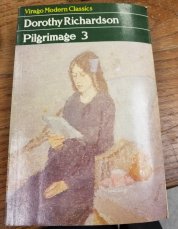
 The timing of my reading Dorothy’ Richardson’s paragraph in Deadlock on the symbolism of walls could not have been more perfect:
“For so long the walls had ceased to be the thrilled companions of her freedom, they had seen her endless evening hours of waiting for the next day to entangle her in its odious revolution. They had watched her, in bleak daylight, listening to life going on obliviously all round her, and scornfully sped her desperate excursions into other lives, greeting her empty glad return with the remainder that relief would fade, leaving her alone again with her unanswered challenge. They knew the recurring picture of a form, drifting, grey face upwards, under a featureless grey sky, in shallows, ‘unreached by the human tide,’ and had seen its realization in her vain prayer that life should not pass her by; mocking the echoes of her cry, and waiting indifferent, serene with they years they knew before she came, for those that would follow her meaningless impermanence. When she lost the sense of herself in moments of gladness, or in the long intervals of thought that encircled her intermittent reading, they were all round her, waiting, ready to remind her, undeceived by her daily busy passing in and out, relentlessly noting its secret accumulating shame.”
During a long, sleepless night I kept mulling over Richardson’s words about walls and how perfectly relevant they are to the sad and useless debate about walls currently unfolding in my country. Apparently we have learned nothing from antiquity, the ruined walls of which old nations are scattered around the world and now merely serve as tourist attractions. The Trojans were absolutely convinced that their walls were impenetrable. But I have a feeling that they would tell us now that there is no such thing. Scholars are often amazed at the lack of walls in the archaeological record at the Minoan, Bronze Age site at Knossos. Since they lived on an island, did the sea serve as their “wall”? The Bronze Age site at Mycenae, by contrast, had massive, thick walls built with stones that are weighed by the ton. Did the Mycenaeans feel more secure, safer, more free because of their walls? I doubt it.
And, of course, we can’t forget about Hadrian’s wall in Roman Britain which, many have argued, was intended to keep the barbarian tribes to the north out of Roman territory. Was this massive structure successful? Scholars can’t even agree on the purpose of the wall, let alone its efficacy—was it merely for defense or was it simply a boundary marker? Was Roman Britain safer, more secure, more free because of this wall? I doubt it. But at least now Hadrian’s famous wall serves as an archaeological treasure trove of information about the Roman military.
Miriam Henderson, too, initially views the walls of the room in her boarding house as symbols of her freedom—they represent her independence from her family and the need to get married. But these walls quickly become oppressive and suffocating. Mariam learns that a wall as a symbol of freedom is an absurd idea. If only our current leadership would follow that advice.









 The Book Binder's Daughter