Category Archives: French Literature

My First Encounter with Proust

Charles Swann, the eponymous character of Proust’s first Volume of In Search of Lost Time,  is an old acquaintance of the narrator’s family and, although he has connections to the upper classes and the royals in France and Britian, he never forgets to visit with his middle class friends.  Swann is also very quiet about these other, important social circles to which he has access, and a knowledge of this would have shocked the narrator’s great-aunt:

But if anyone had suggested to my great-aunt that this Swann, who, in his capacity as the son of old M. Swann, was “fully qualified” to be received by any of the “best people,” by the most respected barristers and solicitors of Paris (though he was perhaps a trifle inclined to let this hereditary privilege go by default), had another almost secret existence of a wholly different kind; that when he left our house in Paris, saying that he must go home to bed, he would have no sooner turned the corner than he would stop, retrace is steps, and be off to some salon on whose like no stockbroker or associate of stockbrokers had ever set eyes—that would have seemed to my aunt as extraordinary as, to a woman of wider reading,  the thought of being herself on terms of intimacy with Aristaeus and of learning that after having a chat with her he would plunge deep into the realms of Thetis, into an empire veiled from mortal eyes, in which Virgil depicts him as being received with open arms.

This short passage in Proust brought to mind my very early days as an undergraduate, when taking a Vergil course and being handed these lines from the Georgics and asked to produce a polished translation and commentary.  I carefully and lovingly labored over this Latin text for weeks.  Aristaeus chases Eurydice through a field where she is bitten and killed by a serpent.  Orpheus, in his intense grief, asks the ruler of the Underworld to allow him to bring his wife back, but, by not following the only rule—not to look back at his wife—he is unsuccessful.  As a punishment for his indiscretion Aristaeus’s bees are destroyed and he is allowed to visit his mother and the other nymphs in their underwater lair to get advice on how to resurrect his bees.  I remember the part in which Arisaeus enters this watery realm because there were certain Latin words I keep thinking about and adjusting in my translation.  My mother would call me every week and ask, “How are the bees coming along?”  Although I had studied Latin in high school, I viewed translation as just another acquired skill, but it was due to this Vergil class that I decided to be a classicist.

So many memories.

I have spent the last weekend sitting in my garden, soaking up summer and completely immersed in Proust.  I have no doubt that this experience of summer will be forever linked with my first encounter with Proust’s extraordinary masterpiece.  I had expected something special, but nothing quite like this.  Walter Benjamin, in his essay “The Image of Proust” states it perfectly, “The thirteen volumes of marcel Proust’s À la Recherche du temps perdu are the result of an unconstruable synthesis in which the absorption of a mystic, the art of a prose writer, the verve of a satirist, the erudition of a scholar, and the self-consciousness of a monomaniac have combined in an autobiographical work. It has rightly been said that all great works of literature found a genre or dissolve one—that they are, in other words, special cases.  Among these cases this is one of the most unfathomable.”

One of the most astute and erudite readers I know remarked to me that Proust was a turning point in his reading life—-there is a distinct difference in reading and literature before Proust and after Proust he said.   Even after finishing only the first volume of In Search of Lost Time I think he is absolutely right.


11 Comments

Filed under Classics, French Literature, Vergil

Women in Translation and Women Translators

I offer here some of my favorite women authors in translation from a variety of languages and periods of time. They are in no particular order:

Teffi, Memories: From Moscow to the Black Sea translated by Robert Chandler and Anne Marie Jackson

Karoline von Gunderrode, Poetic Fragments translated by Anna C. Ezekiel

Christa Wolf, Medea translated by John Cullen (I also highly recommend Cassandra and The Quest for Christa T. but her Medea is my favorite.)

Clarice Lispector, Near to the Wild Heart translated by Alison Entrekin (I have enjoyed all of the Lispector I’ve read but this one is my favorite)

Bae Suah, Recitation translated by Deborah Smith

Simone de Beauvoir, Memoirs of a Dutiful Daughter translated by James Kirkup

Friederike Mayröcker, Requiem for Ernst Jundl translated by Roslyn Theobald

Sappho. I like Ann Carson’s stark translations in If Not, Winter. But here are some links to my own translations that I’ve worked on this year: Fragment 16 and The Tithonus Poem

Sulpicia. Unfortunately she is an obscure Roman poet who is overlooked. The only translations of her that I have encountered are those included in the Catullus and Tibullus Loeb edition. For a previous WIT month I did a translation of her Carmen XIII.

For this year I offer my own translation of Sulpicia’s Carmen XIV “Before her Birthday.” She wants to stay in Rome where her lover, Cerinthus, dwells and celebrate her birthday with him, but her uncle has other plans for her:

My dreaded birthday has arrived, which sad event
must be spent in the tiresome country without my
Cerinthus. What is more pleasant than the city? Do I
look like a girl who is only fit to hang around some
country house, or the cold river in the Arrentium fields?
Quit thinking about me so much, Uncle Messala. Travel
is so often badly timed. You can take me away from
the city, but since your force does not allow me
to make my own decisions, I can at least choose to
leave behind my soul and my feelings.

I know August is dedicated to female authors who are translated into English, but what about female translators themselves? Charlotte Mandell’s translation of Enard’s Compass, Shelley Frisch’s translation of Stach’s three volume Kafka biography, and Sophie Wilkins’s translation of Musil’s A Man without Qualities are two wonderful examples that come to mind…

8 Comments

Filed under Classics, French Literature, German Literature, Literature in Translation, Poetry, Russian Literature

Inertia Means Trouble for You: Some Thoughts on Flaubert’s Sentimental Education

Sentimental Education begins with Frederic Moreau, the pupil of said “education”, meeting, by chance, an older woman whose presence affects the rest of his life. Eighteen-year-old Frederic has been visiting a paternal uncle in the hopes of becoming the heir to his fortune when he encounters Madame Arnoux, Monsieur Arnoux and their young daughter on a steamship traveling out of Paris.  Although Monsieur Arnoux is a garrulous and outgoing man, it is his wife that captures Frederic’s attention (trans. Robert Baldick): “She was sitting in the middle of the bench all alone; or rather he could not see anybody else in the dazzling light which her eyes cast upon him.  As he passed, she looed up; he bowed automatically; and when he had walked a little way along the deck, he looked back at her.”  As he walks up and down the deck of the boat, he becomes inert and can concentrate on nothing an no one else but her. But he also hasn’t the courage to speak to such an incredible woman:
Never had he seen anything to compare with the splendour of her dark skin, the seduction of her figure, or the translucent delicacy of her fingers.  He looked at her workbasket with eyes full of wonder, as if it were a thing of beauty.  What was her name, her home, her life, her past? He longed to know about the furniture in her room, all the dresses she had ever worn, the people she mixed with; even the desire for physical possession gave way to a deeper yearning, an aching curiosity which knew no bounds.

Frederic moves to Paris where he attends law school and insinuates himself into the life Arnoux family.   He often visits the object of his desire, but the first half of the novel  describes his love for Madame Arnoux, yet his complete inertia, his inability to act in any definitive way to make her his lover.  I found the second half of the book more interesting as the pace of the narrative becomes quicker and more initeresting.  As the years slip by, this woman continues to be a presence in Frederic’s life and even though he takes up other mistresses he can’t get Madame Arnoux out of his heart or his mind.  He is incapable of committing to a marriage because there is always the hope of being with Madame Arnoux.   Furthermore, his inertia extends to his career since he doesn’t have the attention span to devote to a political career.  He lives on the inheritance from his uncle so he has no real need for a private income.  But having a serious occupation would have benefitted his otherwise unoccupied mind.  He let’s several professional and business opportunities slip through his hands because of his focus on his love and social life.

In the introduction to the Penguin Edition, Geoffrey Wall explains the autobiographical aspect of Flaubert’s novel and quotes the author’s letter to Amelie Bosquet:

I loved immeasurably, a love that was unrequited, intense and silent.  Nights spent gazing at the moon, dreaming of elopements and travels in Italy, dreams of glory for her sake, torments of the body and the soul, spasm at the smell of a shoulder, and turning suddenly pale when I caught her eye, I have known all that, and known it very well.  Each one of us has in his heart a royal chamber.  I have had mine bricked up, but it is still there.”

The object of Flaubert’s secret desire was an older, married woman named Elisa Schlesinger whom he meets as a teenager while on vacation on the Normandy coast.  He, too, would encounter her by chance throughout the years but never confessed his true feelings.

It seemed fitting that this week as I was reading Sentimental Education I was also preparing for my second semester Catullus course for my upper level Latin students.  Catullus is also smitten with an inaccessible, older woman and as I was reading about Frederic and Flaubert, Catullus’s Carmen 51 kept coming to mind.  It is the first, many argue, in the Roman poet’s series of Clodia (a.k.a. Lesbia) poems; Catullus sees Clodia at a party and the first sight of her instantly captivates him and he can only focus on her.  But, like Frederic and Flaubert, he is paralyzed by his feelings and cannot bring himself to approach her.  At the end of the poem, Catullus chides himself for his inaction:

Inertia, Catullus, means trouble for you.
You wallow in your inertia, and you carry it too far.
Such inertia has previously brought about the
destruction of kings and grand cities.

The Latin word otium seemed especially fitting, in my mind, for Fredric. I translated it here as “inertia”, but it can also mean “leisure.” It was originally used as a military term to describe the leisure of the army, when soldiers are encamped and experience boredom. If otium is translated as “leisure” in this Catullus poem then, I think, the meaning of the last few stanzas is completely changed, as it implies that too much leisure gets the poet into trouble. But I prefer to translate it as “inertia,” or “inaction” and see these lines as Catullus scolding himself for inaction which keeps him from being with his true love. This translation of otium also makes more sense in the context of the beginning of the poem during which he is literally and figuratively paralyzed by the site of this woman.

Both translations—“leisure” and “inertia” are equally fitting ways to describe Frederic. His inheritance allows him too much leisure time to get into trouble and his inability to act on his feelings for Madame Arnoux affect his entire life. Otium is the true cause of Fredric’s inability to attain true happiness at any point in his life.

11 Comments

Filed under Classics, French Literature

Respice Futurum: Reading Plans for 2019

As I have mentioned in a previous post, The Woodstock Academy where I have had the privilege of teaching Latin and Classics for many years now, is one of the oldest secondary schools in the United States and has a simple yet profound Latin motto which reflects and respects this tradition: Respice Futurum–-translated literally as “Look back at your future.” This is a fitting way for me to think about and discuss my reading plans for the new year since my previous literary patterns help to shape the future.

In 2018 I was not content to read a single book by an author, but instead engaged in what I called literary projects that involved immersing myself in an author’s oeuvre while also reading whatever additional sources were available by or about that author (letters, essays, biography, autobiography, etc.) Here are a few such projects I have in mind, so far, for 2019:

Classics (20th century or earlier):

John Cowper Powys: I am half way through his novel Wolf Solent and think Powys’s writing is brilliant. I am also planning to read his magnum opus A Glastonbury Romance and his autobiography, aptly titled, Autobiography. I’ve ordered a copy of The Pleasures of Literature which should be arriving any day now and I am also thinking of tracking down some of his letters and poetry which, I believe, are all out of print.

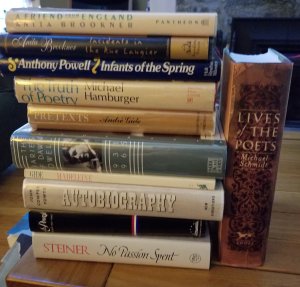
Anthony Powell: A Dance to the Music of Time (I have yet to purchase the entire series, but am leaning towards the University of Chicago Press editions). I also found, last week at my favorite secondhand bookshop, the first volume of his autobiography, Infants of the Spring. When the time comes I will complete my collection of his autobiographical books. Finally, I’ve ordered copies of his non-fiction writing, Miscellaneous Verdicts: Writing on Writers and Under Review: Further Writings on Writers, 1946-1990.

Andre Gide: I discovered Gide in 2018 by reading his very short book, Theseus. I’ve put together a pile of his books that I would like to read in 2019 which include: Madeleine, Journals: 1889-1949, Straight is the Gate, If it Die: An Autobiography, The Andre Gide Reader and Pretexts.

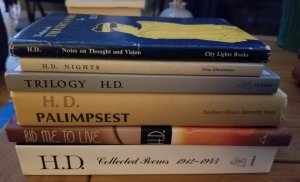
H.D.: I saw quite a few posts last year about H.D.’s writing, especially her poetry, and her volume of Collected Poems which I’ve already been dipping into is magnificent. I also plan to read: Palimpsest, Nights, Notes on Thought and Vision, and Bid me to Live. And I’ve ordered copies of The H.D. Book by Robert Duncan and A Great Admiration: H.D./Robert Duncan Correspondence 1950-1961 which should both arrive any day now.

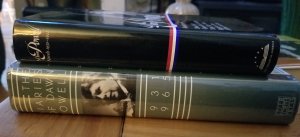
Dawn Powell: I’m especially excited about this author which will be completely new to me. I bought Library America editions of her fiction as well as the volume of her Diaries from Steerforth Press. (Thanks to @deckr_j on Twitter for this discovery).

Anita Brookner: I’ve been tempted for a while to try this author because of Trevor from The Mookse and the Gripes who raves about her books. Having collected three of her books I’m ready to dive in: A Start in Life, A Friend from England and Incidents in the Rue Laugier.

W.G. Sebald: I did a Michael Hamburger reading project this year and discovered that he was also a translator of Sebald. I would like to read all of Sebald’s fiction in the order that they were written and published. I haven’t bought any of his books yet, though, because I would like to research which editions and translations would suit me best.

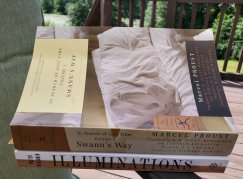
Other possible books that are sitting on my shelves awaiting my attention include the six volume set of Proust’s In Search of Lost Time I received for Christmas, Uwe Johnson’s Anniversaries, Alexander Herzen’s massive autobiography, Casanova’s 12-volume memoir, and Musil’s The Man Without Qualities. I was thinking it might be a good idea to choose one of these as a summer reading project, but there is no way I could get to all of them! I would also like to explore Flaubert, whose Sentimental Education particularly captivated Kafka, and the last George Eliot novel I have yet to read, Romola.

Contemporary:

Giorgio Agamben: The few books I read by him in 2018 captivated my attention due to his discussion of words and language. I am especially excited that Agamben has quite a backlog of translations published by Seagull Books that I have yet to read. I’ve also acquired Profanations, Karman and his magnum opus, Homo Sacer. I will slowly work my way through his shorter pieces before I even think about cracking open Homo Sacer.

Sergei Lebedev: His previous two novels, Oblivion and The Year of the Comet, are brilliant. I am eagerly awaiting The Goose Fritz from New Vessel Press which will be published in March.

Claudio Magris: I have yet to finish his book Journeying from Yale Press and I will also add to my piles his new book, Snapshots, translated for the first time in English and also published by Yale Press.

Kate Zambreno: Her Book of Mutter was intriguing and I am looking forward to her new book due out in April entitled Appendix Project: Talks and Essays

Clarice Lispector: The Besieged City is due out in April. Even though she is a 20th century author, this is a new translation published by New Directions.

I will also catch up on some of the publications from the Cahiers series which are always a delight. And, finally, I have my eye on new releases from Seagull Books, Fitzcarraldo Books, & Other Stories (publishing Gerald Murnane this year) and New York Review of Books which I won’t list here. But all of these publishers are wonderful if you are looking for interesting contemporary authors, literature in translation, or reissued classics.

Poetry:

In 2018, I’ve read more poetry than any other year and would like to continue that into 2019. I always enjoy the variety of publications from Ugly Duckling Presse. I’ve also been tempted by flowerville to explore Emily Dickenson which I haven’t picked up since studying her in school. My intention is to also read Schmidt’s Lives of the Poets and Hamburger’s The Truth of Poetry to enhance my understanding of and appreciation for different types of poets and poetry.

Of course, all of this is subject to change based on weather, mood, alignment of the planets, attention span, etc.

What is everyone else excited to read in 2019?

40 Comments

Filed under American Literature, Autobiography, British Literature, Essay, French Literature, Italian Literature, New York Review of Books, Poetry, Seagull Books

Putting the Shaken House in its New Order: My Year in Reading-2018

There is no doubt that this was a tough year by any measure. The news, in my country and around the world. was depressing, scary and, at times, downright ridiculous. Personally, I had some very high highs and some very low lows. The summer was particularly hot and oppressive. And this semester was unusually demanding at work. More than any other year I can remember, I took solace and comfort by retreating into my books. I have listed here the books, essays and translations that kept me busy in 2018. War and Peace, Daniel Deronda, The Divine Comedy and Stach’s three volume biography of Kafka were particular favorites, but there really wasn’t a dud in this bunch.

Classic Fiction and Non-Fiction (20th Century or earlier):

War and Peace by Leo Tolstoy (trans. Louise and Alymer Maude)

The Bachelors by Adalbert Stifter (trans. David Bryer)

City Folk and Country Folk by Sofia Khvoshchinskaya (trans. Nora Seligman Favorov)

The Juniper Tree by Barbara Comyns

The Mill on the Floss by George Eliot

The Warden by Anthony Trollope

A Dead Rose by Aurora Caceres (trans. Laura Kanost)

Nothing but the Night by John Williams

G: A Novel by John Berger

Two Serious Ladies by Jane Bowles

Artemisia by Anna Banti (trans. Shirley D’Ardia Caracciolo)

The Ballad of Peckham Rye by Muriel Spark

Flesh by Brigid Brophy

The Portrait of a Lady by Henry James

A Handful of Dust by Evelyn Waugh

The Colour of Memory by Geoff Dyer

The Brothers Karamazov by Dostoevsky (trans. by Ignat Avsey)

Daniel Deronda by George Eliot

Lyric Novella by Annmarie Schwarzenbach (trans. Lucy Renner Jones)

The Divine Comedy by Dante Alighieri (trans. Allen Mandelbaum)

The Achilleid by Statius (trans. Stanley Lombardo)

The Life and Opinions of Zacharias Lichter by Matei Calinescu (trans. Adriana Calinescu and Breon Mitchell)

The Blue Octavo Notebooks by Franz Kafka (trans. Ernst Kaiser and Eithne Wilkins)

Memoirs of a Dutiful Daughter by Simone de Beauvoir (trans. James Kirkup)

Journey into the Mind’s Eye: Fragments of an Autobiography by Lesley Blanch

String of Beginnings by Michael Hamburger

Theseus by André Gide (trans. John Russell)

Contemporary Fiction and Non-Fiction:

Kafka: The Early Years by Reiner Stach (trans. Shelley Frisch)

Kafka: The Decisive Years by Reiner Stach (trans. Shelley Frisch)

Kafka: The Years of Insight by Reiner Stach (trans. Shelley Frisch)

Villa Amalia by Pascal Quignard (trans. Chris Turner)

All the World’s Mornings by Pascal Quignard (trans. James Kirkup)

Requiem for Ernst Jundl by Friederike Mayröcker (trans. Roslyn Theobald)

Bergeners by Tomas Espedal (trans. James Anderson)

Kudos by Rachel Cusk

The Cost of Living by Deborah Levy

The Years by Annie Ernaux (trans. Alison L. Strayer)

He Held Radical Light by Christian Wiman

The Unspeakable Girl by Giorgio Agamben and Monica Ferrando (trans. Leland de la Durantaye)

The Adventure by Giorgio Agamben (trans. Lorenzo Chiesa)

Essays and Essay Collections:

Expectations by Jean-Luc Nancy

Errata by George Steiner

My Unwritten Books by George Steiner

The Poetry of Thought by George Steiner

A Handbook of Disappointed Fate by Anne Boyer

“Dante Now: The Gossip of Eternity” by George Steiner

“Conversation with Dante” by Osip Mandelstam

“George Washington”, “The Bookish Life,” and “On Being Well-Read” and “The Ideal of Culture” by Joseph Epstein

“On Not Knowing Greek,” “George Eliot,” “Russian Thinking” by Virginia Woolf

Poetry Collections:

The Selected Poems of Donald Hall

Exiles and Marriage: Poems by Donald Hall

H.D., Collected Poems

Elizabeth Jennings, Selected Poems and Timely Issues

Eavan Boland, New Selected Poems

Omar Carcares, Defense of the Idol

The Complete Poems of Anna Akhmatova

Analicia Sotelo, Virgin

Elizabeth Bishop, Poems, Prose and Letters (LOA Edition)

Michael Hamburger: A Reader, (Declan O’Driscoll, ed.)

I also dipped into quite a few collections of letters such as Kafka, Kierkegaard, Kleist, Tolstoy, Dostoevsky, etc. that I won’t bother to list here. I enjoyed reading personal letters alongside an author’s fiction and/or biography.

My own Translations (Latin and Greek):

Vergil, Aeneid IV: Dido’s Suicide

Statius, Silvae IV: A Plea for Some Sleep

Horace Ode 1.5: Oh Gracilis Puer!

Horace, Ode 1.11: May You Strain Your Wine

Propertius 1.3: Entrusting One’s Sleep to Another

Seneca: A Selection from “The Trojan Women”

Heraclitus: Selected Fragments

Cristoforo Landino, Love is not Blind: A Renaissance Latin Love Elegy

As George Steiner writes in his essay Tolstoy or Dostoevsky: “Great works of art pass through us like storm-winds, flinging open the doors of perception, pressing upon the architecture of our beliefs with their transforming powers. We seek to record their impact, to put our shaken house in its new order.” My reading patterns have most definitely changed and shifted this year. I am no longer satisfied to read a single book by an author and move on. I feel the need to become completely absorbed by an author’s works in addition to whatever other sources are available (letters, essays, biography, autobiography, etc.) Instead of just one book at a time, I immerse myself in what feels more like reading projects. I am also drawn to classics, especially “loose, baggy monsters” and have read very little contemporary authors this year. I image that this pattern will continue into 2019.

21 Comments

Filed under Autobiography, British Literature, French Literature, German Literature, Italian Literature, Kafka, Literary Fiction, Literature in Translation, Nonfiction, Novella, Poetry, Russian Literature, Tolstoi, Virginia Woolf