
 Last year was the most difficult in my 20+ year teaching career. I was burned out and exhausted by June and decided that, except for a quick trip to Boston, I wasn’t going to do any traveling over the summer. In order to recharge and refocus I spent my time at home sitting in my garden which has a beautiful view and I alternated between reading, getting some sun, and swimming.
I began the summer by reading Virginia Woolf’s The Waves which I brought with me on my long weekend to Boston in late June. Of all her books this one seems to get the least attention, but I enjoyed it, in a different way of course, as much as any of her other novels I’ve read. One can see the beginnings of her stream-of-consciousness style for which she is so well-know. The story is heart wrenching and tragic and not an easy read, but so worth the effort. It’s not surprising, now that I look back on the summer, that I chose Horace’s Carpe Diem poem, Ode 2.11 to translate and spend some time with after reading The Waves: “Why would you exhaust your soul making plans for the future, a soul that is not up to the task?”
After this I was in the mood for more Tolstoy, especially after I saw @levistahl post on Twitter that Hadji Murat was one of his favorite summer reads. (Levi is great to follow, by the way, if you like books, cats, dogs, baseball, 70’s movies and Columbo.) Tolstoy is one of those authors whose writings I savor and am rationing the few remaining books of his I have left. J.L. Carr’s novella, A Month in the Country was also on Levi’s list and I read the book and saw the film. Carr’s story was the perfect book for the summer setting in my garden.
I spent all of July reading Robert Musil’s The Man Without Qualities. I was so happy to connect with @genese_grill on Twitter who has translated Musil and who had wonderful insights into this enigmatic magnum opus. (Genese is also great to follow on Twitter for books, literature and translation.) The Man without Qualities, both Volumes I and II , were the most challenging books I have ever read. I’ve seen them described as philosophical novels and the combination of Musil’s complex sentences and thought demanded my focus and concentration. Reading Musil’s Diaries alongside the novels also provided valuable insights into some of the threads that run throughout his narrative.
My final summer reading was spent on the first three volumes of Proust’s In Search of Lost Time. On Friday night I finished Volume III, The Guermantes Way, which felt like it ended on a sad note. The narrator finally gains admittance into the Guermantes’ inner circle and, like many other things, is disappointed by what he finds. The petty gossip and the shallowness of the characters he meets are sad and pathetic. I’ve been thinking a lot about indifference, which word Proust uses continually throughout all three books in a variety of contexts. If I can pull my thoughts together I might write something about this after I finish all six volume. Needless to say, this is one of the most intense, illuminating, pleasurable reads I’ve ever had. It was a wonderful summer, indeed, and I feel refreshed and recharged and ready to inspire my new classes to appreciate an ancient language. Wish me luck!
For the rest of this year I will be occupied with finishing Proust and would also like to finish Schmidt’s Lives of the Poets which I’ve gotten half way through.
(By the way, Henry, my black and white cat, who is quite annoyed that I’ve gone back to work, insisted on sticking his nose into my book photo.)
 “Our love, tell me, what is it?” Claudine asks this heavy, direct, honest, complex question in a letter to her husband. She is on a short trip to see her daughter, who was conceived during a brief affair with a dentist, at boarding school but is snowed in at her lodgings. There are so many layers to the philosophical language of Musil’s stream-of-conscious narrative; but the one that stood out to me the most was his reflection on love, and how we experience another person through the self and internalize emotions that are created through this experience.
 Identity, time, space, art, photography, culture, passion and love. These are just some of the topics that Nooteboom explores in his beautifully written, stirring novella. Arnold Pessers is a Dutch photographer who gets a job with a travel agency to take photos in Japan for one of their brochures. Pessers would rather spend his time doing more creative art projects, but assignments like this boring brochure are what pays his bills. Nooteboom’s description of his character’s profession also gives us a hint at the numbness he feels about his life: “His world, and this was a fact to which he resigned himself, was a world of brochures, of ephemera that no one would ever look at again; the decay, the sell-out, the morass.” Pessers instantly falls in love with the mysterious model he chooses for the photo shoot and over the course of five years he maintains a long distance yet fierce love affair with the woman he calls Mokusei.
 Adua, written by the Somali, Italian author Igiaba Scego and translated by Jamie Richards, moves among three different time periods and two different settings. The main character, Adua, emigrates from Somalia to Italy and her own story is a mix of her current, unhappy life and flashbacks to her childhood in Somalia. The third thread in the book deals with the protagonist’s father and his time spent as a servant for a rich Italian who is part of the Italian attempt at colonialism in East Africa just before World War II. My issue with the book is that I wanted more details about Adua and her father but the plot was too brief to provide the depth of plot and characterization that I craved. The author could have easily turned this story into three large volumes about Adua’s childhood, her father, and her adult life as an immigrant in Italy. Adua did prompt me to research and learn more about Italian colonialism in the 20th century but other than that I didn’t have strong feelings about the title after I finished it.
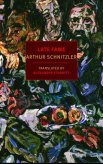 Late Fame, written by Arthur Schnitzler and translated by Alexander Starritt, involves an episode in the life of an older man named Eduard Saxberger who is suddenly reminded of a collection of poetry entitled Wanderings that he had written thirty years earlier and has long forgotten. A group of Viennese aspiring writers stumble upon Saxberger’s volume in a second hand bookshop and invite him to join their literary discussions at a local café. Saxberger, although he never married or had a family, considers his life as a civil servant very successful. The young poets, whom Schnitzler satirizes as bombastic and overly self-important, stage an evening of poetry readings and drama at which event Saxberger is invited to participate. Saxberger learns that although it is nice to get a little bit of late fame and recognition from this ridiculous group of writers, he made the correct decision in pursuring a different career. Trevor at Mookse and The Gripes has written a much better review of this book than I could have done and I highly encourage everyone to read his thoughts:
  Party Going by Henry Green describes exactly what the title suggests: a group of British upper class men and women are attempting to get to a house party in France but are stuck at the train station in London because of thick fog. Green’s narrative starts out on a rather humorous note as he describes these ridiculously fussy, British youth. They panic with what Green calls “train fever” every time they think they are in danger of missing their train. They fret over their clothes, their accessories, their luggage, their tea and their baths. As the story progresses they become increasingly mean and petty towards one another which made me especially uncomfortable. The men are portrayed as idiots and dolts who are easily manipulated by the vain and churlish women. In the end I found Green’s characters so unpleasant that I couldn’t write an entire post about them. I’ve read and written some words about his novels Back and Blindness both of which I thoroughly enjoyed. I still intend to read all of the reissues of his books from the NYRB Classics selections even though I wasn’t thrilled with Party Going.


 The Book Binder's Daughter