
I received a review copy of this title from Peirene Press. The book was published in the original German in 2007 and this English version has been translated by Jamie Bulloch.
My Review:
 This psychological thriller starts innocently enough with a kind old woman offering to split a cake with a young woman she meets outside of a bakery in Vienna. But Stift’s novella becomes gruesome, disturbing and haunting very quickly.
The old woman, whose name is Frau Hohenembs, is oddly dressed in all black and the young woman discovers that the old woman’s apartment is even stranger. Frau Hohenembs has an extensive collection of pictures and mementos of the Empress Elizabeth of Austria or Empress Sissi as many referred to her. The apartment is also packed with furniture, two caged parrots, an enormous dog and a portly servant named Ida. The young woman patiently observes these strange women while she has tea and eats her share of Gugelhupf. The first shocking twist in the book happens when the young woman returns home to her own flat, finishes the rest of her Gugelhupf as well as everything else in her refrigerator and forces herself to throw up the entire contents of her stomach.

Gugelhopf Photo by Dirk Vorderstraße
There are two eerie and gruesome threads that run throughout the story, the first of which is an obsession with food, weight and vomiting. Stift vividl describes the narrator’s grisly decent into the full grip of bulimia and her constant obsession with the cycle of binging and purging:
I was learning a new vomiting technique and was eating by colours. I started with chemical sweets such as bright-green gummy frogs or pink foam bacon bits or claret so-called laces and snakes. These took time to mix with the mush of food that followed, which meant that my vomiting could be monitored. I would puke until I’d arrived at this tough, lurid mass, so I could be sure I’d got everything out.
The narrator also weighs herself incessantly every few minutes on a pair of scales she purchases. She becomes obsessive about her weight and the size of her stomach. She is so consumed with food and vomiting that she stops working and only goes out of her flat every few days to go on a grocery shopping binge. She reveals throughout the course of the story that her mother and maternal grandfather also had an unnatural preoccupation with being thin and this fixation on weight affected her from a very early age. Her deep-seated psychological issues make her easy prey for the manipulative and controlling Frau Hohenembs.

Empress Sissi 1862 by Ludwig Angerer
The second theme that is woven throughout the narrative is that of control, both losing it and gaining it over others. Frau Hohenembs has an obsession with the Empress Sissi and pulls the young narrator into her plots to steal relics and artifacts that once belonged to the Empress. Frau Hohenembs first invites the narrator to a picnic after which they take a bizarre tour through a sex museum. Stift is a master at slowly developing the ways in which the older woman gains control over the younger woman’s life. At first she can’t say no to innocent outings that involve picnics and museums. The next significant turning point in this disturbing relationship is when Frau Hohenembs uses the young woman to steal a duck press from another museum in Vienna. This rather macabre kitchen instrument is used to squeeze the blood, bone marrow and other juices out of duck carcasses. Frau Hohenembs loves to drink the meat juices extracted from the press and throughout the novel she has Ida use the press so that she can always have her favorite drink on hand.
Frau Hohenembs uses this theft of the duck press to gain more control over the narrator’s life. She tells the young woman that if she doesn’t go on outings with her or help her out on her secret missions then she will report her to the police. Frau Hohenembs becomes progressively sinister and appears to have connections around Vienna that would help her to have the young woman prosecuted. The final, and most disturbing, theft that the trio carry out is stealing a cocaine syringe that belonged to the Empress Sissi from a pathology museum in Vienna. Frau Hohenembs then instructs the young woman on how to use it properly to inject the old woman with daily doses of cocaine.
By the end of the novella, the young narrator is trapped and completely controlled, not only by her eating disorder but also by this strange old woman and her maid. Straft is a master at building suspense and presenting an unexpected and frightening conclusion to her psychological thriller.
This is the third and final installment in the Peirene Fairy Tale series. All three books in the collection are very different but are all excellent. I don’t think I can choose a favorite from the series. I have also reviewed the other two Fairy Tale books:
About the Author:
 Linda Stift in an Austrian writer. She was born in 1969 and studied Philosophy and German literature. She lives in Vienna. Her first novel, Kingpeng, was published in 2005. She has won numerous awards and was nominated for the prestigious Ingeborg Bachmann Prize in 2009.
 Bonifacio Reyes has spent his whole life carrying out the commands that others have bestowed on him. When he is a young man he is coaxed into eloping with Emma Valcárcel

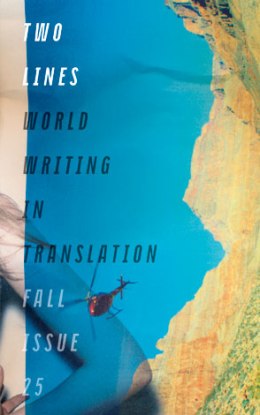 A few times a year I find a book that I rant and rave about and recommend to everyone I know. I become rather obnoxious with my comments that gush with praise. I am giving you fair warning that Two Lines 25 is one of those books. Literature translated from Bulgarian, Chinese, French, German, Hebrew, Japanese, Korean, Norwegian, Russian and Spanish are all contained within the pages of this 192-page volume. I am in awe of the fact that the editors crammed so many fantastic pieces into one slim paperback (there I go gushing again.) This is the type of book that everyone needs to experience for him or herself; but I will attempt to give an overview of some of my favorite pieces.
 CJ Evans is the author of A Penance (New Issues Press, 2012), which was a finalist for the Northern California Book Award and The Category of Outcast, selected by Terrance Hayes for the Poetry Society of America’s New American Poets chapbook series. He edited, with Brenda Shaughnessy,
  We are first introduced to Andres Egger in 1933 when he has had an unexplained instinct to pay a visit to his elderly neighbor, Horned Hannes. Hannes is a reclusive goatherd who lives in the same Austrian mountain village as Egger and when Egger finds the old man he is barely alive. Egger attempts to carry the goatherd on his back down the mountain but in a fit of madness due to his fever the goatherd runs off into the snow never to be seen again. Between the time that Egger loses the goatherd while carrying him down the mountain and the goatherd’s petrified body is found forty years later on a mountain ledge, we are told the story of Egger’s whole life.
 Robert Seethaler was born in Vienna in 1966 and is the author of four previous novels. He also works as an actor, most recently in Paolo Sorrentino’s Youth. He lives in Berlin.


 The Book Binder's Daughter