
I received a review copy of this title from The New York Review of Books. This title was originally published in 1946 and is the first book in a series of nine by author Henry Green that NYRB is reissuing.
My Review:
 The premise of this Green novel is deceptively simple: Charley Summer, recently released from a POW camp in Germany during World War II, is repatriated back into England. Although Charley suffers from a severed leg for which he must wear a prosthesis, his greatest source of pain is the love that he lost while he was in that German prison camp. Rose, a woman with whom he was having a passionate love affair, dies from an illness before Charley is sent home. We first meet Charley when he is trying to find Rose’s grave in an English churchyard and we immediately discover that the plot is much more complicated than we were first led to believe.
Charley is shell-shocked, grief-stricken and disoriented as he tries to settle into a job in London and reconnect with old acquaintances. He visits Rose’s parents, Mr. and Mrs. Grant who are also having a hard time dealing with the death of their daughter amidst sirens and bombings. Mrs. Grant is confused and displays signs of dementia; she doesn’t recognize Charley and thinks that he is her long-lost brother John who died in World War I. Her confusion and trauma reflects Charley’s own disoriented state of mind. As Charley is departing from this painful reunion, Mr. Grant gives him the address of a woman named Nance whom Mr. Grant requests that the young man look up while he is in London.
Charley works in the office of a manufacturing firm in London and when they send him a new secretary his emotions become further muddled. Miss Pitter, a rather plain looking woman, attracts Charley’s attention as he likes to start at her arms. Green relates to us bits and pieces of what a character is thinking only through dialogue, which is oftentimes very sparse. Charley in particular is a man of few words so it is difficult to understand what is really going on inside his head. But he seems, at times, attracted to Miss Pitter and unsure of how to proceed with her. Charley’s diffidence and lingering feelings for Rose appear to keep him from acting on a possible relationship with Miss Pitter. His short sentences, which are oftentimes canned answers like “There you have it,” and his inability to stand up for himself whenever someone is taking advantage of him make Charley a character wholly worthy of sympathy. Green is a master at writing tragic characters who are awash in their sad fates.
To complicate matters even further, Charley pays a visit to Nance who was recommended to him by Mr. Grant. When Nance opens the door to greet Charley he faints dead away because Nance looks just like his Rose. The ensuing confusion over the identity of Nance and Rose reads like a bit of a slapstick, “Who’s on First” type of a comedy. Charley is addressing Nance as if she were Rose, but Nance is completely confused and doesn’t understand what he is talking about. Charley comes to the conclusion that Rose never really died but instead changed her hair color and moved to London to become a tart. He spends quite a bit of time thinking of a way to get her to confess that she really is Rose. These scenes are humorous but also have an underlying hint of sadness because it further highlights Charley’s emotional confusion and turmoil.
One more interesting aspect of Green’s writing that must be mentioned is the story he includes in the middle of the narrative. It is Rose’s widower, James who sends Charley a magazine story about the 18th century French court in which a woman mistakes a royal guard for her lost lover. This is what the Roman poet Catullus would call a libellus, a little book, embedded within the story of Charley. I felt that the story was only tangentially related to Charley’s predicament; there is the case of mistaken identity in both narratives but Charley doesn’t appear to learn any type of a lesson after he reads this libellus. He is too involved in his own issues to gain any type of perspective and it is only very slowly and gradually through love, understanding and patience that Charley begins to untangle his confused mind.
This is a brief but very engrossing novel. It took me the better part of a week to read and absorb all that was going on in order to write these few words about it. Green uses the stress of World War II in order to highlight the madness and confusion into which a traumatized mind can so easily descend. This isn’t a pretty love story but it is certainly one that is more true to real, human life.
About the Author:
 Henry Green (1905–1973) was the pen name of Henry Vincent Yorke. Born near Tewkesbury in Gloucestershire, England, he was educated at Eton and Oxford and went on to become the managing director of his family’s engineering business, writing novels in his spare time. His first novel, Blindness (1926), was written while he was at Oxford. He married in 1929 and had one son, and during the Second World War served in the Auxiliary Fire Service. Between 1926 and 1952 he wrote nine novels, Blindness, Living, Party Going, Caught, Loving, Back, Concluding, Nothing, and Doting, and a memoir, Pack My Bag.
 The country of Tanzania has one of the highest rates of albinism in the world, but it is also one of the most dangerous places for albinos to live. They are shunned by their communities because they are viewed as ghosts who dwell on earth and never die. They also live in constant fear of violence because body parts from albinos are sought out to be used in potions made by African witch doctors. When Pilgrim Jones, the female protagonist in Melanie Finn’s latest novel, finds herself in dusty, decrepit and remote towns of Tanzania, she encounters firsthand the superstition and violence that plagues albinos living in East Africa.
 Melanie Finn has worked as a screenwriter and a journalist, and is the founder and director of the Natron Health Project, which brings healthcare to Maasai communities in Northern Tanzania. Her first novel, Away From You, was published to great critical acclaim in 2004, and was longlisted for the ORANGE and IMPAC PRIZEs.
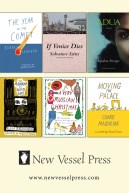 New Vessel Press: A subscription of New Vessel books includes all six of their books for the publication year. Subscribers also get to choose one book from their backlist. The cost is $80 which amounts to about 25% off of the cover prices. I haven’t read a book from New Vessel yet that I haven’t enjoyed. This year’s titles include If Venice Dies and A Very Russian Christmas so this subscription is definitely worth it.
  includes twelve of their titles is $170. A full-year of ebooks is $70 and a half year subscription for six books is also $70. They provide a lot of choices depending on one’s budget. Subscribers who are really passionate about their books and want to spend some money up front can also purchase two or three year subscriptions.
  The New York Review of Books: This press also specializes in reissuing lost classics from different countries around the world. They call their product a “book club” but it is essentially a subscription service. For $140 members receive a book every month for 12 months and the membership automatically renews. For a limited time NYRB is also offering a four issue subscription to The Paris Review when readers purchase a membership. I can’t get enough of the books from NYRB classics and I might have to buy a storage unit to house all of my books from their catalog. I will pretty much read anything they publish and $140 is a pretty good bargain for a year’s worth of their books.
 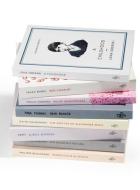 Pushkin online bookshop, and a free copy of Stefan Zweig’s novella Confusion. The Pushkin Collection is a series of paperbacks typeset in Monotype Baskerville, based on the transitional English serif typeface designed in the mid-eighteenth century by John Baskerville. It was litho-printed on Munken Premium White Paper and notch-bound by the independently owned printer TJ International in Padstow, Cornwall. The cover, with French flaps, was printed on Colorplan Pristine White paper.
 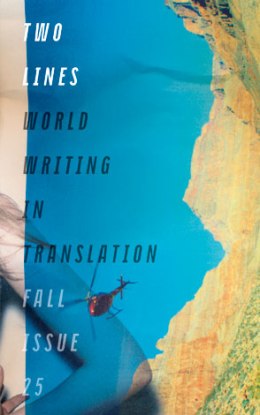 A few times a year I find a book that I rant and rave about and recommend to everyone I know. I become rather obnoxious with my comments that gush with praise. I am giving you fair warning that Two Lines 25 is one of those books. Literature translated from Bulgarian, Chinese, French, German, Hebrew, Japanese, Korean, Norwegian, Russian and Spanish are all contained within the pages of this 192-page volume. I am in awe of the fact that the editors crammed so many fantastic pieces into one slim paperback (there I go gushing again.) This is the type of book that everyone needs to experience for him or herself; but I will attempt to give an overview of some of my favorite pieces.
 CJ Evans is the author of A Penance (New Issues Press, 2012), which was a finalist for the Northern California Book Award and The Category of Outcast, selected by Terrance Hayes for the Poetry Society of America’s New American Poets chapbook series. He edited, with Brenda Shaughnessy,
  Come Back In Winter by Sunandini Bangerjee
 Cartography 02 by Sunandini Banerjee
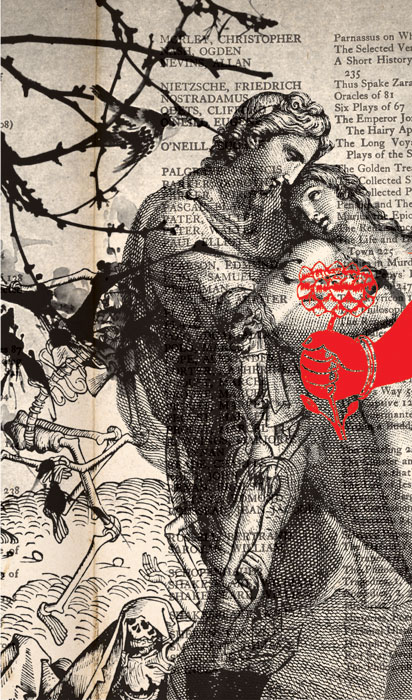 Love and Death by Sunandini Banerjee


 The Book Binder's Daughter