Tag Archives: Poetry

Review: Written in the Dark—Five Poets in the Siege of Leningrad

My Review:
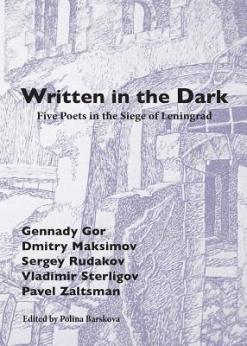
written-in-the-darkThe official, state sponsored view of the Siege of Leningrad was one of heroism and valor and any piece of writing whether it be fiction, non-fiction or poetry that did not align with the Soviet vision of the Siege was suppressed.  The dark and shocking works of the five poets in this collection were written in secret and not uncovered or published until many years after the war and after the fall of the Soviet Union.  The Nazi siege of this Russian city lasted from September 1941 until January of 1944 with an estimated death toll reaching nearly 1,000,000 lives.  The Soviet Union propogated a version of this event that portrayed stoic Russians valiantly enduring the long, German offensive;  the brutality and horror that occurred in the city were buried with those who died during the Siege.  In the introduction to the collection, Polina Barskova writes about the official, state approved, Soviet poetry that was allowed to be published about the Siege:

The “exemplary” Siege self presented to the world in this kind of literature was that of the stoic Soviet soldier.  Even women, children and the elderly were depicted as warriors and likened to the city’s monuments —carved of marble and decorated with gold.  It is these ubiquitous monuments that told, as I recall from my Leningrad childhood, the retouched story of the Siege—filled with hypocritical pathos and barren of the horrific truth.  The truth, however, does emerge, sooner or later.

During the era of perestroika, poetry that was written during the Siege and suppressed by the Soviet regime began to emerge and to give the world a more accurate glimpse into the suffering and death that was thrust upon this city during World War II.  The poets in this collection include Gennady Gor (1907-1981), the artist and film set director Pavel Zaltsman (1912-1985), the philologist Dmitry Maximov (1904-1987), the avant-garde painter Vladimir Sterligov (1904-1973), and the poet-philologist Sergey Rudakov (1909-1944).

The most brutally shocking poems in the book are written by Gennady Gor who became a well-known scholar, science fiction writer and collector of the art of Northern ethnicities when the war was over.  There is an emphasis throughout his poems on cannibalism which is believed to have been widely practiced during the height of the Siege. Even carrion birds are deprived of any meals because there simply is nothing left:

I ate Rebecca the girl full of laughter
A raven looked down at my hideous dinner.
A raven looked down at me like at boredom.
At hwo slowly this human was eating that human.
A raven looked down but it was for nothing.
I didn’t throw it that arm of Rebecca.

Lenigraders on Nevsky Prospect during the Siege, 1942. RIA Novosti archive, image #324 / Boris Kudoyarov via Wikimedia Commons

Lenigraders on Nevsky Prospect during the Siege, 1942. RIA Novosti archive, image #324 / Boris Kudoyarov via Wikimedia Commons

Gor’s poems are obsessed with rotting and cold body parts, even when they are not being eaten.  His emphasis on descriptions of  body parts evokes the images of citizens lying in the streets, completely forgotten. His description of the pervading darkness reminds us of the black nights endured by the citizens because they were constantly under attack by the Germans. Even the moon is not welcome under these horrendous circumstances. Gor reveals the mental and emotional toll that this Siege took on its survivors, which stark details were forbidden to be written about in the official, Soviet poetry:

With a shock wave in my ears,
A cold moon in my soul,
I am a shot to insanity. I am both
Check and mate to myself. I am mute. Now I
Am nothing and running toward nothing.
Now I am no one’s and rushing to no one.
A shock wave in my mouth,
A cold moon in my dark,
A leg in my corner, an arm in my ditch,
The eyes that fell out of my sockets,
A finger forgotten in one of the clinics,
An unneeded moon in my dark.

After reading Vladimir Stergilov’s poems I was stunned that this man could not only survive the Siege, but also serve at the Leningrad Front, and then after the war return to this city where he became a successful artist in the underground, unofficial, avant-garde world of art.  One wonders how could a man who wrote this poem go on after these experiences:

Raised a spoon to your lips—Death
Stretched out your hand to hello—Death
Saw a little goldfinch—Death
On the branch of a little leaf—Death
On a walk with your friends—Death
Looked at the cabbage on the plate—Death
Seeing your friends off, two of them—Death
Happened to glance to the side—Death.

Stergilov’s use of epistrophe with the word “Death” underscores the sheer terror that hovers over the most mundane, daily activities like eating or greeting a friend or walking in the park.

One final poet in the collection that stands out is Sergey Rudakov who elevates the themes of his poetry to encompass the larger event that is the destruction of Leningrad,  a once proud and prosperous stronghold of the Russian state.  He is the only one of these five poets who mentions his native city repeatedly in his Siege poems. In this first excerpt there is a feeling of nostalgia for his beloved city which is no longer recognizable to him:

The poor heart is both happy and unhappy
To recognize in searchlight crosses, to the west,
The native sky of Leningrad.

In the next poem in which he mentions the city there is an emphasis on the wasteland that  his city has become with its empty apartments, streets and shops:

In the wasteland of Leningrad
Clocks still tell time somewhere.
But do not trust their wheels’ gait
Nor the arc of their springs.
Blind Charon keeps idle:
There are no normal burials.

RIA Novosti archive, image #324 / Boris Kudoyarov via Wikimedia Commons

Leningraders on Nevsky Prospect during the Siege, 1942. RIA Novosti archive, image #324 / Boris Kudoyarov via Wikimedia Commons

And in one final poem he uses the city’s former name, perhaps in an attempt to remember what a great city it once was before the Germans invaded. There is also an emphasis in this poem on the scores of unburied dead that were strewn on the city streets:
x

…In those far off years
Which future grandchildren
Will never come to know
In pale accounts of science,
Those days immemorial
Were lost in dreadful frosts.
In makeshift huts, the futile fires
Warmed soups of glue
And glucose for the living.
The dead outnumbered coffins.
The rout of Petersburg abandoned
Without a burial their own.

As difficult as these poems are to read, they are a reminder of the remarkable resiliency of the human spirit.  Rudakov aptly writes that future grandchildren will not come to know the true brutality of the Siege because as time slips by, so do our memories fade.  Our minds, our hearts, our souls have the greatest capacity to overcome the most unspeakable tragedies; this collection of poems puts into perspective the seemingly trivial problems that we might have on a day to day basis—trivial, at least, in comparison to surviving the Siege of Leningrad.

For more information on each of the authors of the collection as well as the editor visit Ugly Duckling Presse.


7 Comments

Filed under Poetry, Russian Literature

Tempus, Aevum, Aeternitas: a review of December by Alexander Kluge and Gerhard Richter

This title was published in the original German in 2010 and this English version has been translated by Martin Chalmers and published by Seagull Books.

My Review:
decemberDecember comes from the Latin word decem, meaning ten because in the original Roman calendar December was the tenth month of the year.  When two new months were added to the beginning of the Julian calendar, thus pushing back December to become the twelfth month, no one bothered to change the name.  As the month which concludes the Julian and Gregorian calendar years it is naturally a month of reflection, of looking back, of becoming more aware of the passage of time.  Kluge and Richter use this last month of the year for the inspiration behind their collection of stories and photographs; there is one entry for each day of the month in December and together the writings and art work serve as a philosophical and poetic commentary about time, fate, choice and even love.

The entries or pieces of writing for each day in December are a mixture of short story, poetry and philosophy.  The dates for the entries vary widely, from 12,999 B.C. to 2009 A.D.  Kluge does tend to favor the events of December 1941 and 2009 as many of the entries are set during one of these two years.  My favorite entry is the one for December 18th, 1941 entitled, “A WRONG DECISION IN WARTIME.”  Kluge describes Marita, the wife of the surgeon Dalquen, who had come to Berlin from her provincial town to stay at the Grand Hotel Furstenberg on Potsdamer Platz.  She falls in love with First Lieutenant Berlepsch but refuses to make love to him on that night because she had not wanted to prematurely hasten their relationship by engaging in one evening of unbridled passion.  Kluge writes, “Only three weeks later she would regret her decision.  The young officer fell in the fighting in northern Russia.”  Marita is deeply upset because she did not take the chance to be with the First Lieutenant when she was presented with a choice.  When Marita is faced with the opportunity later in the war to have one night of passion she takes it, and although it is not with Berlepsch whom she truly loved, she does not regret it.  Kluge’s last quotation in this story is very striking:

For one night full of bliss

 I would give my all

december-1

Kluge’s story about Marita and her fallen love brings up many more questions than answers.  Do we live our lives to the fullest and take advantage of every precious moment, whether there is a war or a crisis raging around us or not?  Do we take time to embrace and appreciate those whom we love?  And if we make the wrong choice is it irrevocable? Or can we find a way to learn from our mistakes and move on?

December is the month of the winter solstice in the northern hemisphere, so the cold and the snow and the shorter days feature  prominently in Kluge’s stories and in Richter’s photographs.  Another story that stands out is the one dated the 20th of December, 1832: “UNEXPECTED CONVERSION OF A HEATHEN.”  Dr. Wernecke has just helped a woman give birth in the village and is setting out through the snow and the woods to go back home.  Kluge writes:

At first he took the path which the villagers, either out of habit or out of superstition, had created as a kind of VILLAGE EXIT INTO DEAD NATURE, because in this hard-frozen winter such a ‘track’ led into nothingness.

As the doctor gets farther along on his snowy journey he becomes increasingly tired and bewildered.  He keeps on moving so he doesn’t freeze but he is becoming tired and disoriented.  The snow and the woods around him are closing in:

The endless expanse of snow produced a certain brightness in the night.  Wernecke could neither say ‘I don’t see anything at all’ nor ‘I see something.’ For that a clue would have been needed, a difference in the monotony of the snow-covered land.

december-2The doctor estimates that he has about four or five hours to live when suddenly he sees a faint, flickering light in the distance.  He isn’t sure if this light is a figment of his bewildered mind but he chooses to follow it anyway.  The light, which is indeed the very thing that saves him, was the lamp of the cathedral verger who at that precise moment was climbing the stairs of the cathedral to ring the nightly bells.

Dull-eyed, Dr. Wernecke nevertheless resolved to trust the light that had soon disappeared.  The light had guided his obstinate heart.  So the doctor found his way to the first houses of the town.

Because the good doctor is saved by this light, he, the “heathen” pays to have an iron lamp installed in the tower next to the bells.  Once again, Kluge poses many deep, philosophical questions with this brief story.  Why do we choose to follow certain paths and not others?  When a light appears in life do we choose to let it guide us, or do we let our obstinate heart convince us to take a less fortunate and unhappy path?  Do we choose to trust and to follow the light like Dr. Wernecke did, or do we ignore it at our own peril?

Each of the 39 photographs in the collection are a variation of trees in a forest that are covered with snow.  The photos are taken up close and give one the feeling of being closed in by the forest and the snow.  Dr. Wernecke’s description of his time in the snow-covered forest, as being able to see something and yet nothing at all, is a fitting description for Richter’s art.  In one picture there is, in the distance, a tiny image of a deer and in the very last photo in the collection a small cottage appears in a clearing through the trees.  Like Dr. Wernecke, can we make our way out of this claustrophobic woods and find that faint glimmer of light?

The second part of the book entitled, “CALENDARS ARE CONSERVATIVE” contains various discussions and meditations on calendars, time, and the passage of time.  One passage in particular caught my attention because of its reference to Latin words for time.  In “Tempus, Aevum, Aeternitas’, an Islamic astrophysicist from Bangladesh and a European ambassador who is a medievalist are discussing different kinds of time by using the Latin names for them.  TEMPUS is time associated with the clock, with checking our watches, it is earthly time that we are always fighting against.  AEVUM, however, is celestial time, experienced only by the angels or other celestial beings.  In Latin it can be literally translated as “Time regarded as the medium in which events occur, indefinite continuous duration, the time series.”  It is oftentimes translated as a “span of time,” a “generation,” or an “age.”  Finally AETERNITAS is brought up by the scholars which, they argue, is the sense of time experienced only by the highest divinity.  It is translated as “infinite time,” eternity,” or “immortality.”  This tricolon crescendo of time presented by the men makes us step outside ourselves and think about time as something other than that ticking clock on the wall or that alarm that wakes us up or that watch which is constantly staring up at us from our wrists.

Seagull Books has published another extraordinary, thought-provoking, beautiful book.  This book is worth owning not only for the literature, philosophy and poetry contained within, but the beautiful prints reproduced on glossy, heavy weight paper make it a very special piece.

About the Author:
Alexander Kluge is one of the major German fiction writers of the late- twentieth century and an important social critic. As a filmmaker, he is credited with the launch of the New German Cinema movement.

About the Artist:
Gerhard Richter is one of the most respected visual artists of Germany, and his seminal works include Atlas (1964), October 18, 1977 (1988) and Eight Grey (2002).

december-3


4 Comments

Filed under Art, German Literature, History, Literature in Translation, Seagull Books, Short Stories

Beauty and Love: My Bookstore Adventure in Maine

maine-books-2
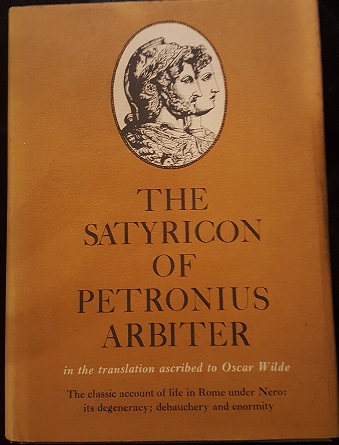
I had the chance to spend some time vacationing in Maine over the Thanksgiving Holiday.  Like any truly dedicated bibliophile, I seek out used bookstores wherever I go and Maine has some great selections.  I browed a rather large one in Wells which not only has rooms and rooms full of books but also has a rather large selection of maps.  I came home with an interesting mix of books, the first of which is a copy of Petronius’s  Satyricon.  Now why would a classicist need another translation of Petronius’s bawdy novel, you might ask.  This copy that I found was published in 1931 and is the translation attributed to Oscar Wilde.  It is attributed to Wilde but no one is quite sure if he actually did the translation himself or if he translated it from the original Latin text.  There are large parts of the translation that were borrowed from three previous translations.  In addition, the original copies of the book were published without naming the translator on the title page but instead the publisher sent out each copy with a slip indicating that the translator was Sebastian Melmoth, Wilde’s pseudonym.  For more information on this interesting literary hoax, here is a link to an excerpt of an article that was written about this translation: https://muse.jhu.edu/article/373513/pdf

wilde-satyricon

The next book I found as I wandered the many rooms of this bookstore was a copy of Thackeray’s Ballads published in 1856.  He is, of course, most famous for his longer work Vanity Fair and it was nice to discover that he had written this short volume of Ballads.  It’s interesting that this author who was known for his satirical works also wrote love poems and some short narrative poems.  The particular bookshop seems to have many editions of very old books.  This particular book of Thackeray’s Ballads is not valuable and I only paid $7.50 for it, but it is now one of the oldest books I have on my shelves.

ballads-2

ballad-inscription

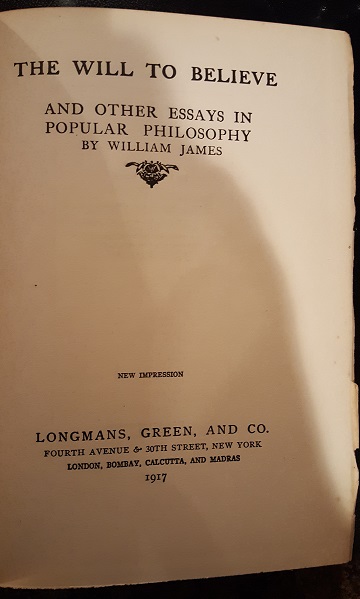
Next, I was specifically looking for a copy of anything I could find by William James, the American pragmatist philosopher.  I recently read American Philosophy by John Kaag and his discovery of a long-forgotten library with over 10,000 books, some of which beloved to James, renewed my interest in American philosophy.  I was surprised when the bookstore clerk said that books by American philosophers are very popular and I was lucky to find this copy of James’s essays published by Longmans, Green, and Co. in 1917.  This collection of essays includes some of his most famous such as “Is Life Worth Living” which was delivered at Harvard’s Holden Chapel in 1985.

james-book

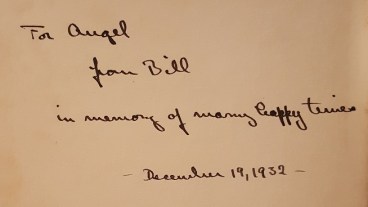
The final book that I found is my favorite of the collection.  At the entrance to the bookshop there is a huge table with stacks of books on the table and around the table that are the shop’s most recent arrivals that haven’t been categorized yet.  I walked up to these piles, which are rather daunting, and plucked a slim volume of poetry off the top.  The author of the book is William Dwight Crane and I noticed that there is a handwritten inscription inside the book that reads, “For Angel, From Bill in memory of many happy times.  December 19, 1932.”  The book is also signed by the author.  I researched the author’s name on the Internet and could find no biographical information on him or titles of other books that he wrote.  This lonely, slim volume might have been sitting on a pile in that bookshop all but forgotten for years.  I am happy to give it a new home with my other books will it will be used and read from time to time.

crane-1

crane-2

crane-3

The poems are a bit simple, but they are clearly from the heart and there is something about their simplicity that captivated me.  I will share one such poem entitled “Beauty and Love” from the collection:

Beauty is the soul of man’s desire
A blessed synthesis of pity, joy, and pain
Burned from out the centre of that fire
Of Passion which else were but a stain
Upon our shields, a funeral pyre
On which in each succeeding age have lain
The ashes of the deeds to which men’s hearts aspire,
Only to rise on phoenix-wings to urge men on again,
Beauty of form, and subtle harmony of line,
Beauty of thought and faery fantasy,
Beauty of deed, which makes the thought divine
Compose this substance born of ecstasy,
We need but fashion it with gentile hands,
And, lo! the image Love before us stands.

My daughter, who also inherited the reading gene, found some books to add to her own growing collection, including one about the ocean.  True bibliophiles know that used bookstores can be such great places of adventure and discovery.  What are your favorite bookshop finds?

14 Comments

Filed under British Literature, Classics, Opinion Posts, Poetry

Review: Two Lines 25 World Writing in Translation

I received a review copy of this title from the publisher, Two Lines Press.

My Review:
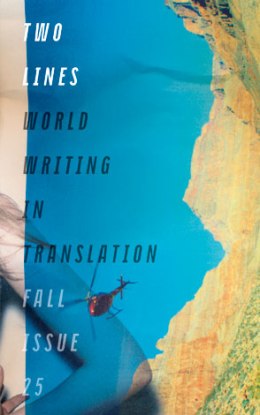
two-linesA few times a year I find a book that I rant and rave about and recommend to everyone I know.  I become rather obnoxious with my comments that gush with praise.  I am giving you fair warning that Two Lines 25 is one of those books.  Literature translated from Bulgarian, Chinese, French, German, Hebrew, Japanese, Korean, Norwegian, Russian and Spanish are all contained within the pages of this 192-page volume.  I am in awe of the fact that the editors crammed so many fantastic pieces into one slim paperback (there I go gushing again.)  This is the type of book that everyone needs to experience for him or herself; but I will attempt to give an overview of some of my favorite pieces.

The volume begins with a humorous and absurdist short story written by Enrique Vila-Matas and translated by Margaret Jull Costa.  I have to mention that not only is the English translation provided in these brilliantly collected pages, but an excerpt from each text in the original language also appears on the facing page in a colorful light blue that matches the artwork on the cover.  Vila Matas’s begins his story, Sea Swell, on a jarring and depressing note:  “I had a friend once.  Indeed, at the time, I only had one friend.”  This nearly friendless narrator, who is also completely broke, visits his one friend, Andre, who is living in Paris.  The unnamed narrator is an aspiring writer and Andre graciously agrees to introduce the narrator to Marguerite Duras.  The story becomes increasingly absurd when Duras offers the narrator an attic flat to rent for practically nothing.  But the narrator almost ruins the entire encounter because of his edgy demeanor which due to the two or three (he isn’t sure exactly how many) amphetamines he has ingested.    The expectation throughout the first few paragraphs is that the narrator is an absolute emotional mess and his friend Andres will have to come to his rescue.  But after Andre drinks two bottles of wine at a dinner party hosted by Duras, it is the narrator who has to pull Andre out of the Seine.  Vila-Matas, in the span of a few pages, writes a ridiculously funny tale but one that finishes with unexpected and surprising turn of events.

Russian author Dmitry Ivanov’s writing can also be found within the pages of this brilliant book.  His short story, Where Sleep the Gods, which is translated by Arch Tait, revolves around the Winter Olympics in Sochi and Putin’s strategy to sell the Olympics to the people of Sochi.  The main character in the narrative, a self-proclaimed “creative,” is named Anton and lives a comfortable life in Moscow while working for an ad agency.  Anton is used to dealing with wealthy customers who only demand the best that their money can buy.  Anton’s strategy in dealing with his wealthy clients is to adopt an air of aloofness: “He was accustomed to treating these types in a perfunctory, even insolent manner.  This was not risky, but, on the contrary, the surest approach to respect.”  When Anton is escorted in a private jet to meet a particularly important client he prepares to don his mask of insolence;  but when Vladimir Putin enters the room any and all attempts at smugness instantly dissolve.  Anton is quickly given the task of marketing the Olympics to the Sochians and is whisked off to that city to set up his Olympic headquarters.  What Anton discovers about the Sochians is astute and funny.  After spending about an hour in that city he decides that his slogan will be: “Thieves, because poets.”  You must read Ivanov’s humorous and brilliant story to fully get the joke!

Finally, I would like to discuss a piece in the collection that occupies the creative literary space somewhere between poetry and philosophy.   Nude Enumerated, written by Jean-Luc Nancy and translated by Charlotte Mandell, is a lyrical reflection on the different societal and emotional views and reactions that we have to nudity. The writing reminds me of Pascal Quignard whose philosophical poetry has also been written in shorter pieces which manage to be unexpectedly thought-provoking with only a minimal amount of words.  This was my favorite translation from the collection and the purchase of the book is worth it just for this one piece.  Nancy begins his reflection with a series of antonyms:

Nude: conquered, triumphant; undone, reassembled; lost, found;

undressed, costumed; obvious, indiscernible; shameless, virtuous;

sexed, neutralized.

Nancy proceeds to challenge us to look at different types of nudity that occur in different circumstances; his words make us uncomfortable but at the same time they make us think more deeply about the experiences we have with our unclothed human bodies.  Note also in this passage that Nancy’s asyndeton, lack of connectives like “and” or “or”, emphasizes the complexity of nudity:

Always elsewhere the male/female nude; not here, which welcomes

only clothed people, but over there somewhere undecided  at a

distance, within reach of desire of touching flattering hiding staining.

If you buy one book this month, if you only buy one more book for this entire year then I implore you to make Two Lines 25.  I haven’t even mentioned the poetry and essays that this volume also offers.  I am wondering how the editors at Two Lines go about choosing what literature to include in their collections.  I have in my mind an image of them exhaustively scouring the world in search of only the best of the best.  I don’t know how else they could produce such an astonishing collection.

To read the full index of works included in Two Lines 25 please visit: http://twolinespress.com/two-lines-journal/

About the Editor:
cj-evansCJ Evans is the author of A Penance (New Issues Press, 2012), which was a finalist for the Northern California Book Award and The Category of Outcast, selected by Terrance Hayes for the Poetry Society of America’s New American Poets chapbook series. He edited, with Brenda Shaughnessy, Satellite Convulsions: Poems from Tin House, and his work has appeared in journals such as Boston Review, Colorado Review, Indiana Review, Pleiades, and Virginia Quarterly Review.

CJ is the editor of Two Lines Press, the publishing program of the Center for the Art of Translation, which has quickly grown into a premier publisher of international literature, and he has edited translations of the works of authors like Marie NDiaye, Jonathan Littell, and Naja Marie Aidt. He also edits Two Lines: World Writing in Translation, a bi-annual journal of the best international literature in translation and curates Two Voices, an event series in San Francisco. He is a contributing editor for Tin House, and occasionally teaches, most recently in the MFA program at the University of San Francisco.

Prior to working at Two Lines Press, CJ was an editor at Tin House for 8 years, and worked at the Academy of American Poets. He received his MFA from Columbia University, and his BA from Reed College, where he wrote a thesis on the poetics of American Hip-Hop. He was the recipient of the 2013 Amy Lowell Traveling Scholarship, and currently lives in San Francisco with his wife, daughter, and son.

For more information visit his website:  cjevans.org

12 Comments

Filed under Literary Fiction, Literature in Translation, Poetry, Russian Literature, Short Stories, Spanish Literature

Review: Sebastian Dreaming by Georg Trakl

I received a review copy of this title from Seagull Books.  These poems have been translated from the original German into this English version by James Reidel.

My Review:
sebastian-dreamingGeorg Trakl died from a cocaine overdose while recovering from a nervous breakdown in a military hospital during World War I.  He was awaiting the proofs of Sebastian Dreaming which he had requested despite the fact that the publication of this collection was put off indefinitely because of The Great War.  Sebastian Dreaming was the second, and final collection that was prepared for publication by the author himself and James Reidel’s translation of this collection is the first that has appeared in English in its entirety.  Although some of the poems have appeared in other collections, the translator has argued that these poems ought to be read as part of this single collection, which is what Trakl himself intended.

In my review of Trakl’s  first collection of poems that was also published by Seagull Books and translated by James Reidel, I argued that, although Trakl’s struggle against depression and despair is evident, an underlying sense of triumph against these demons lingers; Trakl does not let his feelings of dejection overwhelm or destroy him.  Not yet, anyway.    But Sebastian’s Dreaming, which contains more overwhelming images of decay and dying, foreshadows Trakl’s impending overdose which many speculate was a suicide;  by the time this collection was composed he had finally been overwhelmed and defeated by his emotional disturbances, excessive indulgences in drugs and alcohol and the incestuous relationship he shared with his sister.  In short, the tone of these poems is more deeply melancholic than those in the previous collection.  In  Dream and Benightment he writes:

O, cursed breed.  When every fate is consummated in filthy
rooms, death enters the household with mouldering footsteps.
O, that spring was outside and a lovely bird might sing in
the blossoming tree.  But the sparse green withers grey at
the window of those who come by night  and the bleeding
hearts still think about evil.

The collection is divided into five sections, the titles of which suggest something of a final scene, before the curtain of his life has fallen: “Sebastian Dreaming”, “The Autumn of One Alone”, “Song Septet of Death”, “Song of the Solitary,” and “Dream of Benightment.”   In the poem Passion there exists a struggle against nature and our natural surroundings which bring about our inevitable demise.  Orpheus, who was torn apart by wild beasts as he sings a lament for his lost wife, is an apt figure for the destruction that passion can wreak on a human soul:

When Orpheus strums the lyre silver,
Lamenting one dead in the evening garden,
Who are you, one reposed, under towering trees?
The autumn reeds rustle with the lament,
The blue pond,
Dying away under greening trees
And following the shadow of the sister;
Dark love
of a wild kind,
For whom the day rushes by on golden spokes.
Silent night.

Anyone familiar with Trakl’s complicated relationship with his sister Grete can’t help but notice the proximity of the word sister to those of Dark love/of a wild kind.

I found it interesting to learn from reading an introduction to Reidel’s  manuscript,  Some Uncommon Poems and Versions,  that the Austrian pediatrician who lends his name to the disorder believed that Trakl displayed the symptoms of Asperger’s Syndrome.  Trakl’s poetry demonstrates two of the hallmark symptoms of this syndrome:  a gift with language and an emotional remoteness.  As an expressionist poet it is natural that his poetic landscape is full of this movement’s angst, interactions with nature and vivid colors.  But after reading Reindel’s comment about Asperger’s Syndrome I viewed his poems with a different eye, one towards someone who has difficulty with intimate connections and certain emotional cues.  Trakl never tells us he is melancholy or sad or overcome with despair.  But instead he describes Love as a pink angel appearing quietly to a boy or Joy as an evening sonata playing in cool rooms.

Finally, I would like to mention the pervasive use of colors in this collection.  The pages are consumed with the various shades that Trakl sees in nature.  Colors play an interesting role in expressing our emotions; we wear black at a funeral and a red dress to a festive party.  Different colors are associated with different holidays and seasons.  Trakl’s uses of color in his poetry brought to mind the vivid and bright pieces of the Expressionist painters.  Perhaps color was the best way that Trakl knew how to deal with and process his complicated emotional struggles.  He writes about a “blue soul” and a “black silence” in Autumn Soul.  The poem By Night contains a different color in each line that captures the mood of what could be the beginning of a passionate night:

The blue of my eyes is put out in this night.
The red gold of my heart.  O! How still burns the candle.
Your blue mantel enfolds the one falling;
Your red mouth seals the friend’s benightment.

Seagull Books will publish one final collection of poetry in the Trakl series.  I look forward to reading that collection and comparing it with the previous two volumes.

About the Author and Translator:
G TraklGeorg Trakl was born in Salzburg, Austria. As a teenager he gravitated towards poetry, incest and drug addiction and published his first work by 1908, the year he went to Vienna to attend pharmacy school and became part of that city’s fin-de-siècle cultural life. He enjoyed early success and published his first book in 1913. A year later, however, he died of a cocaine overdose due to battle fatigue and depression from the wartime delay of his second book.

 James Reidel is poet, translator, editor and biographer. In addition to the works of Georg Trakl, he has translated novels by Franz Werfel and poetry by Thomas Bernhard, among others. He is the biographer of poet Weldon Kees and author of two volumes of poetry.

11 Comments

Filed under German Literature, Poetry, Seagull Books