
I received a review copy of this title from the publisher, Two Lines Press.
My Review:
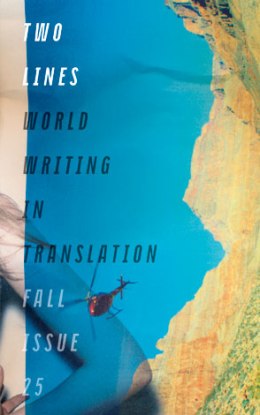 A few times a year I find a book that I rant and rave about and recommend to everyone I know. I become rather obnoxious with my comments that gush with praise. I am giving you fair warning that Two Lines 25 is one of those books. Literature translated from Bulgarian, Chinese, French, German, Hebrew, Japanese, Korean, Norwegian, Russian and Spanish are all contained within the pages of this 192-page volume. I am in awe of the fact that the editors crammed so many fantastic pieces into one slim paperback (there I go gushing again.) This is the type of book that everyone needs to experience for him or herself; but I will attempt to give an overview of some of my favorite pieces.
The volume begins with a humorous and absurdist short story written by Enrique Vila-Matas and translated by Margaret Jull Costa. I have to mention that not only is the English translation provided in these brilliantly collected pages, but an excerpt from each text in the original language also appears on the facing page in a colorful light blue that matches the artwork on the cover. Vila Matas’s begins his story, Sea Swell, on a jarring and depressing note: “I had a friend once. Indeed, at the time, I only had one friend.” This nearly friendless narrator, who is also completely broke, visits his one friend, Andre, who is living in Paris. The unnamed narrator is an aspiring writer and Andre graciously agrees to introduce the narrator to Marguerite Duras. The story becomes increasingly absurd when Duras offers the narrator an attic flat to rent for practically nothing. But the narrator almost ruins the entire encounter because of his edgy demeanor which due to the two or three (he isn’t sure exactly how many) amphetamines he has ingested. The expectation throughout the first few paragraphs is that the narrator is an absolute emotional mess and his friend Andres will have to come to his rescue. But after Andre drinks two bottles of wine at a dinner party hosted by Duras, it is the narrator who has to pull Andre out of the Seine. Vila-Matas, in the span of a few pages, writes a ridiculously funny tale but one that finishes with unexpected and surprising turn of events.
Russian author Dmitry Ivanov’s writing can also be found within the pages of this brilliant book. His short story, Where Sleep the Gods, which is translated by Arch Tait, revolves around the Winter Olympics in Sochi and Putin’s strategy to sell the Olympics to the people of Sochi. The main character in the narrative, a self-proclaimed “creative,” is named Anton and lives a comfortable life in Moscow while working for an ad agency. Anton is used to dealing with wealthy customers who only demand the best that their money can buy. Anton’s strategy in dealing with his wealthy clients is to adopt an air of aloofness: “He was accustomed to treating these types in a perfunctory, even insolent manner. This was not risky, but, on the contrary, the surest approach to respect.” When Anton is escorted in a private jet to meet a particularly important client he prepares to don his mask of insolence; but when Vladimir Putin enters the room any and all attempts at smugness instantly dissolve. Anton is quickly given the task of marketing the Olympics to the Sochians and is whisked off to that city to set up his Olympic headquarters. What Anton discovers about the Sochians is astute and funny. After spending about an hour in that city he decides that his slogan will be: “Thieves, because poets.” You must read Ivanov’s humorous and brilliant story to fully get the joke!
Finally, I would like to discuss a piece in the collection that occupies the creative literary space somewhere between poetry and philosophy. Nude Enumerated, written by Jean-Luc Nancy and translated by Charlotte Mandell, is a lyrical reflection on the different societal and emotional views and reactions that we have to nudity. The writing reminds me of Pascal Quignard whose philosophical poetry has also been written in shorter pieces which manage to be unexpectedly thought-provoking with only a minimal amount of words. This was my favorite translation from the collection and the purchase of the book is worth it just for this one piece. Nancy begins his reflection with a series of antonyms:
Nude: conquered, triumphant; undone, reassembled; lost, found;
undressed, costumed; obvious, indiscernible; shameless, virtuous;
sexed, neutralized.
Nancy proceeds to challenge us to look at different types of nudity that occur in different circumstances; his words make us uncomfortable but at the same time they make us think more deeply about the experiences we have with our unclothed human bodies. Note also in this passage that Nancy’s asyndeton, lack of connectives like “and” or “or”, emphasizes the complexity of nudity:
Always elsewhere the male/female nude; not here, which welcomes
only clothed people, but over there somewhere undecided at a
distance, within reach of desire of touching flattering hiding staining.
If you buy one book this month, if you only buy one more book for this entire year then I implore you to make Two Lines 25. I haven’t even mentioned the poetry and essays that this volume also offers. I am wondering how the editors at Two Lines go about choosing what literature to include in their collections. I have in my mind an image of them exhaustively scouring the world in search of only the best of the best. I don’t know how else they could produce such an astonishing collection.
To read the full index of works included in Two Lines 25 please visit: http://twolinespress.com/two-lines-journal/
About the Editor:
 CJ Evans is the author of A Penance (New Issues Press, 2012), which was a finalist for the Northern California Book Award and The Category of Outcast, selected by Terrance Hayes for the Poetry Society of America’s New American Poets chapbook series. He edited, with Brenda Shaughnessy, Satellite Convulsions: Poems from Tin House, and his work has appeared in journals such as Boston Review, Colorado Review, Indiana Review, Pleiades, and Virginia Quarterly Review.
CJ is the editor of Two Lines Press, the publishing program of the Center for the Art of Translation, which has quickly grown into a premier publisher of international literature, and he has edited translations of the works of authors like Marie NDiaye, Jonathan Littell, and Naja Marie Aidt. He also edits Two Lines: World Writing in Translation, a bi-annual journal of the best international literature in translation and curates Two Voices, an event series in San Francisco. He is a contributing editor for Tin House, and occasionally teaches, most recently in the MFA program at the University of San Francisco.
Prior to working at Two Lines Press, CJ was an editor at Tin House for 8 years, and worked at the Academy of American Poets. He received his MFA from Columbia University, and his BA from Reed College, where he wrote a thesis on the poetics of American Hip-Hop. He was the recipient of the 2013 Amy Lowell Traveling Scholarship, and currently lives in San Francisco with his wife, daughter, and son.
For more information visit his website: cjevans.org
 Zeberjet, the middle-aged man who is the main character of this novel, says a few times throughout his story that he is “neither dead nor alive.” Zeberjet works in the same hotel in which he was born and he rarely ventures outside of its walls. It’s not that he hasn’t wanted to go outside, but it seems more the case that he just hasn’t been interested in the outside world. His hotel, handed down to him through generations of his maternal family, provides him all of the social outlet that he needs.
 Karma, comeuppance, what comes around goes around. There are many terms and phrases for the universal of idea of cause and affect. The Brother is a fast-paced, hard-hitting, short book that uses the plot structure of a western as an allegory for demonstrating the balance of good and evil in the world. The author himself has described the book as “a spaghetti western told in poetic prose, simultaneously paying tribute to both Clint Eastwood and Alessandro Baricco.” The plot of this book is a clever structure for the philosophical and existential ideas that the author explores. When a mysterious man, simply known as Brother, arrives in the unnamed town it is a dark and stormy day and the weather reflects the turmoil that three shady and crooked men have caused for the townspeople.
 Rein Raud is the author of four books of poetry, six novels, and several collections of short fiction. He’s also a scholar in Japanese studies and has translated several works of Japanese into Estonian. One of his short pieces appeared in Best European Fiction 2015.
 The author explains to us in the introduction of the book that the Plimsoll Line is a mark on a ship’s hull that indicates the maximum depth a vessel can be immersed into the water when it is loaded with cargo without being sunk. In the 18th century, British merchants would overload their cargo, knowing full well that the ships would sink and then they would collect the insurance money on them. The Plimsoll Line was then marked on all ships to prevent shipwrecks and save lives. The main character in this book bears so much cargo in the form of tragedy that he wonders if he has overstepped his personal Plimsoll Line and will sink into oblivion.
 Juan Gracia Armendáriz (Pamplona, 1965) is a Spanish fiction writer and contributor to many Spanish newspapers. He has also been part-time professor at the Universidad Complutense of Madrid, and has many works of literary and documentary research. As a writer, he has published a book of poems, short stories, nonfiction books—biographical sketches and a historical story—and several novels. The Plimsoll Line is part of the “Trilogy of Illness”, formed by three separate books that reflect his experience as a person with kidney trouble. The novel was awarded the X Premio Tiflos de Novela 2008.
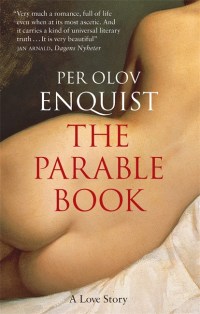 This is the story of an author who is looking back and assessing his life through a series of lesson, or parables, he has learned which have particularly shaped his spiritual life. The author’s name is Perola and his life appears to have an uncanny resemblance to that of Enquist’s himself. When the book begins Perola is lamenting the speech he delivered at his mother’s funeral and decides he wants to write a better one to hand out to his relatives. He reminisces about his childhood with his mother who was his only parent for most of his life.



 The Book Binder's Daughter