
My Review:
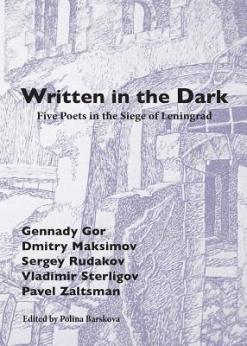 The official, state sponsored view of the Siege of Leningrad was one of heroism and valor and any piece of writing whether it be fiction, non-fiction or poetry that did not align with the Soviet vision of the Siege was suppressed. The dark and shocking works of the five poets in this collection were written in secret and not uncovered or published until many years after the war and after the fall of the Soviet Union. The Nazi siege of this Russian city lasted from September 1941 until January of 1944 with an estimated death toll reaching nearly 1,000,000 lives. The Soviet Union propogated a version of this event that portrayed stoic Russians valiantly enduring the long, German offensive; the brutality and horror that occurred in the city were buried with those who died during the Siege. In the introduction to the collection, Polina Barskova writes about the official, state approved, Soviet poetry that was allowed to be published about the Siege:
The “exemplary” Siege self presented to the world in this kind of literature was that of the stoic Soviet soldier. Even women, children and the elderly were depicted as warriors and likened to the city’s monuments —carved of marble and decorated with gold. It is these ubiquitous monuments that told, as I recall from my Leningrad childhood, the retouched story of the Siege—filled with hypocritical pathos and barren of the horrific truth. The truth, however, does emerge, sooner or later.
During the era of perestroika, poetry that was written during the Siege and suppressed by the Soviet regime began to emerge and to give the world a more accurate glimpse into the suffering and death that was thrust upon this city during World War II. The poets in this collection include Gennady Gor (1907-1981), the artist and film set director Pavel Zaltsman (1912-1985), the philologist Dmitry Maximov (1904-1987), the avant-garde painter Vladimir Sterligov (1904-1973), and the poet-philologist Sergey Rudakov (1909-1944).
The most brutally shocking poems in the book are written by Gennady Gor who became a well-known scholar, science fiction writer and collector of the art of Northern ethnicities when the war was over. There is an emphasis throughout his poems on cannibalism which is believed to have been widely practiced during the height of the Siege. Even carrion birds are deprived of any meals because there simply is nothing left:
I ate Rebecca the girl full of laughter
A raven looked down at my hideous dinner.
A raven looked down at me like at boredom.
At hwo slowly this human was eating that human.
A raven looked down but it was for nothing.
I didn’t throw it that arm of Rebecca.

Lenigraders on Nevsky Prospect during the Siege, 1942. RIA Novosti archive, image #324 / Boris Kudoyarov via Wikimedia Commons
Gor’s poems are obsessed with rotting and cold body parts, even when they are not being eaten. His emphasis on descriptions of body parts evokes the images of citizens lying in the streets, completely forgotten. His description of the pervading darkness reminds us of the black nights endured by the citizens because they were constantly under attack by the Germans. Even the moon is not welcome under these horrendous circumstances. Gor reveals the mental and emotional toll that this Siege took on its survivors, which stark details were forbidden to be written about in the official, Soviet poetry:
With a shock wave in my ears,
A cold moon in my soul,
I am a shot to insanity. I am both
Check and mate to myself. I am mute. Now I
Am nothing and running toward nothing.
Now I am no one’s and rushing to no one.
A shock wave in my mouth,
A cold moon in my dark,
A leg in my corner, an arm in my ditch,
The eyes that fell out of my sockets,
A finger forgotten in one of the clinics,
An unneeded moon in my dark.
After reading Vladimir Stergilov’s poems I was stunned that this man could not only survive the Siege, but also serve at the Leningrad Front, and then after the war return to this city where he became a successful artist in the underground, unofficial, avant-garde world of art. One wonders how could a man who wrote this poem go on after these experiences:
Raised a spoon to your lips—Death
Stretched out your hand to hello—Death
Saw a little goldfinch—Death
On the branch of a little leaf—Death
On a walk with your friends—Death
Looked at the cabbage on the plate—Death
Seeing your friends off, two of them—Death
Happened to glance to the side—Death.
Stergilov’s use of epistrophe with the word “Death” underscores the sheer terror that hovers over the most mundane, daily activities like eating or greeting a friend or walking in the park.
One final poet in the collection that stands out is Sergey Rudakov who elevates the themes of his poetry to encompass the larger event that is the destruction of Leningrad, a once proud and prosperous stronghold of the Russian state. He is the only one of these five poets who mentions his native city repeatedly in his Siege poems. In this first excerpt there is a feeling of nostalgia for his beloved city which is no longer recognizable to him:
The poor heart is both happy and unhappy
To recognize in searchlight crosses, to the west,
The native sky of Leningrad.
In the next poem in which he mentions the city there is an emphasis on the wasteland that his city has become with its empty apartments, streets and shops:
In the wasteland of Leningrad
Clocks still tell time somewhere.
But do not trust their wheels’ gait
Nor the arc of their springs.
Blind Charon keeps idle:
There are no normal burials.
Leningraders on Nevsky Prospect during the Siege, 1942. RIA Novosti archive, image #324 / Boris Kudoyarov via Wikimedia Commons
And in one final poem he uses the city’s former name, perhaps in an attempt to remember what a great city it once was before the Germans invaded. There is also an emphasis in this poem on the scores of unburied dead that were strewn on the city streets:
x
…In those far off years
Which future grandchildren
Will never come to know
In pale accounts of science,
Those days immemorial
Were lost in dreadful frosts.
In makeshift huts, the futile fires
Warmed soups of glue
And glucose for the living.
The dead outnumbered coffins.
The rout of Petersburg abandoned
Without a burial their own.
As difficult as these poems are to read, they are a reminder of the remarkable resiliency of the human spirit. Rudakov aptly writes that future grandchildren will not come to know the true brutality of the Siege because as time slips by, so do our memories fade. Our minds, our hearts, our souls have the greatest capacity to overcome the most unspeakable tragedies; this collection of poems puts into perspective the seemingly trivial problems that we might have on a day to day basis—trivial, at least, in comparison to surviving the Siege of Leningrad.
For more information on each of the authors of the collection as well as the editor visit Ugly Duckling Presse.
 Babel’s band of Jewish gangsters, thieves and smugglers make up the first part of this collection of highly entertaining and lively stories. The setting is the author’s hometown of Odessa, the Russian city on the Black Sea which saw a population boom in the nineteenth century and became a place for Jews to settle and seek out their fortunes. Babel begins his stories by introducing the Godfather of all Jewish gangsters, Benya Krik, also known as “The King” in Odessa. The occasion is the wedding of Benya’s ugly forty-year-old sister and he is delivered some news by an informant that the cops are going to stage a raid on the King’s headquarters. The clipped, rapid fire sentences are reminiscent of a scene from Pulp Fiction or Scarface.
 Isaak Emmanuilovich Babel (Russian: Исаак Эммануилович Бабель; 1901 – 1940) was a Russian language journalist, playwright, literary translator, and short story writer. He is best known as the author of Red Cavalry, Story of My Dovecote, and Tales of Odessa, all of which are considered masterpieces of Russian literature. Babel has also been acclaimed as “the greatest prose writer of Russian Jewry.” Loyal to, but not uncritical of, the Communist Party of the Soviet Union, Isaak Babel fell victim to Joseph Stalin’s Great Purge due to his longterm affair with the wife of NKVD chief Nikolai Yezhov. Babel was arrested by the NKVD at Peredelkino on the night of May 15, 1939. After “confessing”, under torture, to being a Trotskyist terrorist and foreign spy, Babel was shot on January 27, 1940. The arrest and execution of Isaak Babel has been labeled a catastrophe for world literature.
 Boris Dralyuk is an award-winning translator and the Executive Editor of the Los Angeles Review of Books. He holds a PhD in Slavic Languages and Literatures from UCLA, where he taught Russian literature for a number of years. He is a co-editor of the Penguin Book of Russian Poetry, and has translated Isaac Babel’s Red Cavalry and Odessa Stories, both of which are published by Pushkin Press.
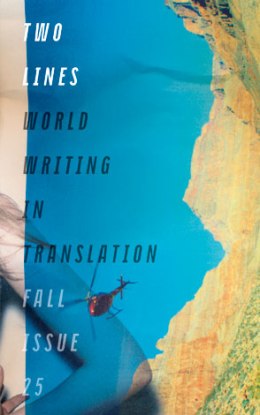 A few times a year I find a book that I rant and rave about and recommend to everyone I know. I become rather obnoxious with my comments that gush with praise. I am giving you fair warning that Two Lines 25 is one of those books. Literature translated from Bulgarian, Chinese, French, German, Hebrew, Japanese, Korean, Norwegian, Russian and Spanish are all contained within the pages of this 192-page volume. I am in awe of the fact that the editors crammed so many fantastic pieces into one slim paperback (there I go gushing again.) This is the type of book that everyone needs to experience for him or herself; but I will attempt to give an overview of some of my favorite pieces.
 CJ Evans is the author of A Penance (New Issues Press, 2012), which was a finalist for the Northern California Book Award and The Category of Outcast, selected by Terrance Hayes for the Poetry Society of America’s New American Poets chapbook series. He edited, with Brenda Shaughnessy,
  This book can only be described as a literary Odyssey, a roaming adventure through the crumbling town of Voroshilovgrad and its surroundings in the post-Soviet period. The plot offers so much more than Herman’s bizarre story as he attempts to run his brother’s gas station; we are confronted by a poetic journey through the landscape of Ukraine and a up close look at the unique people who inhabit this part of what once was Soviet territory.
 Serhiy Zhadan is one of the key voices in contemporary Ukrainian literature: his poetry and novels have enjoyed popularity both at home and abroad. He has twice won BBC Ukraine’s Book of the Year (2006 and 2010) and has twice been nominated as Russian GQ’s “Man of the Year” in their writers category. Writing is just one of his many interests, which also include singing in a band, translating poetry and organizing literary festivals. Zhadan was born in Starobilsk, Luhansk Oblast, and graduated from Kharkiv University in 1996, then spent three years as a graduate student of philology. He taught Ukrainian and world literature from 2000 to 2004, and thereafter retired from teaching. Zhadan’s poetry, novels, and short stories have been translated into over a dozen languages. In 2013, he helped lead the Euromaidan demonstrations in Kharkiv, and in 2014, he was assaulted outside the administration building in Kharkiv, an incident that gained notoriety around the world, including a feature article in the New Yorker. He lives and works in Kharkiv.
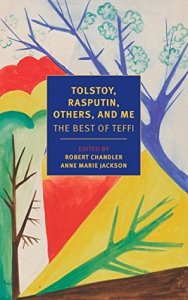 This book is a collection of autobiographical essays from the renowned, female Russian author Teffi. The essays were all written during the early part of the twentieth century and reflect Teffi’s own struggles with having to flee a turbulent and oppressive Russia. The collection is divided into four parts, the first of which is entitled “How I Live and Work.” These first few essays in the book capture her inner thoughts and self-doubts as she becomes Teffi “The Author.”



 The Book Binder's Daughter