Category Archives: Poetry

I Hold You in Imagination: The Poetry of Elizabeth Jennings

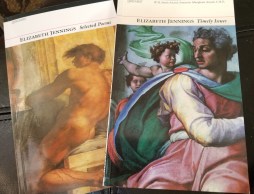
I finally received in the mail today a volume of poetry by Elizabeth Jennings (1926-2001) that I have been eagerly awaiting for weeks. The edition, entitled “Timely Issues” is published by Carcanet Press, which has also printed the other volume I own, her “Selected Poems.” Jennings was very successful with her poetry in her earlier years, publishing her work in various literary magazines and winning awards and prizes. But as her life progressed, she was mentally and physically fragile and suffered from breakdowns which caused her to be hospitalized. Her illnesses, her deep Catholic roots, and the difficult love affairs in which she engaged pervade her poems. I find her poetry simple, yet profound, quite lovely, and even soothing. I include here in my post three of my favorites from the Carcanet collections; they need no commentary or analysis as I think that would ruin my post—they stand better simply, on their own.

About These Things

About these things I always shall be dumb.
Some wear their silences as more than dress,
As more than skin deep. I bear mine like some

Scar that is hidden out of shamefulness.
I speak from depths I do not understand
Yet cannot find the words for this distress.

So much of power is put into my hand
When words come easily. I sense the way
People are charmed and pause; I seem to mend

Some hurt. Some healing seems to make them stay.
And yet within the power that I use
My wordless fears remain. Perhaps I say

In lucid Verse the terrors that confuse
In Conversation. Maybe I am dumb
Because if fears were spoken I would lose

The lovely languages I do not choose
More than the darkness from which they come.

Remembering Fireworks

Always as if for the first time we watch
The fireworks as if no one had ever
Done this before, made shapes, signs,
Cut diamonds in air, sent up stars
Nameless, imperious. And in the falling
Of fire, the spent rocket, there is a kind
Of nostalgia as normally only attaches
To things long known and lost. Such an absence,
Such emptiness of sky the fireworks leave
After their festival. We, fumbling
For words of love, remember the rockets,
The spinning wheels, the sudden diamonds,
And say with delight, ‘yes, like that, like that.’
Oh and the air is full of falling
Stars surrendered. We search for a sign.

Assurance

My love, I hold you in imagination,
Either mine or yours,
And it is stronger than remembered passion.
It uses memory with all its force.

O the clocks go silent, time departs,
Now is forever here.
How delicate yet strong are our two hearts,
Mine beats for you now almost everywhere.

Only when my world is rent with storm,
Threatened by sadness or
Overcome by black words which can come
And threaten me with the inner, hideous war

Only then, I’ve lost you. O but fast
A little flash of sun,
A hurrying memory returns you blessed
And our great love is stalwartly at one.

In a wonderfully written and compelling article entitled “Clarify Me, Please, God of the Galaxies” Dana Gioia concludes about Jennings’s poetry, ” Her poems flash like meteors illuminating what it means to be human.”

What poetry is everyone else reading lately? I would love to have some new recommendations in the comments.

8 Comments

Filed under British Literature, Classics, Poetry

in the kitchen it is cold: Requiem for Ernst Jandl by Friederike Mayröcker

Friederike Mayröcker and Ernst Jandl lived together from 1954 until Jandl’s death in 2000. They were lovers, companions, friends and creative partners; as we read Mayröcker’s elegy to Jundl the feeling of being lost and bewildered without him pervades her text. In a partnership that spans more than forty years, it’s fascinating to see what images and thoughts she brings to her poetic reflection on their time together. After spending so much of her life and her passions with him, how could she possibly choose what to write about in order to honor properly their memories?

One of my favorite pieces in the book is a reflection on a poem fragment that Jandl writes that is stuffed, with many other literary fragments, into his desk. In the winter of ’88 the two are painstakingly excavating the contents of his desk and Mayröcker recollects:

Afternoon after afternoon, actually the entire
winter of ’88, we are absorbed in
viewing, approving, conserving what
has been written down. And then, suddenly,
one day I come across four lines
dashed off in pencil:

in the kitchen it is cold
winter has an awful hold
mother’s left her stove of course
and i shiver like a horse.

She goes on to connect the poem to her current state of grief over Jandl’s passing:

The last line, which informs of the most
profound abandonment, aloneness, exclusion
seeking solace in an attempt
to identify with that mute creature—a carriage
horse in winter’s cold depths, standing
in one place for hours, head hanging, in no
one’s care, waiting for a human to get it
going—is so poignant.

And it is the very last line of the poem that haunts Mayröcker:

This line: mother is not at her stove:
conveys the damnable utterly graceless
transience and finiteness of this life, mother
is not at her stove—where did she go.

I’ve read two other books on grief recently: Will Daddario’s To Grieve and Max Porter’s Grief is a Thing with Feathers. Of all these, Mayrocker’s text elicited the most emotional response from me. Her multifaceted response to grief in all its forms—emotional, philosophical, social—struck a nerve.

8 Comments

Filed under German Literature, Poetry, Seagull Books

Here of a Sunday Morning: The Poetry of A.E. Housman

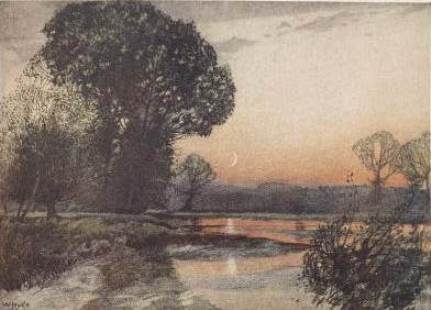
“On the Teme”, one of William Hyde’s coloured illustrations to A.E. Housman’s A Shropshire Lad (1908)

I am very familiar with Housman’s academic writing on classical subjects, but George Steiner’s discussion of Housman promoted me to read his poetry.  I have been reading a few poems a week from The Wordsworth Poetry Library edition I bought and here I offer two of my favorites so far.  They are from A Shropshire Lad collection.

XXI
Bredon Hill

In summertime on Bredon
The bells they sound so clear;
Round both the shires they ring them
In steeples far and near,
A happy noise to hear.

Here of a Sunday morning
My love and I would lie,
And see the coloured counties,
And hear the larks so high
About us in the sky.

The bells would ring to call her
In valleys miles away:
‘Come all to church, good people;
Good people, come and pray.’
But here my love would stay.

And I would turn and answer
Among the springing thyme,
‘Oh, peal upon our wedding,
And we will hear the chime,
And come to church in time.’

But when the snows at Christmas
On Bredon top were strown,
My love rose up so early
And stole out unbeknown
And went to church alone.

They tolled the one bell only,
Groom there was none to see,
The mourners followed after,
And so to church went she,
And would not wait for me.

The bells they sound on Bredon,
And still the steeples hum.
‘Come all to church, good people,’—
Oh, noisy bells, be dumb;
I hear you, I will come.

XIV
There pass the careless people
That call their souls their own:
Here by the road I loiter,
How idle and alone.

Ah, past the plunge of plummet,
In seas I cannot sound,
My heart and soul and senses,
World without end, are drowned.

His folly has not fellow
Beneath the blue of day
That gives to man or woman
His heart and soul away.

There flowers no balm to sain him
From east of earth to west
That ’s lost for everlasting
The heart out of his breast.

Here by the labouring highway
With empty hands I stroll:
Sea-deep, till doomsday morning,
Lie lost my heart and soul.

2 Comments

Filed under British Literature, Classics, Poetry

Slightly Exhausted at the End: My Favorite Books of 2017

I received several lovely books as gifts for Christmas and tucked inside one of them was a handwritten notecard with this quote by William Styron:  “A great book should leave you with many experiences, and slightly exhausted at the end.  You live several lives while reading.”  I thought this sentiment was perfect for writing about my list of books this year that have provided me with rich and deep cerebral experiences;  these are the  books I have thought about on sleepless nights, these are the books that have left me figuratively and literally exhausted.

Many of the books on this list are classics, written in the 19th or 20th century.  Only a couple of titles that were published this year have made the list.  There is also a predominance of classic British and German literature.

Mrs. Dalloway,  To the Lighthouse and The Waves, Virginia Woolf.  This was the year that I finally discovered the wonder that is Virginia Woolf.  Of the three titles I read I couldn’t possibility pick a favorite, they all resonated with me for different reasons.  I’ve also enjoyed reading her essays along side the novels.

Pilgrimage, Vols. 1 and 2, Dorothy Richardson.  I started reading Richardson towards the end of the summer and was instantly captivated by her language and her strong, daring female character.  I made it about half way through Pilgrimage before taking a break.  But I will finish the last two volumes in the new year.

Map Drawn by a Spy, Guillermo Cabrera Infante.  This is another great title from Archipelago books and a chilling account of the author’s escape from his homeland of Cuba.  A unique, eye-opening read on the mindset of those living under an oppressive, totalitarian regime.

And Our Faces, My Heart, Brief as Photos and Bento’s Sketchbook,  John Berger.  I initially picked up And Our Faces when Scott Esposito pointed it out on Twitter several months back.  I just happened to be walking by one of my bookshelves one day and it caught my eye.  I haven’t stopped reading Berger since.  I also remembered that I had a copy of Bento’s Sketchbook which came recommended by someone with impeccable literary taste who said it is one of those “must read” books.  He was not wrong.

The Quest for Christa T., Christa Wolf.  I first discovered Wolf last year when I read her Medea and Cassandra.  Surprisingly, I think of all the Wolf  titles I’ve read so far, The Quest for Christa T. has been my favorite.  I have also gotten about half way through her memoir One Day a Year which I am hoping to finish in the new year.

Effi Briest, Theodor FontaIne.  I saw a list of Samuel Beckett’s favorite books and Effi was on the list.  I immediately picked up a copy and read it.  This is a title that is worthy of multiple reads, one that indeed left me exhausted yet eager to start all over from the beginning.

Other Men’s Daughters, Richard Stern.  It is no surprise that my list includes at least one title from NYRB Classics.  I had never heard of Stern and this book made me want to explore more of his writings.  This is a tale of a marriage and divorce, but Stern’s writing is not typical of this genre in any way whatsoever.

Penthesilea, Heinrich von Kleist.  Kleist’s story of Penthesilea and her brief yet powerful relationship with the hero Achilles was captivating.  I oftentimes avoid retellings of Ancient myths because they veer too far from the original stories, but Kleist’s rendition of these events from the Trojan War deftly incorporate his own backstory with these ancient characters.

Poetic Fragments, Karoline von Gunderrode.  This was another title that I came across on literary Twitter.  For all of the negative things that can be said about social media,  it has definitely served a great purpose for me through interacting with a community of liked minded readers.  Thanks to flowerville, in particular, who has steered me toward many a great German classic that I would otherwise not have been made aware of.

Blameless, Claudio Magris.  As with other Magris novels I have read, I was impressed with the high level of the author’s erudition mixed with poetic language and intriguing plot.  Much like Compass which is also on this list,  it is not an easy read, but for those who enjoy a literary challenge then I highly recommend Blameless

A Terrace in Rome, Pascal Quignard.  I have been slowly making my way through all of  the Quignard that is in translation.  A Terrace in Rome had  all of the elements that I love about a Quignard title; it was poetic, passionate, philosophical, enigmatic, and beautiful.  I am especially eager to get a copy of Villa Amalia which Seagull Books will soon be publishing.

Compass, Mathias Enard.  This is one of the few books actually published this year on my list.  This is a book for those who really enjoy books.  My TBR pile grew by leaps and bounds collecting just a fragment of the titles mentioned by Enard in his fascinating story of a musicologist who suffers from a sleepless night.

Now I’m exhausted just thinking about these books all over again…


32 Comments

Filed under British Literature, Classics, French Literature, German Literature, History, Literary Fiction, Literature in Translation, New York Review of Books, Poetry, Virginia Woolf

My Pilgrimage from Dante to Catullus to Sappho

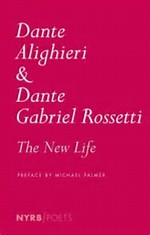
The fifth chapter of Dorothy Richardson’s Pilgrimage  describes Miriam attending a Dante lecture. As I was reading  Interim I remembered that I had bought a copy of Vita Nuova translated by Dante Gabriel Rossetti that was reissued by the NYRB poets series in 2011.  And from Dante I was led to Catullus and then to Sappho.  I am sure that entire dissertations have been written about this topic, but here are my scattered thoughts anyway.

When reading Dante’s Vita Nuova, a comparison between the Italian poet and Catullus immediately comes to mind.  Some of the similarities are so basic and superficial that they can be considered coincidences.  Both poets, for instance, humbly call their collections a “little book” (libello in Italian and libellus in Latin.)  The poetry of both men is deeply personal and autobiographical, although specific details such as dates for events are difficult to glean from their writings.   The Italian and the Roman, both of whom were upper class, wealthy citizens, each fall in love with a woman that is inaccessible and married to another man—Beatrice is for Dante what Clodia (Lesbia) is for Catullus.  And finally, both men are the novi poetae of their respective generations, breaking free from the traditional conventions of their craft (Catullus rejects epic in favor of short, personal poetry; Dante writes in Italian instead of Latin.)

Beginning from the age of nine, Dante writes about each of his encounters with his beloved Beatrice.  On one such occasion, a gathering to celebrate a wedding (some believe it is Beatrice’s own wedding), he sees her with a group of other young women and he is struck dumb by the sight of her.  The loss of all of his senses  is described in a sonnet that was written about this chance meeting with her:

Even as the others mock, thou mockest me;
Not dreaming, noble lady, whence it is
That I am taken with strange semblances,
Seeing thy face which is so fair to see:
For else, compassion would not suffer thee
To grieve my heart with such harsh scoffs as these.
Lo! Love, when thou art present, sits at ease,
And bears his mastership so mightily,
That all my troubled senses he thrusts out,
Sorely tormenting some, and slaying some,
Till none but he is left and has free range
To gaze on thee. This makes my face to change
Into another’s; while I stand all dumb,
And hear my senses clamour in their rout.

The last five lines are similar enough to Catullus Poem #51 to suspect a case of intertextuality. Many scholars have speculated that this poem captures Catullus’ first encounter with Clodia who is sitting with another man at a party while the poet looks on (translation is my own):

This situation steals away all of my senses,
I who am so wretched; For as soon as I looked at you, Lesbia,
nothing else exists for me. But my tongue swells up,
a thin flame simmers beneath my limbs,
my ears are ringing, and darkness covers
both of my eyes.

Catullus 51 is the Roman poet’s translation of Sappho #31 in which poem she is similarly frozen while beholding her lover. Some scholars have speculated that Sappho sees the object of her desire at a wedding, which is an interesting parallel with the setting of Dante’s sonnet (translation is my own):

When I look at you, even for a short time,
I am no longer able to speak.

But my tongue breaks,
and at once a small fire assails me under my skin
my eyes do not see and my ears are ringing.

I am contemplating another reread of Dante’s Divine Comedy and I have Dorothy Richardson to thank for rekindling my interest in the Italian poet and bringing me back to some of my favorite poems from Catullus and Sappho.

For the extra curious here are links to the original languages: Catullus, Sappho, Dante

And here is an abstract of an excellent article about Dante’s influence in Pilgrimage: https://www.research.manchester.ac.uk/portal/en/publications/dantes-pilgrimage-in-dorothy-richardson(6bff1f93-85f3-4b23-99a1-05ddfef79ef4).html

4 Comments

Filed under Classics, Italian Literature, New York Review of Books Poetry, Poetry