Category Archives: Literary Fiction

Review: Two Lines 25 World Writing in Translation

I received a review copy of this title from the publisher, Two Lines Press.

My Review:
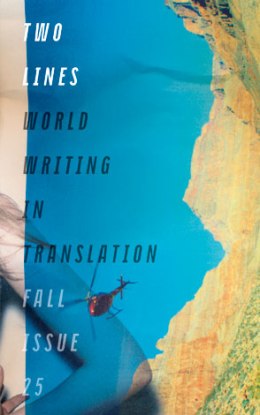
two-linesA few times a year I find a book that I rant and rave about and recommend to everyone I know.  I become rather obnoxious with my comments that gush with praise.  I am giving you fair warning that Two Lines 25 is one of those books.  Literature translated from Bulgarian, Chinese, French, German, Hebrew, Japanese, Korean, Norwegian, Russian and Spanish are all contained within the pages of this 192-page volume.  I am in awe of the fact that the editors crammed so many fantastic pieces into one slim paperback (there I go gushing again.)  This is the type of book that everyone needs to experience for him or herself; but I will attempt to give an overview of some of my favorite pieces.

The volume begins with a humorous and absurdist short story written by Enrique Vila-Matas and translated by Margaret Jull Costa.  I have to mention that not only is the English translation provided in these brilliantly collected pages, but an excerpt from each text in the original language also appears on the facing page in a colorful light blue that matches the artwork on the cover.  Vila Matas’s begins his story, Sea Swell, on a jarring and depressing note:  “I had a friend once.  Indeed, at the time, I only had one friend.”  This nearly friendless narrator, who is also completely broke, visits his one friend, Andre, who is living in Paris.  The unnamed narrator is an aspiring writer and Andre graciously agrees to introduce the narrator to Marguerite Duras.  The story becomes increasingly absurd when Duras offers the narrator an attic flat to rent for practically nothing.  But the narrator almost ruins the entire encounter because of his edgy demeanor which due to the two or three (he isn’t sure exactly how many) amphetamines he has ingested.    The expectation throughout the first few paragraphs is that the narrator is an absolute emotional mess and his friend Andres will have to come to his rescue.  But after Andre drinks two bottles of wine at a dinner party hosted by Duras, it is the narrator who has to pull Andre out of the Seine.  Vila-Matas, in the span of a few pages, writes a ridiculously funny tale but one that finishes with unexpected and surprising turn of events.

Russian author Dmitry Ivanov’s writing can also be found within the pages of this brilliant book.  His short story, Where Sleep the Gods, which is translated by Arch Tait, revolves around the Winter Olympics in Sochi and Putin’s strategy to sell the Olympics to the people of Sochi.  The main character in the narrative, a self-proclaimed “creative,” is named Anton and lives a comfortable life in Moscow while working for an ad agency.  Anton is used to dealing with wealthy customers who only demand the best that their money can buy.  Anton’s strategy in dealing with his wealthy clients is to adopt an air of aloofness: “He was accustomed to treating these types in a perfunctory, even insolent manner.  This was not risky, but, on the contrary, the surest approach to respect.”  When Anton is escorted in a private jet to meet a particularly important client he prepares to don his mask of insolence;  but when Vladimir Putin enters the room any and all attempts at smugness instantly dissolve.  Anton is quickly given the task of marketing the Olympics to the Sochians and is whisked off to that city to set up his Olympic headquarters.  What Anton discovers about the Sochians is astute and funny.  After spending about an hour in that city he decides that his slogan will be: “Thieves, because poets.”  You must read Ivanov’s humorous and brilliant story to fully get the joke!

Finally, I would like to discuss a piece in the collection that occupies the creative literary space somewhere between poetry and philosophy.   Nude Enumerated, written by Jean-Luc Nancy and translated by Charlotte Mandell, is a lyrical reflection on the different societal and emotional views and reactions that we have to nudity. The writing reminds me of Pascal Quignard whose philosophical poetry has also been written in shorter pieces which manage to be unexpectedly thought-provoking with only a minimal amount of words.  This was my favorite translation from the collection and the purchase of the book is worth it just for this one piece.  Nancy begins his reflection with a series of antonyms:

Nude: conquered, triumphant; undone, reassembled; lost, found;

undressed, costumed; obvious, indiscernible; shameless, virtuous;

sexed, neutralized.

Nancy proceeds to challenge us to look at different types of nudity that occur in different circumstances; his words make us uncomfortable but at the same time they make us think more deeply about the experiences we have with our unclothed human bodies.  Note also in this passage that Nancy’s asyndeton, lack of connectives like “and” or “or”, emphasizes the complexity of nudity:

Always elsewhere the male/female nude; not here, which welcomes

only clothed people, but over there somewhere undecided  at a

distance, within reach of desire of touching flattering hiding staining.

If you buy one book this month, if you only buy one more book for this entire year then I implore you to make Two Lines 25.  I haven’t even mentioned the poetry and essays that this volume also offers.  I am wondering how the editors at Two Lines go about choosing what literature to include in their collections.  I have in my mind an image of them exhaustively scouring the world in search of only the best of the best.  I don’t know how else they could produce such an astonishing collection.

To read the full index of works included in Two Lines 25 please visit: http://twolinespress.com/two-lines-journal/

About the Editor:
cj-evansCJ Evans is the author of A Penance (New Issues Press, 2012), which was a finalist for the Northern California Book Award and The Category of Outcast, selected by Terrance Hayes for the Poetry Society of America’s New American Poets chapbook series. He edited, with Brenda Shaughnessy, Satellite Convulsions: Poems from Tin House, and his work has appeared in journals such as Boston Review, Colorado Review, Indiana Review, Pleiades, and Virginia Quarterly Review.

CJ is the editor of Two Lines Press, the publishing program of the Center for the Art of Translation, which has quickly grown into a premier publisher of international literature, and he has edited translations of the works of authors like Marie NDiaye, Jonathan Littell, and Naja Marie Aidt. He also edits Two Lines: World Writing in Translation, a bi-annual journal of the best international literature in translation and curates Two Voices, an event series in San Francisco. He is a contributing editor for Tin House, and occasionally teaches, most recently in the MFA program at the University of San Francisco.

Prior to working at Two Lines Press, CJ was an editor at Tin House for 8 years, and worked at the Academy of American Poets. He received his MFA from Columbia University, and his BA from Reed College, where he wrote a thesis on the poetics of American Hip-Hop. He was the recipient of the 2013 Amy Lowell Traveling Scholarship, and currently lives in San Francisco with his wife, daughter, and son.

For more information visit his website:  cjevans.org
12 Comments

Filed under Literary Fiction, Literature in Translation, Poetry, Russian Literature, Short Stories, Spanish Literature

Review: Mothering Sunday by Graham Swift

Today is the first Sunday in the U.S. for 2016 American football season.  In case you haven’t read my bio., I am a life-long fan of the New York Football Giants and every Sunday in the fall I can be found glued to the scores rolling in throughout the day.  I am also in a fantasy football league with the guys at work so this gives every Sunday some added excitement.  Graham Swift, in his latest work of fiction, also uses the tradition of Sunday being a special day in England at the time when large estates employed servants.

My Review:
mothering-sundayThe most important decisions and in our lives can oftentimes be traced to the events of a single day.  Jane Fairchild is a writer in her nineties and decided that this would be her career on one preternaturally warm spring day in March of 1924.  Jane was a maid at the Beechwoods estate for the Niven family and she was having a secret affair with the upper class son who lived on the neighboring estate and on this day in March her lover summons her to his room for an afternoon of sensual pleasure.

The annual Lenten tradition of giving the staff a day off, called “Mothering Sunday,” was carried on in Britain during the era of large estates which employed servants.  The maids, cooks, butlers and other servants were allowed the day off on this special Sunday and many of them made it a habit to visit their mothers.  But Jane Fairchild is an orphan and, in fact, she is a foundling so she has no idea what her real name is, if she was ever given one, or what her actual date of birth is.  The orphanage named her Jane and assigned her May 1st as a birthday.  But Jane is never bitter or upset about her fate as an orphan.  She believes that if it were not for her humble and unknown beginnings then she never would have experienced that special Sunday in 1924 and might not have ever become a successful writer.

Jane came into service at Beechwoods as a young girl of sixteen and not long after that she meets and begins a passionate affair with Paul Sheringham.  Paul is the confidant and spoiled son of the neighboring Upleigh estate.  He had two brothers who were both killed in The Great War so the fact that he is still alive is a miracle and as the only surviving male heir no one ever questions his actions or choices.   When Paul and Jane begin their affair Paul pays Jane for their little trysts but as the relationship between them develops and becomes more mature they both find themselves invested in their time spent together and they carry on like this for seven years.

Paul is engaged to a woman named Emma Hobday and when the Sheringhams, Hobdays and Nivens are all meeting for lunch on a warm Sunday in March in 1924 Paul immediately summons Jane to his bedroom so that they can take advantage of her day off in the Sheringham’s empty house.  Jane and Paul usually meet in places between the two houses, like the garden path, so this Sunday is very special for Jane.  Paul even greets her at the front door, a place where a common maid would never enter the lavish home.

The first part of the book is a description of Jane’s invitation to Paul’s room and what happens once she gets there.  Swift’s writing is detailed, sensual and mesmorizing.  Jane describes what she sees in Paul’s room since she is visiting it for the first time, she describes how their encounter begins and she describes how Paul gets dressed when they are finished.  There is a focus on their nakedness and the sheer revelry of doing what they want in a place that is normally forbidden to them.  I was captivated by Swift’s writing and the suspense he creates in the story through Jane’s narrative of what happens on this special Sunday.  Jane and Paul never talk about the future or his impending marriage, but Jane assumes that this will be their last encounter and they will never find the time again for these secret and passionate trysts.

My only complaint about the book is the ending.  The last part of the narrative becomes solely about Jane and her feelings about being an author.  By this time she is a ninety-year-old woman who has had a long and successful career and she becomes philosophical about her progress as a writer.  The eroticism and mystique of the first part are lost by the end.   Overall,  this is definitely a book worth going back and starting from the beginning many times over.

About the Author:
graham-swiftGraham Colin Swift FRSL (born May 4, 1949) is a British author. He was born in London, England and educated at Dulwich College, London, Queens’ College, Cambridge, and later the University of York. He was a friend of Ted Hughes.

Some of his works have been made into films, including Last Orders, which starred Michael Caine and Bob Hoskins and Waterland which starred Jeremy Irons. Last Orders was a joint winner of the 1996 James Tait Black Memorial Prize for fiction and a mildly controversial winner of the Booker Prize in 1996, owing to the superficial similarities in plot to William Faulkner’s As I Lay Dying. Waterland was set in The Fens; it is a novel of landscape, history and family, and is often cited as one of the outstanding post-war British novels and has been a set text on the English Literature syllabus in British schools.


10 Comments

Filed under British Literature, Literary Fiction

Review: The Noise of Time by Julian Barnes

I have been recovering from eye surgery for the past few weeks and this is the reason for my lack of posts.  I am slowly getting better and am eager to share reviews of a few fantastic books I have read over the course of the summer.  First up is my review of The Noise of Time by Julian Barnes which, I believe, was eligible for the Man Booker Prize this year.  I am disappointed that it did not make the longlist because it is, in my humble opinion, a true work of literary genius.  The edition I read was published in the U.S. by Knopf.

My Review:
Noise of TimeThis skillfully written and poetic novel, which serves as a fictional biography of the Russian composer Dmitri Shostakovich, is divided into three parts.  The author cleverly chose what, on the surface, appear to be trivial occurrences in the life of the world-renown composer, but on closer examination reveal the soul crushing hold that Despotism and absolute Power had on this creative genius.  The first part of the book is centered around Shostakovich’s nightly ritual of getting dressed and standing by the lift outside his apartment.  While his wife and daughter are safely tucked in bed, the composer stands in the hallway, smoking cigarettes and trying to stay awake for his unusual, nocturnal routine.
It is revealed throughout the course of the first part that Lenin attended a performance of Shostakovich’s opera Lady Macbeth of Mtsensk and hated it.  The next day a bad review which labeled the performance as “muddle instead of music” appeared in Pravda and the composer became terrified that this would not only be the end of his music career but also the end of his existence.  He did not want to be dragged out of bed in the middle of the night and suffer the indignity of being taken to prison in his pajamas.  So he waits for Stalin’s henchmen fully clothed because this was the one and only aspect of the situation he could control.  The first part of the book is absolutely riveting because we never know if or when Shostakovich will be snatched away by Stalin’s thugs and the great composer has a couple of strokes of good luck which factor into the suspense.

The second part of the book is devoted to a conference that Shostakovich is required to attend in the United States.  By this time in his life he is a world famous composer and his music is well-known beyond the borders of the Soviet Union.  But Shostakovich is not only going to the United States to discuss his music but he is also being used as a tool by the Soviet government to promote Communism.  The indignity of delivering speeches which he has not written that extol and praise the virtues of Communism and condemn his beloved Stravinsky make him embarrassed and depressed.  Whenever Shostakovich talks about Power, always written with a capital “P,” and the hold it has over his art and his life my heart broke for the anxiety and mental anguish that this man suffered.  It is nothing short of astonishing that this artist was able to compose beautiful music and keep his family safe while under such intense scrutiny from the highest officials in the Soviet regime.

In the final part of the book Shostakovich suffers towards the end of his life from what he feels is the greatest and deepest blow to his dignity and his self-worth.  Up to this point in his life and career the composer has miraculously been able to avoid becoming a member of the Party.  But those in a position of Power want to exploit Shostakovich’s success once more and make him the Chairman of the Russian Confederation of Composers.  He does everything he can to avoid accepting the title and becoming a member of the party, but in the end Power is too strong for any man to resist, even one who is a famous artist.  Shostakovich tells his son that he only cried twice in his adult life: once when his first wife died and once when he joined The Party.  The last third of the book was the saddest and most difficult to read because Shostakovich is a broken man whose soul has been crushed by Power.

Barnes gives us a glimpse into the internal dialogue and turmoil of this artist and the result is a deeper understanding of the composer’s life under Stalin’s regime.  Even though he had a nice apartment, a car and driver, and world-wide fame, he pays a dear price for all of these things.  Many criticize Shostakovich for not standing up to Power but Barnes, by reconstructing the composer’s innermost thoughts, shows us that dealing with totalitarianism is a complicated matter.   Whenever the composer contemplates refusing the “requests” of government officials, he thinks of his family, “If you saved yourself, you might also save those around you, those you loved.  And since you would do anything in the world to save those you loved, you did anything in the world to save yourself.  And because there was no choice, equally there was no possibility of avoiding moral corruption.”

About the Author:
J BarnesJulian Patrick Barnes is a contemporary English writer of postmodernism in literature. He has been shortlisted three times for the Man Booker Prize— Flaubert’s Parrot (1984), England, England (1998), and Arthur & George (2005), and won the prize for The Sense of an Ending (2011). He has written crime fiction under the pseudonym Dan Kavanagh.

Following an education at the City of London School and Merton College, Oxford, he worked as a lexicographer for the Oxford English Dictionary. Subsequently, he worked as a literary editor and film critic. He now writes full-time. His brother, Jonathan Barnes, is a philosopher specialized in Ancient Philosophy.

He lived in London with his wife, the literary agent Pat Kavanagh, until her death on 20 October 2008.

18 Comments

Filed under British Literature, Literary Fiction

Review: Hot Milk by Deborah Levy (Man Booker Longlist)

I received an advanced review copy of this title from Bloomsbury Publishing via Netgalley.  This title has just made the Man Booker Prize longlist for 2016.

My Review:
hot milkThe setting of this book, on the southern coast of Spain, is the perfect backdrop for a summer book.  Sofia has taken her mother, Rose,  to a clinic in Spain in order to treat her intermittent walking problems.  Sophia and Rose rent an apartment that overlooks the beach but Sofia’s mother doesn’t appreciate the beautiful setting because the only thing she can focus on is her poor health.

The main theme of the book is Sofia’s failure at life; she hasn’t finished her Ph.D. in Anthropology, she has a menial job in England as a coffee barista, and doesn’t even have her own home or apartment.  She is at the constant beck and call of her mother whose health issues have been the centerpiece of both of their lives.  Sophia’s mother has mortgaged her home in England in order to pay for this expensive clinic and it is their last ditch effort to get to the bottom of Rose’s health issues.  But it is evident from the beginning of the story that Rose is a hypochondriac and that many of her health problems are psychosomatic.  Have Rose’s health problems held Sophia back from having her own adult life or is Sophia just using her mother’s health problems as an excuse?  Sophia spends their time in Spain mulling over these issues and more.

Levy’s writing style is what I would describe as sparse.  We get the bare minimum as far as the plot is concerned.  For example, Sophia’s father walked out when she was a child and she hasn’t spoken to him in over ten years.  She thinks a lot about him and his new wife and daughter while she is in Spain.  All of a sudden towards the end of the book Sophia is on a plane to Athens to try and reconnect with her father but there is not much of an explanation as to the process of how she decides to get on that plane.  I can appreciate the fact that Levy chooses to spend her words on setting a scene or the inner dialogue of the characters, but as someone who enjoys the details of a plot I would have appreciated more of a back story.

Readers will either love or hate Sophia who seems numb and awash in what is happening around her.  It is perfectly clear that her mother’s illnesses are not serious but she lets her mother take advantage of her good nature as she waits on her hand and foot.  Sophia also has two sexual relationships with both a man and a woman while she is in Spain.  She doesn’t seem especially attached to either of her partners and her sexual preferences for male or female are ambiguous as well.  Sophia’s sexuality is another issue in her life about which she cannot come to a decision.  The most shocking example of her indifference towards her life is her constant encounters on the Spanish beach with medusa jellyfish.  She doesn’t heed the warnings posted on the beaches and swims through these creatures and suffers painful stings.  We wonder if these wounds are self-inflicted just so that she can prove to herself that she is still alive and can feel something.

Finally, I have to say a word about Dr. Gomez who runs the clinic where Rose becomes a patient.  He is well-dressed, well-spoken and since his wife has died, his greatest love is the cat who serves as the mascot for his clinic.  It is evident that Dr. Gomez sees Rose’s health issues for what they really are and Levy’s sense of humor come out through the battle of wills between Rose and Dr. Gomez.  One of the funniest scenes in the book is a luncheon arranged by Dr. Gomez at which he entices a stray cat to scratch Rose’s foot by dropping calamari onto the floor of the restuarant.  His clever little plot reveals that Rose’s feet can’t possibly be numb if she can feel a cat scratch.

This is an interesting books as far as the setting and the character study.  I am curious to see what others think about Levy’s latest novel.  Does anyone think it will make the Man Booker shortlist?

About the Author:
D LevyDeborah Levy trained at Dartington College of Arts leaving in 1981 to write a number of plays, highly acclaimed for their “intellectual rigour, poetic fantasy and visual imagination”, including PAX, HERESIES for the Royal Shakespeare Company, CLAM, CALL BLUE JANE, SHINY NYLON, HONEY BABY MIDDLE ENGLAND, PUSHING THE PRINCE INTO DENMARK and MACBETH-FALSE MEMORIES, some of which are published in LEVY: PLAYS 1 (Methuen)

Deborah wrote and published her first novel BEAUTIFUL MUTANTS (Vintage), when she was 27 years old. The experience of not having to give her words to a director, actors and designer to interpret, was so exhilarating, she wrote a few more. These include, SWALLOWING GEOGRAPHY, THE UNLOVED (Vintage) and BILLY and GIRL (Bloomsbury). She has always written across a number of art forms (see Bookworks and Collaborations with visual artists) and was Fellow in Creative Arts at Trinity College, Cambridge from 1989-1991.

11 Comments

Filed under British Literature, Literary Fiction

Review: The Trouble with Goats and Sheep by Joanna Cannon

I received an advanced review copy of this title from Scribner via Netgalley.

My Review:
Sheep and GoatsThis was the perfect book for me to take on my recent beach vacation to Maine.  The story is set in England during a sweltering heat wave in the summer of 1976.  This neighborhood in the English Midlands is so tight knit that when Mrs. Creasy goes missing, every one notices, even ten-year-old friends Tilly and Grace.  Since Tilly and Grace are on summer vacation, they decide to use their time to look for clues around The Avenue in order to find out what happened to Mrs. Creasy.  The first person they seek out for advice is the local pastor.

The pastor tries to reassure Tilly and Gracie who are worried about Mrs. Creasy.  The girls don’t want anyone else in their neighborhood to disappear so they look to the pastor for comfort and he tells them that God is everywhere and will protect them.  So in addition to finding Mrs. Creasy, the girls also set out to find where God is hiding himself on The Avenue.  As they visit each house, we are given a glimpse into the quirky and oddball characters that inhabit The Avenue.  Joanna Cannon has written a book that is chock full of likeable and sympathetic characters in whose lives we become emotionally invested.

Some might be hesitant to read a story from a child’s perspective, but the characters of Grace and Tilly are charming and funny.  The girls have some of the most droll and amusing lines in the book.  It is Grace who aptly describes the oppressive heat of the summer: “We had to share bathwater and half-fill the kettle, and we were only allowed to flush the toilet after what Mrs. Morton described as a special occasion.  The only problem was, it meant that everyone knew when you’d had a special occasion, which was a bit awkward.”

As the girls visit their neighbors on The Avenue we are introduced to an engaging cast of characters.  Mr. Creasy is plagued with an obsessive-compulsive disorder and is consumed with counting things.  His wife, Mrs. Creasy, was the only person who could keep his anxiety at bay and now that she is gone his neurosis is back in full force.  Mrs. Forbes is a nervous wreck most of the time as well and her tendency to forget things forces her to constantly make to-do lists.  Mr. Lamb is a widower whose pride and joy is his lush garden.  These are just a few of the interesting characters that we meet on The Avenue.

As much as I enjoyed the characters and the clever writing style of the book, the author’s greatest strength is her ability to create meaningful and compelling relationships between the characters.  Grace and Tilly are best friends and it is touching how Grace is worried for Tilly because of her fragile health.  Grace and Tilly have a touching relationship with Mrs. Morton, a widow who lives alone on The Avenue.  Mrs. Morton takes care of the girls while their parents are having a rest and they feel just as comfortable in her home as in their own.  Grace tells us, “My mother spent most of 1974 having a little lie-down, and so I was minded by Mrs. Morton quite a lot.”  And  Mrs. Creasy, who has a gift for listening and compassion, has a special relationship with many of her neighbors on The Avenue.  We understand throughout the course of the book why everyone is so eager to have this kind woman back in their lives.

The title cleverly points out an important lesson that Tilly, Grace and the rest of The Avenue learn through the mystery of Mrs. Creasy’s disappearance.  All of the neighbors are whispering about some secret that they have been keeping for quite a few years.  They suspect that Mrs. Creasy must have discovered this secret and fled The Avenue. The guilt and the shame of whatever it is that they have done starts to weigh on the neighbors and they start to point fingers at one another.  Tilly and Gracie attend church one Sunday and are fascinated when the pastor reads Matthew 25:31-46:

31 “When the Son of Man comes in his glory, and all the angels with him, he will sit on his glorious throne. 32 All the nations will be gathered before him, and he will separate the people one from another as a shepherd separates the sheep from the goats. 33 He will put the sheep on his right and the goats on his left.

What Grace and Tilly, and really the rest of The Avenue can’t figure out, is how do we tell who is a sheep and who is a goat?  The entire Avenue has decided that their eccentric neighbor Walter Bishop is a goat and as a result they been excluded him from their community.  When I was reading the sections about Walter and his mistreatment at the hands of his neighbors I kept thinking of the famous character of Boo Ridley in To Kill a Mockingbird. Walter Bishop lives alone, is very shy and quiet and has some interesting hobbies like photography.  But The Avenue sees him as a threat to their peaceful cul-de-sac and blame him when anything goes wrong.  But Gracie and Tilly are on a mission and they even visit Walter on their quest to find God and Mrs. Creasy.  These little girls give their neighbor the respect and kindness that no one else will show him and in the process they also learn that it is not always easy to separate the goats from the sheep.

This story was funny, charming and engaging.  I was surprised to find out that this is Joanna Cannon’s first novel because she has the talent of a mature and experienced author.  This has been one of my favorite reads so far this summer.

For more information about Joanna Cannon visit her website: https://joannacannon.com/


13 Comments

Filed under British Literature, Literary Fiction, Summer Reading