
 Monsieur de Sainte Colombe, a virtuoso viol player and teacher in seventeenth-century France, is a man of extremes: he practices his instrument for extensive, solitary hours, he rejects any attention or spotlight for his talents, and he still feels a deep, passionate love for his long-deceased wife. When the novella begins, Colombe’s wife has died but his feelings for her have not faded in the least: “Three years after her death, her image was still before him. After five years, her voice was still whispering in his ears.” He becomes a recluse and music becomes the center of his life: “Sainte Colombe henceforward kept to his house and dedicated his life to music. Year after year he labored at the viol and became an acknowledged master. In the two years following his wife’s death he worked up to fifteen hours a day.”
He takes his solitude and misanthropy to an extreme by having a small practice hut constructed out of an old mulberry tree and doesn’t allow anyone to intrude on his playing, not even his two young daughters. When his daughters are of the appropriate age, he teaches them his craft and the trio offer fortnightly concerts to a small group of friends. The extraordinary talent of Colombe eventually gains the attention of the king who sends ambassadors to invite him to play for the royal court. But in a fit of rage Colombe violently rejects the king’s offer of wealth and fame: “You will thank his majesty for nothing,” he shouted. “I prefer the radiance of the setting sun upon my hands to all the gold he might offer. I prefer my plain clothes to your cumbersome bags of hair. I prefer my hens to the violins of the kings and my pigs to you.”
What fascinated me most about this book, as well as Quignard’s other novella, A Terrace in Rome, is his commentary on the conditions that produce artistic genius. In both of Quignard’s narratives, he imagines an artist who suffers a sudden tragedy and loses the woman that is the love of his life. The trauma drives each man into solitude and this loneliness and craving for the person he cannot have has a profound, positive effect on his craft. In All the World’s Mornings, Colombe’s wife begins to visit him as a ghost— he speaks to her, he drinks wine with her, he continues to feel an intense physical need for her. And all this time he practices the viol harder and for longer hours and creates the most beautiful music. Both novellas have all of the components that I love most in a Quignard text: beautiful and enigmatic language, compelling and provocative thoughts on art and inspiration and a didactic, historical component.
There is a temporary intrusion on Colombe’s seclusion when he accepts a young man named Marin Marais as his pupil. But Colombe cannot seem to transfer his radical and serious ideas about music to his protégé. When Colombe finds out that Marais has performed the viol in front of the king in the royal chapel, the master’s reaction is violent and swift. As he smashes Marais’s viol he shouts at him: “Leave this place forever, Monsieur, you are a great circus performer, a master juggler. The plates go flying around your head and you never lose your balance but you are a paltry musician. You are a musician no bigger than a plum or a cockchafer.” But on the day of his departure from Colombe’s house, Marais begins an affair with Madeleine, Colombe’s oldest daughter, whose intensity of emotion rivals that of her father’s.
Madeleine and Marais not only have a passionate love affair, but Madeleine, a talented viol player herself, continues to teach her lover her father’s musical techniques. But when Marais’s feelings for Madeleine fade, the emotional consequences of the breakup are dire and tragic for her. Madeleine is very similar to her father and clings to her feelings for Marais for many years but, unlike her father, she cannot turn her tragedy into inspiration for her music.
Quignard ends the novella with a surprising reunion of master and teacher. Colombe realizes that if he continues to shut himself off from the world then his music will be lost forever; his Le Tombeau des regrets, a composition that was a memorial to his wife, is the piece that he desires most to be heard by others. And Marais finally learns that it is not for fame or gold that once produces music. The purpose of music, he concludes, is: “A little drinking fountain for those abandoned by language. For the shadows of children. For the hammer blows of shoemakers. For whatever it is that precedes childhood. When one was without breath. When one was without light.”

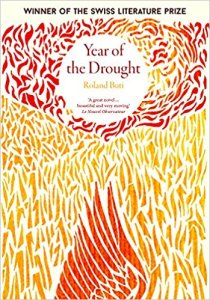 Thirteen-year-old Gus Sutter vividly remembers the summer of 1976 not just for the preternaturally harsh drought, but also for the incidents leading up to the disintegration of his family. Gus, his mother and father, his older sister Lea, and a mentally challenged worker named Rudy live on the family’s farm in the Swiss plateau. Buti’s take on a coming-of-age story is captivating because of the impending sense of doom and ruin that he weaves throughout Gus’s narrative. All of the nature around them foreshadows the sad fate of this family; the crops are burning in the sun, the family dog, Sheriff, keeps fainting and their chickens are dying by the dozens in the heat. The Sutter’s ancient mare, Bagatelle, who never moves from her barn has broken free from her rope and made her way down to the local river to die. And finally, perhaps the most eerie omen of all, is that Gus has found a dove that cannot fly because its fail feathers have been destroyed by a predator.
 I had a couple of very intense discussions recently with two people closest to me about the complicated, enigmatic, confusing concept of love—both filial and passionate.
 The Modiano titles that I’ve read so far, Little Jewel, Suspended Sentences, and this latest novel published by Yale University Press, all have a mysterious yet emotionally languid quality to them. It is both odd and compelling to mix these tones in a narrative but the author does it, quite successfully, in all three of these books.


 The Book Binder's Daughter