Category Archives: French Literature

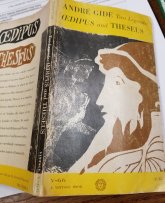
We Each Create Our Own Labyrinth: Theseus by André Gide

When I teach my second year Latin students about ancient heroes, I always have to begin by explaining the distinctions between the modern and ancient concepts of the term hero.  Nowadays the word hero brings to mind first responders saving children from burning buildings,  a good Samaritan saving another person from drowning, and other selfless and kind acts.  Ancient heroes, however, are much more complex, controversial and are prone to carrying out acts of violence even if the end result is for the benefit of the community.  However, more often than not,  they are acting on their own behalf, they are seeking glory and honor and recognition for themselves.  Homeric heroes, for instance, are fighting at Troy for kleos, to be remembered and revered long after they are dead.  Hercules, Theseus and Jason save communities from various beasts and horrible monsters, but their true motivation is for glory and honor that comes with such brave acts.  But the ancient hero also suffers from loneliness, isolation and difficult relationships.

André Gide, in his short story “Theseus” reimagines the myth of the Greek hero Theseus and fills in the gaps where the ancient narratives are lacking.  Gide adeptly captures the pressure to perform that each hero experiences.  In the first chapter, Aegeus, Theseus’s father,  says to his son, “Your childhood is over.  Be a man.  Show your fellow men what one of their kind can be and what he means to become.  There are great things to be done.  Claim yourself.”  After Theseus defeats various, local monsters, he is eager to take on his biggest challenge yet, defeating the Cretan Minotaur.

In Gide’s story, when Theseus lands in Crete he visits the artist Daedalus who explains to him how his labyrinth works and the only way to defeat it.  This passage showcases Gide’s brilliance as a writer, an artist, and even a philosopher:

I thought that the best way of containing a prisoner in the labyrinth was to make it of such a kind, not that he couldn’t get out (try to grasp my meaning here), but that he wouldn’t want to get out.  I therefore assembled in this one place the means to satisfy every kind of appetite.  The Minotaur’s tastes were neither many nor various; but we had to plan for everybody, whosoever it might be, who would enter the labyrinth.  Another and indeed the prime necessity was to fine down the visitor’s will-power to the point of extinction.  To this end I made up some electuaries and had the mixed with the wines that were served.  But that was not enough; I found a better way.  I had noticed that certain plants, when thrown into the fire, gave off, as they burned, semi-narcotic vapors.  These seemed admirably suited to my purpose, and indeed they played exactly the part for which I needed them.  Accordingly I had them fed to the stoves, which are kept alight night and day.  The heavy gases thus distributed not only act upon the will and put it to sleep; they induce a delicious intoxication, rich in flattering delusions, and provoke the mind, filled as this is with voluptuous mirages, to a certain pointless activity; ‘pointless,’ I say, because it has merely an imaginary outcome, in visions and speculations without order, logic or substance.  The effect of these gases is not the same for all of those who breathe them; each is led on by the complexities implicit in his own mind to lose himself, if I may so put it, in a labyrinth of his own devising.

An interesting commentary for the 21st century where many are caught up in a labyrinth of their own choosing, a labyrinth composed of people and things that induce a “delicious intoxication” and are “rich in flattering delusions.”

Daedalus’s advice to Theseus is to keep hold of the thread that Ariadne will give to him and not let it go so she can pull him out of the labyrinth.  But the hero, who is used to fighting his own battles, doesn’t want to be tethered to anyone, especially a woman.  When he arrives in Crete, Ariadne throws herself at him and he views her as a silly girl whom he can use and toss aside.  Ancient heroes, in general, have a very hard time with women; they do not take well to marriage, settling down, domesticity.  In addition to Theseus and Ariadne, the relationships between Jason and Medea, Hercules and Megara end badly.

Gide, however, does linger on the story of one, special woman who is able to captivate Theseus precisely because she poses a challenge for him, the Amazon Antiope.  Theseus says of her, “An accomplished runner and wrestler, she had muscles as firm and sturdy as those of our athletes.  I took her on in single combat.  In my arms she struggled like a leopard.  Disarmed, she brought her teeth and nails into play; enraged by my laughter (for I, too, had no weapons) and because she could not stop herself from loving me.  I have never possessed anyone more virginal.”

Each person in the Theseus-Ariadne-Minotaur myth has his or her own unique point of view.  But, in the end, there really is no happy ending for any of them, is there?

This book has greatly piqued my interest in reading more Gide.  This slim volume that was sitting on my shelf also contains Gide’s Oedipus story, another interesting hero to explore.  Maybe in another post…


8 Comments

Filed under Classics, French Literature

Raised to the Pitch of Incandescence: Memoirs of a Dutiful Daughter by Simone de Beauvoir

“Sartre corresponded exactly to the dream-companion I had longed for since I was fifteen; he was the double in whom I found all my burning aspiration raised to the pitch of incandescence,” writes a young Simone de Beauvoir who is about to begin her most famous love affair.   While reading Memoirs of a Dutiful Daughter, the first in a trilogy of very detailed books about her life, I kept thinking that incandescent, intense, and passionate are the perfect words to describe Beauvoir even from a very young age.

At the age of five or six Beauvoir has vivid memories and intense feelings of love and devotion towards the people who are closest to her: her parents, her younger sister and her nanny, Louise.  She believes they are all perfect and can do no wrong and adores her family with an unwavering and almost romantic fervor.   She writes about her earliest years, “I though it was a remarkable coincidence that heaven should have given me just these parents, this sister, this life.  Without any doubt, I had every reason to be pleased with what fate had brought me.”  When she goes to school she throws herself wholeheartedly into her studies and is very proud when she receives praises and rewards for her academic achievements.  And the young Simone’s religious devotion is just as passionate as her love for her family and her interest in learning:

I was very pious; I made my confession twice a month to Abbe Martin, received Holy Communion three times a week and every morning read a chapter of The Imitation of Christ; between classes, I would slip into the school chapel and, with my head in my hands, I would offer up lengthy prayers; often in the course of the day I would lift up my soul to my Maker.  I was no longer very interested in the Infant Jesus, but I adored Christ to distraction.

As she grows older, she gradually loses her faith and questions the double standards for men and women placed on her not only by the rules of religion but also by the demands of the bourgeois society that she has grown up in. She is discouraged from asking any questions about sex and doesn’t realize until an absurdly late age—at least by today’s standards—how conception takes place and she knows full-well that this is ridiculous.  She detests the idea that it is acceptable for young men to sow their wild oats and have a variety of sexual escapades before marriage, but if  a woman does the same thing then she, and her family, are ruined.

Not surprisingly, Beauvoir goes from one extreme to the next—she embraces atheism, openly rebels against her parents, and chooses education and a career instead of marriage and children.  As she is moving towards these things her desire for more and more freedom causes her a great deal of angst and her moods are rather extreme.  She goes, within the space of a page or two, from being in love with life to being in the absolute pits of despair.  She oftentimes quotes the diary she keeps during these years which are filled with grand, melodramatic statements: “I want life, the whole of life.  I feel an avid curiosity; I desperately want to burn myself away, more brightly than any other person, and no matter with what kind of flame.”

In a lot of ways the memoir is  a tragedy about two of the closest people to her throughout her childhood and her teenage years: her older cousin Jacques and her best friend Zaza.  Beauvoir is intermittently in love with her cousin whom she views as a hero, especially in her younger years.  For a time she even thinks that should could marry Jacques, but her feelings about him, like many other things in her life, run to the extremes of love and rejection.  And Zaza she meets when they are young pupils at the same school.  It is touching to see that as the girls get older they become closer friends and confidants.  But neither Zaza nor Jacques are able to break free from yoke and expectations placed on the by bourgeois life.  While Beauvoir is studying at the Sorbonne, living on her own, and meeting Sartre, her cousin and her best friend are swallowed up by their miserable lives.

This volume of the memoir ends just as Beauvoir is about to take up a love affair with Sartre.  The amount of details, the extremes of emotion, the incandescence are, at times, a bit overwhelming—not that I didn’t like her writing, and, in fact, I oftentimes identified with her.    But I think I will take a break because I am in need of something a little more serene at the moment before I resume her story.

11 Comments

Filed under French Literature, Nonfiction

Kisses Come in Several Kinds: Jean-Luc Nancy Parodies Catullus

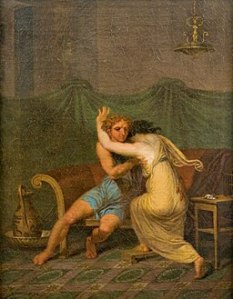
Catullus and Lesbia. Nicolai Abildgaard. 1809. Oil on canvas.

In one of his latest collections to be translated into English, Jean-Luc Nancy’s Expectations  explores the topic of literature and how it intersects with philosophy.  The essays in the book are divided into four categories: Literature, Poetry, Sense, and Parados.  Written over a period of thirty-five years, the themes covered in Expectation are some of Nancy’s favorites that he revisits throughout his career—Reasons to write, narrative, body as theater, Blanchot, etc.

My favorite part of the book is the last section entitled Parados, the Ancient Greek word for the piece of a tragic performance which is sung by the chorus as it enters the stage.  Parados can literally be translated as an “entrance” and this is exactly how Nancy uses texts as an inspiration for writing his own poetry.  He says about his compositions in this section of the book: “They arise, in all cases, from a specific request inviting me, directly or indirectly, to engage with literature.  Or to act as if I had.”

Nancy takes as his parados (entrance) what are arguably the Roman poet Catullus’s most famous Carmina,  5 and 7—the “kisses” poems—for writing this little gem I share today.  I have read it several times over the course of the last week and I see and feel something different—various memories are conjured up—every time I read it.  He takes a simple expression like a kiss and, in what is a deceptively simple poem, he calls our attention to such different contexts (cultural, familial, intimate) in which we have experienced this gesture (translated beautifully by Robert Bononno):


Let him kiss me with his mouth’s kisses
Thus sings the song of songs
Thus his mouth sings and enchants itself
As his demand so his expectation
Not kisses from another mouth
Except from the one she calls

The mouth of the other who loves her
She alone who knows
How to kiss with the kiss of her desire
For in her mouth is held
Completely breath soul perfume
and from her mouth exhaled
The thought the soft weight
Of clinging of joining of
Drinking eating believing oneself

Osculum the little mouth
That advances and arranges the gathered border of two lips
Perhaps quickly on another’s cheek or lips
Kiss kissed surprise surprised
Stolen stolen in this furtive kiss
So soft from the beign so light
Pulp airborne puff
And touch mouth

Visus Allocutio Tactus Osculum
Traced from the linea amoris
Later coming to Coitus
Gift of mercy
Where all mouths are joined
Kiss and kiss one another
Touch and touch one another
Put to bed and put one another to bed

Kisses come in several kinds
Osculum, Basium, Suavium
Kiss of a friend, child, parent
Kiss of peace, of decorum
Or foamy caress
That swells beneath the tongue

Kisses by the thousand like sand
In Libya or grains of wheat
Scattered to the lines of Catullus.

They resonate in several tongues
Their clicks go Kuss, kiss, kyssa
Κυνεω was the Greek name
Sounds like an adoration
Προσκυνεω
Almost a silent Φιλεω
But always mouth addressed
Exclamation of lip and fever
Breath always scent aroma
Breath moved by the soul
That tastes and breathes your own—
Oh, kiss me with your mouth’s kisses.

*Some notes that might help with the Latin and Ancient Greek: Osculum is the Latin, neuter, singular diminutive for mouth, so a “small mouth” is used for the word kiss; basium is the Latin word that Catullus uses to describe the passionate kisses he wants from his lover;  suavium is the neuter, singular form of the Latin adjective meaning ‘sweet’, so suavium is used for kiss to mean a “sweet thing.”  κυνεω is the Ancient Greek word for “I kiss” and Προσκυνεω, which is taken from the verb “I kiss” is “to worship” with the connotation of a respectful kiss.

The book is really worth purchasing for Nancy’s thoughts on literature and philosophy; unfortunately I have not captured his extraordinary prose in this post.  For my more extensive thoughts on some of his other books take a look at my posts on Coming and Listening.

For my translation of Catullus Carmen 5 please see this post (a warning that my interpretation of this poem is not the standard “Carpe Diem” one that is found in textbooks—I received a lot of comments and complaints about my non-traditional reading of this poem):  https://thebookbindersdaughter.com/2016/12/29/let-us-live-and-let-us-love-my-translation-and-interpretation-of-catullus-poem-5/

Leave a comment

Filed under French Literature, Philosophy, Poetry

Entrusting One’s Sleep to Another: Propertius 1.3

Auguste Jean Baptiste Vinchon. Propertius and Cynthia at Tivoli.

Sextus Propertius, a Latin elegiac poet of the Augustan age, is, rather unfortunately, not as well-known as other poets of this era. He was friends with the most famous men of his day including Vergil, Maecenas and Augustus. His talent as an elegist is evident in his four books of poetry which contain 92 poems. I was fortunate enough in graduate school to be in a program that appreciated his work and I took three different classes that focused on this poet. I admit that I haven’t looked at or translated his work in many years, but he seemed like just the thing to suit my mood this week.

In Poem 1.3, he visits his lover, Cynthia, while she is fast asleep in her bedroom. In his amorous and drunken state he is tempted to wake her with a showering of kisses, but holds off for fear of angering her. He, instead, watches her sleep. I find the images of the first 20 lines, comparing her to a sleeping Ariadne and a Bacchante, simple yet sensual and intimate. I offer here my translation of lines 1-20:

Cynthia seemed to me to be breathing softly and quietly while sleeping with her head on her entwined hands; similar to weary Ariadne as she was lying on the deserted shores while Theseus sailed away on his ship; or similar to Andromeda, finally freed from the harsh cliffs, as she was resting during her first sleep; and similar to a Bacchante, exhausted from her continual dances, as she collapses on the grassy banks of the Apidanus. As the slave boys were shaking the torches late into the night, I dragged my feet, drunk with too much Wine, into her room. Not quite yet completely out of my senses, I softly attempted to lie on the bed beside her. Although two relentless gods, Love and Wine, were driving me, seized with a double passion, to disturb Cynthia while she was sleeping and to slip my arm under her and to steal drawn out kisses, I did not dare to interrupt my lover’s rest for fear of incurring the reproaches of her anger with which I am all too familiar. Instead I remained fixed to my spot with my eyes intent upon watching her—I was like Argus, the 100-eyed monster, who kept a vigil over Io with her strange horns.

Propertius’s last few lines, in particular, capture the vulnerability and sensuality of one lover watching another while asleep. It reminds me of the intimacy and trust involved in the experience of sleeping beside another person as described by Quignard in his novel Villa Amalia:

Entrusting one’s sleep to another is perhaps the only real indecency.

To let oneself be watched while sleeping, feeling hungry, dreaming, growing erect or dilated is a strange offering.

She could see his eyes quivering beneath his lids, moving beneath the pale, fragile skin. She could see everything. She could see he was dreaming. Who was he dreaming of? Curiously, she dreamt he dreamt dreams that weren’t dreams of her.

It turned out that he too sighed in his sleep—just like his little daughter.

They both of them gave enormous sighs—like sighs of relinquishment.

Stuart Shotwell’s novel Tomazina’s Folly has, for me, one of the most tender scenes in literature as a woman looks through her lover’s private sketch book in which he has drawn erotic and caring images of his ideal marriage:

As she went on through the book she discovered that a conspicuously recurring theme was that of one spouse watching the other sleep: the wife, sometimes gloriously nude, sometimes fully clothed, either in bed herself or in a chair, watched her husband as he slept; and likewise the husband watching over his wife. There was a tenderness and curiosity and protectiveness in the expression of the watchers, as if they themselves could not sleep, but wanted their spouses to dream undisturbed.

Finally, Jean-Luc Nancy in The Fall of Sleep touches upon the reasons why falling asleep beside another person is an extension of an act of intimacy:

Sleeping together opens up nothing less than the possibility of penetrating into the most intimate part of the other, namely, precisely into his or her sleep. The happy, languid sleep of lovers who sink down together prolongs their loving spasm into a long suspense, into a pause held at the limits of the dissolution and disappearance of their very harmony: intermingled, their bodies insidiously disentangle, however intertwined they can sometimes remain until the end of sleep, until the instant joy returns to them as renewed for having been forgotten, eclipsed during the time of their sleep, where their agile bodies surface again after having been drowned at the bottom of the waters they themselves poured out.

Propertius’s poem ends with his lover waking up, accusing him of being in the embrace of another woman, and complaining that he wasn’t there to fall asleep with her. Cynthia’s wish for him is that he get a taste of his own medicine and that he also experience a lonely night without her in his bed.

8 Comments

Filed under Classics, French Literature, Historical Fiction, Literary Fiction, Poetry

To Love is to Watch Over: Villa Amalia by Pascal Quignard (trans. Chris Turner)

Anne Hidden, Quignard’s protagonist in Villa Amalia,  is a musician and composer who has made a name for herself by condensing, paring down, and reinventing scores of music.  He writes about her process:

What she did was incredibly stark.

She read the score first, far from the piano, then put it back down. She went and sat at the keyboard and—suddenly—delivered the whole thing in the form of a rapid, whirling resume. She didn’t interpret the music. She re-improvised what she had read or what she had chosen to retain of it, de-ornamenting, de-harmonizing, searching anxiously for the lost theme, seeking out the essence of the theme with minimal harmony.”

Quignard’s description of his artist is a metaphor for his own writing. One would expect from this author’s novellas, A Terrace in Rome and All the World’s Mornings, sparse storylines;  but Villa Amalia also requires, even demands, an astute reader, who must seek out the essence of his themes amidst a minimal plot that is beautifully poetic.

Ann Hidden discovers that her boyfriend of sixteen years is seeing another woman, so she decides to jettison and erase anything that has to do with their relationship: she sells the house in Paris they were living in, gets rid of all her furniture, including her three prize pianos, and even throws away her clothes.  We are given small hints in the text that, like her father before her, she deals with grief or loss by running away.  There are few details about Ann’s life and long relationship with Thomas anywhere in the story; as she is fleeing Paris for Italy after the sale of her house, there is a brief, universal description of lovers , one of Quignard’s typical passages, that says nothing yet everything at the same time:

Those who aren’t worthy of us aren’t faithful to us.

This is what she was telling herself in the dream she was having.

It wasn’t their commitment at our sides that led to their fear or laziness, their carelessness or slackness, their regression or silliness.

Sitting in our armchairs, stretched out in our bathtubs or lying in our beds, we see absent, numb people for whom we no longer exist.

We don’t betray them by abandoning them.

Their inertia or their complaining abandoned us before we though of separating from them.

Ann settles on the island of Ischia where she falls in love with a doctor, his young daughter, and a villa by the sea.  But even at this point in Ann’s story, Quignard intervenes to remind us of his style:   “I could fill the months that followed with details.  They were busy, amorous, constructive.  But I shall skip over this.  And more.  And yet more.”

When a tragedy occurs at the villa that deeply affects her, Ann flees yet again, this time back to France to live with an old childhood friend that has helped her through her breakup with Thomas.  The artists in Quignard’s fiction are like wounded animals who, when they are hurt, run and hide and try to nurse their wounds in solitude.  But what sets Ann apart from the other eccentric and emotionally distant artists in A Terrace in Rome and All the World’s Mornings is that Anne, no matter how many times she is hurt, is still open to love.   Time and again she takes a risk and offers her heart to new people in her life.  At the end of the novel, Quignard writes:

In the eyes of children, to love is to watch over.  To watch over sleep, allay fears, give consolation where there are tears, care where there is illness, caress the skin, wash it, wipe it, clothe it.

To love the way one loves children is to save from death.

Not dying means feeding.

I will end with one final thought–that is really more like an unanswerable question— I keep having about Quingard’s fiction.  When I translate and interpret Ovid’s Pygmalion and Daedalus and Icarus myths with my fourth year Latin students, we debate about Ovid’s commentary on role of the artist.  Ovid depicts his artists as lonely men who use their talent, in unnatural ways, to improve their lives but also to flee from others.  Does an artist have to suffer to be creative?  Would these characters be as successful in their art without grief and loss?  What would Quignard say about his artists?

12 Comments

Filed under France, French Literature, Seagull Books
