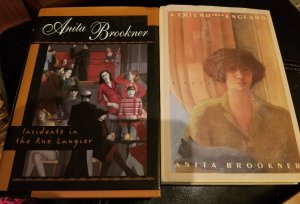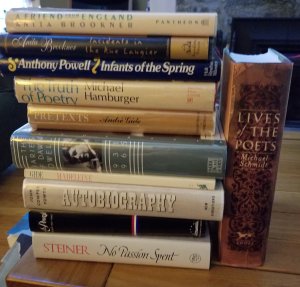
Category Archives: Poetry

Why has Happiness no Second Spring: The Poetry of Charlotte Smith

Spring by Francois Boucher. 1755. The Frick Collection

Some of my favorite discoveries in Michael Schmidt’s Lives of the Poets are neglected and new-to-me female poets.  Schmidt says of one such poet, Charlotte Smith:

Eighteen years after Cowper’s birth, in 1749, a unaccountably neglected poet (half remembered as a novelist) was born.  If Cowper had his hand on the latch of Romanticism, her foot was firmly in the door.  Wordsworth read her: Dorothy Wordsworth recalls his turning the pages of her Elegiac Sonnets, and Other Essays—the fifth edition, for she as popular in her time; and he visited her in Brighton. She treated him politely, introducing him to other women writers in the town.  In London at the end of the century she dined with the young Coleridge.  A recurrent footnote, doggedly represented in anthologies by a sonnet that is wonderful (“Pressed by the moon, mute arbitress of tides”) and to which few attend closely, she is a key poet of the transition to Romanticism.

“Written at the Close of Spring” is one of her elegiac sonnets that showcases her intimate view of nature mixed with personal meditation:

The garlands fade that Spring so lately wove,
Each simple flower, which she had nursed in dew,
Anemonies, that spangled every grove,
The primrose wan, and hare-bell mildly blue.
No more shall violets linger in the dell,
Or purple orchis variegate the plain,
Till Spring again shall call forth every bell,
And dress with humid hands her wreaths again—
Ah! poor humanity! So frail, so fair,
Are the fond visions of thy early day,
Till tyrant passion, and corrosive care,
Bid all they fairy colors fade away!
Another May new buds and flowers shall bring;
Ah! why has happiness—no second Spring?

For her elegiac poems,  like “To Night,” I agree with Michael Schmidt that, “She deserves to be read today.”

I love thee, mournful, sober-suited Night!
When the faint moon, yet lingering in her wane,
And veil’d in clouds, with pale uncertain light
Hangs o’er the waters of the restless main.
In deep depression sunk, the enfeebled mind
Will to the deaf cold elements complain,
And tell the embosom’d grief, however vain,
To sullen surges and the viewless wind.
Though no repose on they dark breast I find,
I still enjoy thee—cheerless as thou art;
For in they quiet gloom the exhausted heart
Is calm, though wretched; hopeless, yet resign’d.
While to the winds and waves its sorrows given,
May reach—though lost on earth—the ear of Heaven!

I’m eagerly awaiting my copy of Smith’s complete collection of Elegiac Sonnets.  I am also tempted to try one of her novels.  If anyone has read any of her novels, please let me know which one(s) you would recommend.


9 Comments

Filed under British Literature, Poetry

Love is Finite, We Grow Old


Pierre Bonnard. A Man and a Woman. 1900.

I put my reading of Schmidt’s Lives of the Poets on hold while on a delightful trip to London this past week. I’ve picked up Schmidt’s narrative again with his insightful description of Andrew Marvell’s poetry:

“Marvell’s verse delivers sharp surprises in part because of its quietness. Surprises emerge, they are insisted on. He seems always to be recognizing significance in what he sees. His whole mind is engaged along with his senses. His intensity is awareness; even as he speaks he is aware of things he might have said. The classics shaped his poems, but scripture is never far away. He doesn’t discharge his poems but launches them quietly.”

“His verse is urbane, detached, with recurrent motifs and words and a recognizable tone that distinguishes it from the work of other Metaphysicals. He has his own themes, too. Wise passivity marks some poems, which leads to closeness with the natural world as his imagination relaxes and receives. Other poems strive for contact through passion or activity, a kind of contact in which individuality is lost in the teeming variety of the world. Underlying these themes is the knowledge that in love or action time can’t be arrested or permanence achieved. A sanctioned social order can be ended with an axe, love is finite, we grow old.”

One of my favorite Marvell poems that came to mind and that I keep rereading because of Schmidt’s writing is “The Definition of Love”

My love is of a birth as rare
As ‘tis for object strange and high;
It was begotten by Despair
Upon Impossibility.

Magnanimous Despair alone
Could show me so divine a thing
Where feeble Hope could ne’er have flown,
But vainly flapp’d It’s tinsel wing.

And yet I quickly might arrive
Where my extended soul is fixt,
But Fate does iron wedges drive,
And always crowds itself betwixt.

For Fate with jealous eye does see
Two perfect loves, nor lets them close;
Their union would her ruin be,
And her tyrannical pow’r depose.

And therefore her decrees of steel
Us as the distant poles have plac’d
(Though love’s whole world on us doth wheel)
Not by themselves to be embrac’d;

Unless the giddy heaven fall,
And earth some new convulsion tear;
And, us to join, the world should all
Be cramped into a planisphere.

As lines, so loves oblique may well
Themselves in every angle greet;
But ours so truly parallel,
Though infinite, can never meet.

Therefore the love which us doth bind,
But Fate so enviously Debra’s,
Is the conjunction of the mind,
And opposition of the stars.


6 Comments

Filed under British Literature, Classics, Poetry

Living Poetic Matter: Catullus Carmen 51

Catullus at Lesbia’s. by Sir Laurence Alma Tadema. 1865

It has been argued that Catullus translates and borrows Sappho Poem 31 to describe the first time he sees his lover Clodia (pseudonym Lesbia) at a party.  In Carmen 51, the Roman poet describes Clodia sitting by an unidentified man (perhaps her husband?) talking and laughing and Catullus is captivated by her presence and experiences what many might call love at first sight (translation is my own):

That man seems to me to be just like a god,
or, if I can get away with saying it,  he is even
better than a god, because of the fact that he
gets to sit near you, and watch you, and continually
listen to your sweet laughter.  But the sight of you and
the sound of your voice destroys all of my miserable
senses; for whenever I lay eyes upon you, Lesbia,
everything else in the world ceases to exist—my
tongue is tied, a delicate flame burns beneath my
limbs, my ears start ringing with a strange sound,
and both of my eyes are covered in complete
darkness.

Louis Zukofsky, in A Test of Poetry, dedicates a chapter of his fascinating little book to presenting different translations of the same passage of an ancient author—Homer, Ovid, Catullus—and provides a brief analysis and commentary on these translations.  For a comparison of different translations of Catullus 51 he presents first Lord Byron’s rendition (1807):

Ah! Lesbia! Though tis death to me,
I cannot choose but look on thee;
But, at the sight, my senses fly,
I needs must gaze, but, gazing, die;
Whilst trembling with a thousand fears,
Parch’d to the throat my tongue adheres,
My pulse beats quick, my breath heaves short,
My limbs deny their slight support;
Cold dews my pallid face o’erspread,
With deadly languor droops my head,
My ears with tingling echoes ring,
And life itself is on the wing,
My eyes refuse the cheering light,
Their orbs are veil’d in starless night:
Such pangs my nature sinks beneath,
And feels a temporary death.

And then Sir Philip Sidney’s translation (1579):

My muse, what ails this ardour?
Mine eyes be dim, my limbs shake,
My voice is hoarse, my throat scorched
My tongue to this my roof cleaves
My fancy amazed, my thoughts dulled
My hearth doth ache, my life faints
My soul begins to take leave.

Zukofsky comments, “Evidently there must be some living poetic matter in the poem of Sappho which has attracted the attention of other poets.” It’s interesting to me that both Byron and Sidney’s poems veer into hyperbole by equating love with death. I don’t think that Catullus meant to push the limits of his metaphor quite that far. His focus on the loss of his senses suggest that love, for him, is a disease, and he is fainting from his symptoms. He’s not dead yet, he’s just “sick!” I also prefer the brevity and repetition of Sidney’s version over Byron’s expanded, rhyming verses.

Zukofsky sums up the reasons why we continue to translation and interpret and identify with poems that are more than 2,0000 years old:

A valuable poetic tradition does not gather mold; it has a continuous life based on work of permanent interest (quality). This tradition involves a knowledge of more than English poetry and the English language. Not all the great poems were written in English. There are other languages.

There are all kinds of measure (metre) in verse. No measure can be bad it if is a true accompaniment of the literal and suggestive sense of the words.


3 Comments

Filed under British Literature, Classics, Poetry

Respice Futurum: Reading Plans for 2019

As I have mentioned in a previous post, The Woodstock Academy where I have had the privilege of teaching Latin and Classics for many years now, is one of the oldest secondary schools in the United States and has a simple yet profound Latin motto which reflects and respects this tradition: Respice Futurum–-translated literally as “Look back at your future.” This is a fitting way for me to think about and discuss my reading plans for the new year since my previous literary patterns help to shape the future.

In 2018 I was not content to read a single book by an author, but instead engaged in what I called literary projects that involved immersing myself in an author’s oeuvre while also reading whatever additional sources were available by or about that author (letters, essays, biography, autobiography, etc.) Here are a few such projects I have in mind, so far, for 2019:

Classics (20th century or earlier):

John Cowper Powys: I am half way through his novel Wolf Solent and think Powys’s writing is brilliant. I am also planning to read his magnum opus A Glastonbury Romance and his autobiography, aptly titled, Autobiography. I’ve ordered a copy of The Pleasures of Literature which should be arriving any day now and I am also thinking of tracking down some of his letters and poetry which, I believe, are all out of print.

Anthony Powell: A Dance to the Music of Time (I have yet to purchase the entire series, but am leaning towards the University of Chicago Press editions). I also found, last week at my favorite secondhand bookshop, the first volume of his autobiography, Infants of the Spring. When the time comes I will complete my collection of his autobiographical books. Finally, I’ve ordered copies of his non-fiction writing, Miscellaneous Verdicts: Writing on Writers and Under Review: Further Writings on Writers, 1946-1990.

Andre Gide: I discovered Gide in 2018 by reading his very short book, Theseus. I’ve put together a pile of his books that I would like to read in 2019 which include: Madeleine, Journals: 1889-1949, Straight is the Gate, If it Die: An Autobiography, The Andre Gide Reader and Pretexts.

H.D.: I saw quite a few posts last year about H.D.’s writing, especially her poetry, and her volume of Collected Poems which I’ve already been dipping into is magnificent. I also plan to read: Palimpsest, Nights, Notes on Thought and Vision, and Bid me to Live. And I’ve ordered copies of The H.D. Book by Robert Duncan and A Great Admiration: H.D./Robert Duncan Correspondence 1950-1961 which should both arrive any day now.
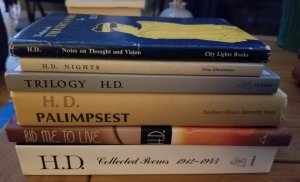
Dawn Powell: I’m especially excited about this author which will be completely new to me. I bought Library America editions of her fiction as well as the volume of her Diaries from Steerforth Press. (Thanks to @deckr_j on Twitter for this discovery).
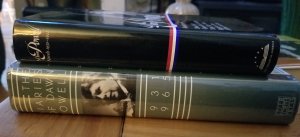
Anita Brookner: I’ve been tempted for a while to try this author because of Trevor from The Mookse and the Gripes who raves about her books. Having collected three of her books I’m ready to dive in: A Start in Life, A Friend from England and Incidents in the Rue Laugier.

W.G. Sebald: I did a Michael Hamburger reading project this year and discovered that he was also a translator of Sebald. I would like to read all of Sebald’s fiction in the order that they were written and published. I haven’t bought any of his books yet, though, because I would like to research which editions and translations would suit me best.

Other possible books that are sitting on my shelves awaiting my attention include the six volume set of Proust’s In Search of Lost Time I received for Christmas, Uwe Johnson’s Anniversaries, Alexander Herzen’s massive autobiography, Casanova’s 12-volume memoir, and Musil’s The Man Without Qualities. I was thinking it might be a good idea to choose one of these as a summer reading project, but there is no way I could get to all of them! I would also like to explore Flaubert, whose Sentimental Education particularly captivated Kafka, and the last George Eliot novel I have yet to read, Romola.

Contemporary:

Giorgio Agamben: The few books I read by him in 2018 captivated my attention due to his discussion of words and language. I am especially excited that Agamben has quite a backlog of translations published by Seagull Books that I have yet to read. I’ve also acquired Profanations, Karman and his magnum opus, Homo Sacer. I will slowly work my way through his shorter pieces before I even think about cracking open Homo Sacer.

Sergei Lebedev: His previous two novels, Oblivion and The Year of the Comet, are brilliant. I am eagerly awaiting The Goose Fritz from New Vessel Press which will be published in March.

Claudio Magris: I have yet to finish his book Journeying from Yale Press and I will also add to my piles his new book, Snapshots, translated for the first time in English and also published by Yale Press.

Kate Zambreno: Her Book of Mutter was intriguing and I am looking forward to her new book due out in April entitled Appendix Project: Talks and Essays

Clarice Lispector: The Besieged City is due out in April. Even though she is a 20th century author, this is a new translation published by New Directions.

I will also catch up on some of the publications from the Cahiers series which are always a delight. And, finally, I have my eye on new releases from Seagull Books, Fitzcarraldo Books, & Other Stories (publishing Gerald Murnane this year) and New York Review of Books which I won’t list here. But all of these publishers are wonderful if you are looking for interesting contemporary authors, literature in translation, or reissued classics.

Poetry:

In 2018, I’ve read more poetry than any other year and would like to continue that into 2019. I always enjoy the variety of publications from Ugly Duckling Presse. I’ve also been tempted by flowerville to explore Emily Dickenson which I haven’t picked up since studying her in school. My intention is to also read Schmidt’s Lives of the Poets and Hamburger’s The Truth of Poetry to enhance my understanding of and appreciation for different types of poets and poetry.

Of course, all of this is subject to change based on weather, mood, alignment of the planets, attention span, etc.

What is everyone else excited to read in 2019?

40 Comments

Filed under American Literature, Autobiography, British Literature, Essay, French Literature, Italian Literature, New York Review of Books, Poetry, Seagull Books

An Insatiable Craving for Books

“One unquenchable longing has the mastery of me, which hitherto I neither would nor could repress; ’tis an insatiable craving for books, although, perhaps I have more than I ought.” —Francesco Petrarch

I had the chance today to visit one of my favorite bookstores in New England.  Located in a small, shoreline community, it actually has five different locations spread throughout the town.  I only managed to visit two of the five locations today and even that took me a few hours.  The main store is a large, old farmhouse with a series of barns on the property, all filled from floor to ceiling with books.  None of the barns are heated so it was a bit rough going on this cold, wet day.  But, in the end, (even though I was cold and drenched and looked like a wet poodle) it was totally worth the trip.  Here is my haul:

Poetry:

I’ve become quite fond of collecting the Library of America editions—they look rather handsome on one’s shelves. I have been making a concerted effort to read more American authors, so this LOA edition of 17th and 18th century poetry was a great find. I was also pleased to add more Michael Hamburger, Marianne Moore and C.P. Cavafy to my poetry collection. The “Diaries of Exile,” translated from the Modern Greek and published by Archipelago Books, was also a pleasant find.

Essays:

I was so thrilled to find another George Steiner collection of essays that I don’t own, as well as another volume of Joseph Epstein essays.  The J.M. Coetzee essays look intriguing—topics include Cees Nooteboom, Translating Kafka, Robert Musil’s Diaries, Dostoevsky and the essays of Joseph Brodsky, just to name a few.  I already owned the paperback version of Michael Schmidt’s Lives of the Poets, and I was excited to upgrade to this hard copy edition that is in perfect condition.  Lord’s The Singer of Tales is a nice addition to my classics library as it deals with the orality of Homeric poetry.  And finally, the Hamburger and Colin Wilson essays will be a nice additions (or editions)  to my shelves.

Autobiography and Letters:

I am especially excited about this stack.  I’ve already started reading John Cowper Powys’s novels and I upgraded to this hard copy edition of his Autobiography.  My Powys reading project will take me into 2019.  I am also planning an Anthony Powell reading project for the new year and was exited to find this first volume of his autobiography.  I own a copy of the first volume of Flaubert Letters which is in tatters, so not only did I get a copy in perfect condition but I also found a copy of the second volume.  Finally, I found a wonderful early, hard copy edition (Yale Press, 1933, collected by Thomas J. Wise) of Robert Browning’s Letters.

Fiction:

Finally, I did manage to buy some fiction as well.  I want to read Anita Brookner in the new year.  I already have one of her books sitting on my shelves so these two will be nice additions.

Bonus: Today’s Book Mail

I’ve also become captivated by Andre Gide’s writing and these two gems arrived today in the mail.  (I thought my family was going to have a fit when I arrived home with all of these books and there were also more books waiting for me in the post!)  I am planning to explore Gide in the new year and I am also awaiting a copy of his Journals which I have already sampled and am eager to dive into.

As Petrarch says, perhaps I have more than I ought?

It doesn’t matter, I will still collect books and read them anyway.

(For what it’s worth I did cull three large bags of books from my shelves today so, overall, I broke even.)

25 Comments

Filed under American Literature, Autobiography, British Literature, Classics, Essay, Letters, Literary Fiction, Nonfiction, Poetry