Category Archives: Poetry

How to Pick up Women: Advice from Ovid’s Ars Amatoria

Yesterday I shared on Twitter a pick up strategy from Ovid that Pound alludes to in the Cantos.  I’ve had a request to translate a few more.  Here are some of my favorites:


From I.139-142.   A great place to pick up a pretty girl is at the Circus:

Sit as close as possible to your lady, nothing is forbidden in the Circus.

Press your leg as close to her leg as possible at all times.

With those close seats there are no boundaries, even if it annoys you,

So you pretty much have to touch your lady when you’re in the Circus.


From I.153-156.  And if she has a wardrobe malfunction make sure you help her:

If the hems of her skirt are dragging on the ground,

then gather them up and lift them from the dirt, and immediately,

as a reward for your attentiveness—if she allows it, of course—

your eyes will get a good look at her bare legs.


From 1.455-458. A little love note is always a good thing:

Go ahead and send her a letter with flattering sentiments,

and use this to explore her feelings and to test the road first.


From 1.505-506 and 509-510. Look presentable but not too metro:

Don’t curl your hair with the curling iron,

and don’t pluck all the hair from your legs.

A man is more handsome when he is not so fussy

about his appearance; Theseus, for example,

carried off Ariadne without spending any time

on his looks.

11 Comments

Filed under Classics, Poetry, Uncategorized

Odi et Amo: Half-Light, The collected poems of Frank Bidart

I have been voraciously reading an incredible amount of excellent poetry lately.  I’ve been sharing some of my favorite passages on Twitter, but I thought I would do a short series on the blog of my favorite collections.  Frank Bidart’s Half-Light, Collected Poems, which includes work spanning the years 1965-2016 was recommended to me by two of my favorite literary Twitter accounts.  It is one of those few collections of poetry that one can read from cover to cover in a few sittings.  I devoured it over the course of this past week.  My favorite parts of this volume are his series of poems based on Catullus 85 as well as his longer, Hour of the Night, series of poems.

It is always difficult for me to teacher Catullus Carmen 85 because, as his shortest poem—a mere two lines—the temptation is for students to translate it quickly and move on.  But there are so many layers to this deceptively simple poem (translation is my own):

I hate you and I love you.

You may be wondering why I feel this way.

I have no idea.

But that’s how I feel.

And I. am. tortured.


Odi et amo. quare id faciam, fortasse requiris?

nescio, sed fieri sentio et excrucior.

Bidart’s brilliant strategy for interpreting this poem is to compose a series of his own two line verses that each focus on a different aspect of the original.

The first version, Catullus: Odi et Amo is:

I hate and love. Ignorant fish, who even

wants the fly while writhing.

The et in italics is subtle yet striking.  And the image of a fish writhing on the fly—why would the creature still want the very thing that is killing him?

Bidart’s second version is Catullus: Excrucior which shifts focus to the end of Catullus’s Carmen-–that all powerful Latin word, excrucior,  which literally means to be crucified:

I hate and—love.  The sleepless body hammering a nail nails

itself, hanging crucified.

The entire first phrase is italicized in this iteration, and the addition of pause with the em dash adds additional emphasis to these different emotions.. Finally, the images of the nails emphasize the “crucifixion.”

Bidart’s trilogy of poems ends with Catullus: Id Faciam, which brings us back to the middle of Catullus poem.  He has no idea why he feels such conflicting emotions:

What I hate I love. Ask the crucified hand that holds

the nail that now is driven into itself, why.

The addition of the relative pronoun is unique in the final poem; the person who is causing such conflicting emotions lingers in the background.  But there is also the hint of self-inflicted torment, the hand that nails its own nail.  All three versions are slightly different, but bring to our attention various pieces of the original. At the same time they all fit perfectly into Bidart’s work as a whole through the theme of desire.

There is a bonus interview with Bidart at the end of this edition in which he describes his series of The Hours of the Night poems:

The myth behind the series of poems is the Egyptian “Book of Gates,” which is inscribed on the sarcophagus of Seti I.  Each night during the twelve hours of the night the sun must pass through twelve territories of the underworld before it can rise again at dawn. Each hour is marked by a new gate, the threshold to a new territory.

Each poem in the series is an hour we must pass through before the sun can rise again.

The collection contains four Hours of the Night stories and a fifth was published this past summer in The Paris Review.  My favorite is the Second Hour of the Night for which Bidart uses as inspiration Ovid’s story of Myrrha from the Metamorphoses.  Once again, Bidart’s focus is on desire and how much control we have or don’t have over this powerful emotion.

Ganymede; Apollo and

Hyacinthus; Pygmalion; Adonis avenged upon

Venus; the apples that Atalanta found irresistible, —

fate embedded in the lineaments of desire

(desire itself helplessly surrounded by what cannot be

eluded, what

even the gods call GIVEN,—)

In addition to italics, words and phrases in all caps are typical of Bidart’s entire collection.  As he continues the story of Myrrha, Bidart emphasizes the pity and helplessness of this young girl who falls in love with her own father.  Like Ovid, Sade and Yourcenar who also write very delicately about matters of incest, Bidart’s character is young and sheltered; she loves what she knows and what is familiar and she wants nothing else:

four steps forward then

one back, then three

back, then four forward—

…but you have lied about your

solace, for hidden, threaded

within repetition is the moment when each step

backward is a step

downward, when what you move toward moves toward

you lifting painfully his cloak to reveal his

wound, saying, “love answers need...”

The gods—well, all those except the Furies—abandon Myrrha.  She prays in the end not to be alive and not to be dead—she can’t even face others in the afterlife.  As a result she is turned into the Myrrh tree:

Aphrodisiac. Embalmers’ oil. “insistence of

sex, faint insistent sweetness of the dead undead.)

Sacred anointment oil: with wine an

anodyne. Precious earth-

fruit, gift fit for the birth and death of

prophets:—no sweet thing without

the trace of what is bitter

within its opposite:—

…MYRRH, sweet-smelling

bitter resin.

These last lines are a chilling echo of the contrasting emotions we feel from the Odi et Amo poems.

3 Comments

Filed under American Literature, Poetry

Respice Futurum: Reading Plans for 2020

It’s time for my annual Respice Futurum post about possible books and reading projects I am interested in for the new year.  I’ve explained in previous years that the institution where I have had the privilege of teaching Latin and Classics for many years now is one of the oldest secondary schools in the United States and has this simple yet profound Latin motto which reflects and respects this tradition: Respice Futurum–-translated literally as “Look back at your future.” This is a fitting way for me to think about and discuss my reading plans for the new year since my previous literary patterns help to shape what I will read moving forward.

There are authors this year whose work I’ve just started to explore and am very eager to continue reading.  These include Camus, Gabriel Josipovici, Fanny Howe, Jorge Luis Borges, Peter Handke and Milan Kundera.  I’m also thrilled to read Boris Dralyuk’s new translations of Tolstoy’s short stories out now from Pushkin Press. I never got around to reading Michael Hamburger’s The Truth of Poetry which I really want to read this year.

I also continue to be heavily influenced by the wonderful readers I’ve met on literary Twitter and in the blogging community.  Some of the recommendations from these friends include Sandor Marai, Hélène Cixous, E. Arnot Robertson and Thomas Mann. I’ve also been inspired to tackle some challenging books such as  Broch’s Death of Virgil, Joyce’s Ulysses, Pound’s Cantos, and to reread Milton’s Paradise Lost.  Thanks to my literary friends, you know who you are!

I usually like to have a least one long-term reading project every year.  While I was reading Proust over the summer I decided it would be interesting to read a series of books on music.  So far I have Adorno’s Essays on Music, Gide’s Notes on Chopin, Quignards The Hatred of Music and Ian Penman’s It Gets Me Home.  There is a thread on Twitter with a wonderful list of additional recommendations as well and I have ordered several more books for this project.

And finally, here is a list of my favorite presses who have new/forthcoming books I am very excited to purchase and read:

Carcanet:

Fifthy Fifthy: Carcanet’s Julilee in Letters, ed by Robyn Marsack

Forgetting by Gabriel Josipovici

Prose by Yves Bonnefoy, ed. by Stephen Romer and Anthony Rudolf

The Woman Who Always Loved Picasso by Julia Blackburn and with illustrations by Jeff Fisher

Contra Mundum:

Microliths by Paul Celan, tr. Pierre Joris

Chapter on Love by Miklós Szentkuthy

Seagull Books:

The Red Scarf by Yves Bonnefoy, tr. Steven Romer

Invitation to the Voyage: Selected Poems and Prose by Charles Baudelaire, tr. Beverley Bie Brahic

Mysterious Solidarities by Pascal Quignard, tr. Chris Turner

There is also a new Jean-Luc Nancy forthcoming from Seagull translated by Charlotte Mandell

New York Review of Books:

Abigail by Magda Szabo, tr. Len Rix

The Criminal Child: Selected Essays by Jean Genet, tr. Charlotte Mandell and Jeffrey Zuckerman

Margery Kempe by Robert Glück

The Magnetic Fields by by André Breton and Philippe Soupault, tr. Charlotte Mandell

The End of Me by Alfred Hayes

Pushkin Press:

The Marquise of O by Henrich Von Kleist, tr. Nicholas Jacobs

And the Earth Will Sit on the Moon: Selected Stories by Nikolai Gogol, tr. Oliver Ready

I will also keep my subscriptions to A Public Space, Poetry, and maybe Ugly Duckling Presse for poetry books and chapbooks.

Of course, all of this reading is subject to mood, the weather, the alignment of the stars, etc.  I never really know where my reading adventures will take me.  At least this gives me a few ideas…

Happy New Year!


15 Comments

Filed under British Literature, Cahier Series, Classics, French Literature, German Literature, New York Review of Books, Nonfiction, Poetry, Pushkin Press, Russian Literature, Seagull Books, Short Stories, Tolstoi, Vergil

Communication in the Midst of Solitude: My Year in Reading—2019

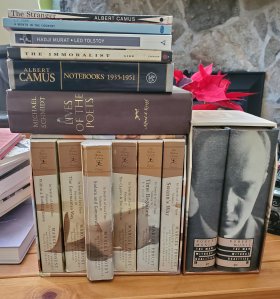
In his essay “On Reading,” Proust writes, “Reading is that fruitful miracle of a communication in the midst of solitude.” I try to make reading plans every year but I honestly never know where the year will take me. This year was a stellar year for me as far as these “communications in the midst of solitude” were concerned. But my communications were carried farther by the literary connections for which I am very grateful—-readers of my blog, my fellow bloggers, and, the one that has the most influence on my reading, the wonderful literary community on Twitter. I know that social media is a tough place for some—I’ve seen many come and go. But my little corner of book Twitter has proven to be a wonderful place this year and I would like to thank all of those who have commented, connected, supported my reading on this blog and on Twitter.

Fiction and Non-Fiction:

Wolf Solent by John Cowper Powys

Deadlock by Dorothy Richardson

Sentimental Education by Gustave Flaubert, trans. by Robert Baldick

A Question of Upbringing by Anthony Powell

The Fox and Dr. Shimamura by Christine Wuunicke, trans. by Philip Boehm

Ovid’s Banquet of Sense by George Chapman

The Odyssey by Homer, trans. Emily Wilson

Romola, by George Eliot (I only got half way through this one. Not the right time for this book for me.)

The Rhyme of the Ancient Mariner, Samuel Taylor Coleridge, illus. by Dore

The Completion of Love by Robert Musil, trans. Genese Grill

The Temptation of Quiet Veronica by Robert Musil, trans. Genese Grill

The Confusions of Young Torless by Robert Musil, trans. Shaun Whiteside

Thought Flights by Robert Musil, trans. Genese Grill

The Voyage Out by Virginia Woolf

Landscapes by John Berger

The Man Without Qualities Volumes 1 and 2 by Robert Musil, trans. Sophie Wilkins

A Month in the Country by J.L. Carr

Hadji Murat by Tolstoy, trans. Kyril Zinovieff and Jenny Hughes

Contre-Jour by Gabriel Josipovici

In Search of Lost Time by Marcel Proust, trans. Moncrieff et al.

The Immoralist by Andre Gide, trans. Richard Howard

The Book of Laughter and Forgetting by Milan Kundera, trans. Michael Henry Heim

Aline & Valcour Volumes 1 and 2 by Marquis de Sade, trans. Jocelyne Genevieve Barque and John Simmons

Notebooks 1935-1951 by Camus, trans. Philip Thody and Justin O’Brien

The Stranger by Camus, trans. Matthew Ward

Lives of the Poets by Michael Schmidt (I have been reading this book for half the year and have about 300 pages left to read which I will finish in the final week of the year.)

Poetry:

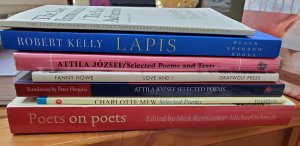
I have read more poetry this year then every before because I have been stopping to read selections from the poets that Michael Schmidt discusses in his book Lives of the Poets. Too many to list here. So listed here are only the collections I’ve read in their entirety:

Poets on Poets, edited by Nick Rennison and Michael Schmidt

A Test of Poetry by Louis Zukofsky

Astonishments: Selected Poems of Anna Kamienska, trans. David Curzon and Grazyna Drabik

Love and I by Fanny Howe

Lapis: Poems by Robert Kelly

Elegiac Sonnets by Charlotte Smith

The Gorgeous Nothings: Emily Dickinson’s Envelope Poems

Selected Poems by Charlotte Mew

The Last Innocence/The Lost Adventures by Alejandra Pizarnik

Selected Poems of Attila Jozsef, trans. Peter Hargitai

The Withering World by Sandor Marai, trans. John Ridland and Peter V. Czipott

The Romantic Dogs by Roberto Bolaño, trans. Laura Healy

I’ve also continued to translate my own selections of Ancient Greek and Latin poetry which I won’t bother to list again. But translating Sappho was a particularly rewarding experience.

And finally, I’ve done posts on the fabulous artwork I’ve had the pleasure of viewing this year. I had the pleasure of seeing the Bonnard exhibit at the Tate Modern, The Blake Exhibit at the Tate Britain, The Ruskin Exhibit at the Yale Center for British Art, and, my favorite, The Troy Exhibit at The British Museum. A stellar year for reading, for poetry and for art all around.

Merry Christmas, Happy Hannukah, Happy Holidays, and Io Saturnalia!

30 Comments

Filed under British Literature, Classics, French Literature, German Literature, In Search of Lost Time, Letters, Literature in Translation, Opinion Posts, Poetry, Russian Literature, Swann's Way, Tolstoi

We are the Convalescents of Experience: The Awakening Goddess by Sándor Márai

The Awakening Goddess

With sunrise she unpicks her secrets.
Aurora awakes,
the young goddess:
the world awakens in the sign of blood,
a wrathful goddess opens her eyes.

We are the convalescents of experience:
poets and women and strong men
who with huddled expectancy lie in wait for the first minute:
we greet the world’s dawns with the chants of those heading off to die.

Softly:
someone is dreaming us,
our beautiful woman-treasures,
our toylike doll-wars,
the clever sawdust in our heads!
Softly!

Our great ships swim for in her dream. A telephone rings.
A train rattles across the prairie. A motion picture rolls in Paris.
Couples unite in hotel rooms: the woman tears her hat off, her dress shreds,
hurry, this is happiness…The diplomat yawns, rubs his nape;
from the swooning blood of a woman a new human cries out. A dog barks;
a hunter contemplates the noontime vapours in the reeds. Kant writes the

Imperative,

Königsberg shakes from bombs. The past determines the future—

Someone screams: tragedy!
the mind responds: twice two is four!
the madman: I’m the king of Mars!
the king: , L’état, c’est moi!
the people: we are the power!
the philosopher: causes give birth to effects!
the love: someone’s upsetting me!
the poet: the world is harmony, this I believe!

Softly:
someone is dreaming us,
with sunrise she unpicks her wrathful secrets,
we’re the passing shades of her bad dream;
let’s not disturb the dreamer’s dream:
the world awakens in the sign of blood.


Someone asked me last week to describe the types of poems I like.  My response: intense, hard hitting, memorable.  Márai’s volume of poetry, The Withering World, suits me perfectly.  (Thanks to literary Twitter’s @Unwise_Trousers for recommending this.)

1 Comment

Filed under Hungarian Literature, Poetry