
 Sappho Fragment 16 (translation is my own):
Some men say that the best thing on this black earth is
a column of horses, others say it is an army of foot
soldiers, and still others say it is a fleet of ships.
But I say that the Best thing on this black
earth is to love someone. It is wholly easy to make this
idea understandable to everyone. For Helen, surpassing
all others in beauty, chose for herself the best man—
he who destroyed all the Majesty of Troy—and she made that
choice without consideration of her child or her beloved parents,
but she was swayed by Love and carried this love far away.
It always seems like a female trait to turn away or to
be light in one’s thoughts. And so now you do not
remember Anaktoria, or so it seems; she whose lovely steps and
whose bright radiance in her face you would like to behold
more than the armies or the hoplites of Lydia. We know that it
is not possible for men on this earth to be completely happy;
We must, however, pray to hold onto our shared memories rather
than to completely forget those experiences.
I have immersed myself in this beautiful and, at times, maddening Ancient Greek fragment for the last two days. I used the longer version of the Ancient Greek text with the last few lines, in particular, reconstructed. I realize this isn’t the standard version with which most are familiar. I see in this poem a stark contrast between male and female, which begins in the first three lines with a primael. Men choose war—cavalries, armies and ships, but women choose love. The best example of this is Helen—she chooses Love in the form of Paris, because, to her, he is the best (aristov).
As the poem concludes, Sappho turns to Anaktoria who left her (some speculate to marry). Sappho, unlike Helen, doesn’t have a choice. But as memory fades the one option for her is to remember their shared experiences. Her beloved, no longer present, can quickly become a case of “out of sight, out of mind”; the poet must make a conscience choice to remember their time together. But as her memories fade and her lover is no longer present, she can just as easily choose to let her go.



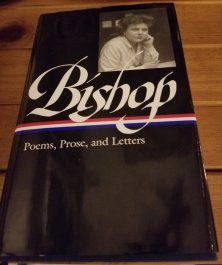 On a recent trip to New York City I found a pristine copy of the Library of America edition of Elizabeth Bishop’s poems, prose and letters. I have been absorbed in reading her poetry and essays ever since I discovered this little gem. I have been sharing some of her poems on Twitter during the past week and I thought I would share a few more of my favorites ones here.



 The Book Binder's Daughter