
In the preface to the Penguin modern classics edition of Borges’s Labyrinths, Andre Maurois writes, “His sources are innumerable and unexpected. Borges has read everything, and especially what nobody reads any more: the Cabalists, the Alexandrine Greeks, medieval philosophers. His erudition is not profound—he asks of it only flashes of lightning and ideas—-but it is vast.” This vast erudition is evident in the forty pages of essays that are included in this collection. Argentine, Chinese, Spanish, German, American and ancient literature are all matters of interest for Borges. His essay on Kafka’s sources was a particular favorite. We always think of Kafka as being so unique, in a literary vacuum, without any predecessors. But Borges argues that Zeno’s paradox against movement, the writings of Kierkegaard and Brownings “Fears and Scruples” all contain hints of which authors Kafka had in his mind.

The short stories felt to me like a journey through the labyrinth of Borges’s mind which was always thinking about language and literature. At the center of almost every story is a book or a series of books or a library. The Garden of Forking Paths begins with, “On page 252 of Liddell Hart’s History of World War I you will read that an attack against the Serre-Montauban line by the thirteen British divisions (supported by 1,400 artillery pieces), planned for 24 July 1916, had to be postponed until the morning of the 29th.” The rest of the story is told by a Chinese professor of English named Dr. Yu Tsun. Tsun is a spy who has been found out and is trying to get a message to his German commanders before he is executed. Tsu takes the train to the village of Ashgrove where he meets up with an imminent Sinologist who happens to be studying Tsu’s famous ancestor. Ts’ui Pen was a civil servant of the Emperor but gave up his position to write an immense novel and to construct a labyrinth. The Sinologist realizes that Ts’ui Pen’s labyrinth, his “garden of forking paths” was the novel itself: “In all fictional works, each time a man is confronted with several alternatives, he chooses one and eliminates the others; in the fiction of the almost inextricable Ts’ui Pen, he chooses—simultaneously—all of them. He creates, in his way, diverse futures, diverse times which themselves also proliferate and fork.” I suspect that the literary threads running through Borges’s mind might be described in the same way.
My favorite story in the collection, which I have read and taught with before, is The House of Asterion which gives a background story that is compassionate and sympathetic to the Minotaur. He is lonely and isolated and wants to be put out of his solitary misery. Borges is influenced by Ovid’s Theseus and Ariadne story, but gives us the Minotaur’s point of view. He tells us that every nine years a group of men enter his home but fall and die on their own. One of them prophesies Asterion’s escape:
Since then my loneliness does not pain me, because I know my redeemer lives and he will finally rise about the dust. If my ear could capture all the sounds of the world, I should hear his steps. I hope he will take me to a place with fewer galleries and fewer doors. What will my redeemer be like? I ask myself. Will he be a bull or a man? Will he perhaps be a bull with the face of a man? Or will he be like me?
The morning sun reverberated from the bronze sword. There was no long even a vestige of blood.
‘Would you believe it, Ariadne?’ said Theseus. ‘The Minotaur scarcely defended himself.’James E. Irby, the editor of this edition, sums up Borges’s writing in this collection best: “His fictions are always concerned with processes of striving which lead to discovery and insight; these are achieved at times gradually, at other times suddenly, but always with disconcerting and even devastating effect.” The effect is just as striking for the reader as for the characters in Borges’s stories.

 This long weekend in May in the United States is a federal holiday which is meant to remember and honor veterans who have died while serving in the United States Armed Forces. As I was reading Robert Musil’s essay entitled, “Twilight of War” I thought it sad and ironic that this holiday is called Memorial Day because we really do not seem to learn or retain the lessons that history has taught us. What Musil wrote during the early part of the 20th Century is not only relevant, but good advice today for my country in particular:
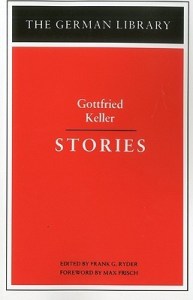 In the Foreword to the German Library (Volume 44) edition of Gottfried Keller’s stories Max Frisch writes:
 Suah’s greatest strength as a writer lies in her ability to take what at first appears to be disjointed images and scenes and weave them together into a singularly beautiful story. The attic room, the poetry, the woman on the platform he longs to kiss are all connected in her character’s mind with a meditation on time and space: “When was it that he had last kissed a woman so ardently, his lips as passionate as when they pronounced poetry? In that city or this, at the house of his acquaintance or on the platform in the north station, while waiting for the train.”


 The Book Binder's Daughter