
I received a review copy of this title from NYRB. This collection was published in the original Hungarian in 2003 and this English version has been translated by Ottilie Mulzet.
x
My Review:
 I was debating whether or not to even attempt any type of review of this collection of poetry. The layers of imagery, references and allusions to great figures like Kafka, Walter Benjamin, Attila József and Erno Szép could never be unpacked or fully explained in one short review. But I found the language and images of Borbély’s poetry so moving that I decided I had to at least attempt to put some thoughts together in order to bring more attention to this Hungarian poet and his tragic end.
The collection of free verse poems is divided into five interwoven themes and each poem in a cycle is given a sequential number. The cycle of poems entitled “Letter” are based upon quotations extracted from diaries and letters of Kafka. Borbély puts his own unique touch on each of Kafka’s quotations by rewriting and reworking them. Kafka is the perfect figure through which to mix images of Berlin, with city he had a connection through Felice, and Hamlet, whose indecision is reminiscent of Kafka’s own hesitancy about his relationship. The first in the series of “Letter” poems is the perfect blend of elements that include Kafka, Berlin, and reticence:
[Letter I]
At last I have a picture of you as I
once saw you. Of course not as when
I glimpsed you
for the first time, without your
jacket, bareheaded,
your face unframed by a hat. but
when
you disappeared before my eyes into
the entrance of the hotel,
as I walked beside you, and nothing
as of yet
connected me to you. Although I
longed only
for the strongest tie to bind me to
you. Tell me,
don’t your relatives pursue you
altogether too much? You shouldn’t
have had time for me, even if I had
come
to Berlin. But what am I saying? Is
this how I want
to bring my self-reproaches to an
end? And finally,
wasn’t I right not to have come to
Berlin? But
when shall I see you? In the
summer? But why
precisely in the summer, if I shan’t
see you at Christmas?
The second cycle of poems specifically deals with the city of Berlin and Berbely’s visit there in the mid-1990’s. Each poem in this series is given the name of a specific place or a district in Berlin. Poem titles include, “Naturhistorisches Museum,” Herrmann Strasse,” and Heidelberger Platz.” The translator, in his afterword, points out that it is in this series of poems where Benjamin’s Arcades Project is heavily alluded to. The poems are a blend of Borbély’s personal experience of Berlin with that city’s complicated history. In “Krumme Lanke” he opens with a memory of the “last days of the Reich” and proceeds to tell a story of two soldiers who ignore their superior’s orders and have a clandestine meeting. The poem then shifts without a transition to the poet’s own memory of walking next to Krumme Lanke: “Our conversation/ was more of a remember, a/revocation of all that had happened earlier. Like a/ film being played in reverse.” There is a deep sense of wandering that pervades these poems as he visits train stations, various seedy parts of the city and the natural history museum and uses these places as starting point with which to reflect on Berlin’s past and the poet’s present.
The series of poems entitle “Epilogue” do not appear to have any specific references to famous authors and are the most deeply personal and reflective. These poems only appear at the beginning and end of the collection and show us a writer who is battling many emotional demons:
[Epilogue II]
For the dead are expected to know the
path
above the precipice of the everyday.
When
they leave the lands of despair, and
depart
towards a kingdom far away and
unknown,
which is like music. Swelling, a solitary
expectation everywhere present. this
music
does not break through the walls. It
taps gently.
It steals across the crevices. Silently it
creeps,
and cracks open the nut hidden deep
within the coffer.
Next, are a series of poems entitled “Fragment” which are all addressed to an unnamed receiver. There is a deep sense of not only hesitation but also loneliness in these poems. He begins the first “Fragment” poem:
Yes, I could express it simply by
saying
that our conversation left in me a vacant space. Since then, every
day contains this space.
Of the five different categories of poetry, the “Fragments” are my favorite because Borbély’s own voice, pain, and struggle come through most clearly. I found a line from “Fragment III” especially chilling and laden with foreshadowing: “My need is for those who will know/how/all of this will end.” Borbély tragically takes his own life in 2014at the age of fifty and there are hints throughout his poems that allude to his melancholy.
The final category of poems are called “Allegory” and are a mixture of philosophical observations which still maintain obvious references to Kafka. The first poem in the collection especially evokes images of Kafka and his complicated relationship with his father:
[Allegory I]
The pierced heart, in which lovers
believe, recalls me to
my task. Always have I desired
to be led. My father’s spirit instruc-
ted me
in ruthlessness. what he missed in
life, he now
in death wished to supplant. I did
not
find my upbringing to be a comfort.
the spirit of our age is for me
excessively
libertine. My scorn is reserved for
the weak.
Finally, a word must be said about the afterward which was beautifully written by the translator. It serves as a thorough introduction to Borbély’s life, literary influences, and style of writing but is also a fitting eulogy for this gifted poem whom the world lost too soon.
About the Author:

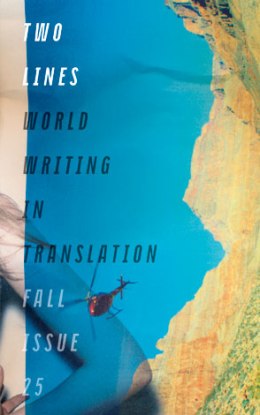 A few times a year I find a book that I rant and rave about and recommend to everyone I know. I become rather obnoxious with my comments that gush with praise. I am giving you fair warning that Two Lines 25 is one of those books. Literature translated from Bulgarian, Chinese, French, German, Hebrew, Japanese, Korean, Norwegian, Russian and Spanish are all contained within the pages of this 192-page volume. I am in awe of the fact that the editors crammed so many fantastic pieces into one slim paperback (there I go gushing again.) This is the type of book that everyone needs to experience for him or herself; but I will attempt to give an overview of some of my favorite pieces.
 CJ Evans is the author of A Penance (New Issues Press, 2012), which was a finalist for the Northern California Book Award and The Category of Outcast, selected by Terrance Hayes for the Poetry Society of America’s New American Poets chapbook series. He edited, with Brenda Shaughnessy,
  Georg Trakl died from a cocaine overdose while recovering from a nervous breakdown in a military hospital during World War I. He was awaiting the proofs of Sebastian Dreaming which he had requested despite the fact that the publication of this collection was put off indefinitely because of The Great War. Sebastian Dreaming was the second, and final collection that was prepared for publication by the author himself and James Reidel’s translation of this collection is the first that has appeared in English in its entirety. Although some of the poems have appeared in other collections, the translator has argued that these poems ought to be read as part of this single collection, which is what Trakl himself intended.
 Georg Trakl was born in Salzburg, Austria. As a teenager he gravitated towards poetry, incest and drug addiction and published his first work by 1908, the year he went to Vienna to attend pharmacy school and became part of that city’s fin-de-siècle cultural life. He enjoyed early success and published his first book in 1913. A year later, however, he died of a cocaine overdose due to battle fatigue and depression from the wartime delay of his second book.
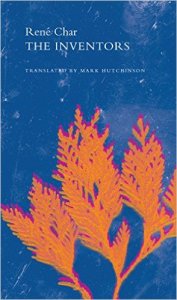 As I first read the introduction to this volume, the piece of information that stuck out to me immediately was that Char was influenced by Heraclitus, the pre-Socratic philosopher. Char imitates Heraclitus’ style of short and puzzling works as well as his theme of strife. The pre-Socratic course I took in graduate school was one of the most challenging yet rewarding courses in my career as a student. The Ancient Greek, which is fragmentary, is difficult to put together and even more difficult to analyze when one has come up with an English version. Heraclitus acquired the nickname “The Obscure” for good reason. I had the same feelings, both of obscurity and difficulty, as I was reading Char.
 He spent his childhood in Névons, the substantial family home completed at his birth, then studied as a boarder at the school of Avignon and subsequently, in 1925, a student at L’École de Commerce de Marseille, where he read Plutarch, François Villon, Racine, the German Romantics, Alfred de Vigny, Gérard de Nerval and Charles Baudelaire.
 This collection of poems begins with a series of short pieces that have some common themes, the most striking of which is a reflection on memory. The poems appear to the reader as snippets of the poet’s memory as he is trying to reflect on pieces of his life that have passed. Sometimes the images are very clear and precise. For example, the end of one poem reads:



 The Book Binder's Daughter