Category Archives: Nonfiction

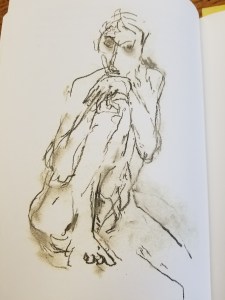
Freed from the Block: Bento’s Sketchbook by John Berger

I had intended to finish the year reading a stack of German literature that I have acquired, but instead I have fallen down a John Berger rabbit hole.  Bento’s Sketchbook is one of those titles recommended by a friend with the very strong assertion that it is something I “must read.”

We know from different sources that the philosopher Baruch (Benedict or Bento) Spinoza (1632-1677) enjoyed drawing and that he always carried his sketchbooks around with him, none of which seemed to have survived.  When John Berger’s friend gives him a virgin sketchbook, he decides, “This is Bento’s!”  Berger begins to making drawings “prompted by something asking to be drawn.”  He comments about the development of his book, “As time goes by, however, the two of us—Bento and I—become less distinct.  Within the act of looking, the act of questioning with our eyes, we become somewhat interchangeable.  And this happens, I guess, because of a shared awareness about where and to what the practice of drawing can lead.”

For Berger a cluster of irises, a painting in the National Gallery, a friend’s old bicycle all become subjects for drawing and reflection.  The stories and the sketches are simple yet fascinating.  My favorite, one of the more abstract and philosophical pieces, begins:

Around her is a block.  The block is invisible because totally transparent.  Nor does the block restrict her movements.  Is the block what separates Being from Becoming? I don’t know, for this is happening where there are not words.

Normally, we face words frontally and so can read them, speak them or think them.  This was happening somewhere to the side of language.  Any frontal view of language was impossible there.  From the side I could see how language was paper thin, and all its words were foreshortened to become a single vertical stroke—I—like a single post in a vast landscape.

The task was to dismantle the block—to take it apart and lift it off piece by piece.  She allowed this to happen—No. Active and Passive have merged together.  Let us say: She happened this to herself with the utmost ease.  I was with her in what she (we) were doing.

The lovers slowly begin to dismantle the block starting from her head.  The task is tiring, he says, and he needs to take breaks.  But when he is tired he also embraces her and they gain strength from one another.  Finally the block is completely gone and:

She was there whole, looking exactly as she had at the beginning, capable of the same actions and no more, having the same name, the same habits, the same history.  Yet, freed from the block, the relations between her and everything which was not her had changed.  An absolute yet invisible change.  She was now the centre of what surrounded her.  All that was not her made space for her.

This passage of Berger’s pulled my thoughts toward Ovid’s version of the Pygmalion myth.  Although it is oftentimes viewed as a commentary about unattainable standards of beauty, I’ve always seen more in the Latin than this message.  Pygmalion, in his daily solitude, uses the utmost care and love to gently coax a form out of the white block of marble that will become his beloved: “Pygmalion is amazed at his creation and drinks up the with his heart the passionate fires of her simulated body.”  Both stories demonstrate the power that love, kindness, and, most importantly, patience can have on our relationships.


3 Comments

Filed under Art, British Literature, Nonfiction

Ruins in Motion: My Essay for the 2017-2018 Seagull Books Catalogue

Every year Naveen Kishore and the talented staff at Seagull Books craft and publish a catalogue filled with original pieces of literature, art and translations from around the world.  This year they have truly outdone themselves.  Each of the 1500 catalogues has an different and individual cover.  I have included some photos of my copy, Naveen’s provocation for this publication and my response which is included in the catalogue.

Naveen’s Provocation:

It begins slowly. Always in slow motion. With just the right pink and gold that the light designer ordered for the occasion. The script as perfect as can be. The director’s genius about to be rewarded. The performance about to, yes, begin. The curtain to rise. An audience seated. Resigned to what they know will unfold. Without change. Like having seen it happen before. Not here. Not at this particular venue. Or at this play. In their lives. They know the drama. The realism. The script. The dance. The moves. They know. Everything.

Drop a bomb. Set off a device. Blow to smithereens. Unless you do. The image that springs to mind when you see a ruin is gentle. Floating into the mind. Sideways. Almost horizontal. A sense of having fallen into something slowly. Over time. Perhaps what you labeled love. Like leaves. The kind that autumn sheds. Those. Very. Leaves. I guess things fall into gentle ruin. They do. That is the phrase I seek. The familiarity of the tragic. The kind that is foretold in every gesture you create. For yes. It is creative. This ruination. How else would it ever have got to the stage it has. One of utter helplessness. Descending into an aesthetically designed. Even overwhelming. Futility.

Embraces like coagulated clots growing. Thickening. Clinging walls. Solidifying layers settling. In an intense and congealed setting for decay to blossom. Into? Dare I say it? Decay. Decay yet to be born so unborn decay. The kind that waits. Waiting to grow. Flourish. Thrive. Open. Unfolding decay. One that matures into full blown decay. Without containment or known boundaries. Therefore spreading. This decay. Decay as epidemic. A decay of ruination. Utter and complete. Defeated decay. Gnawing at the foundations. Of what? Of what once. Was. Eroding decay. Relentless and unceasing. And yes. A committed decay.

A twilight turned yellow.

My Response:

Ruins. From the Latin noun Ruina—meaning a forward, uncontrollable movement, a headlong rush; a headlong fall, a downward plunge; a collapse. Derived from the Latin verb ruo—to move swiftly, to hurry on. Ruins are in motion, moving forward, taking on new shapes and forms. The story of Dido and Aeneas in Vergil’s Aeneid comes to mind as I think about ruins in motion.

Dido and Aeneas are both refugees—Latin profugus, to have a forward flight, also a word in motion— attempting to escape the ruins of their respective cities and their former lives. My favorite character in Vergil’s Aeneid, even going as far back as my first attempt at translation of this epic in high school, has always been Dido. The love of her life, her husband Sychaeus, was murdered by her brother Pygmalion in order to steal Sychaeus’s fortune. Pygmalion’s greed and violence forces Dido to flee Tyre and abandon her former, happy life. Similar to the boatloads of homeless Syrians we see today also escaping the Levant, Dido travels across the Mediterranean to the shores of North Africa where she attempts to build a new home, a new kingdom in Carthage.

In the midst of trying to put her life and her city back together Aeneas, a refuge himself from Troy, lands on her shores after his fleet encounters a violent storm at sea. Interestingly, Vergil describes this storm as caeli ruina, “the ruin of the sky.” The poet’s first mention of ruina comes at the very moment when fate drives Aeneas towards Dido and the Carthaginian shores. But we know that as soon as the curtain opens on this epic, that the fate of Dido is not a happy one; her encounter with Aeneas, though at first passionate and mutual, will be the source of her final and tragic ruin. Vergil poignantly, repeatedly and sympathetically calls Dido infelix, “unlucky.”

At first, Dido’s story shows us that ruins can be a good thing, an excuse or an impetus for a new start. When Aeneas arrives on the shores of Carthage he witnesses a new city being built under the careful guidance of Dido. Vergil is a master at juxtaposing` the old and the new, destruction and rebuilding, ruins and rebirth. Aeneas eagerly surveys the building of Dido’s new city—the harbor, walls, a theater and a temple are all works in progress that draw the Trojan’s amazement and wonder. Vergil compares the workers, the builders of this city to a hive of bees, filling the cells of their hives with honey and getting the necessary materials for their work. Fervent opus, redolentque thymo fragrantia mella. “Their work glows; the fragrant honey is scented with thyme.” This is Dido’s second chance, her spring, her twilight. Or is it?

Amidst the construction of her new city, Vergil inserts an opposing image of ruins in the form of a fresco in the temple at Carthage. As Aeneas tours this temple he views some of the most horrific scenes from the fall of Troy: the allotment of the Trojan women, the body of dead Hector being dragged around the walls by Achilles and the murder of Priam in the midst of his own palace. Aeneas weeps openly at the sight of these reminders of his ruined city.

Dido, the very symbol of these opposing themes—ruins and rebuilding– is standing at the center of this temple and it is significant that this is the first place where she encounters Aeneas. The frescoes of Troy become not only a reminder of the ruins Aeneas has fled, but they also serve as a foreshadowing of the destruction that Dido will inevitably suffer as a result of her encounter with Aeneas. Ruins in the Aeneid are always in motion.

In her kindness, compassion and empathy Dido opens up her home as a place of solace. She and Aeneas share the miserable fate of refugees escaping ruins and searching for a better place to put back together their lives: Non ignara mali miseris succurrere disco. (Not ignorant myself of misfortune, I know how to help those who are also miserable.) Dido runs to help Aeneas—the verb succurrere in Latin literally translates as “running to help”— thereby setting her ruin in motion; her expeditious offer of succor is paid for with her destruction. Aeneas and Dido engage in a physical relationship and settle into a “marriage” of sorts that is fittingly blessed by the goddess of marriage, Juno, and the goddess of love, Venus.

Jupiter, however, the Paterfamilias of the universe and the god who represents fate sends an urgent reminder to Aeneas of his mission to found and build a new Troy. And so Aeneas readies his men and his fleet to leave Carthange and set sail for Italy which act of utter abandonment has a devastating effect on Dido. Vergil’s description of Aeneas flight from Troy is striking; he hurries the preparations for his journey like a man on fire: Idem omnes simul ardor habet; rapiuntque ruuntque: /Litora deseruere; latet sub classibus aequor. (The same fervor grabbed hold of all the men at the same time; they rushed and they carried themselves away, and they deserted the shores; the sea lie hidden under so many ships setting sail.)As Aeneas is rushing away (ruunt, verb form of ruina) from Carthage, Dido sits atop her own funeral pyre, plunging herself headlong into Aeneas’s sword and into her final destruction.

As early as Book I, Vergil alludes to the difficulty of founding a new city in the wake of the utter destruction of Troy: tantae molis erat Romanam condere gentem (It was such a monumental task to found Roman.) Molis here is another building word in Latin also meaning “rocks, a pile of materials.” Troy had to fall, many hardships had to be suffered and Dido had to be left behind and abandoned in order for Rome to be built; the ruins of Troy rise again in the form of the greatness and splendor of Rome.

Vergil’s message not only applies to the ruins from which the grandeur of Rome came about, but also to the circumstances under which human life and fate operate. Something bigger and grander and stronger have the potential to emerge out of the ruins that befall us in life; and Vergil reminds us that, yes, there have to be sacrifices, ruina (ruins) like the death of Dido, that are strewn along the roads that lead to something better.

Anthony from Time’s Flow Stemmed has also written a beautiful and profound response:

A Contribution to Seagull Books’s Annual Catalogue

Joe from Roughghosts has written a deeply personal and poetic response:

The cost of words: My submission to the 2017-2018 Seagull Books catalogue

14 Comments

Filed under Nonfiction, Seagull Books

The Early Essays of Virginia Woolf

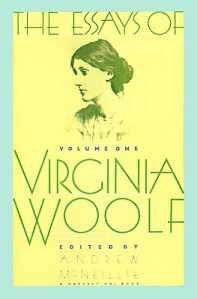
I am making my way through the first volume of Virginia Woolf’s essays that she composed between the years 1904 and 1912.  In “The Decay of Essay Writing” (1904) she gives us some insight into her motivations behind writing her personal essays.  She teaches us how to read her essays with a bit of a rant about the way in which writers in her day have approached the personal essay:

But though it seems thus easy enough to write of one’s self, it is, as we know, a feat but seldom accomplished.  Of the multitude of autobiographies that are written, one or two alone are what they pretend to be.  Confronted with the terrible spectre of themselves, the bravest are inclined to run away or shade their eyes.  And thus, instead of the honest truth which we should all respect, we are given timid side-glances in the shape of essays, which, for the most part, fail in the cardinal virtue of sincerity.

I wonder what Woolf would think of the personal essays written  in the 21st century?  In the age of the Internet and social media, have we gone too far the other way with oversharing?

Much of the first volume is taken up with reviews of books that Woolf did for the Guardian and the TLS in order to earn some money.   I am in awe of the wide range of books that she read.  Just as a sample, for the year 1905 she read:

Fiction: The Golden Bowl by Henry James; Arrows of Fortune by Algernon Gissing; A Dark Lantern by Elizabeth Robins.

Non-fiction: The Women of America by Elizabeth McCracken; The Thackeray Country by Lewis Melville; The Dickens Country by F.G. Kitton.

Even when her reviews are not flattering, she still makes me want to read a book.  I want to read what she read and replicate her literary experience.  Her review of James, for example, is not positive but she still inspires me to take another look at his novels:

‘She rubbed with her palm the polished mahogany of the balustrade, which was mounted on fine iron-work, eighteenth-century English.’ These are trivial instance of detail which, perpetually insisted on, fatigues without adding to the picture.  Genius would have dissolved them, and whole chapters of the same kind, into a single word.  Genius,  however, is precisely what we do not find; and it is for this reason that we do not count Mr. James’s characters among the creatures of our brains, no can we read his books easily and without conscious effort.  But when we have made this reservation our praise must be unstinted.  There is no living novelist whose standard is higher, or whose achievement is so consistently great.

12 Comments

Filed under British Literature, Classics, Nonfiction, Virginia Woolf

A Lover’s Discourse—Fragments by Roland Barthes

I had a couple of very intense discussions recently with two people closest to me about the complicated, enigmatic, confusing concept of love—both filial and passionate.
There were two comments, each from a different person, that didn’t sit well with me and that I keep returning to over and over in my mind:

“You can dislike someone but still love that person.”

And

“You can love someone but feel no affection for that person.”

I did what I always do when I am struggling with something:  I read a book.  Roland Barthes A Lover’s Discourse is what jumped out at me from my shelves.  Divided into fragments, each chapter of sorts deals with different terms related to love—absence, affirmation, body, languor, tenderness, etc.  The author’s thoughts come from reading Goethe, Plato and Nietzsche, from conversations with friends and from his own life experiences.  Wayne Kostenbaum in the introduction to the translation describes Barthes writing: “Barthes never dissertates.  Barthes never stops to explain.  He is happy to make the lightest of allusions—a lodestone such as “Nietzsche” or “Descartes” in the margins—but to leave the reference unplumbed.”

I will share a few passages that were especially striking to me:

From the fragment entitled “Atopos”:

The atopia of Socrates is linked to Eros (Socrates is courted by Alcibiades) and to the numbfish (Socrates electrifies and benumbs Meno).  The other whom I love and who fascinates me is atopos.  I cannot classify the other, for the other is, precisely, Unique, the singular Image which has miraculously come to correspond to the specialty of my desire.  The other is the figure of my truth, and cannot be imprisoned in any stereotype (which is the truth of others).

Yet I have loved or will love several times in my life.  Does this mean, then, that my desire, quite special as it may be, is linked to a type?  Does this mean that my desire is classifiable?  Is there, among all the beings that I have loved, a common characteristic, just one, however tenuous (a nose, a skin, a look), which allows me to say: that’s my type!

From the fragment entitled “At Fault”—fautes/faults

Any fissure within Devotion is a fault: that is the rule of Cortezia.  This fault occurs whenever I make any gesture of independence with regard to the loved object; each time I attempt, in order to break my servitude, to “think for myself” (the world’s unanimous advice), I feel guilty.  What am I guilty of, then, is paradoxically lightening the burdern, reducing the exorbitant load of my devotion—in short, “managing” (according to the world); in fact, it is being strong which frightens me, it is control (or its gesticulation) which makes me guilty.

From the fragment entitled “The Ghost Ship”—errance/errantry:

How does a love end?—Then it does end?  To tell the truth, no one—except for the others—ever knows anything about it; a kind of innocence conceals the end of this thing conceived, asserted, lived, according to eternity.  Whatever the loved being becomes, whether he vanishes or moves into the realm of Friendship, in any case I never see him disappear: the love which is over and done with passes into another world like a ship into space, lights no longer winking: the loved being once echoed loudly, now that being is entirely without resonance (the other never disappears when and how we expect).  This phenomenon results from a constraint in the lover’s discourse: I myself cannot (as an enamored subject) construct my love story to the end: I am its poet (its bard) only for the beginning; the end, like my own death, belongs to others; it is up to them to write the fiction, the external, mythic narrative.

From the fragment entitled “Special Days”—fete/festivity:

The Festivity is what is waited for, what is expected.  What I expect of the promised presence is an unheard-of totality of pleasures, a banquet; I rejoice like the child laughing at the sight of the mother whose mere presence heralds and signifies a plenitude of satisfactions: I am about to have before me, and for myself, the “source of all good things.”

For the Lover, the Man-in-the-Moon, the Festivity is a jubilation, not an explosion: I delight in the dinner, the conversation, the tenderness, the secure promise of pleasure: “an ars vivendi over the abyss.”

Barthes’ book of fragments is one that I will dip into over and over again and find something new, fresh, and thought-provoking each time.

Finally, Books, Yo has written a fabulous personal reflection about love in his review of Thérèse and Isabelle by Violette Leduc.  Please do take a look at his blog and his fantastic writing.


8 Comments

Filed under French Literature, Nonfiction, Philosophy

The Bookshop and The Beach: My Vacation to Maine

Harding Books on Route 1 in Wells, Maine

My family and I went on our annual summer vacation this year to Kennebunk Beach in Maine. This has been our favored destination for the past few years and I thought I would say a few words about my favorite bookshop in Maine and my recent finds there. Harding’s Rare and Used Books is located one town adjacent to Kennebunk, in Wells, Maine on Route 1.  The staff is kind, friendly and very knowledgeable.  I was told by the employees that they buy books every day and their owner, a very nice gentleman named Douglas, also buys books from auctions and dealers.

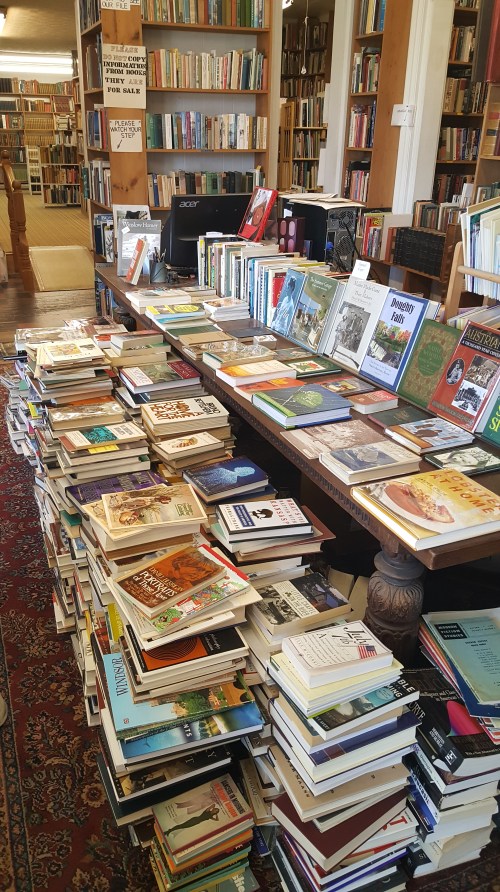
One realizes this is a serious bookshop when, upon opening the front door, one encounters two gigantic piles of their newest acquisitions.  It took me a while to sift through these piles, but my patience was greatly rewarded by finding a first edition of I, Claudius by Robert Graves. I also dug out a copy of Susan Sontag’s Illness as Metaphor and William H. Gass’s Reading Rilke from these piles.


The rest of the store is like a maze with rooms of various shapes and sizes piled with books from floor to ceiling.  Harding’s has a wide variety of first editions as well as signed books and they also have  the largest selection of books about New England that I have ever encountered.  I found a first edition copy of Within the Harbor by Sara Ware Bassett, a New England author whose books are set in two Cape Cod villages that she created.  This is an interesting little find that makes visiting this store so much fun.

A view of part of the hard copy fiction books at Harding’s


I spent most of my time in the Latin and Ancient Greek, Poetry and Classic Fiction sections.  Among the classic fiction books, I found two titles to add to my ever growing collection of New York Review of Books classics and I also found five Virago Modern Classics to add to my shelves.

My haul from Harding’s

The Latin and Ancient Greek section had a nice selection of Loebs as well as ancient authors in translation.  My favorite find was a dual language edition of Oedipus by Sophocles with an introduction by Thornton Wilder.  The illustrations in this edition are also quite interesting.

I also found in the Ancient Civilization section a copy of Michael Grant’s book on Nero which is in mint condition; not only is it an excellent introduction to this enigmatic and misunderstood emperor (and my favorite), but it also contains some gorgeous color plates to go along with the text.

Among the poetry books I found a hard copy edition of the Collected Poems of W.H. Auden that was only $5.00.  I have to say that all of the books at Harding’s are very reasonably priced, including the first editions and signed books.

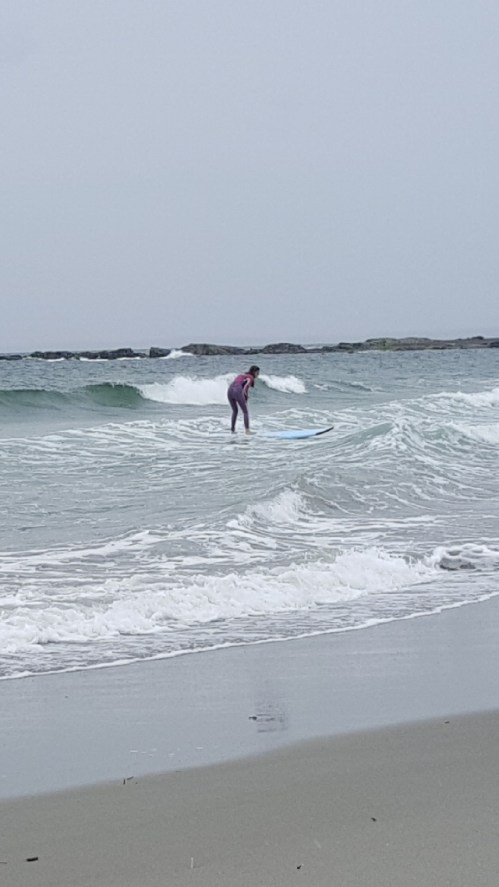
But I didn’t spend all of my time in the bookshop.  I also enjoyed the beach very much, worked on my tan and did a little swimming even though the water was quite chilly.  My daughter did some surfing (I only watched and took some pictures.)  My beach reads were Henry Green’s Party Going and Clarice Lispector’s Agua Viva—more thoughts on those to come.

Surfing at Kennebunk Beach

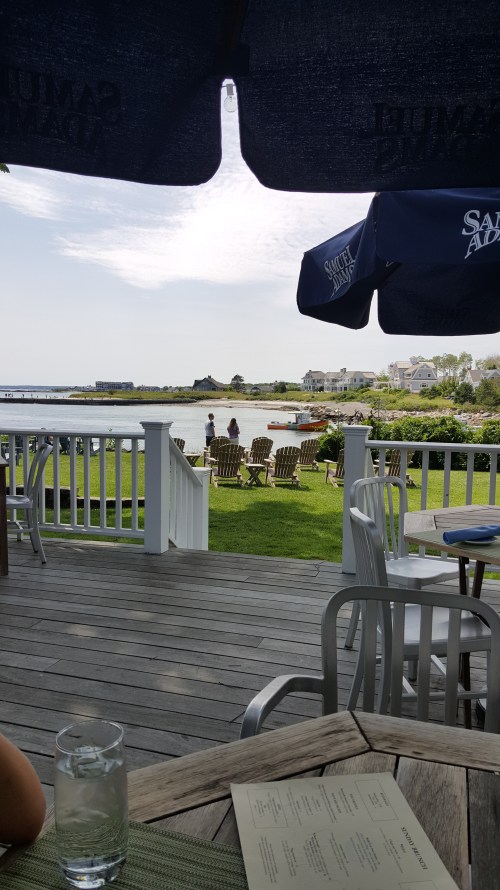
Finally, we had some truly fabulous meals in Kennebunk and Kennebunkport.  One of our favorites is David’s KPT in Dock Square whose selection of raw oysters is spectacular and decadent.  It is no surprise that the seafood dishes, in particular, are wonderful no matter the restaurant.  I will spare everyone pictures of my food as well as a picture of myself wearing one of those goofy lobster bibs.  The picture below is a view we had during Sunday Brunch.

Where have you spent your holidays this summer?  Have you found any interesting books or bookshops?

15 Comments

Filed under British Literature, Classics, History, New York Review of Books, Nonfiction, Opinion Posts, Poetry, Travel Writing