Category Archives: Historical Fiction

Review- Lorna Doone: A Romance of Exmoor by R.D. Blackmore

This book has been on my “to read” list for a long time.  When someone, whose opinion I highly value, recommended that I read the book, I immediately picked it up.  My only regret is that I waited so long to finally read Lorna Doone.  Originally published in 1869, R.D. Blackmore sets his book on the wild frontier of Exmoor, England where the Crown does not have complete control over the land.

My Review:

Lorna DooneThe plethora of interesting aspects to this book makes it difficult to decide about which ones to write.  John Ridd is a young boy living in the wilds of western England in the 17th century, when his father is murdered by a band of outlaws who torment, bully and rob the farmers and good people of Exmoor.  The Doones occupy their own outlaw village and not only survive by robbing those around them but also prey on the their neighbors for sport.  When John Ridd’s father stands up to these bullies, he is murdered and leaves behind his widow, Sarah Ridd, his prosperous farm, and his three children.

Although John grows up without the guidance of his father, he develops into an upstanding, strong and honest man.  Never for a minute does John harbor resentment or a grudge against the Doones.  If he had let hate and vengeance consume him, his heart would never have been open to receive the love of Lorna Doone and he would have missed out on the greatest love of his life.  What impressed me most about these star-crossed lovers is that they refuse to let the sins of their families ruin their happiness.  R.D. Blackmore has created a character in John Ridd that is an enduring moral example for all ages.

Despite unfortunate circumstances and countless obstacles, the zeal of John and Lorna’s love never wanes.  John’s thoughts and actions are always carried out with his love in mind, no matter how long it has been since he has beheld her face.  This romance is an interesting lesson for those of us in the 21st century who are accustomed to social media, Skype, text messaging, and any number of gadgets that keep us constantly in connection with one another.  We do not have to wait days and weeks for a letter from a loved one or travel on an extended and tedious journey to reach our beloved.  In this age of “out of site, out of mind,” would a man and woman be so patient, faithful and enduring in their love as John and Lorna?

oare_church

Oare Church in Exmoor

The plot is also one of the factors that made me devour this book.  The reader is kept in constant suspense wondering whether or not the evil villians, in the form of the Doones, and especially their leader Carver Doone, will get their just deserts.  Will anyone come to the aid of the innocent people of Exmoor to stomp out these bullies, or will John Ridd and his neighbors take matters into their own hands?  John’s cousin, Tom Faggus, who is also a highway robber, has many interesting parts in the storyline.  Although, as a counterexample to the Doones, he robs the rich and gives the spoils to the poor.  R.D. Blackmore kept me guessing the various fates and outcomes of his characters until the very end.

R.D. Blackmore’s tale has the perfect formula for a great novel: romance, adventure, a bucolic setting, and indelible characters.  The tale of John Ridd has truly captured my heart and like all my favorite classic books, it will be one of those that I will reread again and again.
2 Comments

Filed under Classics, Historical Fiction, Literary Fiction

Guest Post: Author Carol M. Cram talks about Medieval Italy


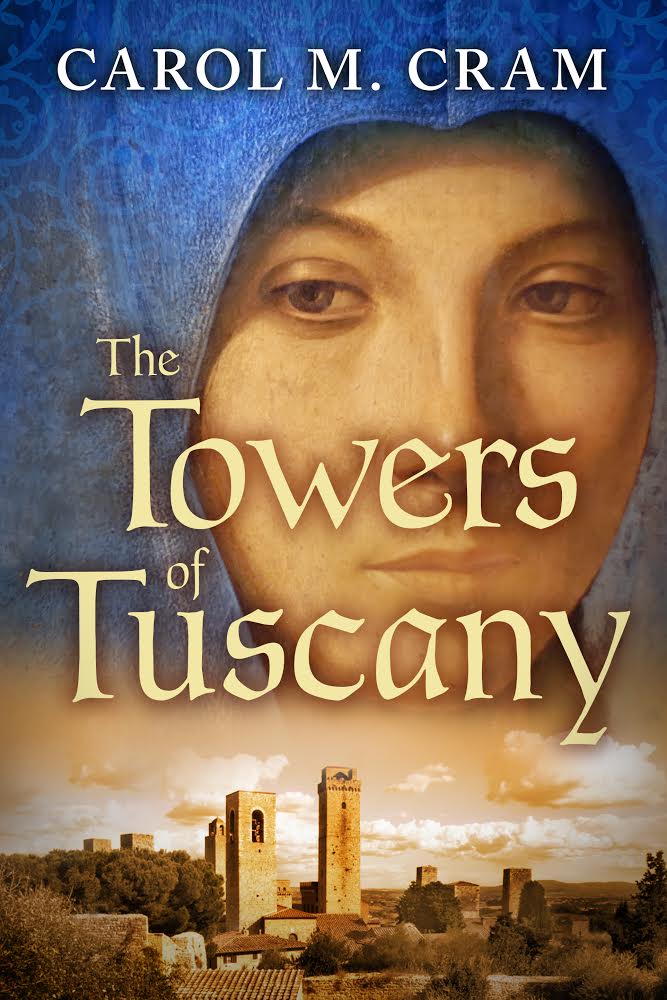
I invited author Carol M. Cram to talk about why she chose to set her historical fiction novel The Towers of Tuscany in Medieval Italy.  Here is her response:

01_The-Towers-of-Tuscany-CoverI have visited Italy several times over the past two decades and was particularly drawn to the medieval towns such as San Gimignano, Montalcino, and Siena. At night when the streets were quiet, I was easily transported back to a time when life was short and harsh and at the same time produced so much wonderful art.

The Italian Renaissance, with its Michelangelo and da Vinci and a host of other artists is considered—and rightly so—as the era that produced some of the world’s most magnificent art. However, I was intrigued by the art that preceded that Renaissance and led to it. In the 14th century, painters were struggling with perspective, experimenting with fresco and tempera (no oil paints yet!), and starting to explore non-religious themes. I wanted to dig deeper into the psyche of a 14th century painter to reveal their passions and their struggles.

I decided to make my painter a woman because I was also intrigued by the fact that, so far as we know, none of the art produced during the first half of the 14th Century when the novel takes place, was produced by a woman. The key phrase here is “so far as we know.” In the 14th Century, painting was very much a family affair. The master who ran a workshop passed his knowledge down to his sons and brothers and nephews. But what if a master had no sons or brothers or nephews? What if he had only a daughter—a bright, precocious child fascinated by the tools of the painter’s trade? I contacted an expert in art of the period, the wonderful Dr. Efrat El-Hanany who later became my historical advisor on the novel, and asked her if it was plausible that a man could teach his daughter how to paint. She thought that yes, the idea was plausible. That’s all I needed to dive in and invent Sofia Barducci—a young, spirited woman who makes a very big mistake.

Unlike most girls of her era, Sofia is allowed to marry a man who she chooses. Unfortunately, she chooses wrong. How many women have made that mistake? Sofia’s plight, although rooted in the prejudices and customs of 14th Century Tuscany, is not so different from the plight of many women all over the world in our own time.  Sofia wants to follow her passion and paint. The world and her own choices conspire against her.

Regarding my research for “The Towers of Tuscany,” I was very fortunate to have a translation of “Il Libro dell’Arte, an amazing handbook for painters written in the late 14th Century by Cennino d’Andrea Cennini. Most of the references to painting techniques come for Cennin’s wonderful book. In it, he advises painters in all aspects of the trade—from grinding pigments to making sizing from goat’s hooves to painting haloes. Cennini acknowledges the need for the painter to have “passion and enthusiasm” for the work. A painter in the 14th Century did not consider himself an “artist” as we would use the word. A painter was a craftsman who served a long apprenticeship to learn the skills of his trade. Painters were also businesspeople who, with their painted panels and frescoes, made important contributions to religious and secular life in the 14th Century.

Thanks so much to Carol for her thoughtful response.  Carol is on tour with her book until January.  Click on the tour banner below to see reviews of her book.

Towers Tour Banner


2 Comments

Filed under Author Interviews, Historical Fiction

Historical Fiction Book Giveaway

In order to show a little appreciation to my faithful readers, I am giving away three different historical fiction novels, all of which are hardcopy versions.  The entry is very easy.  Just leave me a comment below and let me know which book you are interested in winning and reading!  Open to US/Canada only. I will pick a winner of each book at the end of the week.  Winners will be notified via email and have 48 hours to respond.  Happy Holidays from The Book Binder’s Daughter!

Book #1: Neverhome by Laird Hunt

NeverhomeConstance is a farmer from Indiana who wants to see more of the world outside of her rural farm. She decides that fighting in the Civil War will give her this chance. Her husband Bartholomew would not be a good soldier and so she decides that she will make the sacrifice and march off to war and fight for her country in his place. She puts on the Union uniform, hides her feminine qualities and in this disguise travels down south to the heart of the battleground where she takes on the name of Ash Thompson.  Read my full review here


Book #2: Juliet’s Nurse by Lois Leveen

Juliet's NurseI enjoy stories that are retellings of classics, so I was delighted when I had the chance to review a book that narrated the Romeo and Juliet story from the nurse’s point of view.  This story begins with Angelica and her husband Pietro who are peasants living in 14th century Verona.  Although they are poor, they love each other dearly and have had a wonderful life raising 6 boys.  When the plague claims the lives of all of their children, they think they will never have the chance to rear another.  Read my full review here.


Book #3: Gutenberg’s Apprentice by Alix Christie

Gutenberg's ApprenticeWe all take for granted the written word, especially in the 21st century when not only are physical books readily available but so are books in electronic form.  In Muniz, Germany in the 15th Century an Elder by the name of Gutenberg had a crazy and obsessive idea of finding a way to mass produce books instead of having them laboriously copied by hand through scribes.  Peter is one such scribe and is recalled from his scribal duties in Paris at a monastery by his foster father.  Peter’s foster father, with whom he has been living since the age of 10, wants Peter to become Gutenberg’s apprentice as Gutenberg works on his new printing press.  Fust, Peter’s adoptive father is a merchant who has heavily invested in Gutenberg’s new invention.  Read my full review here.

18 Comments

Filed under Giveaways, Historical Fiction

Review: Hand of Fire by Judith Starkston

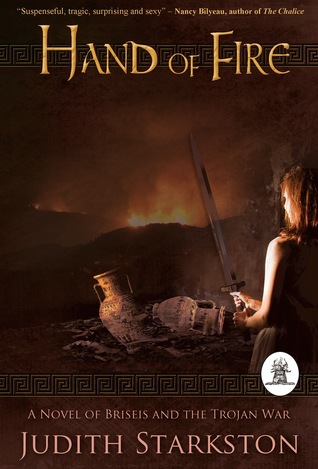
The Iliad is one of my favorite pieces of literature from Ancient Greece. So I was thrilled when I received an advanced copy from the author of The Hand of Fire, a novel set during the Trojan War.

My Review:
perf6.000x9.000.inddIn Homer’s Iliad, Achilles, the best of the Greek warriors, has taken as one of his prizes the woman Briseis.  Briseis is captured from the city of Lyrnessos which Achilles and the Myrmidons raided in their search for prizes, livestock and anything else to help sustain their war effort.  The character of Briseis in the Iliad says very few words.  But what would it have been like to be a princess of a prosperous Bronze Age city and then taken captive by a Greek warrior?  How was Briseis treated by Achilles and did she actually love him?  These are the questions that Judith Starkston attempts to answer in her new novel Hand of Fire.

When Hand of Fire begins, Lyrnessos is a thriving city and Briseis has been raised by her mother to be a priestess and a healer who will serve her people.  She is betrothed to the prince of Lyrnessos and she will someday become the city’s queen.  The aspect of the novel that impressed me the most is the amount of research that the author did pertaining to Bronze Age homes, religious customs, and society.  I have read the Iliad countless times, and I have even translated it in from the original Ancient Greek.  Hand of Fire let me see the world of the Trojan War in a way in which I had never fully imagined. Continue reading

2 Comments

Filed under Historical Fiction

Review and Author Interview: Tomazina’s Folly by Stuart Shotwell

I thought that the best historical novel I had ever read was Edmund Persuader by Stuart Shotwell which I finished last spring.  However, now that I have read Tomazina’s Folly, the sequel to Edmund Persuader, I have realized that Mr. Shotwell has truly outdone himself with his writing and I cannot decide if Edmund Persuader or Tomazina’s Folly is the best historical book I have ever read.  I invite you to read my review of Tomazina’s Folly and to read the wonderful answers to my questions that the author has graciously agreed to write.

My Review:

Tomazina's FollyOvid, in his epic poem the Metamorphoses, demonstrates most deftly the pain of unrequited love through the myth of Apollo and Daphne.  After Apollo mocks and attempts to belittle Cupid, the God of Love strikes Apollo with a golden arrow, the arrow that makes Apollo fall in love with the nymph Daphne.  But Cupid then pierces Daphne with the dreaded lead arrow, the arrow which makes someone turn away from the beloved.  Apollo desperately tries to pursue Daphne and the more she is pursued by Apollo, the more adamant Daphne is in her rejection of him.

When Tomazina’s Folly opens, it is Tomazina who has taken on the role of Apollo and she loves someone who cannot possibly love her back.  As a young, unmarried woman living in 19th century England whose father is devoutly religious, any sort of sexual feelings she might have are viewed as a sin.  Tomazina is tormented by her secret passion to the point where she thinks about harming herself.  Tomazina desires a marriage to a man who will be her intellectual, spiritual and physical equal.  She believes that there is only one man in the world who could possibly fulfill this role and he is already married.  Tomazina views her unrequited love and impulsive passion as her greatest folly.

Continue reading

6 Comments

Filed under Historical Fiction