Monthly Archives: December 2014

Review: For They Have Sown The Wind by Alessandro Perissinotto

I received an advanced review copy of this book from the publisher through NetGalley. It is translated into English from the original Italian novel.

My Review:

For they have sown the windGiacomo Musso finds himself in an Italian prison, accused of having a role in the violent death of his wife.  Giacomo’s lawyer, in order to help prove his client’s innocence, asks Giacomo to write his story down on paper.  The story that he writes while he is incarcerated does not begin just before his wife’s death. Giacomo asks his lawyer for a box of old photographs and through these photos he retraces his marriage all the way back to the first time his met his wife when they were living in Paris.

The first half of the story is the best part as it describes Giacomo as a shy man who gradually wins Shirin’s love.  They live in her apartment in Paris for about a year and then they decide to move back to Giacomo’s small hometown which is high in the mountains in Northern Italy.  Giacomo takes job a as an elementary school teacher in his hometown where he teaches 12 children of all different grades in a one room schoolhouse.

Giacomo and Shirin’s life, however, is completely changed by their decision to live in this small town.  Although they are charmed by the scenery, the history of Giacomo’s ancestral home and the childhood friends who welcome Shirin, racism soon rears its ugly head.  Events soon occur that prove this isolated part of Italy is rife with prejudice against Muslims and although she is a French citizen, Shirin’s Iranian descent makes her the target of racial bigotry.

This book made me think, once again, about marriage and relationships.  At the first sign of trouble, Giacomo and Shirin’s marriage begins to crumble.  They are portrayed by Giacomo in his writing as a happy pair who never argue or even bicker.  But when a serious situation arises that tests their love, they turn on each other and take out their resentment on the very person who should be offering succor.

Shirin’s response to the isolation she suffers as a result of racism is one of  extreme, and even violent, retaliation.  This reminds me of the recent events in Ferguson, Missouri which city had a rash of violent protests, burnings and lootings.   When a group of people become victims of racial profiling, bigotry and persecution, the reaction of these victims is oftentimes that of violence and outrage.  But in both the case of Shirin and the looters in Ferguson, is violence really a reaction that will bring about an end to racial tension and bigotry?  I am not saying we can blame these victims for such a reactive response, but in the end what does it really solve?

FOR THEY HAVE SOWN THE WIND is for those readers who like a thought-provoking book about marriage, relationships, racism and small town life.

add-to-goodreads-button3


2 Comments

Filed under Literary Fiction, Literature in Translation

Review: Tales of Arcadia by Stuart Shotwell

Since I enjoyed reading Edmund Persuader  and Tomazina’s Folly so much, I was thrilled to find that the author also published this collection of short stories. For those who are familiar with my reading habits, short stories are one of my favorite genres to review and I am very excited to write about this particular collection.

My Review:

Tales of ArcadiaThese short stories, as the title Tales of Arcadia suggests, are set against a simple, pleasurable and pastoral backdrop.  The setting especially resonates with me because it is redolent of rural New England where I currently reside.  The characters in these tales are humble people attempting to navigate their lives and experience the very connections that make us human: love, friendship, grief, infidelity and longing.

Stuart Shotwell’s writing genius lies in his ability to create characters who experience a variety of human relationships. Within these stories are examples of husbands and wives who cannot live without each other and whose love and mutual respect makes them better people.  But within these tales there is also a taste of marital life in which spouses are discontent, inattentive, withdrawn and selfish.

Stuart Shotwell reminds us that love is possible at any age and we always have the choice to extend our love to another person.  When a situation seems utterly hopeless, it is at these trying times that we must reach deep within ourselves, learn a lesson and become stronger through our struggles.  When something of ourselves is truly given from the heart, whether it be love, friendship or even a small gift, it is better than anything money can buy.

Even though I enjoyed the 10 short stories, the essays that begin and end the collection are my favorite pieces of writing.  The greatest desire of many authors is to accumulate vast wealth, to be at the top of every best seller list and to gain the status of celebrity with their publications.  Through practical lessons learned in his personal life that he applies to his work, the author recognizes that his writing, and the writings of any author, have the potential to affect a higher moral purpose and greater good both for his readers and for himself.

The author’s lesson about writing can even be applied to my little blog. I originally started this blog just for my own pleasure and to challenge myself to write better reviews and maybe share them with like-minded readers.  Sometimes I am frustrated when I see other bloggers with vast numbers of followers who review massed produced, pop culture books.  I have come to the conclusion that the most pleasurable and rewarding experiences that have resulted from my words are the connections I have made with readers and authors, even if it is only a select few.  Tales of Arcadia has reminded me that it is these human connections which bring the most meaning to my activities and to my life.

I have read a few so-called “best seller” novels and none have affected me nearly as much as Edmund Persuader, Tomazina’s Folly and Tales of Arcadia.  From the quality and depth of his writing it is evident that Stuart Shotwell’s novels and stories are a gift from the heart and are better than anything that money can buy.

A Few of My Favorite Quotes:

I usually do not quote from books that I review.  In fact, I don’t believe there is a single review on this blog that contains a quotation from a book.  But I am making an exception for these stories because so many of the beautifully written lines have lingered in my mind.

“If we know who we are and feel worthy in ourselves, we make the choices that are for the good of all.”  -from “Saul’s Road”

“This choice was in his power: the choice to believe in love, to love someone else, to try again.”  -from “Jack”

“Music, Clement thought, was as boundless as friendship itself–the more of yourself you gave to it, the more you found in yourself to give.” -from “Archon’s Gift”

“Open your basket, girl. What do you want to read?”  “I haven’t read Homer yet.”  “Then you haven’t read Greek.”  -from “Who Holds Thee?”

“And yet all we really have, when the dogmas and delusions are stripped away is one another: in our fellow humans and in our fellow creatures on earth lies our only sure source of meaning.” -from “The Lord’s Well”


4 Comments

Filed under Literary Fiction, Short Stories

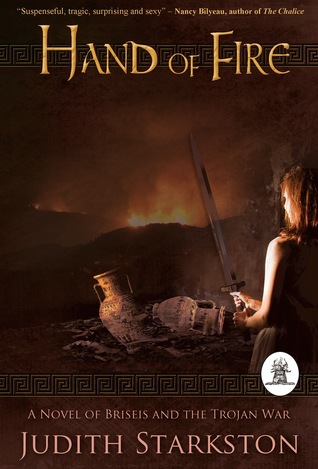
Review: Hand of Fire by Judith Starkston

The Iliad is one of my favorite pieces of literature from Ancient Greece. So I was thrilled when I received an advanced copy from the author of The Hand of Fire, a novel set during the Trojan War.

My Review:
perf6.000x9.000.inddIn Homer’s Iliad, Achilles, the best of the Greek warriors, has taken as one of his prizes the woman Briseis.  Briseis is captured from the city of Lyrnessos which Achilles and the Myrmidons raided in their search for prizes, livestock and anything else to help sustain their war effort.  The character of Briseis in the Iliad says very few words.  But what would it have been like to be a princess of a prosperous Bronze Age city and then taken captive by a Greek warrior?  How was Briseis treated by Achilles and did she actually love him?  These are the questions that Judith Starkston attempts to answer in her new novel Hand of Fire.

When Hand of Fire begins, Lyrnessos is a thriving city and Briseis has been raised by her mother to be a priestess and a healer who will serve her people.  She is betrothed to the prince of Lyrnessos and she will someday become the city’s queen.  The aspect of the novel that impressed me the most is the amount of research that the author did pertaining to Bronze Age homes, religious customs, and society.  I have read the Iliad countless times, and I have even translated it in from the original Ancient Greek.  Hand of Fire let me see the world of the Trojan War in a way in which I had never fully imagined. Continue reading

2 Comments

Filed under Historical Fiction

Indie and Small Press Author Blog Hop


Blog Hop 5

This year I have had the tremendous good fortune to connect with so many wonderful authors.  I thought that it would be a nice idea to co-host a blog hop that is just for Indie and Small Press authors so they can showcase their writing and allow readers opportunities to win lots of great books.  Today I am giving away a copy of Harry Patz’s Book The Naïve Guys AND a $25 Amazon Gift Card. Thanks to Harry for co-hosting this great event with me.

Here are some of my favorite Indie and Small Press Author Books.  A few of these authors are joining the blog hop!

This slideshow requires JavaScript.

About The Prizes: Continue reading

5 Comments

Filed under Giveaways

Review and Author Interview: Tomazina’s Folly by Stuart Shotwell

I thought that the best historical novel I had ever read was Edmund Persuader by Stuart Shotwell which I finished last spring.  However, now that I have read Tomazina’s Folly, the sequel to Edmund Persuader, I have realized that Mr. Shotwell has truly outdone himself with his writing and I cannot decide if Edmund Persuader or Tomazina’s Folly is the best historical book I have ever read.  I invite you to read my review of Tomazina’s Folly and to read the wonderful answers to my questions that the author has graciously agreed to write.

My Review:

Tomazina's FollyOvid, in his epic poem the Metamorphoses, demonstrates most deftly the pain of unrequited love through the myth of Apollo and Daphne.  After Apollo mocks and attempts to belittle Cupid, the God of Love strikes Apollo with a golden arrow, the arrow that makes Apollo fall in love with the nymph Daphne.  But Cupid then pierces Daphne with the dreaded lead arrow, the arrow which makes someone turn away from the beloved.  Apollo desperately tries to pursue Daphne and the more she is pursued by Apollo, the more adamant Daphne is in her rejection of him.

When Tomazina’s Folly opens, it is Tomazina who has taken on the role of Apollo and she loves someone who cannot possibly love her back.  As a young, unmarried woman living in 19th century England whose father is devoutly religious, any sort of sexual feelings she might have are viewed as a sin.  Tomazina is tormented by her secret passion to the point where she thinks about harming herself.  Tomazina desires a marriage to a man who will be her intellectual, spiritual and physical equal.  She believes that there is only one man in the world who could possibly fulfill this role and he is already married.  Tomazina views her unrequited love and impulsive passion as her greatest folly.

Continue reading

6 Comments

Filed under Historical Fiction