
I hate you and I love you.
You may be wondering why I feel this way.
I have no idea.
But that’s how I feel.
And I. am. tortured.
Odi et amo. quare id faciam, fortasse requiris?
nescio, sed fieri sentio et excrucior.
(Translation is my own.)
I hate you and I love you.
You may be wondering why I feel this way.
I have no idea.
But that’s how I feel.
And I. am. tortured.
Odi et amo. quare id faciam, fortasse requiris?
nescio, sed fieri sentio et excrucior.
(Translation is my own.)
Filed under Classics

In order to prepare them for the selection of “Lesbia” poems that we translate, I ask each of the students in my upper level Catullus class to find a love song, play it for the class and to analyze the song in terms of the theme of love. This specifically is what I ask them to write about and discuss:
I have about 2 or 3 students each day over the course of about a week play their songs and lead a discuss about it with the class. The range of music they choose is always interesting and exciting to me and my students. Discussions about music and culture always take place as a result of their presentations. Since I do this at the beginning of the course it’s also a good way for me to get to know my students better and for them to get more comfortable with each other.
This year some of the artists they chose included Kendrick Lamar, Elvis, Ed Sheeran, The Cure and John Legend. I put together a Spotify list so that we could play it in class throughout the semester and discuss these songs in comparison to the themes we see in Catullus. I inevitably get comments like, “Catullus is so whiny” or “Catullus is too melodramatic” or “Catullus needs to just get over this woman.” But then I remind that the emotions the Roman poet experienced more than 2000 years ago are still an part of human life and I point to specific songs that they played, and sang along to and identified with at the beginning of the class.
In addition, the students are able to recognize in their songs basic poetic devices such as hyperbole, alliteration, simile, etc. But I also use these songs along with the Catullus texts to teach them about and to help them understand more complex poetic devices like chiasmus, synchysis, zeugma, polyptoton, etc.
It is fun to watch them sing along. If you would like to do so, there here is our playlist on Spotify:
Filed under Classics
 Sentimental Education begins with Frederic Moreau, the pupil of said “education”, meeting, by chance, an older woman whose presence affects the rest of his life. Eighteen-year-old Frederic has been visiting a paternal uncle in the hopes of becoming the heir to his fortune when he encounters Madame Arnoux, Monsieur Arnoux and their young daughter on a steamship traveling out of Paris. Although Monsieur Arnoux is a garrulous and outgoing man, it is his wife that captures Frederic’s attention (trans. Robert Baldick): “She was sitting in the middle of the bench all alone; or rather he could not see anybody else in the dazzling light which her eyes cast upon him. As he passed, she looed up; he bowed automatically; and when he had walked a little way along the deck, he looked back at her.” As he walks up and down the deck of the boat, he becomes inert and can concentrate on nothing an no one else but her. But he also hasn’t the courage to speak to such an incredible woman:
Never had he seen anything to compare with the splendour of her dark skin, the seduction of her figure, or the translucent delicacy of her fingers. He looked at her workbasket with eyes full of wonder, as if it were a thing of beauty. What was her name, her home, her life, her past? He longed to know about the furniture in her room, all the dresses she had ever worn, the people she mixed with; even the desire for physical possession gave way to a deeper yearning, an aching curiosity which knew no bounds.
Frederic moves to Paris where he attends law school and insinuates himself into the life Arnoux family. He often visits the object of his desire, but the first half of the novel describes his love for Madame Arnoux, yet his complete inertia, his inability to act in any definitive way to make her his lover. I found the second half of the book more interesting as the pace of the narrative becomes quicker and more initeresting. As the years slip by, this woman continues to be a presence in Frederic’s life and even though he takes up other mistresses he can’t get Madame Arnoux out of his heart or his mind. He is incapable of committing to a marriage because there is always the hope of being with Madame Arnoux. Furthermore, his inertia extends to his career since he doesn’t have the attention span to devote to a political career. He lives on the inheritance from his uncle so he has no real need for a private income. But having a serious occupation would have benefitted his otherwise unoccupied mind. He let’s several professional and business opportunities slip through his hands because of his focus on his love and social life.
In the introduction to the Penguin Edition, Geoffrey Wall explains the autobiographical aspect of Flaubert’s novel and quotes the author’s letter to Amelie Bosquet:
I loved immeasurably, a love that was unrequited, intense and silent. Nights spent gazing at the moon, dreaming of elopements and travels in Italy, dreams of glory for her sake, torments of the body and the soul, spasm at the smell of a shoulder, and turning suddenly pale when I caught her eye, I have known all that, and known it very well. Each one of us has in his heart a royal chamber. I have had mine bricked up, but it is still there.”
The object of Flaubert’s secret desire was an older, married woman named Elisa Schlesinger whom he meets as a teenager while on vacation on the Normandy coast. He, too, would encounter her by chance throughout the years but never confessed his true feelings.
It seemed fitting that this week as I was reading Sentimental Education I was also preparing for my second semester Catullus course for my upper level Latin students. Catullus is also smitten with an inaccessible, older woman and as I was reading about Frederic and Flaubert, Catullus’s Carmen 51 kept coming to mind. It is the first, many argue, in the Roman poet’s series of Clodia (a.k.a. Lesbia) poems; Catullus sees Clodia at a party and the first sight of her instantly captivates him and he can only focus on her. But, like Frederic and Flaubert, he is paralyzed by his feelings and cannot bring himself to approach her. At the end of the poem, Catullus chides himself for his inaction:
Inertia, Catullus, means trouble for you.
You wallow in your inertia, and you carry it too far.
Such inertia has previously brought about the
destruction of kings and grand cities.
The Latin word otium seemed especially fitting, in my mind, for Fredric. I translated it here as “inertia”, but it can also mean “leisure.” It was originally used as a military term to describe the leisure of the army, when soldiers are encamped and experience boredom. If otium is translated as “leisure” in this Catullus poem then, I think, the meaning of the last few stanzas is completely changed, as it implies that too much leisure gets the poet into trouble. But I prefer to translate it as “inertia,” or “inaction” and see these lines as Catullus scolding himself for inaction which keeps him from being with his true love. This translation of otium also makes more sense in the context of the beginning of the poem during which he is literally and figuratively paralyzed by the site of this woman.
Both translations—“leisure” and “inertia” are equally fitting ways to describe Frederic. His inheritance allows him too much leisure time to get into trouble and his inability to act on his feelings for Madame Arnoux affect his entire life. Otium is the true cause of Fredric’s inability to attain true happiness at any point in his life.
Filed under Classics, French Literature

Titian. Bacchus and Ariadne. Oil on Canvas. 1520-3.
In Greek myth, Ariadne is the daughter of Minos, King of Crete, and Pasiphae, whose horrifying union with the Cretan bull produces the legendary monster, the Minotaur. We don’t hear very much about Ariadne’s life in the ancient narratives until her encounter with Theseus; she immediately falls in love with this Athenian hero who is sent to defeat the Minotaur and release Athens from its obligation of sending seven men and seven women every nine years to Crete where they are locked in the labyrinth and devoured by the Minotaur. In her eagerness to capture his attention and secure his affections she stealthily offers him the tools to defeat the labyrinth and the Minotaur: a ball of thread and a sword. But through the act of helping this hero she also betrays her home and her family. Theseus professes his love and appreciation for Ariadne and takes her with him when he sails home to Athens. After a brief stop, however, on the island of Naxos, Theseus “forgets” Ariadne on the shores of the island and sets sail to Athens without her.
The Roman poet Catullus writes an epyllion, his longest poem, Carmen 64, in which Ariadne is given her own voice and tells her own side of the story. When she is abandoned on Naxos, she immediately realizes her mistake in trusting this man who was supposed to be a hero. In Carmen 64.132-148 Ariadne speaks to a now absent Theseus and gives full vent to her anger, her heartache and her grief (translation is my own):
You treacherous and dishonest man, Theseus! Have you really carried me away from my father’s home and abandoned me on this deserted shore? Are you really being so forgetful and leaving me behind, completely neglecting the divine will of the gods, and carrying the curse of such false oaths back to your own home? Is there nothing that could change this decision of your cruel mind? Do you truly possess no mercy that would have allowed your ruthless heart to take pity on me? You certainly didn’t act this way when you were lavishing promises on me with your flattering voice. And you certainly didn’t act like this when you were giving me hope of a happy marriage and wedded bliss, all of which futile promises are now dispersed by the light winds. From now on may no woman ever put her trust in any man who makes promises; from now on may no women believe that the words of any man can be trusted. While a man’s mind is set on getting something and his mind eagerly longs to gain that thing, then he will swear to anything, he will promise anything. But as soon as the desire of his greedy mind is sated, he remembers none of his previous words, he cares nothing about his false promises.
Many of the poems in Analicia Sotelo’s new collection of poems, entitled Virgin, drawn on the plot, theme and point of view of the Ariadne and Theseus myth as it is described by Catullus. As I was reading Sotelo’s poems throughout the course of the last few days I was captivated by her interpretation of this myth for a 21st century audience. Ariadne’s rejection, self-doubt, and heartbreak are placed into contexts that make her story meaningful for a modern reader. In “Ariadne Discusses Theseus in Relation to the Minotaur,” Sotelo’s Ariadne, similar to the character we hear from in Catullus, also has a dire warning for other women:
When a man tells you he’s a monster,
believe him.
When a man says you will get hurt
leave…
Sotelo’s Ariadne also has trust issues after being abandoned by a lover. But, if she could do things over again, would she really be able to resist this man? Once again reminiscent of the laments expressed by Catullus’s Ariadne, Sotelo’s poem “Ariadne’s Guide to Getting a Man” incisively describes the tension that one suffers in a lost love, the alternating feelings of remorse and a longing to continue that human connection. Catullus’s Ariadne dreams of wedded bliss, Sotelo’s Ariadne remembers the feel of her lover’s body under her hands. The last line of this stanza is like a punch in the face when Ariadne is brought back to the reality of her situation when she remembers what love did to her mother:
Do you trust him? No, but everyone has left you
to take in the country air.
Three nights later you see him again—
his tall, crepuscular body separates itself from the lilies.
And you realize the body is not grotesque—that it is, in fact,
like a bolt of fine batiste gathered in your hand,
but first you must give up
a willingness to be right about the world.
Your brother is howling.
Your brother is howling
because your mother chose love and look where it left her.
And in one of my favorite poems in the collection Ariadne is viewed through the eyes of her brother, the Minotaur. Catullus’s Ariadne also expresses deep remorse for what she does to him even though he is a monster. Similar to Georgi Gospodinov”s novel The Physics of Sorrow and Jorge Luis Borges’s short story “The House of Asterion,” Sotelo’s poetry shows pity for the Minotaur and she gives him his own story. After all, he, too, is a victim of fate. In “The Minotaur’s Letter to Ariadne,” Sotelo’s monster tugs at the heart strings:
Like a buttercup was your heart in my hand
in the field when we were children
Crown myrtle in your hair,
a gurgling song
Then you grew
delicate as an ox,
obstinate as a—It was you
who taught me metaphor,
said, Mother is a door
I said, What does that mean?
All those years I misheard the men
say, Your mother is a whore,
thinking it was
something that swung open
so almost anything could enter
Oh sister, do not go
Like a buttercup was your heart in my hand.
But through the raw emotions, self-doubt, grief and heartache, Sotelo does offer small glimpses of hope for the abandoned. In Catullus’s version, Ariadne is saved by the god Bacchus who finds her wandering the shores of Naxos and whisks her away to heaven where she also becomes divine. In Sotelo’s version, “Ariadne plays the Physician”, she attempts to heal her own wounds:
We must set this story straight
We must say there is another angle
to this foreign particle
lodged in my ribs like a small ivory
tiger or a Chinese lamp, the oil
coating my bones. Theseus,
you know you didn’t break me.
Sotelo’s collection includes additional, brilliant reworkings of myth. Another of my favorites is “South Texas Persephone” which is a rather sad commentary on marriage that uses inspiration from the Demeter, Persephone and Hades myth. I am glad to have encountered such a raw, emotional, and passionate collection like Sotelo’s that makes Greek and Roman myth accessible to and relevant for a current audience.
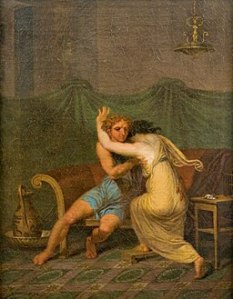
Catullus and Lesbia. Nicolai Abildgaard. 1809. Oil on canvas.
In one of his latest collections to be translated into English, Jean-Luc Nancy’s Expectations explores the topic of literature and how it intersects with philosophy. The essays in the book are divided into four categories: Literature, Poetry, Sense, and Parados. Written over a period of thirty-five years, the themes covered in Expectation are some of Nancy’s favorites that he revisits throughout his career—Reasons to write, narrative, body as theater, Blanchot, etc.
My favorite part of the book is the last section entitled Parados, the Ancient Greek word for the piece of a tragic performance which is sung by the chorus as it enters the stage. Parados can literally be translated as an “entrance” and this is exactly how Nancy uses texts as an inspiration for writing his own poetry. He says about his compositions in this section of the book: “They arise, in all cases, from a specific request inviting me, directly or indirectly, to engage with literature. Or to act as if I had.”
Nancy takes as his parados (entrance) what are arguably the Roman poet Catullus’s most famous Carmina, 5 and 7—the “kisses” poems—for writing this little gem I share today. I have read it several times over the course of the last week and I see and feel something different—various memories are conjured up—every time I read it. He takes a simple expression like a kiss and, in what is a deceptively simple poem, he calls our attention to such different contexts (cultural, familial, intimate) in which we have experienced this gesture (translated beautifully by Robert Bononno):
Let him kiss me with his mouth’s kisses
Thus sings the song of songs
Thus his mouth sings and enchants itself
As his demand so his expectation
Not kisses from another mouth
Except from the one she calls
The mouth of the other who loves her
She alone who knows
How to kiss with the kiss of her desire
For in her mouth is held
Completely breath soul perfume
and from her mouth exhaled
The thought the soft weight
Of clinging of joining of
Drinking eating believing oneself
Osculum the little mouth
That advances and arranges the gathered border of two lips
Perhaps quickly on another’s cheek or lips
Kiss kissed surprise surprised
Stolen stolen in this furtive kiss
So soft from the beign so light
Pulp airborne puff
And touch mouth
Visus Allocutio Tactus Osculum
Traced from the linea amoris
Later coming to Coitus
Gift of mercy
Where all mouths are joined
Kiss and kiss one another
Touch and touch one another
Put to bed and put one another to bed
Kisses come in several kinds
Osculum, Basium, Suavium
Kiss of a friend, child, parent
Kiss of peace, of decorum
Or foamy caress
That swells beneath the tongue
Kisses by the thousand like sand
In Libya or grains of wheat
Scattered to the lines of Catullus.
They resonate in several tongues
Their clicks go Kuss, kiss, kyssa
Κυνεω was the Greek name
Sounds like an adoration
Προσκυνεω
Almost a silent Φιλεω
But always mouth addressed
Exclamation of lip and fever
Breath always scent aroma
Breath moved by the soul
That tastes and breathes your own—
Oh, kiss me with your mouth’s kisses.
*Some notes that might help with the Latin and Ancient Greek: Osculum is the Latin, neuter, singular diminutive for mouth, so a “small mouth” is used for the word kiss; basium is the Latin word that Catullus uses to describe the passionate kisses he wants from his lover; suavium is the neuter, singular form of the Latin adjective meaning ‘sweet’, so suavium is used for kiss to mean a “sweet thing.” κυνεω is the Ancient Greek word for “I kiss” and Προσκυνεω, which is taken from the verb “I kiss” is “to worship” with the connotation of a respectful kiss.
The book is really worth purchasing for Nancy’s thoughts on literature and philosophy; unfortunately I have not captured his extraordinary prose in this post. For my more extensive thoughts on some of his other books take a look at my posts on Coming and Listening.
For my translation of Catullus Carmen 5 please see this post (a warning that my interpretation of this poem is not the standard “Carpe Diem” one that is found in textbooks—I received a lot of comments and complaints about my non-traditional reading of this poem): https://thebookbindersdaughter.com/2016/12/29/let-us-live-and-let-us-love-my-translation-and-interpretation-of-catullus-poem-5/
Filed under French Literature, Philosophy, Poetry



 The Book Binder's Daughter