Category Archives: Classics

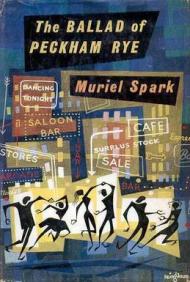
The Ballad of Peckham Rye: My First Experience with Muriel Spark

This is my first Muriel Spark book (thanks to Grant at 1st Reading for giving me the nudge to try her) and I knew from these opening sentences that I would enjoy her writing very much:

‘Get away from here, you dirty swine,’ she said.

‘There’s a dirty swine in every man,’ he said.

‘Showing your face round here again,’ she said.

The “he” is Humphrey, who has recently jilted his bride-to-be, Dixie, at the altar and the “she” is Dixie’s mother.  Spark’s narrative is full of surprises, the first, and most obvious of which, is that the author begins her story at the end.  My impression after reading the first page was poor Dixie, what an awful thing to happen to her.  But over the course of the next 140 pages Spark convinces me that Humphrey probably made the right decision.  Men might have something of the dirty swine in them, but the ladies don’t fair much better in this humorous and strange book.

Dougal Douglas, the new guy in town, is blamed not only for the failed wedding, but also for the other mayhem that has recently broken out in town—fighting, absenteeism at the local textile factory, and even murder.  He keeps showing everyone that he used to have two horns on his head that were surgically removed and so many people believe that he is, physically and mentally, a devil.  Although Dougal is shrewd and quirky, his intentions are not really evil.  And, unlike everyone else in Peckham, he is rather forthcoming about his greatest weakness—he can’t stand any type of sickness.  At the first sign of a disease he will flee as fast as he possibly can.

The two subplots in the text that entertained and intrigued me the most were those that involved Mr. Druce, a manager at the local factory and Dixie’s thirteen year-old brother, Leslie.  Mr. Druce is in a rather unhappy marriage of twenty years and is having a an affair with the head of the typing pool.  When Dougal questions Druce about his reasons for staying in the marriage, it seems that the wife has some sort of secret that she is holding over her husband.  And what is even more interesting is that the pair having spoken in a few years, only communicating through notes.  Mr. Druce and his odd behavior keep the tension building in this bizarre narrative right up to the final page.

Leslie, at first, seems like a typical, sulky teenager who is withdrawn from his family.  But as the story goes on we learn that this boy has a much more sinister side and is involved with gangs, blackmail and roughing up old ladies.  His parents argue over his upbringing, or lack thereof; his father thinks that since he works all day that the responsibility of childrearing falls on the maternal parent and his mother thinks that his father ought to take more of an interest in his son’s life.  So the result of this parental stalemate is a wild boy who tortures his sister and his neighbors and never suffers any consequences for his bad behavior.

This was just the perfect book to enjoy poolside on a hot Sunday afternoon.  I look forward to reading more of Spark over my summer holidays.  I have Open to the Public, The Mandelbaum Gate and Memento Mori sitting on my TBR piles.  Please let me know what other books of hers you would also recommend.
18 Comments

Filed under Classics

Her Soul Receded into the Winds: Dido’s Suicide in Aeneid Book 4

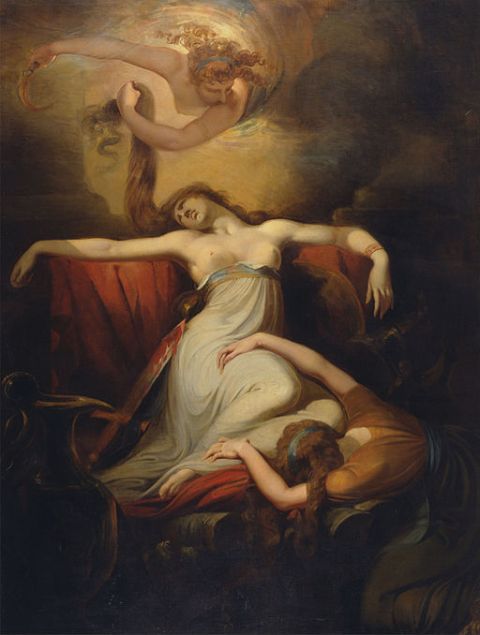
Henry Fusel. Dido. 1781. Oil on Canvas.

If you haven’t read  The Aeneid then I implore you to do yourself a favor and at least read Book 4.  It is one of my favorite pieces of literature to read in Latin and in English. (I recommend the Fagles translation or the new Ferry translation.)  I won’t go through all of the specific reasons for Dido’s suicide in this book because you really need to read it for yourself to understand the complexity of her situation.  But she does feel hopeless, abandoned, deceived, angry. In the culmination of this heart wrenching scene, Dido climbs on to the top of the funeral pyre on which she has placed all her gifts from Aeneas, the Trojan hero who, at this very same moment, is sailing away from Carthage and from her (these translations are my own):

After she looked down at the Trojan’s robes and the all-too-familiar couch, and with her mind hesitating in tearful recollection, she laid down on that same couch and spoke her final words: “Oh gifts that were dear to me as long as the fates and the gods were allowing, accept my spirt and release me from my sorrows.  I have lived and I have finished the course which Fortune had set out for me, but now my famous soul will go to the underworld.  I have established a famous city, I have looked upon my city’s walls, and having avenged my husband, I exacted punishment from my hateful brother.  Unlucky, oh I am too unlucky—if only those Trojans ships had never reached our shores.” When she finished her speech she pressed a kiss into the couch and said, “I will die unavenged, but let me die anyway. In this way, yes, in this way it eases my pain to approach my death.  I hope that cruel Trojan drinks in this fire with his eyes as he sails away, and I hope he carries with him the omen of my death.” As she had said these things, Dido’s loved ones saw her fall onto Aeneas’s sword while standing in the midst of all his other gifts.  Both the sword and her hands were sprayed with blood.  A shouting reaches all the parts of the palace; the report of her death quickly spreads throughout the shattered city.

Since Dido kills herself, her soul is not allowed to be accompanied to the underworld by Mercury.  Instead the goddess Juno sends Iris to release Dido’s spirit:

Therefore, dewy Iris, dragging thousands of colors against the sun and through the sky with her yellow wings, descends and stands by Dido’s head: “I, having been ordered by Juno to carry out the rituals of the dead, release you from this sword and from your body.”  After Iris said this she cut a lock of Dido’s hair: at the same time all the warmth slipped from her body and her soul receded into the winds.

That last sentence is just beautiful, it gets me every time I translate it.  Please do read it and let me know what you think about Dido’s story.


24 Comments

Filed under Classics

How Always Alone: Nothing but the Night by John Williams

Published in 1948, Nothing but the Night is John Williams’s, little known about, first novel.  It takes place over the course of a single day in the life of twenty-three year old Arthur Maxley who has suffered a very traumatic experience in his childhood.  When we first meet Arthur, he is alone in his apartment—he is most often alone—and after a night of solitary drinking and reading is just waking up from a dream.  The story is intense and suspenseful from the very beginning as Williams slowly reveals the tragedy Arthur has suffered in his early life.  By slowing down time in his narrative, we are given a realistic glimpse into Arthur’s fractured and damaged mind.  For instance, Arthur forces himself to get out of bed and take a walk in the park, but never actually makes it to the park because he goes into at a seedy diner.  The vivid and startling description of his breakfast is a clue that Arthur is truly suffering:

From the chipped blue plate, the egg stared up at him like a knowing, evil eye.  At first, he was amused by the fancy; but as he stared longer and as the yellow eye glared back at him, he became acutely uncomfortable.  He blinked rapidly.

And still the yellow pupil stared senselessly at him from its greasy white orb.  He reached for the bottle of Tabasco sauce and poured a bit of the fiery red liquid on the eye.  As if it were suddenly irritated beyond all endurance, the white surrounding matter became alarmingly bloodshot and developed a network of liquidly shifting veins, changing the vacant expression into something almost frightening.  It looked up at him reproachfully, as if in great agony.

With an effort, he tore his gaze away and forced his lids down to cover his own eyes and he shook his head vigorously from side to side.  He tried to laugh at himself.  These fancies…Why did he allow them to take hold of him?  It was only and egg, a simple thing, and for a moment his imagination (it was only his imagination) had made him think that…

Throughout the course of his ordinary day, Arthur is on edge and easily startled by what appear to be the simplest things.  Two events in particular, though, trigger flashbacks to that fateful day in Arthur’s childhood—a letter and a visit from his father.  Williams slowly builds up to revealing Arthur’s tragic memory at the very end of the book which, I thought, was rather unexpected.  The dramatic suspense and Williams’s depiction of the loneliness of mental illness are the strengths of this book.  No one can truly understand Arthur’s suffering, even if he were able to put it into words.  A brief distraction with a lovely woman at a nightclub only highlights Arthur’s abiding sense of being alone.  He thinks he is happy for a fleeting moment, but then his intrusive thoughts come flooding back to him:

And again the desire to convey to her his utter contentment overwhelmed him.  But there was the barrier, always the barrier of words; and that which he now felt was beyond words, deeper and more meaningful.  He opened his mouth to speak, then closed it again, and said nothing.

For at the moment he realized that this understanding which he so desired was a thing that must come from between them, inviolate and alone, unasked and unacknowledged.  And he thought for a moment that he had discovered the secret.

This was the thing that drew men and women together: not the meeting of minds nor of spirits, not the conjunction of bodies in the dark insanity of copulation—none of these.  It was the tenuous need to create a bond, a tie more fragile than the laciest ribbon.  It was for this that they strived together, ceaselessly and always really alone; it was for this that they loved and hated, gathered and threw away. For only the little thread which they could never test for the fear of its destruction, for only the delicate thread which they could never secure for fear of breaking it in two.

How alone we are, he thought. How always alone.

The three books of Williams’s that I have read—Stoner, Augustus, and Nothing but the Night—are all very different stories.  I would advise not to go into this short novel expecting any of the narrative elements that are in his other two books.  What is similar, however, in all three novels is the author’s brilliant and mesmerizing way he uses language; there is something about Williams’s style of writing that completely absorbs me and draws me into these different worlds he creates.

(I read the Vintage edition published in the U.K., but NYRB Classics is also reissuing this book later this year.)


15 Comments

Filed under Classics, Literary Fiction, New York Review of Books

A Certain Amount of Daring: Two Serious Ladies by Jane Bowles

When I mentioned on Twitter that I was going to read my first Jane Bowles story, there was a rather strong, positive reaction to her writing.  But the comments I received about Two Serious Ladies still did not prepare me for reading this story.  This short novel, in fact her only one, is enigmatic, humorous, surprising, even shocking and sad all at the same time.  Truman Capote’s description of the story, I think, sums it up best:

Voyaging for the first time into Two Serious Ladies, I was immediately disoriented.  I did not know what to make of this object at all.  There was no discernible narrative strategy.  There was no way of explaining or analyzing the processes at work.  Interpretation was useless.  The vistas were dispiriting, the food foul, the wind always howling.  Her people were mournful, impulsive, and as erratic in their peculiar journeys’ flights as bats.  They were often drunk.  They thought continuously, obsessively, but had no thoughts exactly, no helpful method of perceiving the world or their positions in it.

Miss Goering and Mrs. Copperfield, the two serious ladies, spend very little time together as they are casual acquaintances.  Each has her own distinct story, but what fascinated me about both of them is their attempt to live on their own terms and find their own versions of happiness.  I found them a bit crazy but also rather brave.  Mrs. Copperfield is dragged to Central America by her adventurous husband; we get the feeling that she stays with him out of a sense of duty, even fondness or nostalgia, but she would much prefer to be off on her own.  And that’s exactly what she does.  In Colon she stays at a seedy hotel, makes friends with a prostitute, and drinks way more gin than she ought to.  At the end of the story she tells Miss Goering, “I have gone to pieces, which is a thing I’ve wanted to do for years.  I know I’m as guilty as I can be, but I have my happiness, which I guard like a wolf and I have authority now and a certain amount of daring, which, if you remember correctly, I never had before.”

Miss Goering is horrified by Mrs. Copperfield’s new outlook on life, but perhaps she is frightened by those qualities which she recognizes in herself.  When the story begins she is a spinster living alone on her family’s home in upstate New York but she slowly gathers a rather strange entourage of people around her.  I found Miss Goering’s narrative to be the most surprising.  What oftentimes begins as a humorous description of her adventures quickly turns melancholy; twice she is invited by men back to their apartments and on both occasions nothing turns out as one would expect.  She is different from Mrs. Copperfield in that she seems to be on a mission to save herself and the strange men she meets from some sort of sin.  Her last words in the novel are mysterious and disconcerting: “‘Certainly I am nearer to becoming a saint,’ reflected Miss Goering, ‘but it is possible that a part of me hidden from my sight is piling sin upon sin as fast as Mrs. Copperfield?’ This latter possibility Miss Goering thought to be of considerable interest but of no great importance.”

I am very eager to read Bowles’s letters which I am impatiently awaiting to arrive in the mail.  I suspect, from what little I know about her life and from reading this book, that I will find among them humor, sadness, loneliness and a lot of drinking.

16 Comments

Filed under Classics, Literary Fiction

Entrusting One’s Sleep to Another: Propertius 1.3

Auguste Jean Baptiste Vinchon. Propertius and Cynthia at Tivoli.

Sextus Propertius, a Latin elegiac poet of the Augustan age, is, rather unfortunately, not as well-known as other poets of this era. He was friends with the most famous men of his day including Vergil, Maecenas and Augustus. His talent as an elegist is evident in his four books of poetry which contain 92 poems. I was fortunate enough in graduate school to be in a program that appreciated his work and I took three different classes that focused on this poet. I admit that I haven’t looked at or translated his work in many years, but he seemed like just the thing to suit my mood this week.

In Poem 1.3, he visits his lover, Cynthia, while she is fast asleep in her bedroom. In his amorous and drunken state he is tempted to wake her with a showering of kisses, but holds off for fear of angering her. He, instead, watches her sleep. I find the images of the first 20 lines, comparing her to a sleeping Ariadne and a Bacchante, simple yet sensual and intimate. I offer here my translation of lines 1-20:

Cynthia seemed to me to be breathing softly and quietly while sleeping with her head on her entwined hands; similar to weary Ariadne as she was lying on the deserted shores while Theseus sailed away on his ship; or similar to Andromeda, finally freed from the harsh cliffs, as she was resting during her first sleep; and similar to a Bacchante, exhausted from her continual dances, as she collapses on the grassy banks of the Apidanus. As the slave boys were shaking the torches late into the night, I dragged my feet, drunk with too much Wine, into her room. Not quite yet completely out of my senses, I softly attempted to lie on the bed beside her. Although two relentless gods, Love and Wine, were driving me, seized with a double passion, to disturb Cynthia while she was sleeping and to slip my arm under her and to steal drawn out kisses, I did not dare to interrupt my lover’s rest for fear of incurring the reproaches of her anger with which I am all too familiar. Instead I remained fixed to my spot with my eyes intent upon watching her—I was like Argus, the 100-eyed monster, who kept a vigil over Io with her strange horns.

Propertius’s last few lines, in particular, capture the vulnerability and sensuality of one lover watching another while asleep. It reminds me of the intimacy and trust involved in the experience of sleeping beside another person as described by Quignard in his novel Villa Amalia:

Entrusting one’s sleep to another is perhaps the only real indecency.

To let oneself be watched while sleeping, feeling hungry, dreaming, growing erect or dilated is a strange offering.

She could see his eyes quivering beneath his lids, moving beneath the pale, fragile skin. She could see everything. She could see he was dreaming. Who was he dreaming of? Curiously, she dreamt he dreamt dreams that weren’t dreams of her.

It turned out that he too sighed in his sleep—just like his little daughter.

They both of them gave enormous sighs—like sighs of relinquishment.

Stuart Shotwell’s novel Tomazina’s Folly has, for me, one of the most tender scenes in literature as a woman looks through her lover’s private sketch book in which he has drawn erotic and caring images of his ideal marriage:

As she went on through the book she discovered that a conspicuously recurring theme was that of one spouse watching the other sleep: the wife, sometimes gloriously nude, sometimes fully clothed, either in bed herself or in a chair, watched her husband as he slept; and likewise the husband watching over his wife. There was a tenderness and curiosity and protectiveness in the expression of the watchers, as if they themselves could not sleep, but wanted their spouses to dream undisturbed.

Finally, Jean-Luc Nancy in The Fall of Sleep touches upon the reasons why falling asleep beside another person is an extension of an act of intimacy:

Sleeping together opens up nothing less than the possibility of penetrating into the most intimate part of the other, namely, precisely into his or her sleep. The happy, languid sleep of lovers who sink down together prolongs their loving spasm into a long suspense, into a pause held at the limits of the dissolution and disappearance of their very harmony: intermingled, their bodies insidiously disentangle, however intertwined they can sometimes remain until the end of sleep, until the instant joy returns to them as renewed for having been forgotten, eclipsed during the time of their sleep, where their agile bodies surface again after having been drowned at the bottom of the waters they themselves poured out.

Propertius’s poem ends with his lover waking up, accusing him of being in the embrace of another woman, and complaining that he wasn’t there to fall asleep with her. Cynthia’s wish for him is that he get a taste of his own medicine and that he also experience a lonely night without her in his bed.

8 Comments

Filed under Classics, French Literature, Historical Fiction, Literary Fiction, Poetry
