Tag Archives: New York Review of Books

Review: Slow Days, Fast Company by Eve Babitz

I received a review copy of this title from New York Review Books via Edelweiss.

My Review:

babitz_Slow_Days_hi-res_largeI have to admit that I have never been to Los Angeles and the quiet, New England girl in me has always been afraid to even think about visiting the famed city on the other coast.  Images of the fast life with celebrities, drugs and name dropping via shows like The Kardashians and The Real Housewives are just too much for me.  Eve Babitz was the original glamor girl and in her book Slow Days, Fast Company she describes the Hollywood of the 1960’s and 1970’s that was just as intense, if not more so, as the Hollywood of the 21st century.

Slow Days, Fast Company is a collection of stories about Eve’s life as an artist and a writer living in the heart of Hollywood.  She meets countless celebrities that are the who’s who of L.A. in the 60’s and 70’s, from artists to rock stars and movie execs.   The impression that I got from the casual tone of the book is that she is unfazed by many of the rich and famous characters that she encounters.  In the story entitled, “Heroine” Eve is introduced to Janis Joplin twice but both times Joplin is so strung out on drugs that she is incapable of speech.  Babitz isn’t angry or disappointed that she never gets to speak with the famous rock star, but instead she is sad that drugs have consumed and destroyed another life with so much potential for greatness.  Eve herself drinks quite a bit, does cocaine, and pops a lot of Valium, but she draws the line at taking Heroine because she has seen too many people destroyed by it.

Babitz is open and brutally frank about her sex life throughout the stories.  She manages affairs with multiple men at one time and engages in the occasional ménage à trois.  Her attitude towards sex and these various relationships is also rather laid back, as if balancing several men at a time and sleeping with two men at a time is something that is totally normal and part of every day life.  There is also an undertone of humor as far as her sex life is concerned, especially when it comes to her lover named Shawn.  Shawn was a gay man living in the American south with his partner, and now finds himself in the middle of the Hollywood scene and hanging out with Eve Babitz.  She takes him on as her lover and he features prominently in several of the stories as they go on vacation together, go out to dinner, and do other things that are typical of a romantic couple.

My favorite story in the collection is the one entitled “Bad Day at Palm Springs.”  Eve is introduced to a rich socialite named Nikki Kroenberg who is married to a lawyer and has too much time on her hands.  Nikki invites Eve and Shawn to spend the weekend with her in Palm Springs and Eve jumps at the chance to spend a few quiet days away from the smog and congestion of L.A.  In this story Eve gives us a lesson about the fluidity and imprecise nature of time on the west coast.  Shawn says that he will be ready for their weekend getaway at 7 p.m. but two hours later Eve and Nikki are still sitting in Shawn’s kitchen waiting for him to finish a photo shoot.  Eve deals with the constant waiting by always keeping a paperback book with her; but the pressure of keeping Nikki busy while they wait for Shawn causes Eve to swallow a few extra Valium.  When they finally make it to Palm Springs, the slow pace of life in the sun is just too much for Eve and she is itching to get back to her life in L.A.

In Slow Days, Fast Company Babitz provides an inside look at the life of the rich and famous while at the same time not taking herself too seriously.  I never felt that Babitz was name dropping to make herself sound more important and for this reason the book was a highly entertaining read.  I still don’t have a desire to visit California anytime soon, but experiencing it through the eyes of this writer and artist is amusing.

About the Author:

Eve Babitz is the author of several books of fiction, including Sex and Rage: Advice to Young Ladies Eager for a Good Time, L.A. Woman, and Black Swans: Stories. Her nonfiction works include Fiorucci, the Book and Two by Two: Tango, Two-Step, and the L.A. Night. She has written for publications including Ms. and Esquire and in the late 1960s designed album covers for the Byrds, Buffalo Springfield, and Linda Ronstadt. Her novel Eve’s Hollywood is published by NYRB Classics.

8 Comments

Filed under Classics, New York Review of Books

Review: Zama by Antonio de Benedetto

This book was originally published in Spanish in 1956 and this English version has been translated by Esther Allen.

My Review:
ZamaDon Diego de Zama is a clerk serving the Spanish monarchy in a remote town in Paraguay at the end of the eighteenth century.  His position as an assistant for the Governor is supposed to be one of prestige and the first step as he moves up in his political career.  But if only he could find a way to get out of the backwater of Paraguay and be assigned a better position in Buenos Aires, which would also be closer to his home and his wife.  Zama is a lazy, selfish, and even at times stupid man who only seems to do things that hurt his career and his family.
There is a scene in the book in which Zama has just finished spending what little money he has at the racetrack betting on horses.  He decides to take a siesta in the shade where he encounters another man resting.  While this man is sound asleep Zama sees a poisonous spider about to jump on this man’s face and Zama decides to do absolutely nothing about it.  He doesn’t lift a finger to dispose of the spider or even warn the man of the impending danger of the venomous arachnid that is about to jump on his face.  Zama simply sits there and watches the scene unfold and seems rather detached from the fact that a poisonous spider is crawling on another man’s face.  This episode perfectly exemplifies Zama’s selfish attitude not only towards the world around him, but also towards his life, his job and his family.

The book is divided into three parts, the first of which takes place in 1790.  When we are first introduced to Zama he is waiting for a ship to come in that might contain a letter from his wife and the salary that is owed to him by the Spanish crown.  Zama misses his wife a great deal, but the lack of intimate contact with her for almost two years drives him to find a woman to fulfil his sexual desires.  In a scene that is reminiscent of the Actaeon and Artemis story from Greek mythology, he accidentally sees a local upper class woman naked while she is bathing in a river.  Once he finds out who this woman is he does everything he can to scheme his way into her home without attracting the notice of her husband or the rest of the town.  His attempts to seduce this woman are clumsy and not well planned.

The novel skips forward four years to 1794 and Zama is still stuck in this town in Paraguay. But by this time he has moved into a ramshackle farmhouse with a widow named Emilia and has a son with her.  Zama’s salary that he is owed by the Spanish crown is very seldom paid to him, so he lives in poverty and doesn’t have very much to offer his mistress and child.  He notices the child is oftentimes dirty and crying but he is never moved to console the child or find a way to provide a better life for his family.  When he has extra money in his pocket he doesn’t offer it to Emilia or his son but instead he buys his own meals at the local inn or tavern.  His own needs continue to always come first.  Zama’s wife, whom he was so eager to be near in the first part of the book, is not mentioned at all during this time.  Zama’s emotional detachment from the hardships that his families suffer is astonishing.

In the final part of the book  Zama’s selfish nature finally brings about his downfall.  The year is now 1799 and Zama is sent on an expedition with the local militia to hunt down a notorious pillager and thief.  The sole reason that he volunteers for the mission is that he thinks it will finally get him a promotion.  The final part of the book is the most exciting as Zama travels with soldiers into remote parts of South America that are dangerous because of Indian tribes.  There is also a bit of intrigue during this part of the book when the bandit’s true identity is revealed and the only one who knows this key piece of information is Zama.  His selfish and clumsy reaction to this situation is typical of his character throughout the book but this time his impetuous actions bring about his own demise.

Reading about Zama’s life is like watching a train wreck.  We know from the beginning that because of his clumsy behavior Zama is headed for a bad end, but we can’t put the book down because of our morbid curiosity to know how he finally does himself in.


About the Author:
A BenedettoAntonio di Benedetto, (born 2 November 1922 in Mendoza – died on 10 October 1986 in Buenos Aires), was an Argentine journalist and writer. Di Benedetto began writing and publishing stories in his teens, inspired by the works of Fyodor Dostoevsky and Luigi Pirandello. Mundo Animal, appearing in 1952, was his first story collection and won prestigious awards. A revised version came out in 1971, but the Xenos Books translation uses the first edition to catch the youthful flavor.  Antonio di Benedetto wrote five novels, the most famous being the existential masterpiece Zama (1956). Los suicidas (The Suicides, 1969) is noteworthy for expressing his intense abhorrence of noise. Critics have compared his works to Alain Robbe-Grillet, Julio Cortázar and Ernesto Sábato.  In mid-sixties or early seventies he caused a diplomatic faux-pas at a NATO meeting when during a ceremonial toast he raised his cup and said “cin cin” to bystanding Japanese diplomats. This caused an international pandemonium, as “chin chin” is a slang term for penis in Japanese. This later led to his prosecution. In 1976, during the military dictatorship of General Videla, di Benedetto was imprisoned and tortured. Released a year later, he went into exile in Spain, then returned home in 1984. He travelled widely and won numerous awards, but never acquired the worldwide fame of other Latin American writers, perhaps because his work was not translated to many languages.

8 Comments

Filed under Classics, Literature in Translation, New York Review of Books, Spanish Literature

Review: Grand Hotel by Vicki Baum

I received a review copy of this title from the New York Review of Books.  The original book was published in 1929 in German and this English version has been translated by Basil Creighton.

My Review:
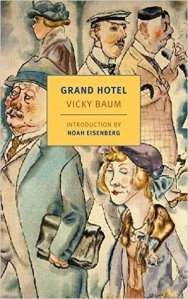
Grand HotelThe Grand Hotel is the place to stay for anyone who wishes to be surrounded by luxury and high society in 1920’s Berlin.  The guests that have all checked into the hotel in March of 1929 are an interesting mix of misfits whose stories all collide in a cleverly intertwined plot.
The first character to whom we are introduced is Dr. Otternschlag.  He sits for hours each day reading the paper and watching people go in and out of the revolving doors of the hotel.  He asks the porter several times if a letter has come for him and it is sad that no letters ever arrive for this lonely man.  He suffered a horrible injury during World War I which has left his face horribly scared.  He is utterly lonely, sad and has no zest for life.  He is the absolute opposite of Baron Gaigern who is also a guest at the hotel.

The Baron wears the finest clothes, has impeccable manners, is charming and extremely handsome.  He enjoys life to its fullest with gambling, fast cars, and lots of women.  But little does everyone know that the Baron is actually a petty thief and has no money other than that which he steals from his unsuspecting victims.  He latest mark is an aging ballerina named Grusinskaya whose famous string of pearls are said to be worth over 500,000 marks.  He has been secretly following the dancer around so that he can best ascertain how to get his hands on those pearls without being caught.  His plan for the heist is one of the most amusing and thrilling parts of the plot.  In the course of carrying out his carefully laid out plan, the unexpected happens to the normally cool and collected Baron–he falls in love with the woman who is supposed to be his victim.

The next person to check into the Grand Hotel is Otto Kringelein who is a lowly and badly paid clerk from a small town.  He is very sick and has only been given a few weeks to live so he gathers up all of his life savings, leaves his miserable wife and books a room at the hotel where he intends to have an exciting adventure before he passes away.  When his boss, Mr. Preysing, also checks into the hotel, he won’t let this angry and horrible bully spoil his fun. Kringelein finds a companion in the doctor for a while and even goes to the ballet with him.  But it is not until Kringelein meets up with the Baron that he really starts to feel alive.  The adventures that the Baron takes this provincial and naïve man on, which include boxing, gambling and flying, are absolutely hilarious.

The final adventure that Kringelein takes is of his own making as he comes to the aid of a beautiful young woman.  The story ends well for Kringelein even though it is still likely that he doesn’t have long to live.  He, like many others, checked into the Grand Hotel, as a solitary misfit.  But his exploits with the other guests turn him into a more worldly and confidant man who yearns to experience all that life has to offer.  The New York Review of Books has managed to reissue another fantastic classic that I devoured in just a few sittings.  I can’t recommend this book highly enough.

About the Author:
Vicki BaumVicki Baum (penname of Hedwig Baum) was born in a Jewish family in Vienna, Austria. She moved to the United States in 1932 and when her books were banned in the Third Reich in 1938, she started publishing in English. She became an American citizen in 1938 and died in Los Angeles, in 1960.

24 Comments

Filed under Classics, German Literature, Literature in Translation, New York Review of Books, Summer Reading

Review: Hill by Jean Giono

I received an advanced review copy of this title from NYRB classics.  The original title was written and published in French in 1928 and this English edition has been translated by Paul Eprile.

My Review:
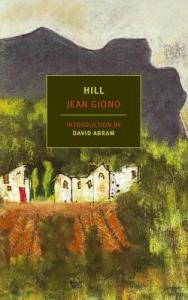
HillFour families live quiet and simple lives at the foot of a hill in Provence in the early twentieth century.  Their small community consists of four white houses and a small shack for an old bachelor that also lives among these peasants.  Their days consist of working the land, drinking wine and telling stories.  But their bucolic life is threatened when day when a black cat crosses their paths.
Janet, the eldest of the group, has lived at the foot of this hill for most of his life and the last time that this black cat came around it also meant trouble for their little village.  Janet’s son-in-law, a man named Gondran, as well as the other neighbors are all on high alert as they are anticipating some kind of calamity to happen to them.  The peasants believe in many old wives tales and different forms of superstition and to them a black cat is the ultimate sign of bad fortune about to strike.

When their well runs dry and they are desperate for water, the villagers decide that it is finally time to consult Janet about what to do.  But Janet is on his deathbed and spends his days laying in bed and mumbling gibberish.  Janet also has strange visions and at one point he thinks there are snakes coming out of his fingernails.  They are doubtful as to whether or not they can pry some useful information out of this delirious old man.

What Janet gives them is a beautiful and timeless commentary on mother earth and a lesson on how we ought to treat and respect nature.  Janet paints for them a picture of an earth where everything is alive and has feeling.  Every time we chop down a tree, or drive a spade into the dirt or hunt an animal the earth feels it and it hurts her.  The idea that the earth senses pain and actually cries out every time we use a foreign object to dig into the soil was one of the most powerful points in the book for me.

Giono personifies the earth through language rich with spiritual terms; he imagines a supreme protector of the earth who walks around in a sheep skin that was gifted to him by the animals.  And humans have harmed earth so much that the kindly, supreme being can no longer heal her many wounds.

The commentary on the spirituality of nature and our abuse and misuse of the limited resources that the earth gives us is a timely theme that we continue to discuss in the twenty-first century.  We must realize that the pollutants we put into the air, the poisons we put into the ground and the extraction of natural resources all have a negative effect on our environment.  Giorno’s words are just as applicable today as they were almost one-hundred years ago when he wrote this brief yet powerful little story.

The plot itself of this book is not necessarily a page-turner, but the inspirational language and social commentary are well worth the read.

About the Author:
Jean GionoJean Giono, the only son of a cobbler and a laundress, was one of France’s greatest writers. His prodigious literary output included stories, essays, poetry,plays, filmscripts, translations and over thirty novels, many of which have been translated into English.

Giono was a pacifist, and was twice imprisoned in France at the outset and conclusion of World War II.

He remained tied to Provence and Manosque, the little city where he was born in 1895 and, in 1970, died.

Giono was awarded the Prix Bretano, the Prix de Monaco (for the most outstanding
collected work by a French writer), the Légion d’Honneur, and he was
a member of the Académie Goncourt


12 Comments

Filed under Classics, France, New York Review of Books

Review: My Marriage by Jakob Wassermann

I received an advanced review copy of this title from The New York Review of Books.  The original novel was published in German in 1934 and this English translation has been done by Michael Hofmann

My Review:
My MarriageWassermann presents us with the story of Alexander Herzog and his disastrous marriage to a woman from a middle-class German family named Ganna.  Alexander begins his tale with a history of Ganna’s childhood which seems to have a profound effect on her mental stability as an adult.  Ganna is one of six daughters, fifth in line, and is described as a duckling among swans.  She is not as pretty, graceful or demure as her sisters.  Her disobedience and lying often result in brutal beatings from her father.  No one ever thinks that Ganna could attract a man to marry; but Alexander, a young and up-and-coming writer, enters the scene and Ganna is smitten with him.


The beginning of the story has a light and funny tone as Alexander tells us about Ganna’s devotion to him and his writing.  She follows him around like a puppy and adores anything and everything he writes.  During this time Alexander is not able to make a successful living from the sales of his books so he is often in debt and wondering where his next meal will come from.  It starts to wound his pride when he is forced to rely heavily on the charity and pity of his friends.  Ganna suggests marriage to him because her rather sizeable dowry would mean the end of his financial woes.  Alexander dismisses Ganna’s suggestion of marriage as ridiculous, first and foremost because is not the one- woman, settling-down type of man.  But Ganna is relentless and finally wears him down, even threating to jump off a balcony if Alexander doesn’t agree to marry her.

Alexander lets Ganna and her world wash over him and he accepts his fate as her husband and a member of her extended family.  But Alexander’s passivity is his greatest flaw and he ignores the many warning signs of his impending misery and doom.  I kept reading the book and cringing because of all the gloomy foreshadowing.  The marriage starts to unravel rather quickly because it is evident that Ganna is mentally unstable, volatile, paranoid, and quite possibly psychotic.  She yells at the servants and then plays the part of the victim; she makes quick and intimate friends with various people in society and just as quickly makes them her mortal enemy.  Ganna and Alexander fight constantly and all the while Alexander keeps believing that he can change Ganna, calm her down, make her see reason.

After about ten years of marriage Alexander has many affairs which Ganna accepts as something that Alexander needs to do;  she is content with the fact that she is the lawful wife and that he will always come home to her.  But when Alexander meets and falls in love with a woman named Bettina, all of this changes.  Bettina is kind and patient and happy and Alexander, possibly for the first time in his life, falls deeply in love with her.  After carrying on their affair for several years, Alexander finally decides that he must ask Ganna for a divorce.  This divorce pushes Ganna over the edge to the point at which she is completely obsessed with making Alexander’s life miserable.  She employs one lawyer after another to ring more  and more money out of him and to drag out the divorce for years.  At one point it is estimated that she has a team of forty lawyers working to make Alexander’s  life miserable.  The last third of the book goes on for pages about the awful mess that Ganna makes out of everyone’s life and the horrible stress she causes to Alexander and Bettina.

I really should not have finished reading this book before bed because I laid awake for quite awhile thinking about it.  The combination of Alexander’s passivity and Ganna’s mental instability causes a perfect storm of misery for both of them.  The book is also an interesting commentary on mental illness and the far-reaching effects it has on a family.  How does one deal with a person who is so completely irrational, paranoid and volatile?  I think if Ganna were written about in the 21st century should would probably be diagnosed with a personality disorder or a psychosis.

The New York Review of Books has reissued another great classic from the German Language which I highly recommend if you enjoy books that explore marriage, psychological issues and unforgetable characters.


About the Author:
J WassermannBorn in Fürth, Wassermann was the son of a shopkeeper and lost his mother at an early age. He showed literary interest early and published various pieces in small newspapers. Because his father was reluctant to support his literary ambitions, he began a short-lived apprenticeship with a businessman in Vienna after graduation.

He completed his military service in Nuremberg. Afterward, he stayed in southern Germany and in Switzerland. In 1894 he moved to Munich. Here he worked as a secretary and later as a copy editor at the paper Simplicissimus. Around this time he also became acquainted with other writers Rainer Maria Rilke, Hugo von Hofmannsthal, and Thomas Mann.

In 1896 he released his first novel, Melusine. Interestingly, his last name (Wassermann) means “water-man” in German; a “Melusine” (or “Melusina”) is a figure of European legends and folklore, a feminine spirit of fresh waters in sacred springs and rivers.
From 1898 he was a theater critic in Vienna. In 1901 he married Julie Speyer, whom he divorced in 1915. Three years later he was married again to Marta Karlweis.

After 1906, he lived alternatively in Vienna or at Altaussee in der Steiermark where he died in 1934 after a severe illness.
In 1926, he was elected to the Prussian Academy of Art. He resigned in 1933, narrowly avoiding an expulsion by the Nazis. In the same year, his books were banned in Germany owing to his Jewish ancestry.

Wassermann’s work includes poetry, essays, novels, and short stories. His most important works are considered the novel Der Fall Maurizius (1928) and the autobiography, My Life as German and Jew (Mein Weg als Deutscher und Jude) (1921), in which he discussed the tense relationship between his German and Jewish identities.

12 Comments

Filed under Classics, German Literature, Literature in Translation, New York Review of Books