
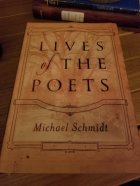
With Lives of the Poets, Michael Schmidt takes up the daunting task of tracing the history of English poetry from the Middle Ages to the present. His engaging style of writing has immediately drawn me into this wonderful book. He writes:
Poems swim free of their age, but it’s hard to think of a single poem that swims entirely free of its medium, not just language but language used in the particular ways that are poetry. Even the most parthenogenetic-seeming poem has a pedigree. The poet may not know precisely a line’s or a stanza’s parents; indeed may not be interested in finding out. Yet as readers of poetry we can come to know more about a poem than the poet does and know it more fully.
Schmidt’s point about pedigree and influence was proven for me almost immediately in his book with the chapter on Chaucer. The early English poets of the fourteenth century were struggling to break free from the literary supremacy of both Latin and French but, by including the introduction to Chaucer’s Troilus and Criseyde, Schmidt shows that although he chooses to write in English, Chaucer’s Latin ancestors are never far from his mind:
Go, litel bok, go, litel myn tragedye,
Ther God thi makere yet, or that he dye,
So sende might to make it som comedye!
But litel book, so making thow n’envie,
But subgit be to alle poesye;
And kis the steppes, where as thow seest pace
Virgile, Ovide, Omer, Lucan, and Stace.
The references to Ancient Epic authors is quite obvious, but there is also a hidden allusion in these lines to Catullus that Schmidt doesn’t mention. Catullus was not widely read in this period, but the discovery of his manuscript in 1300 does make it slightly possible that Chaucer know about Catullus’s own libellum (little book) and his introductory poem which is also self-deprecating. In Carmen 1, Catullus begins his collection of poetry(translation is my own):
To whom should I dedicate my new, charming, little book
that I just polished with my dry pumice stone? To you,
Cornelius, you who used to think that my petty scribblings
were actually worth something.
I’ve always suspected that Catullus knows the worth of his talent and that this modesty in the dedication is feigned. Schmidt’s discussion of Chaucer has me wondering the same thing about the English author and his “litel bok.”
I took a British Literature course which was required when I was in high school and I credit this course with making me the reader I have become as far as classic literature is concerned. The first work we read in the class was Chaucer’s Canterbury Tales which captivated my 16-year-old attention. I haven’t read Chaucer, unfortunately, since I was a teenager, and a pleasant side effect of Schmidt’s book is the rediscovery of old favorites. My plan is to read Chaucer’s Troilus and Criseyde as well as Gower’s Confessio Amantis from the same time period.
Last week when I translated Catullus Carmen 1 with my Latin students, I also read to them Chaucer’s lines from Troilus and Criseyde. Not a single student knew who Chaucer was; British Literature is not a required course. So sad…
 Sentimental Education begins with Frederic Moreau, the pupil of said “education”, meeting, by chance, an older woman whose presence affects the rest of his life. Eighteen-year-old Frederic has been visiting a paternal uncle in the hopes of becoming the heir to his fortune when he encounters Madame Arnoux, Monsieur Arnoux and their young daughter on a steamship traveling out of Paris. Although Monsieur Arnoux is a garrulous and outgoing man, it is his wife that captures Frederic’s attention (trans. Robert Baldick): “She was sitting in the middle of the bench all alone; or rather he could not see anybody else in the dazzling light which her eyes cast upon him. As he passed, she looed up; he bowed automatically; and when he had walked a little way along the deck, he looked back at her.” As he walks up and down the deck of the boat, he becomes inert and can concentrate on nothing an no one else but her. But he also hasn’t the courage to speak to such an incredible woman:

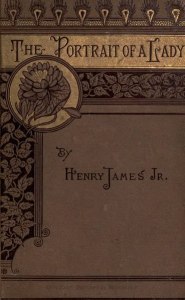 In an essay that explains his process and literary technique in The Portrait of a Lady, Henry James writes:


 The Book Binder's Daughter