
I received a review copy of this title from Two Lines Press. This book is also being published in the U.K. by And Other Stories. The book was written and published in the original French in 2013 and this English version has been translated by Jennifer Higgins and Sophie Lewis.
My Review:
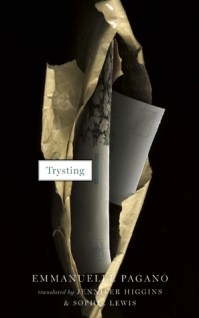 Trysting is one of those rare books that defy description it in any sort of a review. At its core, Pagano’s book presents us with a series of writings in various lengths that deal with the human experience of love. Her musings in this book range from short, one line epigrams to longer two page narratives that read like flash fiction. Pagano attempts to capture all of the stages that being in love and having a lover encompass—meeting someone special for the first time, spending time together, learning the habits of another person, breaking up, getting over a lover. She intersperses within these events things that lovers leave behind like feathers, rubber bands, a bicycle. Some of the vignettes are shocking, some are tender and sweet. But at their core, they all try to delineate the mysterious and illusive sensation of love. Senses—touch, site, smell, sound, taste are all described within the context of love.
The shorter pieces, which are only a line or two, read like epigrams and feel as though Pagano is trying to capture a moment in time between lovers. They read like a caption on a photograph:
“He sprays a mist of water onto his newspaper to stop the pages rustling as he reads next to me while I sleep.”
“His breathing, even during the day, even when he’s busy doing something, is like that of a person asleep. Regular and calm. I like this peace.”
“No one sees what I see when I look at her.”
“He has a serene way of being in silent moments. I was never afraid of having nothing to say to him.”
The longer pieces, which range from two to three pages in length, read like flash fiction stories and provide a frame for which the reader can fill in the rest of the picture. In one story, for instance, a couple moves from apartment to apartment, like vagabonds constantly on the move living in different places. The couple pretends to be interested in renting an apartment and gets the key from the estate agent and spends as much time as they can get away with at each rental: “The estate agents never notice a thing, nor do the landlords. We make love in their apartments, we sleep in them, we live our shared life in them and it’s as good a life as any. We change location, move to a different town, everyday.”
In another story, a musician who plays the saxophone is always annoying his upstairs neighbor even though he uses a mute for his instrument. She leaves him terse little notes and knocks on his door whenever he is practicing. The only noise he ever hears from her apartment is the dull sound of her squeaking bed when her boyfriend stays over: “They always screw to the same rhythm, and as far as I’m concerned, it’s definitely screwing, not making love, because it’s always the same dogged, dreary, binary rhythm.” The musician wants to invite the woman to his apartment and get to know her and introduce her to a whole new world of rhythm: “I’ll tell her to let herself go, be carried by my breath, by my sax, my mouth, my lips, my melody.”
One final aspect I want to mention that is integral to the writings in this collection is their sensual nature. Pagano manages to represent all the senses and put them in the context of lovers:
Touch: “It was very cold. I hadn’t put gloves on. I defrosted my fingers between my thighs before letting them touch her.”
Sound: “I met him when I called a wrong number. His voice was so lovely, saying I must have made a mistake, that I couldn’t bring myself to hang up.”
Smell: “I used to sniff her all the time. Odours are always stronger when they’re damp. Perfumers dampen thin strips of paper to sample their scents. Dampening an area, an object, or a body helps us to smell it and get to know it fully. I moistened her all over with saliva to get to know her off by heart.”
Hearing: “The things I miss most are the sounds, the sounds of our love, the noises of lovemaking and sleeping together, the noises of waking up.”
Sight: “We are getting old. I like the signs of ageing on him, the wrinkles and folds, the emergence of moles and liver spots. I wonder if these marks appear all of a sudden or little by little. I look out for signs of these blossomings. Tine is pollinating his skin with flowers, with speckles with stars.”
This book is a truly unique literary experience that can be read like a collection of poetry, slowly, a little bit at a time when one has quiet and the mood strikes.
About the Author:
 Emmanuelle Pagano has published over a dozen works of fiction, which have been translated into German, Hungarian, Italian and Spanish. She has won the EU Prize for Literature among other prizes and lives in the Ardèche region with her family.
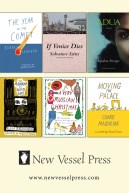 New Vessel Press: A subscription of New Vessel books includes all six of their books for the publication year. Subscribers also get to choose one book from their backlist. The cost is $80 which amounts to about 25% off of the cover prices. I haven’t read a book from New Vessel yet that I haven’t enjoyed. This year’s titles include If Venice Dies and A Very Russian Christmas so this subscription is definitely worth it.
  includes twelve of their titles is $170. A full-year of ebooks is $70 and a half year subscription for six books is also $70. They provide a lot of choices depending on one’s budget. Subscribers who are really passionate about their books and want to spend some money up front can also purchase two or three year subscriptions.
  The New York Review of Books: This press also specializes in reissuing lost classics from different countries around the world. They call their product a “book club” but it is essentially a subscription service. For $140 members receive a book every month for 12 months and the membership automatically renews. For a limited time NYRB is also offering a four issue subscription to The Paris Review when readers purchase a membership. I can’t get enough of the books from NYRB classics and I might have to buy a storage unit to house all of my books from their catalog. I will pretty much read anything they publish and $140 is a pretty good bargain for a year’s worth of their books.
 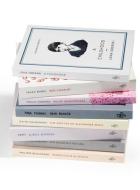 Pushkin online bookshop, and a free copy of Stefan Zweig’s novella Confusion. The Pushkin Collection is a series of paperbacks typeset in Monotype Baskerville, based on the transitional English serif typeface designed in the mid-eighteenth century by John Baskerville. It was litho-printed on Munken Premium White Paper and notch-bound by the independently owned printer TJ International in Padstow, Cornwall. The cover, with French flaps, was printed on Colorplan Pristine White paper.
  This book is set in an apartment building in Mexico City in which a group of elderly retirees live. The residents of the building engage in various activities together in order to fend off boredom, including the most popular activity which is the daily gathering and discussion at the literary salon. Francesca, the building president and leader, is also the head of this salon. As each new member moves into the building, he or she is given a warm welcome and an invitation to the salon. The only person who has ever dared to turn down an invitation to the salon is our witty, clever and crabby narrator, a man who goes by the name of Teo.
 Juan Pablo Villalobos was born in Guadalajara, Mexico, in 1973. His first novel, Down the Rabbit Hole, was the first translation to be shortlisted for the Guardian First Book Award (in 2011). He writes regularly for publications including Granta and translated Rodrigo de Souza Leão’s novel All Dogs are Blue (also published by And Other Stories) into Spanish. His work has been translated into fifteen languages. He lives in Barcelona and has two children.
 Lukas Zbinden lives in a nursing home in Germany and even though he isn’t as fast as he used to be, one of his favorite activities is still taking his daily walk. Most of the book entails Lukas taking walks with Kazim, one of the newly-hired caretakers at the home. On their walks Lukas describes to Kazim the other inhabitants of the home, Lukas’ former life before the nursing home, and Lukas’ philosophical musings on the importance of walking.
 Christoph Simon was born in 1972 in Emmental, Switzerland. After travels through the Middle East, Poland, South America, London and New York, he has settled in Bern. His first novel, Franz, or Why Antelopes Run in Herds (2001) has sold over 10,000 copies, while Planet Obrist (2005) was nominated for the Ingeborg Bachmann Prize. Zbinden’s Progress is his fourth novel and won the 2010 Bern Literature Prize.



 The Book Binder's Daughter