Tag Archives: 19th Century

Review and Giveaway: A Memory of Violets by Hazel Gaynor

My Review:
A Memory of VioletsThis book alternates between two narratives, the first of which describes a pair of poor Irish immigrant orphans living on the streets of London in 1876 and who try to sell flowers in order to survive.  Flora, who is 8, is crippled, and Rosie, who is 5, is blind and although they have wretched lives the one thing that they do have is each other.  This part of the narrative is so pathetic and heart-wrenching that I almost gave up on the book because I could not take the sadness any longer.

The other part of the narrative takes place in 1912, when a young woman named Tilly moves to London to become a house mother at a Training Home for Watercress and Flower Girls.  All of the girls who work at the home are handicapped in some way and if it were not for this training home they would be living on the streets in abject poverty.  At the home the girls learn to make flowers out of fabric and the flowers are sold to vendors around London.

Tilly’s story is rather sad as well and we learn that she has had her own family troubles.  But coming to London and taking care of the girls at the home is a happy endeavor for which she is most grateful.  While Tilly is at the training home, she discovers a diary in the back of her closet written by the orphan girl Flora.  One day while they are selling their flowers, Flora and Rosie get separated on the streets of London and Flora ends up living at the home.  Tilly reads Flora’s diary and tries to discover what became of the two sisters and if they ever had the chance to reunite.

A MEMORY OF VIOLETS is a glimpse at the harsh reality of orphaned children living in the streets of London in the 19th century.  The characters will definitely leave an impression on the reader.  Although the narrative is sad and tragic at the beginning, my advise is to keep on turning the pages because the story does have a good ending.

About The Author:
Hazel-GaynorHazel Gaynor is an author and freelance writer in Ireland and the U.K. and was the recipient of the Cecil Day Lewis Award for Emerging Writers in 2012. Originally from North Yorkshire, England, she now lives in Ireland with her husband, two young children, and an accident-prone cat.

Giveaway:
I have a paperback copy of the book to giveaway, open to US residents only.  Just leave a comment below and let me know you want to win!  The winner will be notified via e-mail and will have 48 hours to respond.  Giveaway ends 2/18.

Click on the TLC tour button below to see all of the blogs participating in A Memory of Violets book tour.

tlc-logo-resized


15 Comments

Filed under Giveaways, Historical Fiction

Review and Giveaway: The Last Campaign of Marianne Tambour by David Ebsworth

Today I welcome France Book Tours back to the blog with a historical fiction novel set during the last campaign of Napoleon at Waterloo.  I invite you to read my review, learn a bit about the author, and enter to win your own copy (open internationally).

My Review:
The Last CampaignThe historical novels that I seem to enjoy the most are the ones that provide the most rich detail about the period in which they are set.  David Ebsworth’s novel about The Battle of Waterloo is one such novel.  It is the story of Marianne Tambour who is the canteen mistress to Napoleon and his troops.  She rides around camp with a barrel on her hip, doling out brandy to the Emperor and his men.  The camp is a dangerous place and an especially harsh environment for a woman.  Marianne must stay alive, carry out her duties as canteen mistress, and also try to keep her daughter safe.

Ebsworth makes the camp and the battlefield come alive for the reader.  The scenes are bloody, and raw and realistic; we feel the awful circumstances of soldiers marching, living in camp and dying in battle.  This period in French history is also very complex and the author is able to sort out the various sides of this conflict for us.  Napoleon has been in exile after being deposed and the Bourbon king, whom the characters in the book call “Fat Louis” has been on the throne for about a year.  But when Napoleon manages to call up a few hundred thousand troops, Louis immediately flees and the country is once again divided along various political alliances.

It is also worth mentioning that the author includes several detailed maps of the battlefield and troop movements at the end of the book.  Once again, this is a detail that is not only impressive, but will be very much appreciated by readers who like a visual outline of the routes that are mentioned in the narrative.  Ebsworth also gives us a glossary of French terms which I found most helpful in deciphering some of the vocabulary that he uses throughout the text.

Ebsworth provides us with strong female characters that we want to see survive amid a horrible and futile battle.  If you are in search of a historical fiction novel that brings to life Napoleon’s last battle and the volatile political scene of 19th century France, then I highly recommend THE LAST CAMPAIGN OF MARIANNE TAMBOUR.

About The Author:
EbsworthDavid Ebsworth is the pen name of writer, Dave McCall, a former negotiator and Regional Secretary for Britain’s Transport & General Workers’ Union. He was born in Liverpool (UK) but has lived for the past thirty years in Wrexham, North Wales, with his wife, Ann.  Since their retirement in 2008, the couple have spent about six months of each year in southern Spain. Dave began to write seriously in the following year, 2009, and The Last Campaign of Marianne Tambour is his fourth novel.

Visit his website. Follow him on Facebook, Twitter

Giveaway:
The author is generously giving away 5 copies of the book.  Winners will be able to choose print or kindle versions.  The giveaway is open internationally.  Please click on this Entry-Form to participate in the giveaway.

Click on the France Book Tour banner below to see the full list of blogs participating in the tour!

the-last-campaign-banner


13 Comments

Filed under France, Historical Fiction

Review: Adam Bede by George Eliot

We are expecting a blizzard here in the Northeast, so I have the perfect, classic book for you to get snowed in with for the long duration!

My Review:

Adam BedeThe strength of this book lies in the sympathetic, well-rounded and moving characters which Eliot portrays in a 19th Century bucolic setting.  The centerpiece of the book, of course, is Adam Bede himself, a simple but hard-working carpenter who strives to be good at his craft and a dutiful son and brother.  His loyalty and strength of character are admired by all those around him, rich and poor and young and old alike.

In contrast to Adam is Arthur Donnithorne who is the heir to his grandfather’s estates.  As a member of the landed gentry he is held in high esteem simply by virtue of his position in society.  He is younger than Adam and more brash; as a consequence of his youth and perhaps his privileged upbringing he does not take into consideration the consequences of his actions.  And where Adam is always honest and forthright, Arthur will quickly make up lies to cover his indiscretions.

The dramatic juxtaposition of the female characters in the novel is equally fascinating.  Hetty Sorrel, a simple farm girl who spends her days working in her Aunt Poyser’s dairy, wants so desparately to escape her life of hard work and monotony.  Hetty’s life is consumed with thoughts of possessing pretty things, making the most of her outward appearance, and attracting a man who will adorn her with finery.

Dinah, Hetty’s cousin by marriage, is a woman who has adopted Methodist beliefs and actually seeks out others who are suffering; she gives comfort to the poor, sick and dying and cares nothing for earthly possessions.  Dinah also has no interest in marriage or children for fear that these things will be a distraction to her religious and spiritual calling.

Eliot’s minor characters are rich in detail and offer some comic relief. Mrs. Poyser, a wife of one of the tenant farmers, does not hold back from speaking her mind, even to old Mr. Donnithorne whose upkeep of their rented farm does not impress her.  Mrs. Poyser’s cherubic daughter Totty loves her family and is the happiest of little girls as she grows up amidst the animals, gardens and dairy on the Hall Farm.

This multi varied cast of characters are entangled in interesting plot twists that surprised me more than a few times.  Love triangles, lies, romance and even a shocking crime will keep you turning the pages of this book until the very end.  ADAM BEDE is a remarkable piece of 19th Century British literature and a great place to start of you are interested in reading George Eliot.

Many classic books such as Adam Bede are free to download on your Kindle.  Click here to go to Amazon and get this book free.

7 Comments

Filed under Classics

Review: In These Times – Living in Britain Through Napoleon’s Wars, 1793-1815 by Jenny Uglow

I received an advanced review copy of this book from the publisher.

My Review:
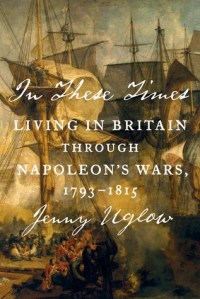
In These TimesUglow’s book is a comprehensive social history of Britain during the period of the Napoleonic Wars.  She makes extensive use of letters, journals and diaries from different social strata; we are given a first hand account of life in early 19th century Britian from clergymen, farmers, bankers, soldiers, mill owners and aristocratic women.  The only class from which we do not directly hear are obviously the illiterate poor.  But that is not to say she excludes them entirely; we are given descriptions about workhouses, wandering homeless and bread shortages from the diaries of the middle and upper  classes.

We do learn about the famous players in the wars like Pitt, Nelson, King George III, Wellington and Napoleon himself.  But they are not the focus of this history.  One will not find military battles, biographies of famous generals or copies of treaties in this book.  But the reader will discover how the daily lives and routines of British citizens were affected by this prolonged and costly war.

Uglow’s chapters are organized by themes and topics that occupied British citizens at home while soldiers were elsewhere in the world fighting the French.  At the beginning of the war, fear of invasion is a constant threat.  In order to make themselves feel more secure, local towns formed their own militia and proudly did drill practices in case the enemy ever landed on their shores.  We hear from coopers, bankers, shoemakers, farmers and men from all walks of life who were eagerly getting ready to defend their own borders from the likes of the French.

The themes of many of the chapters are related to money and economics.  Banking, bread prices, the running of mills and the national debt were all affected by the wartime economy.  Thousands of soldiers had to be given uniforms, shoes, and weapons.  The government had to pay for all of these supplies so taxes were constantly being raised.  The farmers felt a great impact from the demand placed on them for supplying food to the army and navy.  Farmer Randall Burroughes reports in his journal that he is dedicating the use of more and more land for planting oats and wheat.

The greatest strength of this book is Uglow’s extensive use of diaries, letters and journal entries that are woven throughout her narrative.  William Harness, who is serving in the British navy, writes longingly to his wife and children whom he is away from for extended periods of time.  He laments missing his children growing up and sharing in their childhood milestones.  Bessy, his wife, writes him back tenderly with news of home and their blossoming brood of children.

Randall Burroughes, a tough but fair old farmer, keeps a detailed journal which catalogs weather patterns, crop rotations, farm workers, and soil conditions.  He is the perfect example to remind the reader that, despite the fact that a global war is raging against the French, ordinary people are still farming their land, attending balls, gossiping and going to church.

In the Autumn of 1813, Uglow describes Napoleon’s defeat through the diary of John Oakes: “two Great Battles…at which The French and her Allies were totallyl routed, 30,000 taken Prisoner and 35,000 Killed & Sick taken. Bonaparte made his Escape wh. a party of Cavalry to Erfurt.”  Political and military events are recorded in the diaries of British citizens alongside weather reports, births, deaths and other family news.

This book also gave me a better appreciation for some of my favorite books that are set in the 19th century.  The chapter on “British Tars” chronicles in great detail the fear of the press gangs as they lurked around the British seaside looking for able bodied men to kidnap and force into naval service.  This reminded me of the vivid scenes in Gaskell’s Silvia’s Lovers in which one of characters is taken off by a press gang and not heard from again for years.  The discussions of the superior British navy and the opportunity for men to advance and get rich from prize money reminded me of Captain Wentworth in Austen’s Persuasion.  In the chapters about the brief pause in the war, the Peace of Amiens, Uglow describes the extended travel vacations that were enjoyed by the aristocracy; in the summertime a favorite destination was the Lakes region of Britain which, of course, reminds us of Lizzie’s journey with her aunt and uncle through this part of the country and her accidental meeting with Darcy.

Some of the transitions between topics in different chapters were rather abrupt.  A few times I became very interested in a particular story and the author would abruptly move on to another topic.  For example, the chapter “Going to the Show,” which describes the elaborate celebrations for the Jubilee of King George III and the types of theatrical events staged during the war, ends with an odd and out of place description of Napoleon’s separation from Josephine.

Overall, this is a comprehensive tome that will be appreciated by a wide variety of readers.  Those who take pleasure in British history, and social history in particular, will revel in the extensive use of primary source letters and journals.  Those who are fans of Austen, Burney and Gaskell will enjoy learning more about the time period in which their favorite books are set.  And finally, those who enjoy a well-written, thoroughly researched and interesting history will not want to miss reading IN THESE TIMES.

About The Author:
UglowJennifer Sheila Uglow OBE (née Crowther, born 1947) is a British biographer, critic and publisher. The editorial director of Chatto & Windus, she has written critically acclaimed biographies of Elizabeth Gaskell, William Hogarth, Thomas Bewick and the Lunar Society, among others, and has also compiled a women’s biographical dictionary.


4 Comments

Filed under History, Nonfiction

Review and Author Interview: Tomazina’s Folly by Stuart Shotwell

I thought that the best historical novel I had ever read was Edmund Persuader by Stuart Shotwell which I finished last spring.  However, now that I have read Tomazina’s Folly, the sequel to Edmund Persuader, I have realized that Mr. Shotwell has truly outdone himself with his writing and I cannot decide if Edmund Persuader or Tomazina’s Folly is the best historical book I have ever read.  I invite you to read my review of Tomazina’s Folly and to read the wonderful answers to my questions that the author has graciously agreed to write.

My Review:

Tomazina's FollyOvid, in his epic poem the Metamorphoses, demonstrates most deftly the pain of unrequited love through the myth of Apollo and Daphne.  After Apollo mocks and attempts to belittle Cupid, the God of Love strikes Apollo with a golden arrow, the arrow that makes Apollo fall in love with the nymph Daphne.  But Cupid then pierces Daphne with the dreaded lead arrow, the arrow which makes someone turn away from the beloved.  Apollo desperately tries to pursue Daphne and the more she is pursued by Apollo, the more adamant Daphne is in her rejection of him.

When Tomazina’s Folly opens, it is Tomazina who has taken on the role of Apollo and she loves someone who cannot possibly love her back.  As a young, unmarried woman living in 19th century England whose father is devoutly religious, any sort of sexual feelings she might have are viewed as a sin.  Tomazina is tormented by her secret passion to the point where she thinks about harming herself.  Tomazina desires a marriage to a man who will be her intellectual, spiritual and physical equal.  She believes that there is only one man in the world who could possibly fulfill this role and he is already married.  Tomazina views her unrequited love and impulsive passion as her greatest folly.

Continue reading

6 Comments

Filed under Historical Fiction