 Pindar, an Ancient Greek lyric poet from Thebes, wrote a series of epinikia, odes to commemorate athletic victories in the Olympic, Nemean, Pythian and Isthmian games. His poems are notoriously difficult to translate and understand because they are highly allusive, switch abruptly between topics, and contain compound adjectives that he makes up. It is no wonder that Geoffrey Hill, whose poetry is also highly allusive and difficult to read, uses the lyric poet as a model for his series of poems entitled Pindarics. The traditional Ancient Greek ode has a triadic structure with each triad composed of a strophe, antistrophe and epode. Hill adopts this triad structure to fit his own purposes by composing a series of 34 poems, each with three stanzas; the first and second stanzas of each poem have nine lines and the final stanzas each have five lines.
Simon Collings, in the PN Review Issue 240 has written a wonderful essay about the themes of love and sex in Hill’s Pindarics. But even as far as specific allusions to people, personal or otherwise, it is a guessing game when it comes to unpacking and dissecting Hills poetry. In the past two weeks I have especially lingered over Pindarics 7 and 13 in which he discusses one of his favorite topics, poets and poetry. In Pindaric 7 he begins with:
Rub two distichs together, wise not to
bet against fire. A view to fail,
repump a washed-up beach ball, palp a god,
cross vows with a convenience metaphor.
All is invention; I am spoiled for choice.
Assign me Pindar’s job-lot born to sing
modernities traduced or what you will;
homeo-pharmacopeia’s adagia
spilled upon none that reads. Your votes Ile dig—
“All is invention; I am spoiled for choice” are especially striking here. Hill has centuries of poetic forms from which to borrow, and his use of lyric triads could be his attempt to “repump a washed-up beach ball.” And the last part of the stanza specifically mentions Hill’s view of himself as a modern Pindar but instead of singing about athletic victories his topics are “modernities traduced or what you will.” The last two lines are also a more subtle nod to Pindar as Hill makes his own compound word: “homeo-pharmacopeia,” a special homeopathic book with remedies that serve as a type of “adagia,” The adagia is a book of proverbs compiled by Erasmus. But Hill’s wisdom via this adagia is, in typical self-deprecating fashion, “spilled upon none that reads,” ie. only those who read—really read and understand his arcane verses.
Pindaric 13 is also filled with allusions to poets and poetry. In the first stanza he writes:
How reconciled, then, Ovid, by such time
as in Voronezh he was no man’s fool?
Hill’s specific subject here is the exiled Roman poet Ovid was banished to the Black Sea town of Tomis in 8 A.D. . This was done personally by the Emperor Augustus himself. We are given very few details about what Ovid did and he only tells us it was due to a carmen (a poem) and an error (a mistake). He is absolutely wretched in exile and writes two works about it: Tristia and the Epistulae ex Ponto. He dies in 17 or 18 A.D. while still in exile.
But, as is typical with Hill, there is another subtle reference to the Russian poet Osip Mandelstam who also suffered exile at the hands of the Soviet government and Stalin in particular. Tristia, literally meaning “sad things, sorrows, lamentations” is also the title for Mandelstam’s collection which he wrote in self-imposed exile while in the Crimea in the early 1920’s. The dire and desperate personal consequences of war and revolution drove him to this region of Russia which was more isolated from civil war. His time away from the north inspired him to produce these poems that are filled with images of separation, loss, darkness and exile. It is chilling that the poems also serve as a glimpse into the poet’s future which will include arrest, torture, and forced exiles to the Urals and Voronezh. He must have known, deep down in his soul, that his first, temporary, voluntary exile was a harbinger of tribulations to come in later years.
Mandelstam’s Voronezh Notebook, to which Hill specifically refers, is a collection of eighty nine verses that the Russian poet wrote while he was exiled to the city of Voronezh. During the early 1930’s Mandelstam wrote and published poetry that mocked and criticized Stalin and so it is no surprise that he was arrested and sent into exile. During part of his exile he was allowed to live in Voronezh which was a bit more civilized as far as Russian exiles were concerned. He lives is a crowded boarding house that he describes as a “coffin” in the first poem. He and his wife have no privacy and they hear every movement and sound of their neighbors. In the third poem of the first Notebook he begs Voronezh to have mercy on him and “restore” him but throughout these poems we get the sense that he feels hemmed in, claustrophobic and hopeless.
Hill’s second stanza in Pindaric 13 becomes more bleak:
What Ces describes—duration of real pain—
spikes with its radicals the roots of thought.
Hebrew mates word and thing, the acting word,
the basic punning language though not all
punsters are poets nor would wish to be.
The absolute’s absolution is itself
Presence of the intrinsic saved for death
politic power was one uncivil term.
How strange you have to be to stay faithful.
The “Ces” in the first line is Cesare Pavese to whom the Pindarics are addressed. Pavese, an Italian poet who was also subjected to self-imposed exile during the Fascist regime in Italy, committed suicide at the age of 42 after another failed love affair. Ces is also mentioned in Pindaric 1 and in the same stanza Hill refers to himself as an “exile among books.” Ovid, Pavese and Mandelstam had to all navigate the vicissitudes of tyranny and choose to stay faithful to their poetry and their art or to risk the ire of “politic power.”
So what does this all mean for Hill himself? He has a self-imposed exile of sorts when, after his first marriage falls apart, he moves to the United States. But I think this is too literal an interpretation for his poetry. I suspect that Hill felt himself to be an outsider of sorts, someone who lingered on the fringes of mainstream poetry and he, like his fellow poets, had no intention of changing himself to fit a preconceived idea of what a writer or artist ought to be. A line from Pindar Pythian IV.247-8 comes to mind (trans. my own): “It is too long of a path for me to follow the usual road; I only have a brief amount of time, and I know a shorter path . In poetic technique, I am a guide for many other poets.”

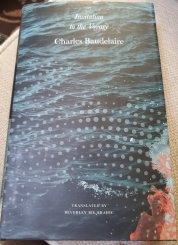 Beverly Bie Brahic is not only a talented poet, but she is also a gifted translator. Her latest work, a series of Baudelaire’s poems selected and translated for this edition entitled Invitation to the Voyage, was chosen from the wide array of the French poet’s oeuvre. Brahic describes her experience choosing, organizing and translating of Baudelaire’s work in the introduction to this volume: “When I began to translate Baudelaire, it was as an exercise in reading, visceral, as translation always is. The sensuous poems—dreams of escape to an impossible, often tropical, elsewhere, visions of voluptuousness—drew me first for their descriptive and perceptual richness. But the sensual Baudelaire needs the bitter, compassionate, desolate Baudelaire…”
 Hans Jürgen von der Wense (1894-1966) was a German composer, poet, aphorist, encyclopedist, avid walker and naturalist. When he died, he left behind in his small apartment in Göttingen over 300 folders containing about 30,000 pages of his letters, poems, photographs and diaries. Wense had intended to write an All-Book which that would be an encyclopedia, arranged alphabetically by keyword, of his aphorisms, translations and interpretations of more than 100 cultures and languages. He was also working on his Wanderbuch, which would include the lengthy observations and surveys of the landscapes he explored on his impressive daily walks.

 Geoffrey Hill intended the Book of Baruch to be published posthumously and he worked on this collection of poems right up until his death in 2016. The book contains a sequence of 270 numbered poems with no titles. It is the most erudite, difficult and engrossing volume of poetry I have ever read, which statement I do not make lightly. Even though it is a fairly slim volume it has taken me about two weeks to read and absorb Hill’s thoughts, reflections, aphorisms and cultural references. I have spent hours chasing down references to various politicians, poets, artists, and even rappers that Hill writes about. These were all of the things occupying his mind as he nears the end of his life.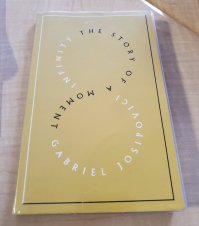



 The Book Binder's Daughter