An Addendum to my Personal Canon

When I recently wrote a list of the books that have had the greatest impact on my life, I naturally included several ancient authors.  Each work on the list is something I have translated myself and I was thinking about those texts in the original Latin or Ancient Greek.  But I have had many inquires about my favorite translations of these texts, so here is my addendum.  This is by no means an exhaustive list, but these are the old chestnuts that I return to time and again:

Homer, Iliad: The Robert Fagles translation is still my favorite (the intro. to this text written by Bernard Knox is worth the price of the book alone).  For those who want something more daring, Chapman’s translation of Homer is also something I have really enjoyed.  And for those who want something really daring, Christopher Logue’s interpretation of the Iliad, entitled War Music, is stunning (regular readers of my blog will know that I flipped my lid over this and wrote four different posts about it.)

Presocratic Philosophers: Since these authors are in fragments, the best book I have found that includes both interpretations as well as translations is The Presocratic Philosophers by G.S. Kirk, J.E. Raven and M. Schofield.

Aeschylus, Agamemnon: Once again, I have to go with the Robert Fagles translation of this which is a Penguin Edition.  This edition also includes translations of the Libation Bearers and the Eumenides.

Euripides, Trojan Women, Medea: The Oxford World’s Classics editions translated by James Morwood are my staple translations for all of Euripides. The Trojan Women and Medea are in separate volumes.  The edition with Medea also includes Hippolytus, Electra and Helen.  The edition with Trojan Women also includes translations of Hecuba and Andromache.

Sopocles, Oedipus, Antigone: The Penguin edition is my favorite which is translated by Robert Fagles and includes all three of the Theban plays. (Can you tell that I am partial to the translations of Fagles?)

Plato, Symposium: The Tom Griffith translation by the University of California Press is still my favored edition and also includes engravings by Peter Forster.

Aristotle, Poetics: I still go back to the first translation of this I’ve ever read by Leon Golden published in 1968 by Florida State University Press.  It also includes an excellent running commentary.

Catullus, Carmina: Although the English is a bit Archaic since it was originally published in 1913, I still love the Loeb translation edited and revised by G.P. Gould.  This edition also includes the poems of Tibullus which I also highly recommend.  Tom, whose erudite writing about classic literature can be found at Wuthering Expectations, recommended the Horace Gregory translation published in 1952 which I am thoroughly enjoying!  I have been reading the translations from Gregory this semester as I translate the Latin text with my students and it has been a most enjoyable experience.  Sometimes a different translation, even an older one, gives us fresh eyes.

Vergil, Aeneid: I’ve always loved the Robert Fitzgerald translation of the Aeneid which is the Vintage Classics edition, that is, until Robert Fagles published his. I also am excited to read the new translation of it that will be published by the University of Chicago Press in the fall of 2017.  Word on the street is that David Ferry’s new translation is fabulous.  Stayed tuned for my official opinion.

Seneca, everything he wrote, especially The Trojan Women: I love the dual language edition by Elaine Fantham which has been out-of-print for quite a while.  The introduction and the commentary are extraordinary.  There is also a new translation of all of Seneca’s plays that was just published by The University of Chicago Press.  Elaine Fantham was part of the team of editors and translators on this project before she passed away and I am very eager to devote my full attention to these new translations.  Stay tuned for my thoughts!

Cicero, De Senectute, Pro Caelio: The Penguin Editions of both of these translations are excellent. Cicero: Selected Works, translated by Michael Grant includes De SenectuteCicero: Selected Political Speeches includes the Pro Caelio. These are the editions that I use to teach Cicero in my classes.

Ovid, Metamorphoses, Heroides: For the Metamorphoses I have always loved Rolfe Humphries’s translation that was originally published by The University of Indiana Press in 1960.  The translation by Allen Mandelbaum published in 1995 is also excellent.  Finally, the A.S. Kline translation is also very good and is available online here: http://ovid.lib.virginia.edu/trans/Ovhome.htm

The Loeb edition of the Heroides, translated in 1914 by Grant Showerman and revised by G.P. Gould, is still my favorite. This edition also includes the Amores which I very highly recommend.  Maybe I also should have included the Amores on my personal canon?

Propertius, Elegies: (Many read Catullus and Ovid and unfortunately bypass Propertius.  But his poems are just as good and important.)  Once again, I have to go with the trustworthy Loeb edition translation by G.P. Gould.

Lucan The Civil War: (A very underappreciated epic from the Latin Silver Age)  And yet again, I have to go with the Loeb edition of Lucan translated by J.D. Duff and originally published in 1928.

I realize that there are quite a few Loeb editions on the list, but the dual text and the older translations have always appealed to me.  Please leave further suggested translations for any of these authors in the comments!
13 Comments

Filed under Classics, Opinion Posts

Venit Ver (Spring Arrives)

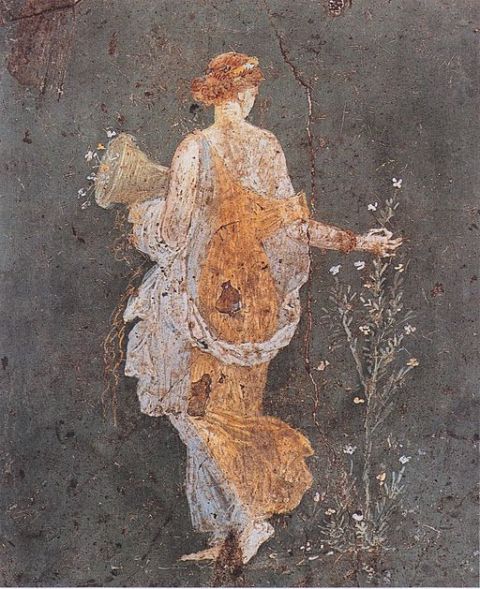
Fresco, The Roman Goddess Flora

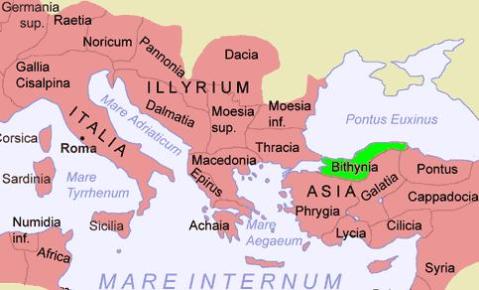
The Latin poet Catullus had a passionate yet turbulent love affair with a prominent married woman named Clodia. When Clodia finally releases him for good, Catullus accepts a position on the staff of the Roman governor of Bithynia to get out of town for a while and away from any painful reminders of his love affair. He chooses this long and tedious journey to get as far away as possible from Rome in order to nurse his sore wounds. But as we learn from poem 10, the governor of Bithynia was a crook and Catullus did not make any profit there. After a year in this outpost in Asia Minor, Catullus writes a poem in 56 B.C. as he is about to embark on his journey home. It is springtime and Catullus has that renewed sense of hope which comes with the warmer air and the fresh breezes. The meter is hendecasyllabic:

Catullus, Carmen 46:

Iam ver egelidos refert tepores,
iam caeli furor aequinoctialis
iucundis Zephyri silescit aureis.
Linquantur Phrygii, Catulle, campi
nicaeaeque ager uber aestuosae:
ad claras asiae volemus urbes.
Iam mens praetrepidans avet vagari,
iam laeti studio pedes vigescunt.
O dulces comitum valete coetus,
longe quos simul a domo profectos
diversae varie viae reportant.

My Translation of Carmen 46:

Now spring returns the mild warmth
now the fury of the equinoctial sky is silenced
by the pleasant breezes of the west-wind.
Let the Phrygian plains, Catullus,
and the fertile fields of Nicaea be left behind:
Let us fly through the well-known cities of Asia.
Now my mind, trembling with anticipation, strongly desires to roam,
now my happy feet become lively with eagerness.
Take care, oh cherished group of friends
who, having traveled together far from our homes,
are now being carried back on different roads.

I find this time of the year, May in particular, to be the most difficult to get through as far as teaching my classes are concerned. The springtime causes the students to become increasingly impatient because they are trapped in a classroom as the weather is becoming warmer.  Who could blame them! The spring has mixed blessings for me: I enjoy the warmth of the sun and the budding flowers but I don’t look forward to fidgety students who are increasingly eager to carry their laeti pedes (happy feet) away from these halls of learning for summer.

Fresco from the Villa di Livia

9 Comments

Filed under Classics, Opinion Posts

My Personal Canon of Great Books

There have been lots of fascinating lists of personal canons of great books among lit bloggers and I’ve succumbed to peer pressure and made my own list.  As I was thinking about my list I realized that the ancient authors are embarrassingly predictable.  So I’ve broken my canon into two parts, ancient and everything else.

Ancient Authors:

Homer, Iliad

Presocratic Philosophers, The Main Fragments in Ancient Greek

Aeschylus, Agamemnon

Euripides, Trojan Women, Medea

Sopocles, Oedipus, Antigone

Plato, Symposium

Aristotle, Poetics

Catullus, poems

Vergil, Aeneid

Seneca, everything he wrote, especially The Trojan Women

Cicero De Senectute, Pro Caelio

Ovid Metamorphoses, Heroides

Propertius, Elegies  (Many read Catullus and Ovid and unfortunately bypass Propertius.  But his poems are just as good and important.)

Lucan The Civil War  (A very underappreciated epic from the Latin Silver Age)

Everything Else:

James M. Redfield, Nature and Culture in the Iliad

Pascal Quignard, The Roving Shadows and The Sexual Night

Jean-Luc Nancy, Corpus and Coming

John Wiliams, Augustus and Stoner (Stoner is his more popular novel, but Augustus is brilliant!)

Anne Carson, Nay Rather, The Bakkhai (This is being published in the US in the fall and it is stunning.)

Christopher Logue, War Music

Antal Szerb,  Journey by Moonlight

Christa Wolfe, Medea

Alexander Pushkin, Eugene Onegin

R.D. Blackmore, Lorna Doone

Elizabeth Barrett Browning, Aurora Leigh

George Eliot, Middlemarch

Sandford Friedman, Conversations with Beethoven

Derek Walcott, Omeros

Georgi Gospodinov,  The Physics of Sorrow

Sergei Lebedev, Oblivion and The Year of the Comet

Stuart Shotwell, Edmund Persuader, Tomazina’s Folly (a little know author, both books are 1500 pages each and some of the best modern writing I’ve ever encountered)

Charlotte Bronte, Jane Eyre

Jane Austen, Persuasion and Pride and Prejudice

Teffi, Tolstoy, Rasputin, Others and Me

Of course all of this is subject to change according to the year, my mood, the weather, etc.  What are the books on your personal canon?

34 Comments

Filed under Opinion Posts

Review: Blindness by Henry Green

Blindness is the first of Henry Green’s nine novels and has elements of autobiography woven into the character sketch of seventeen-year-old John Haye, a student attending British public school in the early twentieth century. The first part of Blindness is written as a series of diary entries by John who is attending Noat, a school that closely resembles Green’s alma mater, Eton. John’s diaries are filled with entries about his keen interest in writing, stories of his silly friends, anecdotes about public school life and the various duties of his important role as the secretary of the Noat art society. During one of his trips home, John is injured in a horrendous, freak accident and he is permanently blinded. Forced to leave school and live at Barwood with his stepmother and old Nanny, John’s carefree life comes to a dramatic end. In Green’s unique presentation of a Bildungsroman, young John must reexamine the world through the use of his other senses and learn to deal with his new version of reality as he moves forward with his life.

Green’s use of diary entries for part one of his book, the single chapter of which is aptly called “Laugh,” is a subtle way of showing us the humor and quirks of John’s easy existence but without turning his protagonist into a ridiculous caricature of a British school boy. John’s entry for October 1 reads:

Brown, a friend of mine, has hit Billing, who keeps the food shop where you get rat poison, in the stomach so that he crumpled up behind the counter: the best thing that has happened for years.

Billing had apparently hit Brown previously, and had sent him to the Headmaster for being rude, and he, instead of backing Billing up, had asked Brown why he had not hit back: so when Billing hit Rockfeller today, Rockfeller being with Brown was rude to Billing, who attacked Brown, who laid Billing out. Meanwhile Brown has gone to his House master to ask that Billing’s shop may be put out of bounds, and Billing presumably is going to the Headmaster. There will be a fine flare-up.

John’s diary is replete with these seemingly mundane stories that Green’s writing style manages to make witty and charming. John takes his role as secretary of the Noat art society very seriously and is oftentimes stressed out because of the various shows and lectures the he helps to organize. Social ostracism, wearing the right clothes and hats, thoughts on his favorite books and his interest in a writing career are topics that fill up the pages of this entertaining diary. We also get a glimpse of John’s fussy stepmother who is consumed with running her household, fighting with the Town Council and making certain that everyone in the village is behaving properly. John thinks that she doesn’t really understand him on any kind of a deep level, but he acknowledges that she is a concerned and loving mother figure to him.

Although the rest of the book is not written in diary form, Green continues to narrate the actions through the intimate thoughts of various characters. Green’s strength as an author begins in this first book with his ability to allow his audience to experience the events and images of the book right alongside with his characters. For example, we learn through her rambling thoughts that Nanny has raised John since he was born and that she is completely distraught over the accident; Mamma is concerned that John will never have anything to do with his life and will be in danger of staying a bachelor. Mamma dearly misses her husband, John’s father, whom she is certain would have know the right courses of action to deal with this tragedy.

Parts two and three have a marked change of tone from the humorous to the more serious. But Green manages to do this without turning the story into a banal tragedy. What ties the three parts of this book together is John’s optimism even when he can no longer see. As he learns that there is no chance that he will ever have his vision back, he absorbs this bad news with a stoicism that developed in him while he was a student at Noat. He tries to console his mother and his nanny who seem much more distraught at the news of his blindness than John himself. While he is getting used to the darkness that has permanently set in we see the first glimpses of his optimism:

But he was blind, everyone would be sorry for him, everyone would try to help him, and everyone would be at his beck and call; it was very nice, it was comfortable. He would take full advantage, after all he deserved it in a conscience. He would enjoy life. Why not? But he was blind.

Another strength of Green’s writing that shines through in Blindness is his ability to describe in great detail images that beautifully capture the splendor of the English countryside. Green weaves these different images throughout his story so that they are fitting for John’s metamorphosis from Caterpillar, to Chrysalis, to Butterfly, as the three parts of the novel are fittingly named. When John is first blinded he is still trying to experience the beauty of Barwood estate through memories of vision. Green writes:

So much of life had been made up of seeing things. The country he had always looked to for something. He had seen so much in line, so much in colour, so much in everything he had seen. And he had noticed more than anyone else, of course he had.

But when he had seen, how much it had meant. Everything was abstract now personality had gone. Flashs came back of things seen and remembered, but they were not clear-cut. Little bits in a wood, a pool in a hedge with red flowers everywhere, a red-coated man in the distance on a white horse galloping, the sea with violet patches over grey where the seaweed stained it, silver where the sun rays met it. A gull coming up from beneath a cliff. There was a certain comfort in remembering.

As John adjusts to his new world, Green shifts his imagery in the final part of the book from an emphasis on the visual to the aural and the tangible:

He was in the summer house. Light rain crackled as it fell on the wooden roof, and winds swept up, one after the other, to rustle the trees. A pigeon hurried rather through his phrase that was no longer now a call. Cries of rooks came down tohim from where they would be floating, whirling in the air like dead leaves, over the lawn. The winds kept coming back, growing out of each other and when a stronger one had gone by there would be left cool eddies slipping by his cheek, while a tree further on would thunder softly.

John’s newfound outlook on life coincides with a bizarre relationship he has with a woman named Joan who lives in a dilapidated cottage with her drunken father. Green’s insertion of this storyline and character has a mixed success in the overall narrative structure of the story. There is a long interlude at the end of part two that describes Joan and her miserable life with her father who was once the village parson but has been ostracized because of his alcoholism and the rumors that he deceased wife was cheating on him. The abrupt change from John and his family’s perspective to Joan and her father seemed out of place especially since her story was given no real ending by Green. At best Joan serves as a catalyst for John to explore the world through other senses as he and Joan take long walks in the woods together. But it is evident that their different social classes and upbringing is too much of an obstacle for them to have any long-term commitment to one another.

The Joan episode is not completely devoid of its merits within the framework of the book, however. Green could have been easily turned their story into the cliché blind-rich-boy meets and marries poor-downtrodden-scared girl who live happily ever after. Even in his first novel Green writes an unexpected ending; John’s optimism wins over and an unlikely character, who isn’t Joan, helps him embrace a new life and become the adventurous, independent butterfly he is meant to be.

About the Author:
Henry Green was the nom de plume of Henry Vincent Yorke. Green was born near Tewkesbury, Gloucestershire, into an educated family with successful business interests. His father Vincent Wodehouse Yorke, the son of John Reginald Yorke and Sophia Matilda de Tuyll de Serooskerken, was a wealthy landowner and industrialist in Birmingham. His mother, Hon. Maud Evelyn Wyndham, was daughter of the second Baron Leconfield. Green grew up in Gloucestershire and attended Eton College, where he became friends with fellow pupil Anthony Powell and wrote most of his first novel, Blindness. He studied at Oxford University and there began a friendship and literary rivalry with Evelyn Waugh.

Green left Oxford in 1926 without taking a degree and returned to Birmingham to engage in his family business. He started by working with the ordinary workers on the factory floor of his family’s factory, which produced beer-bottling machines, and later became the managing director. During this time he gained the experience to write Living, his second novel, which he worked on during 1927 and 1928. In 1929, he married his second cousin, the Hon. Adelaide Biddulph, also known as ‘Dig’. They were both great-grandchildren of the 1st Baron Leconfield. Their son Sebastian was born in 1934. In 1940, Green published Pack My Bag, which he regarded as a nearly-accurate autobiography. During World War II Green served as a fireman in the Auxiliary Fire Service and these wartime experiences are echoed in his novel Caught; they were also a strong influence on his subsequent novel, Back.

Green’s last published novel was Doting (1952); this was the end of his writing career. In his later years, until his death in 1973, he became increasingly focused on studies of the Ottoman Empire, and became alcoholic and reclusive. Politically, Green was a traditional Tory throughout his life.

10 Comments

Filed under British Literature, Classics, New York Review of Books

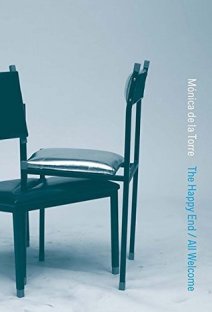
Review: The Happy End/All Welcome by Mónica de la Torre

My Review:

As much as companies like Google have attempted to rearrange office space into non-traditional configurations and break free of the rat maze of traditional cubicles, we still show up to work every day and have to function within a corporate structure.  Monica de la Torre’s collection of poems in The Happy End/All Welcome satirize the futile attempts of office dwellers to break free of the constraints imposed on them by bosses, human resources, and even the chairs they sit in.  De la Torre cleverly highlights the absurdity that we face in our every day work lives by using a scene from the unfinished Kafka novel, Amerika,  as her backdrop.

Kafka’s Amerika, which was published posthumously, tells the story of sixteen year-old Karl Roßmann who is forced to emigrate to the United States after it is revealed that he was seduced by a housemaid.  At the end of the novel, after Karl has had adventures with a stoker from the passage ship, a couple of drifters and his uncle, he sees a job advertisement for the Nature Theater of Oklahoma which promises to employ every applicant.  When Karl is hired as a “technical worker” he goes off to Oklahoma by train but the novel breaks off suddenly within this final chapter.  The poems in de la Torre’s collection are all set in a job fair being held by the Nature Theater of Oklahoma from Kafka’s novel.

De la Torre uses an interesting array of formats and arrangements for her poems: interviews, ad copy, reports, questionnaires and descriptions of chairs are all employed to satirize every aspect of corporate life from the job interview, to office design, to strategic plans, to the use of social media and to office politics.  Inspired by artist Marin Kippenberger’s installationThe Happy End of Franz Kafka’s Amerika” the poet states at the beginning of her collection that we are to imagine “an assortment of numbered tables and office desks with pairs of mismatched chairs within a soccer field flanked by grandstands.”  The numbered tables become the settings of poems involving job interviews for applicants who are sorely unqualified but are hired anyway.  These series of poems magnify the painful experience for everyone involved–applicant, employers, human resources, headhunters— in the job application process.  At Table 20, for example, an aspiring lifeguard with a terrible case of astigmatism is immediately given the job despite openly admitting his vision impairment.  And some applicants are asked to do the most random, absurd tasks that seem more fitting for auditions for a reality TV show than an office job:

Three people sitting on a tandem bench come forth.

Each applicant is assigned a color around which to improvise
lyrics for jingles.

Only found language displayed in the color assigned to each can
be used.

Applicants are given two hours to go searching for text in the city.

The Assistant Director selects corresponding loops from the
Buddha Machine 2.0, a portable music player, as accompaniment.

One of the funniest and most absurd poems describes a headhunter and the object of his hunt, a man who oddly looks like the artist Martin Kippenberger:

A Headhunter at the hunting blind at the edge of the field
keeps an eye on a middle-aged potbellied man in oversized
underwear who eerily resembles Martin Kippenberger. He’s
about to get in a full-sized Barbie tub near a couple of lifeguard
chairs, holds a cigarette in one hand and a hard-boiled egg in
the other.

In the Headhunter’s estimation, the man could be either rapt
in thought or overhearing the interview between the Bather
and the Lifeguard next to him. He might also be reminiscing
on the teepee villages at American Western theme campsites
he stayed at in the old days with friends, which always had hot
tubs.

The Headhunter wonders if he is seeking employment—why
else would he be at the fair? He cannot begin to imagine
what position might be appropriate for this individual defying
categorization, whose insouciance clashes with the professional
aspirations of the fairgoers.

An idea comes to him in a flash: this man could play the
Unhappy Hedonist!

This poem is set in the middle of the collection and serves a centerpiece that showcases de la Torre’s many talents as a poet.  The image of the headhunter lurking in the bushes underscores the ridiculous name given to workers whose role is recruitment.  She also brings us back to Kippenberger the artist whose installment is the specific inspiration for her strange job fair setting.  As the headhunter marks his “victim,” he proceeds to psychoanalyze him so that he can slot him into the company role that will suit him best, even if he has to invent a new job title.  It appears that the theater will now have an “Unhappy Hedonist” which position reminds us of the absurd titles that corporations have used to give a façade of importance in order to attract the highest quality of candidates for jobs which no one can clearly identify.  As I was reading this poem I kept thinking about the vague names we have for jobs even in schools. For instance, we no longer have the specific title of “Librarian” but instead we now have the difficult-to-pinpoint position of  “Media Specialist.”

When one does finally land what he or she thinks is a desirable job, reality and disappointment often set in as we see in this Case Study poem. It is interesting to note that Kafka’s working title for his novel was “The Man Who Disappeared” which is fitting for the theme of an oppressive and hard-to-break-free-from system of working life where few stand out among the corporate crowd.  The tone of this piece is markedly sadder than others in the collection:

On the first day of a new job, after quitting a highly desirable
one, the subject experiences genuine befuddlement when asked
to contribute $20 for a colleague’s taxi fare from the airport.

The day’s obligations include putting documents in boxes and
loading them into a coworker’s trunk. It soon becomes ap-
parent that the subject occupies the lowest rung of the bureau-
cracy and that, other than this odd version of paperwork, there
is nothing of consequence at stake.

The most clever and thought-provoking pieces were those that explored the idea of how we use furniture and space in an office.  An entire thriving industry has been devoted to choosing, planning and fitting out offices to make workers more comfortable and more productive.  De la Torre’s poems exude a particular tension between open and confined space, and productive and unproductive workers and ask us to think about whether or not a different arrangement of space truly makes people more active and engaged members of an office hierarchy.  In one of the poems entitled “Yes or No,” she writes:

So that personnel can move around and up and down
and function as vertical machines
office landscapes are sectioned into action offices.

It is suboptimal to give vertical machines space to move
around and up and down.

Flexible offices are not cost-effective.

Furniture in action offices is placed orthogonally.

Plants are replaced by partitions on three sides.

Action offices become cubicles.

Action offices become dead offices.

Plants enliven offices in pictures.

Living offices are safe environments for plants.

These poems force us to question whether or not it really matters how we arrange our furniture, our partitions, or our plants.  There is still a hierarchy which must be obeyed in a workplace environment or all will fall into chaos.  This collection uses several descriptions of chairs as a metaphor for the constraint that must be endured when we walk into an office regardless of  how the space is used or how it is decorated.    De la Torre poems include “The View from an Aeron Chair,” “The View from the Folding Chair,” “The View from a Womb Chair” and so on.  My favorite view from a chair is the Dodo Chair.   The Dodo is a swivel armchair, easily converted into a lounger, which is ergonomically designed for comfort.  But the poet uses a reference to the extinct bird by the same name to satirize the practicality of a comfortable chair in an office where not a single moment of rest is allowed.

A mutable shape stating that downtime hasn’t gone the way of the Dodo.

Yet the days of sitting around seem extinct.

Now it’s all go-go.  No need to go into it; who doesn’t know the feeling?

The dodo maybe?  Its temporality is other.

Its inability to adapt rendered it obsolete.

It is ironic that in an age in which we are working longer hours, are more stressed out than ever that we spend so much time in fitting out our offices with just the right type of chairs and configurations of chairs.  De la Torre sums it up best when she writes, “The office chair’s revolution is an oxymoron.”

This is one of the most clever, well-written, descriptive and hilarious collection of poems I have read this year.  For anyone looking for a new and innovative book of poems for poetry month then this one comes highly recommended by me.

Read an interview with Monica de la Torre about her inspiration for this collection at Lit Hub: http://lithub.com/monica-de-la-torre-on-corporatese-and-the-oppression-of-fancy-chairs/

About the Author:

Mónica de la Torre is co-author of the book Appendices, Illustrations & Notes (Smart Art Press) with artist Terence Gower, and co-editor, with Michael Wiegers, of Reversible Monuments: Contemporary Mexican Poetry (Copper Canyon Press). She edited and translated the volume Poems by Gerardo Deniz, published by Lost Roads and Taller Ditoria, and has translated numerous other Spanish-language poets. Born and raised in Mexico City, she moved to New York in 1993. She has been the poetry editor of The Brooklyn Rail since 2001 and is pursuing a PhD in Spanish Literature at Columbia University. Her work has appeared in journals including Art on Paper, BOMB, Bombay Gin, Boston Review, Chain, Circumference, Fence, Mandorla, Review: Latin American Literature and Arts, and Twentysix. Talk Shows was her first book of original poetry in English.

5 Comments

Filed under Poetry