
This is my review of David Ferry’s new translation of The Aeneid (University of Chicago Press, Septemeber 2017) that originally appeared in the September issue of Open Letters Monthly.

My first encounter with translating Vergil’s Aeneid was in my third year Latin course in high school. I was not very impressed. I distinctly remember thinking, how could anyone consider this work, which is a blatant plagiarizing of Homer, such a masterpiece? I mean, come on, the Roman poet even admits in the first two words of the epic—arma virumque cano (I sing of arms and a man)—that he is going to steal his material from the Ancient Greeks.
It wasn’t until I translated The Aeneid again, during my second year in college, that I began to understand fully and grasp the genius and beauty of the Latin hexameter, the poetic devices and the decidedly Roman characters that Vergil created. The Augustan Age poet, whose full name was Publius Vergilius Maro (making his name more correctly rendered in English as Vergil, and not the popularly used Virgil) composed over 10,000 lines of Latin verse, in 12 books, the first half of which deal with his hero, Aeneas, wandering around the Mediterranean Sea while being pursued by an angry goddess. This brave man, who is described in Homer’s Iliad as a valiant warrior, has escaped from his homeland of Troy as it is being looted and burned by the Greeks and he is looking for a new place to settle. Vergil’s poem, in telling the story of the aftermath of the Trojan War and how Aeneas’ settlement in Italy will lead to the founding of Rome, is a distinctly Roman contribution to the Homeric tradition. The first six books are Vergil’s nod to The Odyssey, the focus of which epic is also on the virum (man) who is trying against impossible odds to get home. Books VII-XII of The Aeneid focus on arma (warfare) and serve as Vergil’s attempt to compose a Roman Iliad as he tells the story of Aeneas’ landing in Italy and his battles against the Rutulians.
The classicist Anne Carson, in her book Nox which contains an English translation of a poem composed by the Roman poet Catullus, describes her experience with Latin translation: “But over the years of working at it, I came to think of translation as a room, not exactly an unknown room, where one gropes for the light switch.” For centuries, scholars have been groping around in that dark room, searching for that evasive switch whereby they might shine a new light on Vergil’s epic. John Dryden, Richard Lattimore, Stanley Lombardo, Robert Fitzgerald and Robert Fagles are just a few of the brave classicists who have attempted to render The Aeneid into fluid English that captures the poetry and brilliance of the original Latin. David Ferry, whose translation of The Aeneid was published by the University of Chicago Press in September of 2017, is the latest scholar to add his name to this illustrious list of translators.
The language of the Ancient Romans is succinct and tight, oftentimes lacking grammatical structures that add to the complexity of a Germanic language like English. Latin contains no articles, has only six verb tenses, and has a much smaller vocabulary than most modern languages . Whereas word order is of the utmost importance in comprehending a sentence in English, Latin is inflected so that nouns, pronouns and adjectives are assigned different endings to indicate their case and use (subject, direct object, etc.) in a sentence. So how does a translator deal with these linguistic differences while at the same time taking into account the meter and figures of speech that are also contained within the lines of Vergil’s Aeneid?
In the Preface to his translation, Ferry cites a line in Aeneid XI that helps to elucidate the important and distinctly Roman themes and concerns in Vergil’s epic. When Aeneas and his men are preparing to collect and bury the dead heroes from the battlefield the scene begins:
Aurora interea miseris mortalibus almam
Extulerat lucem referens opera atque labores.
Aurora rose, spreading her pitying light,
And with it bringing back to sight the labor
Of sad mortality.
Ferry explains the significance of these lines:
This beautiful two-line sentence with which Vergil’s Latin introduces this passage from book 11 is definitive. It defines for us how we are to experience the telling of this heartbreaking scene; it is also, I believe, the definitive declaration of how to read the whole continuing enterprise of the poem, the accounting of what men have done and what has been done to them and what they must do to mourn, here and in every episode of the work.
When the epic begins, we are in medias res, in “the middle of things”, as Aeneas and his men are sailing the Mediterranean and Sicily is in sight. Aeneas is battle and sea weary and is looking forward to landing his ships when a vicious storm threatens to drown his entire crew. Despite the fact that he has suffered so many hardships, he continues to be subjected to the cruel whims of the gods and fate. This windstorm has been sent by the goddess Juno who is still angry that any Trojan might have escaped the burning of Troy, especially the very man who is fated to set in motion a series of events that will result in the founding of the city that will one day destroy her beloved Carthage. The force of the tempest and the wretched state of Aeneas and his men are fully captured in Ferry’s poetic rendition:
All winds together, Notus and Eurus and Africus, and
Southwest, East and South, teeming with tempests,
And vast tsunami roll toward helpless shores.
And then were heard the cries of terrified men,
And the shriek of the vessels’ cables; all light of day
Was suddenly ripped away from the Trojans’ eyes;
Black night upon the ocean waters, thunder
From pole to pole and sheets of shaking lightening
Tell of the mariners’ deaths now there at hand.
There are two aspects of Ferry’s delivery of these lines that are particularly noteworthy and that make his translation stand apart from others who have come before him. Ferry’s incorporation of poetic devices into these lines relate the immediacy and swiftness with which the storms swallow the ships. He uses polysyndeton, repeated use of the connective “and”, which punctuates the vast number of winds that are working against the fleet. Ferry further extends the polysyndeton into an anaphora, the repetition of the first word in a line, by repeating “and” once again, at the beginning of three consecutive verses that describe the ferocious winds and the reaction of the horrified men and their battered ships. One of the most disappointing features of modern versions of The Aeneid is that translators tend to leave out these poetic devices that are deliberately placed in the text and are so important to experiencing the tones and textures of the original Latin.
It is not surprising that Ferry is sensitive to using such figures of speech in his translation because of his background as a poet. Although his translations of Vergil’s Ecologues and Horace’s Odes have been widely praised, it is Ferry’s original poetry for which he has been more widely recognized. In 2012 he won the National Book Award for his collection of poems entitled Bewilderment. His discussion in the preface about his choice to use iambic pentameter for this translation of The Aeneid further underscores his talent as a poet who recognizes the importance of choosing an appropriate meter whether it be for an original piece of work or for a translation. Like generations of English translators of ancient epic that have come before him, Ferry agrees that this meter works best in the language in which he is working: “In my view, the forward-propulsive character of English speech favors iambic pentameter, in which iambic events naturally dominate, with anapestic events as naturally occurring.” The rhythm of unstressed and stressed syllables (x –) that the iambics provide are especially fitting for the rolling out of the winds as they descend over the ocean in the lines translated above
Ferry’s word choice of “tsunami” also stands out in his translation of this scene. The Latin phrase that Vergil chooses in the original to describe the sea that threatens to swallow Aeneas’ fleet is vastos fluctus. Fagles renders these words as “huge killer-breakers” and Fitzgerald goes with “high combers”. These previous attempts seem rather flat and archaic compared to Ferry’s use of “tsunami,” which word will cause a 21st century audience to conjure up images from the media of homes and villages destroyed by such a force of nature.
Books I-VI continue with Aeneas and his men suffering additional misfortunes brought on by fate. When Aeneas and what few men he has left finally reach shore, they find themselves in North Africa and are welcomed by a group of Phoenicians, having themselves recently been forced from their home as refugees, led by Queen Dido. Aeneas’ encounter with her and their tragic parting is one of the most poignant and heartrending instances of Vergil’s argument throughout his narrative that fate is destructive and cruel, especially when people try to resist the fortune that is laid out for them. In this epic poem when people stand in the way of fate they are destroyed, and Dido’s tragic death is symbolic of what will happen to her country when, later in their history, they challenge the Romans in war.
When Aeneas lands in Carthage he engages in a physical relationship with Dido and settles into a “marriage” of sorts that is fittingly blessed by the goddess of marriage, Juno, and the goddess of love, Venus. But not even these goddesses can stand in the way of fate. Jupiter sends his messenger, Mercury, down to Aeneas to force him to leave Carthage and set sail, once again, for Italy. As he tries to sneak away, Dido confronts him with a force of emotion that demonstrates the poet’s sympathy for her plight. Dido says to this hero whom she loved and trusted:
…O faithless! Did you think that you
Could hide this deed from me, and steal away?
Cannot our love keep you from doing this?
Cannot your plighted word keep you from this?
Cannot the thought of the death you would leave me to,
Keep you from this?…
By repeating “Cannot” in Dido’s anguished questions, Ferry demonstrates his acute awareness of the stirring and emotional poetry of these lines. When Aeneas is not deterred from his plans by Dido’s impassioned speech, she makes another attempt to persuade him, this time with words that are increasingly insulting and hurtful:
He did not look at me, he did not sigh, when I
Was weeping, and he did not weep himself,
In pity for me and for my love of him.
What shall I say? What is there for me to say?
Great Juno’s eyes do not look at this with injustice.
The eyes of Saturnian Jupiter do not.
There is nowhere where faith is kept; not anywhere.
He was stranded on the beach, a castaway,
With nothing. I made him welcome. Insanely, I
Gave him a place beside me on my throne.
I made his companions safe and saved his fleet—
The fire, oh, the fire rages around me!
Ferry successfully renders the full tension and force of Dido’s argument by emphasizing the third person with which she delivers her speech. Aeneas is not addressed by his name, or even in the second person as “you”, but instead becomes a “he” which is engendered in Ferry’s translation with vehement sarcasm and anger. Furthermore, the “fire” in Dido’s speech foreshadows her suicide and the flames that will pour forth from the funeral pyre that Aeneas will notice as he is sailing away.
Dido’s horrific death, as dramatic as it is, doesn’t even serve as the conclusion of the first six books of this epic. Aeneas also suffers greatly when he loses his father and makes a journey to the dreaded underworld to learn more about what fate has in store for him. There are many more labors and hardships yet to come for him.
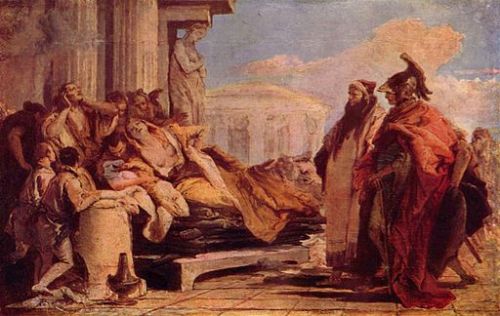
The Death of Dido, Giovanni Battista Tiepolo, mid-18th century.
When Aeneas lands in Italy, he begins building a fortress for his new settlement and he also attempts to make peace with the Latin tribes who have already built their homes there. The Rutulians, under the leadership of Turnus, vehemently oppose what they view as an invasion of foreigners in their land and, spurred on by Juno, bring about the deaths of many brave Trojans. Similar to the war scenes in The Iliad, fierce warriors, the female Camilla among them, are given their moment of valor on the battlefield.
Aeneas, however, is a distinctly Roman hero as Vergil’s emphasis of his pietas “duty”, reminds us that this isn’t Homer and we are no longer spending our time among the Greek heroes at Troy. Gone is the selfishness of the Homeric heroes who fight at Troy to win kleos “fame” or “glory” for themselves. The Greeks were never one, unified state, and although they were fighting against the Trojans as a group, each hero was fighting for his own glory and his own pride.
The Romans, however, who successfully conquered a vast amount of territory and placed it under the rule of a single leader, are fighting for the glory and the unity of a whole empire. Aeneas, whose epithet throughout the epic is pious Aeneas, is the ultimate example of pietas, which all Romans ought to follow. Bernard Knox, in his introduction to Fagles’ translation writes about this very important, Roman concept: “But pietas describes another loyalty and duty, besides that to the gods and the family. It is for the Roman, to Rome, and in Aeneas’ case, to his mission to found it in Hesperia, the western country, Italy.”
But, once again, sacrifices have to be made for this duty to be carried out and this time it will be Turnus whose life is cruelly taken in the course of his fateful encounter with Aeneas. The culminating scene in Book XII is the battle between these two warriors and, once again, Vergil is sympathetic to the vanquished:
Then Turnus saw his opportunity
And confidently raised his threatening sword—
The shouting around him of the Trojans and
His anxious Latins, both sides watch him holding
High his sword—-and then with all his body’s
Strength he struck—and the sword he struck with broke,
And it fell away, and Turnus was left defenseless,
The unfamiliar handle of the sword
Was gone, and there was nothing to do but run.
It is evident from this excerpt, one of the final scenes in the epic, that Ferry stays committed to weaving the poetic devices and figures of speech throughout his translation. His uses of anaphora and other forms of repetition, in particular, combined with the iambic pentameter serve to remind us that this is an epic poem, best read aloud regardless of the language into which it is translated. Ferry’s melodic and sensitive translation make it possible for any audience, whether first time readers or seasoned classicists, to appreciate Vergil’s message about the workings of fate. Although tragic sacrifices, like the deaths of Dido and Turnus, have to be made, something bigger and grander and stronger have the potential to emerge out of the ruins that befall us in this life.
Ferry’s rendition of The Aeneid has allowed me to look at this epic with fresh eyes and as a result has given me a new enthusiasm and excitement for The Aeneid which I never thought would be possible since I have translated it from the Latin on my own and have read various English versions of it so many times. It is astounding that in 2006, at the age of 82, Ferry undertook the most formidable and difficult work of his career by beginning his translation of The Aeneid. At an age when most literary and academic careers are winding down, Ferry has done his very best and most ambitious work.






 I had a couple of very intense discussions recently with two people closest to me about the complicated, enigmatic, confusing concept of love—both filial and passionate.
 The fifth chapter of Dorothy Richardson’s Pilgrimage describes Miriam attending a Dante lecture. As I was reading Interim I remembered that I had bought a copy of Vita Nuova translated by Dante Gabriel Rossetti that was reissued by the NYRB poets series in 2011. And from Dante I was led to Catullus and then to Sappho. I am sure that entire dissertations have been written about this topic, but here are my scattered thoughts anyway.


 The Book Binder's Daughter