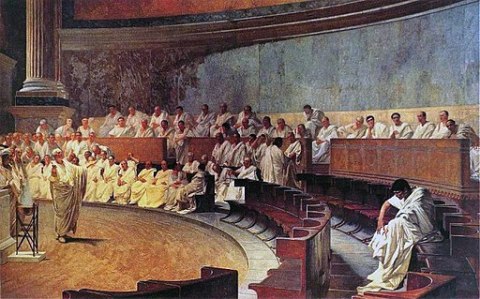
Cesare Maccari. Cicero Denounces Catiline. 1888.
The essays in Anne Boyer’s collection are fierce, poetic, erudite, engrossing and melodic. The first piece of writing is simply and strongly entitled “No.” “History is full of people who just didn’t,” she begins. A common theme throughout the essays is the multitude of ways that people and animals refuse. Her discussion about silence as resistance, however, resonated with me the most:
Saying nothing is a preliminary method of no. To practice unspeaking is to practice being unbending, more so in a crowd. Cicero wrote cum tacent, clamant—‘in silence they clamor”—and he was right: never mistake silence for agreement. Silence is as often conspiracy as it is consent. A room of otherwise lively people saying nothing, staring at a figure of authority, is silence as the inchoate of a now-initiated we won’t.
The Latin that Boyer cites is from Cicero’s Speech against Catiline who has been accused of plotting to overthrow the Roman government in an open meeting of the Senate. Cicero is attempting to persuade Catiline that, instead of being convicted of his crimes and put to death, it would be better for him to leave the city and take his band of thieves with him. When Catiline walks into the Senate to face Cicero and hear the changes against him, Cicero points out the deafening silence with which the alleged criminal is met. The two verbs in Cicero’s Latin can be translated even more strongly to reflect better the contrast that Cicero is attempting to make in his speech. “When they (The Senate) are silent, they are shouting.” Cesare Maccari, in his painting “Cicero Denounces Catiline” depicts the dejected, lonely Catiline who has been the target of this silence. Nothing is more hurtful to me than when I am ignored, stood up, ghosted; I would rather be yelled at by someone than given the silent treatment.
I detected another type of silence-as-resistance in her essays entitled Erotology. Boyer hints at unsuccessful love affairs and unrequited love in other essays, but in Erotology the longing one experiences for another person is shrouded in the lonely silence of the night:
Night performs a difference operation: you want what you want which isn’t what you want at all, but a desire formed by processes, by having had, then having no more. It is as if in matters of heartbreak the night world and the day work take on different planets with different axes or in different courts with different testimonies, different warrants, different judges, different sentences, different prisons, different laws. The night contests the day, then the day contests the night. The clarity and ordinary pace of the day is suspicious to the heartbroken person in the night: what if what the day says about the longing at night is slander?
Who among us hasn’t spend a long, solitary night contemplating an unrequited love, a lost love, an impossible love?
Many of her other essays are also a struggle, her own and others, a resistance, against all of the harsh ugliness that we are forced to endure in this strange world. The way that Boyer engages with and makes connections among different texts is engrossing. Her essay, entitled “Kansas City,” for instance, includes a reflection on that Midwestern city by drawing on the music of Fats Domino and a quote from Socrates:
When Fats Domino sings his version of the song ‘Kansas City,’ he is like Socrates who says of his ideal city: ‘Let me feast my mind with the dream as day dreamers are in the habit of feasting themselves when they are walking alone; for before they have discovered any means of effecting their wishes…they proceed with their plan, and delight in detailing what they mean to do when their wish has come true.’
Fats Domino might take a plane to the ideal city, he might take a train, but even if he has to walk there, he will get to it the same.
Kansas City becomes, for Boyer, one of the first places that she associates with resistance. The city resists or defies real description or categorization; depending on who one asks, it is a utopia—like the Kansas City of Fats Domino, it is the façade of a city that was erected for the set of the Robert Altman film, or it is the difference between freedom or slavery for black people in the 1850’s. Boyer herself moves to Kansas City in 1996 and lives there for four years and the city becomes a source of personal resistance:
What I knew when I got to Kansas City was I couldn’t be a poet—that I refused to be one—and I was soon inside whatever was not a poem, working in the shelters and community centers of Kansas City and thinking the only possible life was a life of politics, and the only possible politics was a politics for women and children and the poor. When I think of telling you what was in Kansas City the year the facades of Kansas City were built, my thoughts turn red and what I see is a field of feeling: sorrow, rage.
Her work with the poor women and children of Kansas City is one of many passionate and poignant reflections of the real struggle it is to be female in this world. In “The Dead Woman,” she writes, “But women become dead women every minute and always have, so I’m more surprised the whole world is not on fire every minute, that the winds are not roaring, that the earth hasn’t shaken open, that everyone hasn’t felt like they could die. There’s a line in Alice Notley’s epic poem Alma that I can’t find now but remember and need: something like ‘women are born dead.'” In “Shotgun Willie” she describes barely making ends meet as a single parent when her daughter was young, living in a small apartment and only listening to the A-side of a Willie Nelsen album which she bought at the Goodwill for a dime: “I didn’t like whiskey, but wanted, like Willie Nelson, for a river to take my mind, to take my memory, not from the torture of unattainable, unrequited love, but my failures, how I’d basically just let myself be nothing at all, and for years then, and treated poorly, and barely rebelling against my own poor treatment.”
One of my favorite essays (although it’s really difficult to choose) is entitled “My Life” in which she writes about three strong, talented, and resilient women who resist the struggles they face as women—the singer Mary J. Blige, the poet Lyn Hejinian and Anne Boyer herself. She begins the essay with a powerful statement that reminded me of the line about women from Notley’s epic poem cited above: “This is about calling what isn’t a life a life and calling what isn’t one’s own life one’s own, about the embellishment of any ‘my’ on a life that isn’t and can’t be or isn’t quite living, at least not all the time.” Similar to the Kansas City essay, she reads, interprets, quotes the singer and the poet and creates her own poetry through her reactions:
Mary J. Blige at the opening for the Mary J. Blige Center for Women…Blige removed her sunglasses to wipe away her tears. ‘When I was 5 years old there was a lot that happened to me …that I carry…all my life… And when…I was growing up after that, I saw so many women beaten to death, almost to their death, by men.’ LH: ‘As for we who love to be astonished, we close our eyes to remain for a little while longer within the realm of the imaginary, the mind, so as to avoid having to recognize our utter separateness from each other.’ Mary J: ‘I still love you/You know I’ll never live without you/ I wish you’d change your ways soon enough/ So we an be together.’ Mary J. Blige made a perfume. It is called My Life. The thing about My Life is almost anyone can wear it. Though a perfume is not an album and an album is not a life and a life is not a book of poetry and a book of poetry is not an essay written for a journal of music and experimental politics, one might mistake one for the other when My Life is, for so many of us, so difficult to find.
There is a struggle throughout the essays with her writing, her craft. In “Clickbait Thanatos,” Boyer laments the surfeit of poetry available online which drains the entire body of 21st century verse of its uniqueness. (In the next essay she has several humorous and, sometimes disgusting, ways of making poetry more difficult to publish.) It is full of “TMI and OMG—just like anyone’s Facebook feed.” Boyer’s thoughts about her art remind her of Lucretius’s De Rerum Natura, which Epicurean, Roman, epic poem, written during the last years of the Republic, ends with a horrifying description of the plague. The meter of the poem, no doubt, has helped it last for centuries, but the poem’s baffling and gruesome ending probably also has something to do with its preservation: “…what is also in the work of Lucretius is that everything, and nothing, lasts forever.”
Anne Boyer’s collection of writing also ends with her own description of a plague, of sorts; the last several essays have heartbreaking descriptions of her long struggle with cancer. I like to think that Lucretius ends his epic with a description of disease in order to test his readers; he has spent hundreds of lines of poetry convincing us that since life is short, we must avoid pain and do things in this life that bring us pleasure. He also believes, unlike the Stoics, that there is no afterlife, so once we are dead then that’s the end of it—no more worries, no more pain, no more resistance. Lucretius explains in Book 4 that his poetry is the equivalent of putting honey on the rim of a cup of medicine so that a child will be tricked into taking something that is good for her. If De Rerum Natura has successfully served as a type of didactic honey with which to trick people into learning his Epicurean lesson, then no one will be upset by a silly plague, will they? Although Boyer’s last few essays are especially tough to read, they, too, are a test to see if we are paying attention to her poetry, her writing on resistance, her resilient spirit. A Handbook of Disappointed Fate, is what Lucretius would call musaeus dulcis mel (the sweet honey of the muses.)
I’ve made a playlist on Spotify of the music that Boyer writes about in her essays. I found that listening to the music and rereading some of the essays as I listened made them even more meaningful:
As the week comes to a close, I’ve been basking in the afterglow of my reading experience with these essays and listening to the playlist. Please do give Boyer’s essay a try and also look at Ugly Duckling Presse for other brave, smart, riveting literature.



 Published in 1948, Nothing but the Night is John Williams’s, little known about, first novel. It takes place over the course of a single day in the life of twenty-three year old Arthur Maxley who has suffered a very traumatic experience in his childhood. When we first meet Arthur, he is alone in his apartment—he is most often alone—and after a night of solitary drinking and reading is just waking up from a dream. The story is intense and suspenseful from the very beginning as Williams slowly reveals the tragedy Arthur has suffered in his early life. By slowing down time in his narrative, we are given a realistic glimpse into Arthur’s fractured and damaged mind. For instance, Arthur forces himself to get out of bed and take a walk in the park, but never actually makes it to the park because he goes into at a seedy diner. The vivid and startling description of his breakfast is a clue that Arthur is truly suffering:
 When I mentioned on Twitter that I was going to read my first Jane Bowles story, there was a rather strong, positive reaction to her writing. But the comments I received about Two Serious Ladies still did not prepare me for reading this story. This short novel, in fact her only one, is enigmatic, humorous, surprising, even shocking and sad all at the same time. Truman Capote’s description of the story, I think, sums it up best:


 The Book Binder's Daughter