Category Archives: Opinion Posts

Venit Ver (Spring Arrives)

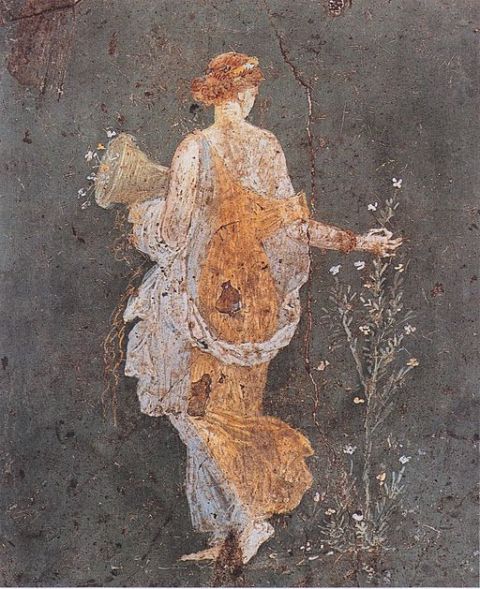
Fresco, The Roman Goddess Flora

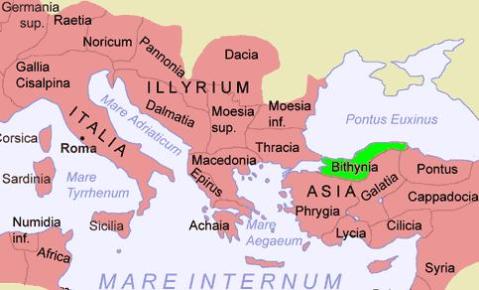
The Latin poet Catullus had a passionate yet turbulent love affair with a prominent married woman named Clodia. When Clodia finally releases him for good, Catullus accepts a position on the staff of the Roman governor of Bithynia to get out of town for a while and away from any painful reminders of his love affair. He chooses this long and tedious journey to get as far away as possible from Rome in order to nurse his sore wounds. But as we learn from poem 10, the governor of Bithynia was a crook and Catullus did not make any profit there. After a year in this outpost in Asia Minor, Catullus writes a poem in 56 B.C. as he is about to embark on his journey home. It is springtime and Catullus has that renewed sense of hope which comes with the warmer air and the fresh breezes. The meter is hendecasyllabic:

Catullus, Carmen 46:

Iam ver egelidos refert tepores,
iam caeli furor aequinoctialis
iucundis Zephyri silescit aureis.
Linquantur Phrygii, Catulle, campi
nicaeaeque ager uber aestuosae:
ad claras asiae volemus urbes.
Iam mens praetrepidans avet vagari,
iam laeti studio pedes vigescunt.
O dulces comitum valete coetus,
longe quos simul a domo profectos
diversae varie viae reportant.

My Translation of Carmen 46:

Now spring returns the mild warmth
now the fury of the equinoctial sky is silenced
by the pleasant breezes of the west-wind.
Let the Phrygian plains, Catullus,
and the fertile fields of Nicaea be left behind:
Let us fly through the well-known cities of Asia.
Now my mind, trembling with anticipation, strongly desires to roam,
now my happy feet become lively with eagerness.
Take care, oh cherished group of friends
who, having traveled together far from our homes,
are now being carried back on different roads.

I find this time of the year, May in particular, to be the most difficult to get through as far as teaching my classes are concerned. The springtime causes the students to become increasingly impatient because they are trapped in a classroom as the weather is becoming warmer.  Who could blame them! The spring has mixed blessings for me: I enjoy the warmth of the sun and the budding flowers but I don’t look forward to fidgety students who are increasingly eager to carry their laeti pedes (happy feet) away from these halls of learning for summer.

Fresco from the Villa di Livia

9 Comments

Filed under Classics, Opinion Posts

My Personal Canon of Great Books

There have been lots of fascinating lists of personal canons of great books among lit bloggers and I’ve succumbed to peer pressure and made my own list.  As I was thinking about my list I realized that the ancient authors are embarrassingly predictable.  So I’ve broken my canon into two parts, ancient and everything else.

Ancient Authors:

Homer, Iliad

Presocratic Philosophers, The Main Fragments in Ancient Greek

Aeschylus, Agamemnon

Euripides, Trojan Women, Medea

Sopocles, Oedipus, Antigone

Plato, Symposium

Aristotle, Poetics

Catullus, poems

Vergil, Aeneid

Seneca, everything he wrote, especially The Trojan Women

Cicero De Senectute, Pro Caelio

Ovid Metamorphoses, Heroides

Propertius, Elegies  (Many read Catullus and Ovid and unfortunately bypass Propertius.  But his poems are just as good and important.)

Lucan The Civil War  (A very underappreciated epic from the Latin Silver Age)

Everything Else:

James M. Redfield, Nature and Culture in the Iliad

Pascal Quignard, The Roving Shadows and The Sexual Night

Jean-Luc Nancy, Corpus and Coming

John Wiliams, Augustus and Stoner (Stoner is his more popular novel, but Augustus is brilliant!)

Anne Carson, Nay Rather, The Bakkhai (This is being published in the US in the fall and it is stunning.)

Christopher Logue, War Music

Antal Szerb,  Journey by Moonlight

Christa Wolfe, Medea

Alexander Pushkin, Eugene Onegin

R.D. Blackmore, Lorna Doone

Elizabeth Barrett Browning, Aurora Leigh

George Eliot, Middlemarch

Sandford Friedman, Conversations with Beethoven

Derek Walcott, Omeros

Georgi Gospodinov,  The Physics of Sorrow

Sergei Lebedev, Oblivion and The Year of the Comet

Stuart Shotwell, Edmund Persuader, Tomazina’s Folly (a little know author, both books are 1500 pages each and some of the best modern writing I’ve ever encountered)

Charlotte Bronte, Jane Eyre

Jane Austen, Persuasion and Pride and Prejudice

Teffi, Tolstoy, Rasputin, Others and Me

Of course all of this is subject to change according to the year, my mood, the weather, etc.  What are the books on your personal canon?

34 Comments

Filed under Opinion Posts

Lucretius, Epicureanism, and a sinking ship: My thoughts on the Inauguration

Battle of Actium. Castro, 1672.

Battle of Actium. Castro, 1672.

The beginning of Book II of Lucretius’s De Rerum Natura has always been one of my favorite parts of this Roman poet’s epic.  As Inauguration Day approaches in my country, I keep mulling over these lines for various reasons which I will explain.  First, I offer my translation of De Rerum Natura 2.1-19:

Suave, mari magno turbantibus aequora ventis
e terra magnum alterius spectare laborem;
non quia vexari quemquamst iucunda voluptas,
sed quibus ipse malis careas quia cernere suavest.
suave etiam belli certamina magna tueri
per campos instructa tua sine parte pericli;
sed nihil dulcius est, bene quam munita tenere
edita doctrina sapientum templa serena,
despicere unde queas alios passimque videre
errare atque viam palantis quaerere vitae,
certare ingenio, contendere nobilitate,
noctes atque dies niti praestante labore
ad summas emergere opes rerumque potiri.
o miseras hominum mentes, o pectora caeca!
qualibus in tenebris vitae quantisque periclis
degitur hoc aevi quodcumquest! nonne videre
nihil aliud sibi naturam latrare, nisi ut qui
corpore seiunctus dolor absit, mensque fruatur
iucundo sensu cura semota metuque?

It is pleasant, when on the vast sea the winds are stirring up
the water, to look at the great misfortune of another person
from the land; not because it is pleasant to rejoice in
another man’s troubles, but because it is a relief to
comprehend what types of evils from which you yourself
have been spared. It is pleasant indeed to look upon great
battles in war being carried out on the battlefield,
the dangers of which you have no part in. There is
nothing sweeter than to possess the fortified, lofty doctrines of
the wise, as serene temples, from which place you might look
down upon others and see that they wander everywhere
seeking a path for their aimless lives, as they struggle with
their intelligence and fight for nobility, as night and day
they wrestle with great toil to climb to the highest
mountain of riches and to acquire things.
O miserable minds of men, o blind souls!
In what shadows of life, in what perils is this age of
yours have you passed! You see, don’t you, that nature barks
for nothing other than this, that pain be severed from the body
and that the mind, freed from worry and fear, enjoy
a pleasant feeling.

As I have spoken to various friends from around the world, especially in the blogging community, I can’t help but feel that other countries are standing on the shores and watching in horror the shipwreck that is occurring in American politics with the inauguration of our 45th President. I have a sense that Canadians in particular, with their universal healthcare, and progressive Prime Minister, are grateful, in the sense Lucretius describes, that they are not part of these turbulent waters in which we Americans have found ourselves drowning.

As the Inauguration approaches, I have tried very hard not to read about any of the preparations for it and I have also vowed not to watch the news coverage on the day of the event. I don’t want to experience this shipwreck of an historical event, but then I realized that perhaps my inability to watch the shipwreck signifies that I have created an illusion for myself. It’s not that I don’t want to watch it, but instead it’s impossible for me to see it because I am on that very ship, being drowned in those waters which the wind has stirred up. Sometimes it’s very difficult not to have such a feeling of despair.

In order to mitigate our despair what are those “lofty doctrines of the wise” Lucretius suggests to which we can cling? How do we counteract a war being played out in horror in front of our eyes—a war against healthcare, basic human rights, freedoms and liberties? We cannot exist in some Epicurean garden or paradise and simply watch these things happen without being affected and without protest or action.

I can’t help but think of our incoming president as I translate Lucretius’ description of men who crave riches and devote their lives to the acquisition of things. It is evident from any thirty-second sound bite we hear that our new leader struggles with intelligence (ingenio) and has quite a lofty view of his own nobility (nobilitate). I site as an example of this exaggerated sense of nobilitas the opulent signs displaying his name on every building he owns or partially owns.

Finally, I particularly admire Lucretius’ word choice in the last few lines when talking about pain (dolor)—our nature barks or howls out (latrare) for us to get rid of any type of pain that invades our bodies and to embrace those things that bring us pleasure. How can we apply Lucretius’ advice to our current political situation? Lucretius’ suggestion of avoidance, as I noted above, seems impossible in this instance. Avoidance, in fact, is downright irresponsible. We are left with the other piece of his philosophy—to embrace those things that give us pleasure. For me this would take the form of reading, writing, connecting with friends, holding my family especially close and setting an example of kindness, tolerance and understanding for my daughter and my students. Will this be enough to mitigate the pain? Who knows. Perhaps it might be better to look to the Stoics or the Cynics for more philosophical advice in this instance.

17 Comments

Filed under Classics, Opinion Posts

Respice Futurum: Reading Plans for 2017

books-2017

I have the privilege every day of going to work at a place that I love and that has a long and rich tradition of education.  The Woodstock Academy, founded in 1801, is one of the oldest public schools in the United States and it has a simple yet profound Latin motto which reflects and respects this tradition: Respice Futurum– “Look back at your future.” (For the philologists out there, respice is a present active imperative, a compound made up of the prefix re (back, again) and the verb spicio (to look) and futurum is the accusative, singular of the noun futurum which is formed from the future active participle of sum.)

These two simple Latin words capture the idea that one moves towards the future while also reflecting on the past.  My husband likes to say that this motto is the equivalent of moving forward on a train while sitting in a seat that is facing backward.  I thought Respice Futurum is apt for a reflection on books as well;  it seems fitting to look ahead to my reading plans for 2017 while also reflecting on the types of books I have encountered over the past year and how they will influence my reading choices moving forward.

According to my list on Goodreads I read 105 books, a total of 24, 484 pages in 2016.  A few books were left off this list such as Pascal Quignard’s Roving Shadows and The Sexual Night. The Goodreads list also doesn’t include a few volumes of poetry I’ve read and some collections of essays.  And my list does not include any of the Latin or Greek authors I’ve translated or retranslated in 2016.   This was not a bad year for me, but not my best either.   The books in translation I have read have come from the following languages:  French, German, Spanish, Estonian, Russian, Italian, Bulgarian, Korean, Malayalam, Kannada, Hungarian, Swedish, Turkish, Slovene, Icelandic, Hebrew, Norwegian, Portuguese.

In looking at this list of lit in translation, I would like to explore more books from Asia and Africa which are not well-represented on my list.  I would also love to explore more books translated from Arabic which is a huge gap in my translated fiction.  If anyone has suggestions, please leave them in the comments!

Almost all of the books I have read have been published by small presses which will continue to be my main source of reading: Seagull Books, New Vessel Press, Open Letter and Deep Vellum, Archipelago, New York Review of Books and Persephone Books. 

My first read of 2017 has been The Story Smuggler by Georgi Gospondinov.  This is #29 in the Cahier Series and the first one I’ve read from this series.  I loved it so much that I went back and bought six more titles from the series, so there will be more Cahier titles in my future.

Gospondinov’s book The Physics of Sorrow is my favorite book from the Open Letter Catalog and one of my first reads in 2017 that I just started is another title from Open Letter, Justine by Iben Mondrup. 

A book that I have already started in 2016 and will finish in 2017 is The Collected Prose of Kafka from Archipelago Press.  This is a title that I am slowly making my way through and savoring.  Archipelago has managed to collect some of Kafka’s best short pieces into one volume.

I have discovered the works of French philosopher Jean-Luc Nancy this year and reading his extensive backlist published in English should keep me busy for a very long time.  Next up on my list of books written by him is his title on Sleeping.

Speaking of French writers, I am eager to read Pascal Quignard’s Terrace in Rome and All the World’s Mornings in 2017.

I was lucky enough to get an advance review copy of  Russian author Sergei Lebedev’s The Year of the Comet which is being published in 2017 by New Vessel Press.  I am very excited that I will have an interview with Lebedev coming up in an issue of Numero Cinq, for which literary magazine I am also privileged to continue to do production editing, to scout and recruit translators and to write reviews.   I am also looking forward to two additional lit in translation titles from New Vessel:  Moving the Palace (from Lebanon) and Adua (from Italy.)

I am always eager to read whatever Seagull Books publishes and thanks to their wonderful catalog I have discovered some classics of Indian literature.  I am also looking forward to reading Goat Days by Benyamin which is already sitting on my bookshelf.  I also understand that Seagull is publishing more works from Tomas Espedal in English translation which I am very eager to get my hands on.  A long-term, very long-term goal of mine is to read the entire backlist from Seagull Books.  I will do my best to put a large dent in that list this year.

This year I discovered Ugly Duckling Presse and I am eager to explore their backlist of poetry as well as their essays.  I have a copy of To Grieve by Will Daddario on my shelf already.  I would like to read more essays this year, so please leave suggestions for essays in the comments!

Finally, I would like to read more classics in 2017, especially Tolstoy, Pushkin and other Russian masters.  I have a collection of Tolstoy’s short stories and a copy of The Complete Prose of Pushkin sitting on my shelf that I have yet to read.  I also look forward to the reissues of classics from NYRB who is publishing more books my Henry Green.  I am hoping to have read all six reissued Green books by the end of 2017.  And, as always, I look forward to whatever classics from British, (mostly) female authors that Persephone Books has in store.

And as far as posts on my blog are concerned, I have always shied away from writing about Latin and Greek and classics, but my reading of Logue’s War Music has inspired me to continue writing about The Iliad and to do some of my own translations and interpretations of various Latin authors.

classics-booksA sampling of some of my most cherished classics books; the Loebs are nestled snugly on the bottom shelf.

Well, I could go on and on about my reading plans for 2017 or I could just go and actually get to reading.  Happy new year to all of my fellow bibliophiles.  I hope you also get a chance to Respice Futurum.

chair-bookroomThe cozy spot where much of my reading takes place.  It is overlooked by a print of The Roving Shadows cover done by Sunandini Banerjee, Seagull Books artist.

 

36 Comments

Filed under British Literature, Classics, Favorites, French Literature, German Literature, Hungarian Literature, Italian Literature, Literary Fiction, Literature in Translation, New York Review of Books, Opinion Posts, Persephone Books, Seagull Books

Venit Hiems (Winter Arrives)

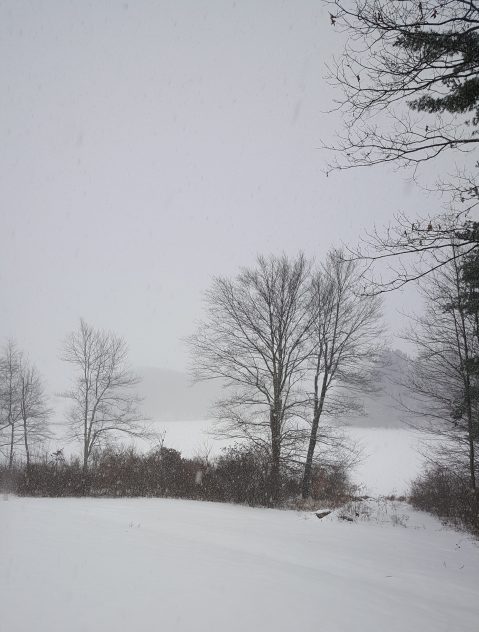
My favorite season in New England is winter.  Most people that I encounter dread the cold and the snow, but I find it relaxing and cozy when I wake up on a day like today and find a winter wonderland outside my window.  My view from every window in the house is one of stark whiteness and yet comfort for me.

The view from my back deck which overlooks a pond.  The pond is frozen over with a pristine coating of powdery snow. 
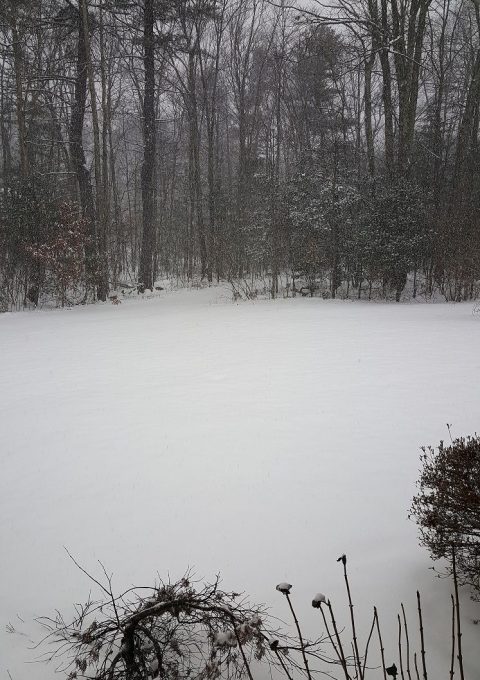
 

The view from my dining room looking up towards the driveway


The gazebo covered in a layer of fresh snow. 


The view from my kitchen looking out over the snowy woods.


Our Cape Cod style home with the wrap around porch looks best to me with a  fresh dusting of pure, white snow

 

Vergil’s agricultural poem The Georgics, describes the usefulness of winter for farmers and this passage in particular captures my feelings about winter as a time to slow down, reflect and make time for the little things for which we are usually too busy.  In Georgics 1.299-310 he writes about winter:

..hiems ignaua colono:
frigoribus parto agricolae plerumque fruuntur               300
mutuaque inter se laeti conuiuia curant.
inuitat genialis hiems curasque resoluit,
ceu pressae cum iam portum tetigere carinae,
puppibus et laeti nautae imposuere coronas.
sed tamen et quernas glandes tum stringere tempus               305
et lauri bacas oleamque cruentaque myrta,
tum gruibus pedicas et retia ponere ceruis
auritosque sequi lepores, tum figere dammas
stuppea torquentem Balearis uerbera fundae,
cum nix alta iacet, glaciem cum flumina trudunt.

…Winter is relaxing for the farmer:
During the period of cold farmers especially enjoy their lot
And they merrily engage in shared feasts with one another.
Friendly winter gives them rest and releases them from cares,
Just as when laden ships finally touch the port
and the happy sailors places garlands on their decks.
But now is the time to strip acorns from the oaks
and berries from the laurel tree and olives and the blood-red myrtle,
Now is time to place down the traps for the cranes and snares for
the stags and to chase the long-eared hares, now is the time to
strike the deer by hurling the hempen thong of a Balearian sling,
when the snow lies deep and when the rivers force along the ice.*

Although I will not be hurling a Balerian sling at deer or gathering acorns, I am taking the time today to enjoy the cozy fire, read some fabulous books, sip my favorite tea and spend time with my family.  When a winter storm is raging outside it provides me with a serene sense of peace and calm like nothing else and it forces me to slow down and enjoy the simple things.

*Translation of the Latin text is my own


23 Comments

Filed under Opinion Posts