Category Archives: Novella

Review: Twenty-Four Hours in the Life of a Woman by Stefan Zweig

I received a review copy of this title from Pushkin Press via Netgalley.  This novella was published in the original German in 1925 and this English version has been translated by Anthea Bell.

My Review:
twenty-four-hoursStefan Zweig is a master at writing short stories that are full of descriptive details, interesting characters and surprise plot twists.  It is truly amazing that he manages to do this all within the span of 100 pages.  The setting of this short piece is a hotel on the French Riviera where a group of upper class citizens from various countries are vacationing.  A shocking social incident has occurred within their social circle and this scandal has all of the guests arguing and gossiping.

The narrator, who never gives us his name, is staying on the Riveria and interacts with the other guests, incluing a German husband and wife, a “portly” Dane, an Italian married couple, and a distinguished and older English lady.  This group of strangers usually just engage in small talk and mild jokes while eating their meals, but the disappearance of Madame Henriette has disturbed their peaceful routine.  A young, handsome and garrulous Frenchman arrived at the hotel on the previous day and captivated everyone’s attention.  Zweig shows his skill at describing characters with just the right mix of adjectives and metaphors:

Indeed everything about him was soft, endearing, charming, but without any artifice or affectation.  At a distance he might at first remind you slightly of those pink wax dummies to be seen adopting dandified poses in the window displays of large fashion stores, walking-stick in hand and representing the ideal of male beauty, but closer inspection dispelled any impression of foppishness, for—most unusually—his charm was natural and innate, and seemed an inseparable part of him.

The shock comes when Madame Henriette, the wife of a wealthy businessman, disappears with the Frenchman after knowing him for only a couple of days.  All of the guests at the hotel are very quick to condemn and judge Henriette for throwing away her marriage, her children and her reputation.  The narrator is the only person who comes to Henriette’s defense and reminds the guests that it might have been possible that Henriette was caught in a “tedious, disappointing marriage” and thus had a valid reason for running off with a young man who was virtually a stranger.  This heated debate has a profound effect on Mrs. C, the distinguished English lady, who requests a private meeting with the narrator.

The story that Mrs. C. tells the narrator involves an incident in her life when she was forty-two, some twenty years earlier.  The incident had left her so embarrassed and mortified that she never told a word of it to another soul, until now.  Henriette’s impulsive decision to run away with the Frenchman has brought up old memories for Mrs. C. and she wants to unburden her soul from the guilt of her own folly.  Mrs. C. tells the narrator that, as a widow who lost her husband to an unexpected illness, she traveled around Europe while grieving for her beloved spouse.  Alone and miserable, she finds herself in Monte Carlo, one of her husband’s favorite places for entertainment, and meets a twenty-four-year old man with a serious gambling problem.

The events that unfold between Mrs. C. and the gambler bring up feelings of passion, anger, redemption, impulsivity and regret.  I don’t want to give away what happens between the widow and the young man, but I will say that Zweig has a gift for writing shocking and unexpected plot turns.  I never would have guessed the ending to Mrs. C’s story and I was riveted until the very last page of this short book.  Zweig shows us that he is an astute observer of human emotions; love, loneliness, passion and sexual desire can make us lose our minds and do irrational things which are completely out of character.

One final aspect of Zweig’s writing that must be mentioned is his careful attention to detail, even in a short work like this novella.  When Mrs. C. arrives at the casino, she describes the chiromancy—guessing a person’s moves by observing their hands— that her husband had taught her.  This English woman spent hours observing the players’ hands which are much more telling than facial expression.  Zweig writes about Mrs. C’s practice of chiromancy:

All those pale, moving, waiting hands around the green table, all emerging from the ever-different caverns of the players’ sleeves, each a beast of prey ready to leap, each varying in shape and colour, some bare, others laden with rings and clinking bracelets, some hairy like wild beasts, some damp and writhing like eels, but all of them tense, vibrating with a vast impatience.

Zweig’s description of the players via their hands is absolutely fascinating and absorbing and is another surprising gem found within the pages of this short piece.

November is German Lit. Month hosted by Lizzy’s Literary Life and Beauty is a Sleeping Cat.  The full list of reviews for this event can be found here: http://germanlitmonth.blogspot.co.uk/ and on Twitter #GermanLitMonth.

About the Author:
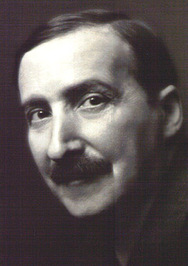
Stefan Zweig was one of the world’s most famous writers during the 1920s and 1930s, especially in the U.S., South America and Europe. He produced novels, plays, biographies and journalist pieces. Among his most famous works are Beware of Pity, Letter from and Unknown Woman and Mary, Queen of Scotland and the Isles. He and his second wife committed suicide in 1942.

Zweig studied in Austria, France, and Germany before settling in Salzburg in 1913. In 1934, driven into exile by the Nazis, he emigrated to England and then, in 1940, to Brazil by way of New York. Finding only growing loneliness and disillusionment in their new surroundings, he and his second wife committed suicide.

Zweig’s interest in psychology and the teachings of Sigmund Freud led to his most characteristic work, the subtle portrayal of character. Zweig’s essays include studies of Honoré de Balzac, Charles Dickens, and Fyodor Dostoyevsky (Drei Meister, 1920; Three Masters) and of Friedrich Hlderlin, Heinrich von Kleist, and Friedrich Nietzsche (Der Kampf mit dem Dmon, 1925; Master Builders). He achieved popularity with Sternstunden der Menschheit (1928; The Tide of Fortune), five historical portraits in miniature. He wrote full-scale, intuitive rather than objective, biographies of the French statesman Joseph Fouché (1929), Mary Stuart (1935), and others. His stories include those in Verwirrung der Gefhle (1925; Conflicts). He also wrote a psychological novel, Ungeduld des Herzens (1938; Beware of Pity), and translated works of Charles Baudelaire, Paul Verlaine, and mile Verhaeren.

Most recently, his works provided inspiration for the 2014 film ‘The Grand Budapest Hotel’

12 Comments

Filed under Classics, German Literature, Novella, Pushkin Press

Review: The Empress and the Cake by Linda Stift

I received a review copy of this title from Peirene Press.  The book was published in the original German in 2007 and this English version has been translated by Jamie Bulloch.

My Review:
the-empress-and-the-cakeThis psychological thriller starts innocently enough with a kind old woman offering to split a cake with a young woman she meets outside of a bakery in Vienna.  But Stift’s novella becomes gruesome, disturbing and haunting very quickly.

The old woman, whose name is Frau Hohenembs, is oddly dressed in all black and the young woman discovers that the old woman’s apartment is even stranger.  Frau Hohenembs has an extensive collection of pictures and mementos of the Empress Elizabeth of Austria or Empress Sissi as many referred to her.  The apartment is also packed with furniture, two caged parrots, an enormous dog and a portly servant named Ida. The young woman patiently observes these strange women while she has tea and eats her share of Gugelhupf.  The first shocking twist in the book happens when the young woman returns home to her own flat, finishes the rest of her Gugelhupf as well as everything else in her refrigerator and forces herself to throw up the entire contents of her stomach.

googlehupf_10564761126

        Gugelhopf Photo by Dirk Vorderstraße

There are two eerie and gruesome threads that run throughout the story, the first of which is an obsession with food, weight and vomiting. Stift vividl describes the narrator’s grisly decent into the full grip of bulimia and her constant obsession with the cycle of binging and purging:

I was learning a new vomiting technique and was eating by colours.  I started with chemical sweets such as bright-green gummy frogs or pink foam bacon bits or claret so-called laces and snakes.  These took time to mix with the mush of food that followed, which meant that my vomiting could be monitored.  I would puke until I’d arrived at this tough, lurid mass, so I could be sure I’d got everything out.

The narrator also weighs herself incessantly every few minutes on a pair of scales she purchases.  She becomes obsessive about her weight and the size of her stomach.  She is so consumed with food and vomiting that she stops working and only goes out of her flat every few days to go on a grocery shopping binge.  She reveals throughout the course of the story that her mother and maternal grandfather also had an unnatural preoccupation with being thin and this fixation on weight affected her from a  very early age.  Her deep-seated psychological issues make her easy prey for the manipulative and controlling Frau Hohenembs.

Empress Sissi 1862 by Ludwig Angerer

       Empress Sissi 1862 by Ludwig Angerer

The second theme that is woven throughout the narrative is that of control, both losing it and gaining it over others.  Frau Hohenembs has an obsession with the Empress Sissi and pulls the young narrator into her plots to steal relics and artifacts that once belonged to the Empress.  Frau Hohenembs first invites the narrator to a picnic after which they take a bizarre tour through a sex museum.  Stift is a master at slowly developing the ways in which the older woman gains control over the younger woman’s life.  At first she can’t say no to innocent outings that involve picnics and museums.  The next significant turning point in this disturbing relationship is when Frau Hohenembs uses the young woman to steal a duck press from another museum in Vienna.  This rather macabre kitchen instrument is used to squeeze the blood, bone marrow and other juices out of duck carcasses. Frau Hohenembs loves to drink the meat juices extracted from the press and throughout the novel she has Ida use the press so that she can always have her favorite drink on hand.

Frau Hohenembs uses this theft of the duck press to gain more control over the narrator’s life.  She tells the young woman that if she doesn’t go on outings with her or help her out on her secret missions then she will report her to the police.  Frau Hohenembs becomes progressively sinister and appears to have connections around Vienna that would help her to have the young woman prosecuted.  The final, and most disturbing, theft that the trio carry out is stealing a cocaine syringe that belonged to the Empress Sissi from a pathology museum in Vienna.  Frau Hohenembs then instructs the young woman on how to use it properly to inject the old woman with daily doses of cocaine.

By the end of the novella, the young narrator is trapped and completely controlled, not only by her eating disorder but also by this strange old woman and her maid.  Straft is a master at building suspense and presenting an unexpected and frightening conclusion to her psychological thriller.

This is the third and final installment in the Peirene Fairy Tale series.  All three books in the collection are very different but are all excellent.  I don’t think I can choose a favorite from the series.  I have also reviewed the other two Fairy Tale books:

Review: Her Father’s Daughter by Marie Sizun

Review: The Man I Became by Peter Verhelst

About the Author:
l-stiftLinda Stift in an Austrian writer. She was born in 1969 and studied Philosophy and German literature. She lives in Vienna. Her first novel, Kingpeng, was published in 2005. She has won numerous awards and was nominated for the prestigious Ingeborg Bachmann Prize in 2009.

 

8 Comments

Filed under German Literature, Literature in Translation, Novella

Review: 33 Revolutions by Canek Sánchez Guevara

My Review:
33-revolutionsI first became interested in the tumultuous history of the small island of Cuba when I took a Caribbean politics course in college.  It fascinated me that an island which is so geographically close to the United States could be so very different in its political system.  33 Revolutions captures life under the Castro regime from the point-of-view of an ordinary citizen who has become disillusioned from promises of change and is trying to scratch out a bare existence.

This book is more of an ode to a an island that has been betrayed by promises of revolution than a novella.  In order to capture the atmosphere is his life the author’s constant refrain throughout the writing is “like a scratched record.”  His monotonous job is like a scratched record;  the small and nondescript apartment he lives in alone is like a scratched record;  the monotonous routine of his office where he performs minimal tasks for a government agency is like a scratched record.  Guevara’s prose is lyrical and captures the frustration of citizens like this unnamed author who feel stuck and trapped:

The whole country is a scratched record (everything repeats itself: every day is a repetition of the day before, every week, month, year; and from repetition to repetitions, the sound deteriorates until all that is left is a vague, unrecognizable recollection of the original recording—the music disappears, to be replaced by an incomprehensible, gravelly murmur.)

The narrator tells us about the beginnings of the revolution in Cuba and as a result of which upheavel his well-bred mother and his ignorant peasant of a father were able to connect:

They met—or rather, bumped into each other— at one of those huge meetings where anger and fervor fused, and further encounters in various associations and assemblies ended up giving rise to an awareness that they were equal, that they had the same dreams, were part of a project that included them and made demands on them equally.

The narrator spends the rest of the novella explaining the countless ways in which this revolution failed its people and took away any spark of fervor that they once had to make their lives better. The narrator himself is brought up fully indoctrinated into the ideals of the revolution and the regime.  He was the model citizen until one day when he started reading and a whole new world, one outside of Cuban Communism, opened up to him.

One of the most interesting and enlightening descriptions in the book is that of Cuban citizens using makeshift rafts and boats to try and escape the Communist regime.  The author comments that boats full of people used to attempt to escape under the clandestine cover of night, but now people are brazen and openly board their skiffs in public during the day.  It is an incident with a large group of young people who try to hijack a government boat in the harbor that serves as the narrator’s breaking point.  He decides he can’t take the scratching of that broken record any longer and declares, “I’m not going to suppress anybody.”  And with these simple words, he declares his own minor revolution and never looks back.

About the Author:
canek-sanchez-guevaraCanek Sanchez Guevara, grandson of Che Guevara, left Cuba for Mexico in 1996. He worked for many of Mexico’s most important newspapers as a columnist and correspondent, and he wrote a regular newspaper column called “Motorcycleless Diaries.” He was a measured and informed critic of the Castro regime. He died in January 2015 at the age of forty.

Leave a comment

Filed under Novella, Spanish Literature

Review-A Whole Life: A Novel by Robert Seethaler

I received a review copy of this title from Farrar, Straus & Giroux via Netgalley. The book was published in the original German in 2014 and this English version has been translated by Charlotte Collins.

My Review:
a-whole-lifeWe are first introduced to Andres Egger in 1933 when he has had an unexplained instinct to pay a visit to his elderly neighbor, Horned Hannes.  Hannes is a reclusive goatherd who lives in the same Austrian mountain village as Egger and when Egger finds the old man he is barely alive.  Egger attempts to carry the goatherd on his back down the mountain but in a fit of madness due to his fever the goatherd runs off into the snow never to be seen again.  Between the time that Egger loses the goatherd while carrying him down the mountain and the goatherd’s petrified body is found forty years later on a mountain ledge, we are told the story of Egger’s whole life.

From the beginning of the book there is a sense of foreboding and ill omen.  As Egger is struggling down the mountain side with the goatherd strapped to his back they engage in an eerie conversation about death.  Horned Hannes tells Egger:  “People say death brings forth new life, but people are stupider than the stupidest nanny goat.  I say death brings forth nothing at all!  Death is the Cold Lady.”  This discussion of death hangs over the entire story like a dark storm cloud.  Egger’s tragic beginnings as an orphaned child further serve to set the tone as one of tragedy and misfortune.

Egger is orphaned as a small boy of four when his mother dies of consumption and he is sent to live with a distant relative.  The relative, a farmer named Hubert Kranzstocker, took pleasure in beating the small boy with a hazel rod for the slightest indiscretions like spilling his dinner.  Kranzstocker is so brutal in his beatings that he breaks the boy’s leg and causes Egger to have a limp for the rest of his life.  The author builds sympathy for this boy throughout the first part of the narrative: “To all intents and purposes he was not seen as a child.  He was a creature whose function was to work, pray, and bare his bottom for the hazel rod.”  To an outsider looking in, this wretched boy who is given no love and no warm place to call his own is deserving of the utmost pity;  but Egger himself would never think to waste a single moment on self-pity.  He stoically accepts what fate has to offer him and he does the best he can given his awful fate.

When Egger finally breaks free of his abusive relative at the age of eighteen he supports himself by taking on odd jobs and he saves up to buy himself a small piece of land on the mountain.  His earthly possessions are meager but they are his pride and joy because he bought them with his own earnings and he can make what he wants out of them.  The most sentimental thing that he owns is the gate that leads onto his property; one day he hopes to open the gate to a real visitor so he can show someone what he has made of the place.  This is a subtle hint that although Egger doesn’t complain about his isolation from the rest of the village, he still experiences loneliness and longs for some human contact and intimacy.  His visitor finally does come, in the form of a woman as gentle and brave as Egger himself.  But once again, cruel fate has other circumstances in store for Egger.

Egger eventually gets a regular job helping to build cable cars that will ferry tourists up to the top of the mountain.  He has conflicting emotions about his job because although it does provide him with a steady and respectable income, he doesn’t like cutting down trees and disturbing the natural landscape of his beloved mountain.  Egger recognizes the tension that his mountain must feel as each piece of rock is blasted from her façade and each precious tree is felled from her forest.  There is a hint in the text that the destruction caused by avalanches that occasionally happen on the mountain are mother nature’s way of exacting her revenge.

Through the years Egger continues to work hard and survive the best way that he knows how.  He has an adventure during World War II when, after fighting for only a couple of months, he is captured by the Russians and lives for years in a prison camp.  Even while he is in the camp Egger never complains about his fate.  As long as there is enough work in the camp to keep him busy then his mind is able to endure much more hardship than most.  And looking back on his life, perhaps it is the misery of Egger’s early years that have helped him to become strong and to even survive the hunger, disease and cold of a Russian prison camp.

The author’s simple prose is fitting for the life of this simple man; Egger’s story is emotionally jarring yet uplifting at the same time.  When the book comes to its end Egger has lived to be almost eighty years old and he has no regrets in his whole life:  “He had never felt compelled to believe in God, and he wasn’t afraid of death.  He couldn’t remember where he had come from, and ultimately he didn’t know where he would go.  But he could look back without regret on the time in between, his life, with a full-throated laugh and utter amazement.”

About the Author and Translator:
r-seethalerRobert Seethaler was born in Vienna in 1966 and is the author of four previous novels. He also works as an actor, most recently in Paolo Sorrentino’s Youth. He lives in Berlin.


Charlotte Collins studied English at Cambridge University. She worked as an actor and radio journalist in both Germany and the U.K. before becoming a literary translator. She previously translated Robert Seethaler’s novel The Tobacconist.


14 Comments

Filed under German Literature, Literature in Translation, Novella

Review: The Brother by Rein Raud

I received a review copy of this title from Open Letter  Books via Edelweiss.  The book was first published in the original Estonian in 2008 and this English version has been translated by Adam Cullen.

My Review:
the-brotherKarma, comeuppance, what comes around goes around.  There are many terms and phrases for the universal of idea of cause and affect.  The Brother is a fast-paced, hard-hitting, short book that uses the plot structure of a western as an allegory for demonstrating the balance of good and evil in the world.   The author himself has described the book as “a spaghetti western told in poetic prose, simultaneously paying tribute to both Clint Eastwood and Alessandro Baricco.”  The plot of this book is a clever structure for the philosophical and existential ideas that the author explores.  When a mysterious man, simply known as Brother, arrives in the unnamed town it is a dark and stormy day and the weather reflects the turmoil that three shady and crooked men have caused for the townspeople.

Brother finds Laila, his long-lost sister and explains why they have never met.  Brother simply states that his sudden appearance is caused by his desire to fulfill the dying wish of their father by helping Laila out of a tough time.  How Brother became privy to this information no one knows but the men who have swindled Laila out of her home and her inheritance are very nervous at Brother’s mysterious presence.  Brother’s imposing figure, with his large boots and long, black overcoat certainly cause these three men a fair amount of consternation, but it is also evident that their own guilty consciences are driving their actions.

Laila appears, at first, to be a sad and lonely woman whose entire life has revolved around an ancient family villa where she lived with her mother.  She describes her childhood as one in which she spend trying to be invisible.  At school she realized very quickly that she was much smarter than the other students but feigned stupidity so that she would not stand out among the others.  She felt that being an honors student and winning awards would draw negative attention to her in the form of jealousy so she maintained average grades and a low profile.  Laila seems to have been the perfect victim of the notary, the banker and the lawyer.

But Laila doesn’t act the part of a downtrodden victim; she enjoys her new life working in an antique shop and losing the villa allows her to break free and escape from her past.  As Laila’s life gets better and becomes happier with a newfound brother, a new job and eventually a new place to live, the three crooks in town experience a significant decline in their own fortunes.  These three men all blame Brother for their streak of bad luck even though Brother has in no way tried to exact any vengeance for the crimes against Laila.  Brother becomes the symbol for the forces in the universe that divvy out proper fate and just punishments.

But just like in life, people are not always so easily placed in a good guy or bad guy category and there is some gray area.  Willem, the banker’s assistant, is tasked with finding out who Brother is and if, in fact, he is Laila’s biological brother.  All of the evil characters in the story are known simply by their profession, such as the notary, the banker and the lawyer.  The good people or the victims, like Laila, are given real names.  It appears that Willem, as the banker’s henchman would fit into the evil category.  But in the end he does have more of a conscience than the other villains and finds some redemption.  In westerns the bad guys wear black hats and the good guys wear white hats and I think Raud’s use of names or occupations in place of names is a subtle way of using the same type of imagery to point us to the heroes and the villains.

And the title “Brother” is neither a true name or an occupation but, to me, it seemed more of a term of endearment.  Raud doesn’t even use an article and write “The Brother” but simply calls his hero “Brother.”  My twin nephews who are eight years-old oftentimes call each other or refer to each other as “Brother”;  I have always found it so sweet because they especially use it when they are helping each other or are being protective of one another.  Similarly, Raud’s uses “Brother” as a title to set the same tone of kind helper and hero for Laila’s long-lost sibling.

This appears to be the first book of Raud’s translated into English and I was so thoroughly impressed with his language, imagery and characters.  I hope more of his works will be translated into English and published in the U.S.

About the Author:
r-raudRein Raud is the author of four books of poetry, six novels, and several collections of short fiction. He’s also a scholar in Japanese studies and has translated several works of Japanese into Estonian. One of his short pieces appeared in Best European Fiction 2015.

13 Comments

Filed under Literature in Translation, Novella