
 Arguably the most enigmatic of the Ancient Greek gods, Poseidon is not as revered or respected as his brother Zeus, the god of the sky, lord of the universe, nor is he as feared as his brother Hades, master of the gloomy and dark underworld. Poseidon’s realm is the sea, the ultimate middle child whose domain is the middle of the earth, the watery depths that occupy the space between sky and underworld. Peter McDonald’s new, verse translation of the Homeric Hymns, beautifully and succinctly captures the multidimensional nature of this deity:
Hymn 22
To Poseidon:
Here the first great god that I
mention is Poseidon, mover
of the earth, the unpastured sea;
ocean god, presiding over
broad Aegae and Helicon.
Earth-shifter, the gods assigned
you a twofold part, the one
horse-taming, the other to find
safety for ships; I salute
you Poseidon, carrier
of the world and absolute
god with black and streaming hair:
keep your heart in charity
with those sailing on the sea.
It is this greatly feared, earth-shifter, master of the sea, to whom Cees Nooteboom decides to address a series of letters. The author, writing these notes from his Mediterranean garden on the island of Menorca, imagines the lonely deity still ruling over the sea with his trident and his seahorse-drawn carriage. Nooteboom uses the image, history and myth of this long-neglected deity to meditate on time, space, mortality and death; he is especially captivated by the anthropomorphic nature of god who is prone to anger and vengeance. Nooteboom has many questions for Poseidon, among the most important of which are how he feels about being forgotten and abandoned for all of these centuries since the emergence of the one God and His Son:
I have always wondered how it felt when no one prayed to you any longer, and no one asked anything of you. There must, once upon a time, have been one last supplicant. Who was it? And where? Did you and the other gods talk about it? We look at your statues, but you are not there. Were you jealous of the gods who came after you? Are you laughing now that they too have been abandoned?

The tone of Nooteboom’s letters ranges from deeply philosophical and meditative, to humorous and playful. On the one hand he feels sympathy for a god who is supposed to be immortal, but is no longer worshipped—in a way this abandonment has been like a death for this neglected ancient deity. But on the other hand, Poseidon has a certain amount of freedom now to talk with the other gods and laugh at the irony of his situation:
What is a human being to the gods? Do you despise us for being mortal? Or is the opposite the case? Are you jealous because we are allowed to die? Because your fate is, of course, immortality, even though we have no idea where you are now.
No one talks about you anymore, and perhaps that hurts. It is as if you have simply vanished.
In between the twenty-three letters he pens to Poseidon, the author also includes meditations, observations and thoughts about time and space via objects (his watch, a dying aloe plant), places he visits (a museum, an airport in South Korea, a beach), and newspaper articles (a story about infanticide or a looted Egyptian museum.) Nooteboom’s thoughts about the looted Egyptian museum reflect the seventy-nine-year old’s ever-increasing awareness of his own mortality. As he reads an article about the looting of a the museum, he is captivated by the head of a mummy that has been discarded on the floor, separated from the rest of its body:
Is a person who has been dead for a few thousand years as dead as someone who died last year? Is there a hierarchy in the kingdom of the dead, giving those with more experience of death a different status from the newcomers, those who have not yet been touched by eternity, but who still smell of time, of life? Are there social distinctions between mummies and corpses?
This book gave me a fresh perspective of not only the god Poseidon, whom I have to admit I had never given more than a passing thought, but also of how we look at the concept of divinity and immortality. Nooteboom concludes his letters: “Of course I know that I have been sending letters to nobody. But what if, tomorrow, out on the rocks, I should happen to find a trident.”
About the Author:
 Cees Nooteboom (born Cornelis Johannes Jacobus Maria Nooteboom, 31 July 1933, in the Hague) is a Dutch author. He has won the Prijs der Nederlandse Letteren, the P. C. Hooft Award, the Pegasus Prize, the Ferdinand Bordewijk Prijs for Rituelen, the Austrian State Prize for European Literature and the Constantijn Huygens Prize, and has frequently been mentioned as a candidate for the Nobel Prize in literature.
His works include Rituelen (Rituals, 1980); Een lied van schijn en wezen (A Song of Truth and Semblance, 1981); Berlijnse notities (Berlin Notes, 1990); Het volgende verhaal (The Following Story, 1991); Allerzielen (All Souls’ Day, 1998) and Paradijs verloren (Paradise Lost, 2004). (Het volgende verhaal won him the Aristeion Prize in 1993.) In 2005 he published “De slapende goden | Sueños y otras mentiras”, with lithographs by Jürgen Partenheimer.
 Nox
Nox


 I have always loved handwritten, personal letters; they are so much more tangible, intimate and sensual than the digital correspondence to which we have become accustomed in the 21st century. There is a certain anticipation and excitement when one sends a letter and eagerly waits for a response; to see the other person’s handwriting, to touch the object they once touched, to tuck it away in a special place are all of the things we lose with digital communication. When I was reading the letters, post cards, notes, telegrams and poems sent between Ingeborg Bachmann and Paul Celan I felt like I was eavesdropping or spying on the unfolding of an intense, passionate and, at times tortured, love affair. I wondered what this correspondence would look like in the 21st century and it occurred to me that texts, direct messages, emails and video chats would not have the same underlying tone of intimacy that one feels while reading the Bachmann and Celan letters.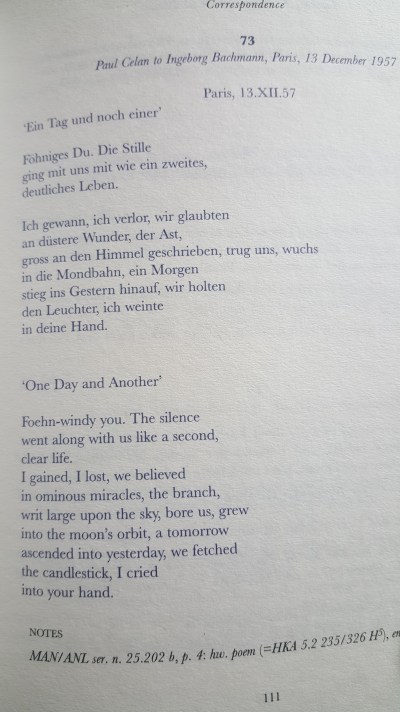
 When I gave birth to my daughter eleven years ago I suffered from a severe bout of post-partum depression. About two weeks after she was born it was as if a cloud or a thick fog had descended over me and I no longer felt like myself. I could barely move except to do the most essential tasks to take care of my newborn and was silent for most of the day. I also felt a deep sense of embarrassment over experiencing this depression because what should have been one of the happiest times of my life was one of the saddest. Talking about one’s physical health seemed far more socially acceptable than discussing ones struggle with mental health. The New York Review of books reissuing of Down Below helps to ease this stigma and to begin much needed conversations about the importance of mental health.
 Kate Zambreno composed Book of Mutter, whose title is taken from Kafka’s diary, over the course of the thirteen years following her mother’s painful death from lung cancer. Zambreno’s writing is a beautiful mixture of memoir, poetry, literary reflection, historical commentary and diary that is impossible to classify into one genre. Similar to Kafka, there is a feeling that the author’s process of writing is an active and cathartic way for her to remember her mother and their complicated relationship and to work through her grief:


 The Book Binder's Daughter