Category Archives: Literature in Translation

Review: None So Blind by José Ángel González Sainz

I received a review copy of this title from Hispabooks via Edelweiss.  The original book was published in Spanish and this translation has been done by Harold Augenbraum.

My Review:
None So BlindThis is a difficult title to review because it is impossible to describe the beautiful and philosophical language which permeates the book.  When the narrative begins Felipe Díaz Carrión  is returning to his home in a small village in Spain, but returning from where we do not yet know.  When he reaches his native village he takes great comfort in the familiar surroundings in which he grew up; the trees, the road, the nest of Egyptian vultures, the bronze doorknocker on his house and a cross which is the grave marker for his own father are all soothing to him.  As a person who likes her routine and is comforted by old, familiar things, I was mezmorised by the first few pages of this story as Felipe slips back into his peaceful and calm surroundings.

We are told that Felipe not only grew up in this small village, but he also met his wife, married her and started a family here.  When his son is about ten years old Felipe loses his job as a typesetter and he decides to move his family to a city in order to find work.  While in the city Felipe takes a job at a chemical factory and he settles into a new pattern where he walks the same road every day to work.  But the road in the city is greatly contrasted to his favorite road in the small village.  Whereas the small village dirt road is full of nature, is serene and peaceful, his road to work in the city is crowded, polluted and noisy.  But Felipe happily makes this transition for the good of his family, or so he thinks.

While his family is living in the city, his wife Asuncion gives birth to their second son.  Felipe is thrilled to have another son and he is proud to give his second son his own name.  Felipe’s relationship with the younger Felipe is tender and one built on respect and mutual interests.  But during this time trouble with his firstborn son also arises.  His eldest son spends less and less time at home and develops an attitude of disdain for his father.  It appears that his son has become radicalized through contact with his friends and acquaintanes in the city.  Felipe’s wife also becomes distant from him and she develops a newfound confidence and outspokenness about her.  She starts to attend political meetings at her friends’ homes and she even arranges her hair and clothing differently.  For twenty years Felipe calmly watches as his wife and oldest son grow farther and farther apart from him and their comments about his pacifism become increasingly abusive.

The biggest question facing the reader in the book is why Felipe turns a blind eye to his son’s and his wife’s radicalization, even when it is apparent they are breaking the law.  There is a lot of imagery, as one can imagine from the title, that revolves around blindness.  Felipe is shunned by his neighbors and beaten badly; his youngest son comes home with a black eye and his eldest son disappears for months on end.  During all of this Felipe doesn’t see or even try to see what is going on.  There are clues that he has suspicions about his son’s behavior, but he never confesses that he truly sees what is going on.  The significance of eyesight and blindness is further enhanced by the prolonged descriptions of the Egyptian vultures who nest around his home village.  They eat the softer parts of their prey like the tongue and eyes.

When Felipe is given an early retirement package from the chemical plant he realizes that there is nothing left for him in the city and so he moves back to his beloved village by himself.  He lives there peacefully for about year when he younger son shows up to deliver the awful news that his oldest son is accused of some horrific crimes.  Felipe is devastated and keeps wondering how much he is to blame for his son’s actions.  Felipe then takes us on a journey through the memories of his own father’s murder which he witnessed as a young boy.  It is no wonder that Felipe has become passive and almost numb to the things around him.  But does the fact that Felipe  turned a blind eye to his son’s behavior mean that Felipe is partly responsible for his son’s horrible crimes?  At which point in his son’s upbringing should Felipe have intervened?  And, finally, if he did speak up and intervene, would his son have listened to his father’s advice?

This is my first experience with a publication from Hispabooks.  I am so impressed with the beauty of the language and philosophical questions this book raises.  I can’t wait to see what else is in the Hispabooks catalog.

About the Author:
J.Á. González Sainz is a Spanish fiction writer and translator and co-founder of the Centro Internacional Antonio Machado, a Spanish language learning center for foreign students based in Soria, his hometown in Spain. He won the Premio de las Letras de Castilla y León in 2006, a prestigious Spanish literary fiction award.

7 Comments

Filed under Literature in Translation, Spanish Literature

Review: The Man I Became by Peter Verhelst

I received a review copy of this title from Peirene Press . It was first published in the original Dutch in 2013 and this English translation has been done by David Colmer.

My Review:
The Man I BecameI don’t normally read Dystopian, Orwellian type novels with talking Gorillas.  But since this book is published by Peirene Press I decided to give it a try anyway and I am glad I did.  The narrator tells us that he was living a happy life in the wild until one day members of his family start disappearing from their idyllic home.  He then finds himself drugged and dragged out of his natural habitat against his will.  He, along with his family, are chained together and forced on an arduous journey during which they are given just enough food and water to survive.  Some of them die along the way and the living are forced to march on and leave their loved ones behind..  I found this to be the most heart wrenching and sad part of the book.  Their fear was palpable and it was difficult to read about these innocent animals as they are taken out of their natural surroundings, and forced on a journey towards the unknown.

After a long ride on a ship in cramped quarters, the animals reach what they call The New World.  They are given clothes, taught how to clean and groom themselves and are given speech lessons.  They practice walking upright, which is very uncomfortable to them and they practice carrying on polite conversations.  It is clear that their captors are trying to turn them into something as close to human as possible.  After a period of time the animals are given a test to see how far their human training has come; they are dressed up and attend a coctail where they meet other animals that have also been trained.  This part of the book is an interesting commentary on what it means to truly be human.  If one can look the right way, and speak the right way and have manners, is that person truly human?  Are a bath, the ability to walk upright and to carry on a conversation really the only things that separate us from animals?

There is one other important social criticism that comes through in the narrative and that is our reliance on technology, especially the cell phone.  When the gorillas reach a certain point in their training they receive a phone and are told that it is their identification and they  must carry it wherever they go.  At first they can only receive calls on their phone and it is another way that their captors keep track of them.  As the narrator becomes more human, he gains more privileges for his phone, such as the ability to dial out to other numbers.  The humans who are in charge of the animals possess multiple phones  and are always seen answering their phones, looking at their phones and talking on their phones.  Is this electronic contraption really another thing that separates us from the animals or does it separate us from other humans and our sense of humanity?

The ending is very interesting and I don’t want to give it away.  But I will say that the gorilla’s life does appear to have a happy ending.  He no longer remembers his previous life and he has found some peace with his human existence.  He is a bit smarter than the rest of his family and he gradually begins to realize that conformity isn’t always the best decision; he questions and investigates his surroundings and those who have positions of authority.  I am sure that there are additional layers of meaning in the story that I did not understand.  I can’t wait to see what other readers make of this story.

This is the first release from Peirene Press this year in their Fairy Tale: End of Innocence series.  The Man I Became is a powerful and thought-provoking first book with which to start the Fairy Tale series and I look forward to the other novellas with great anticipation.  Please visit their website for more details: http://peirenepress.com/

About the Author:
peter_verhelst_0Peter Verhelst, born in 1962, is a Belgian Flemish novelist, poet and playwright. He has written more than 20 books. His work has been praised for its powerful images, the sensuality and richness of its language and the author’s unbridled imagination. His breakthrough came in 1999 with the novel Tonguecat, which won the Golden Owl Literature Prize and the Flemish State Prize for Literature. The Man I Became is his eleventh novel.
17 Comments

Filed under Literature in Translation, Novella

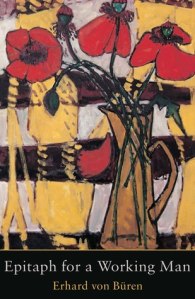
Review: Epitaph for a Working Man by Erhard von Büren

I received a review copy of this book from the translator, Helen Wallimann.  The book was published in the original German in 1990 in Switzerland and this English version was released in 2015.  I invite you to read my review and scroll down to the end of the post to win your own copy of Epitaph for a Working Man.

My Review:
EpitaphHaller resides in a nursing home in Switzerland where he still participates in a very full and active life.  He visits the local pub, he continues doing some work as a stone mason and he entertains his roommates with his quick, sarcastic wit.  This book is the story of the last year of his life as told by his only child, his son.

When the story begins, Haller’s son, who is never given a name, is picking up his father’s belongings from the nursing home at which he had resided for the last twelve years of his life.  His father’s only earthly possessions are contained in two small boxes.  His son slowly begins to recount his father’s illness which began as an odd mole on his back that at first only caused him some minor discomfort.  We guess from the description of this growth that Haller has melanoma and as the story progresses this diagnosis is confirmed.

Haller has to make three trips a week to the hospital in order to undergo radiotherapy treatments for his back.  At first the prognosis seems quite good and the doctor is optimistic that the treatments will take care of the growth on the old man’s back.  Haller’s son meets him at the hospital for all of his father’s appointments and waits for him while he receives his treatments.  Haller and his wife divorced when their child was very young so Haller and his son have never been very close.  It is Haller’s illness and his time at the hospital that bring the father and son together into a closer relationship and connection.

Haller’s son has lost his job as a typesetter and has been living on unemployment for many months now.  He has lost his sense of purpose and his only task during that day is that of “house husband.”  He makes meals for his wife, picks up around the house and does laundry while his wife is at work all day.  He takes the news that his wife is having an affair with her boss in a rather emotionally detached way.  He wonders where they meet to have their trysts and he also wonders if he should leave her.  He doesn’t seem to be all that upset about this development in their marriage so we are left to speculate if he wasn’t all that emotionally attached to the relationship in the first place, or if he is just numb with shock and depression.

The last few days of his life, which are very painful for Haller, are related to us in some detail.  Haller’s son never shares with his father when the cancer reaches his organs.  He struggles with his decision not to be honest with his father about his diagnosis.  He also struggles with how to make his father the most comfortable in his final days.  The strength of this story lies in its subtle commentary on how we struggle as human beings to deal with our final days.  Helen’s translation beautifully renders the heartwarming relationship between father and son into English for us.

About the Author and Translator:
Erhard von Büren was born near Solothurn, Switzerland, in 1940. After a PhD in Psychology and German philology from Zurich University (Zur Bedeutung der Psychologie im Werk Robert Musils. Atlantis, Zürich) and study stays in France he worked as a teacher in advanced teacher training. He lives in Solothurn, Switzerland.     He has had three novels published in Switzerland: Abdankung. Ein Bericht (Zytglogge Verlag, Bern 1989), Wespenzeit (Rotpunktverlag, Zürich 2000), Ein langer blauer Montag (verlag die brotsuppe, Biel/Bienne 2013).     Erhard von Büren has won various literary awards including the Canton of Solothurn Prize for Literature in 2007.     Homepage: http://www.erhard-von-bueren.ch

Helen Wallimann was born in 1941 and grew up in Cheltenham. She received her MA from Edinburgh University in 1963.She has worked in publishing in Munich, Paris and London. From 1973 to 2001 she was a teacher of French and English at the Kantonsschule Solothurn.  Her literary translations in book form include Legends from the Swiss Alps. MCCM Creations, Hong Kong 2009 (translated from German); Leung Ping-kwan, The Visible and the Invisible. Poems. MCCM Creations, Hong Kong 2012 (translated from Chinese).

Giveaway:
The translator put together a fun little multiple choice quiz about Switzerland for my readers.  Whoever gets the most answers correct will win a paperback copy of the book.  If there is a tie I will randomly choose a winner.  The quiz will be open until Friday, Feb. 19th.  This giveaway is open internationally.  Good luck!


8 Comments

Filed under German Literature, Literature in Translation

Review: The Voronezh Notebooks by Osip Mandelstam

My Review:
MandelstamThis edition of Mandelstam’s Voronezh Notebooks, recently published by the New York Review of Books, is a collection eighty nine verses the Russian poet wrote while he was exiled to the city of Voronezh.  During the early 1930’s Mandelstam wrote and published poetry that mocked and criticized Stalin and so it is no surprise that he was arrested and sent into exile.  During part of his exile he was allowed to live in Voronezh which was a bit more civilized as far as Russian exiles were concerned.  He was lucky that his wife Nadezhda was allowed to go with him and if it were not for her then much of his poetry would have been lost to us.

The first notebook contains poetry written between April and July of 1935.  All of the poems are numbered as well as dated.  In this first series of poems we understand that Mandelstam is relieved to be in Voronezh although he by no means feels at home in this city.  He lives is a crowded boarding house that he describes as a “coffin” in the first poem.  He and his wife have no privacy and they hear every movement and sound of their neighbors.  In the third poem he begs Voronezh to have mercy on him and “restore” him but throughout these poems we get the sense that he feels hemmed in, claustrophobic and hopeless.

The second Notebook beings in December of 1936 and goes through February of 1937.  The imagery of winter that one encounters in these poems are particularly striking.  He describes this season as a “postponed present” because the length of its extent is always uncertain.  Poem #37 is one of my favorites from this collection; he admires the goldfinch who “curses the sticks and perches of his prison.”  He admires this  bird who makes so much noise and is “disobedient.”

The final notebook is written between March and May of 1937.  As I have already hinted at through his writing of winter and the goldfinch, Mandelstam’s lines abound with images of nature and the forest.  In the introduction to this volume, Andrew Davis, the translator, tells us that Mandelstam composed these verses in his head while he was walking.  He seems to have done a great deal of exploring his natural surroundings and appreciated, even for a few hours, the illusion of freedom which they provided.  But Mandelstam realizes that his stay in Voronezh is not his own choice and he is still a captive of a fascist regime.  In Poem #72, for example, he writes of the night sky and the stars which he is fighting against as they hem him in and suffocate him; although the sky appears limitless, he is stuck under the sky that only encompasses this city.    In Poems #76 he declares, “I am ready to roam where the sky is greater.”

Finally, in his introduction to the collection Davis points out that the Notebooks were saved through the extraordinary efforts of his wife who, even after his death, saved pieces of them in teapots and other small places hidden around her apartment.  Each day she would practice memorizing them and Davis explains that “she made it her life’s work to preserve her husband’s poetry.”  Because of her act of devotion and bravery this seemed to me like a fitting collection to review as we celebrate and acknowledge those we love on this upcoming Valentine’s Day.


About the Author:
OsipOsip Mandelstam was a Russian poet and essayist who lived in Russia during and after its revolution and the rise of the Soviet Union. He was one of the foremost members of the Acmeist school of poets. He was arrested by Joseph Stalin’s government during the repression of the 1930s and sent into internal exile with his wife Nadezhda. Given a reprieve of sorts, they moved to Voronezh in southwestern Russia. In 1938 Mandelstam was arrested again and sentenced to a camp in Siberia. He died that year at a transit camp.
The translator has written a wonderful article about the difficulties of translating Mandelstam’s poems from Russian to English that I encourage everyone to read: https://psa.fcny.org/psa/poetry/crossroads/own_words/Osip_Mandelstam/


14 Comments

Filed under Literature in Translation, New York Review of Books, Osip Mandelstam, Poetry, Russian Literature

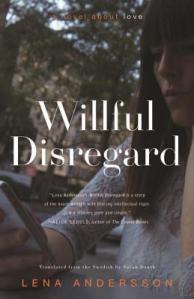
Review: Willful Disregard by Lena Andersson

I received an Advanced Review Copy of this title from Other Press.  The original book was published in Swedish in 2013 and this English version has been translated by Sarah Death.

My Review:
Willful DisregardOne of my favorite poems from the Roman elegiac poet Catullus is his shortest, which contains two very powerful and vivid lines:

Odi et amo. quare id faciam, fortasse requiris? nescio, sed fieri sentio et excrucior.

(I hate and I love.  Perhaps you may ask why I do this?  I don’t know,  but I feel that it is so and I am tortured)  -Catullus, poem 85

At the time of composing this poem Catullus had been in the throws of an illicit affair with a woman twenty years his senior.  In the beginning the affair is intense and all-consuming; but the woman slowly grows tired of poor Catullus and the agony he experiences as a result of what turns out to be a one-sided love affair is aptly expressed in this poem.  When love is not reciprocal, and expectations are higher for one person and not the other, feelings of torment and torture are the result.

Lena Andersson, in her latest novel, also employs a brevity of powerful words to express a woman’s disappointment and torment when an affair becomes one-sided.  When the book opens, the  main character, Ester, is a strong, independent, hardworking, artistic woman who has a successful career writing articles for art magazines and journals.  She is hired to give a lecture about one of Sweden’s most prominent modern artists, Hugo Rask; what ensues is a year’s worth of frustration, torment and false hope for this woman who was once strong and independent.  Even as she researches Hugo to give her lecture he becomes a larger than life, heroic artist and her interest in him borders on obsession.  When she meets Hugo in person she is immediately attracted to him and wants to be around him all of the time.  She breaks up with her live-in boyfriend, a kind man named Per, because she wants nothing more than to have a relationship with Hugo.

Ester begins her tentative interactions with Hugo through dinners and long conversations.  There is an interesting subtext that is cleverly at work in the novel as well since many of Ester and Hugo’s conversations deal with fascism, totalitarianism, freedom and independence.  The exact details of the conversations are not always given since the book mainly deals with Ester’s inner dialogue.  Ester tells us that the conversations with Hugo are erotic and emotionally charged and she fully expects that they will become lovers.  She appears desperate to be in the full throws of a relationship with this artist whom she idolizes and she becomes very impatient when the relationship does not advance as quickly as she expects.

The author’s foreshadowing in this book is brilliant.  At the beginning, when Ester begins to talk about Hugo and her interactions with him she oftentimes describes them as causing her torment and pain, much like the torture that Catullus feels in the above mentioned poem.  There are quite a few things that neither we, the readers, nor Ester know about Hugo.  He mysteriously disappears every other weekend to another city in Sweden.  Ester assumes that he might have a relationship with another woman with whom he is spending so much time on the weekends, but she doesn’t really know.  And she never asks him directly!  Hugo also puts her off from showing her his apartment and only ever meets her at his work studio.  Ester chalks all of this up to Hugo’s mysterious nature as an artist, but the astute reader understands that this secretive nature of his doesn’t bode well for their relationship or any chance of them having a future together.

When Ester and Hugo finally end up in bed her feelings intensify and she becomes even more obsessed with the progression of their relationship.  She analyses and over analyzes every text message and e-mail from him.  She waits impatiently for him to return her phone calls.  She can’t stand it when days go by without seeing him.  I found myself wanting to scream at her while reading, “He’s not worth it.”  “Run the other way and never look back before this ridiculous farce of a relationship destroys you!”  Her friends, which she describes as the “girlfriend chorus” do give her this wise advice but she cannot tear herself away from the emotional attachment she feels towards Hugo.  We are left wondering page after page when poor Ester will finally come to her senses and regain her independence and free herself from these destructive feelings.

This author truly has a gift for philosophical writing; the description of hope and the negative effects in has on the lover at the very end of the book are nothing short of brilliant.  Andersson compares hope to a parasite that” has to be starved to death if it is not to beguile and dazzle its host.  Hope can only be killed by the brutality of clarity.  Hope is cruel because it binds and entraps.”

I always tell my students that it is no wonder that hope was in Pandora’s box of evils.  If you have ever been in the throws of love and have been tortured by hope because of a futile love then you should read this book.

About the Author:
L AnderssonLena Andersson (born 18 April 1970 in Stockholm) is a Swedish author and journalist. She won the August Prize in 2013 for the novel Wilful Disregard . In the same year, the same book, won her the Literature Prize given by the Swedish newspaper Svenska Dagbladet.

8 Comments

Filed under Art, Literature in Translation
