
 Transit, Cusk’s second book in what will be a trilogy of fictional autobiographies about the aftermath of her divorce, begins with an unsolicited email that Faye, the narrator, receives from a psychic. The self-proclaimed astrologist says that she is in possession of specific details about Faye’s life: “She wished me to know that a major transit was due to occur shortly in my sky.” Just as in Outline, the narrator deliberately leaves details about herself out of the narrative; we only get passing glimpses of her life through her interactions with others. A visit to the hairdresser, a trip to a literary festival, a date, and a party at a friend’s home all become the backdrop for intriguing conversations and interactions that partly reveal Faye’s own story.
At the beginning of this story, Faye has moved back to London with her boys after her divorce and has bought an apartment that is a disaster. It requires a complete overhaul and the demolition of her apartment by the contractors becomes a metaphor for her own life. She sends her boys away to spend a few weeks with their father while her surroundings are being dismantled. She describes her house to a man with whom she agrees to go on a date:
I felt cold. There were builders in my house, I added. The doors and windows were constantly open and the heating had been turned off. The house had become a tomb, a place of dust and chill. It was impossible to eat or sleep or work—there wasn’t even anywhere to sit down. Everywhere I looked I saw skeletons, the skeletons of walls and floors, so that the house felt unshielded, permeable, as though all the things those walls and floors ought normally to keep out were free to enter.
There is always the feeling in a Cusk novel that a simple description, like this one about her renovated home, has a much heavier and deeper meaning than what we encounter at first glance. There are several passages that I found throughout the book that I underlined and were worthy of multiple reads.
One additional aspect of Transit that I found particularly intriguing were the descriptions of Faye’s children. Similar to Outline they are never physically present with Faye in the book. We only get descriptions of them when they call her from their father’s home. When the boys call her they are lost, or locked out of the house, or feeling alone; they are still in need of her maternal love and I felt sad that they were separated from her, even if only for a little while. At the end of the book Faye is at a party and the boys call her cell phone because they are fighting and cannot solve their conflict. They ask her for help and admit that their father is nowhere to be found. There are additional hints at the father’s anger, maltreatment of Faye and lack of involvement in the boys’ lives. I am very interested to see if Cusk will further explore the post-divorce family dynamic in the final book of the trilogy.
Fate, identity, love, marriage and transitions are all themes that Cusk explores though the interesting conversations she writes for her characters. Cusk’s writing is both compelling and philosophical, a combination which so few writers are successfully able to achieve.
 Anna K. Yoder, who interviewed Kate Zambreno in 2010 about her first novel, describes O Fallen Angel: “Zambreno’s first novel reads like the bastard offspring of an orgy between John Waters’s Polyester, Elfriede Jelinek’s Lust, and Oliver Stone’s Natural Born Killers.” Similar to these other cutting edge artists, Zambreno experiments with structure, language, and setting to present a novel that is disturbing and bizarre.
 Caveat lector. Let the reader beware. This book is deeply sad and does not have a happy ending. But for many readers a happy ending is not a necessary factor for a book to be considered successful The narrator of Ismailov’s novel is a child nicknamed Mbobo whose mother is from Siberia and whose father is an unknown African athlete that visited Moscow, and his mother, during the Olympics in 1980. The boy’s sad story of a tumultuous childhood fraught with domestic violence and racism is told posthumously: “My mother died when I was eight, and I died four years later.”
 Born in an ancient city in what is now Kyrgyzstan, Hamid Ismailov is an Uzbek novelist and poet who was forced to leave his home in Tashkent when his writing brought him to the attention of government officials. Under threat of arrest, he moved to London and joined the BBC World Service, where he is now Head of the Central Asian Service. In addition to journalism, Ismailov is a prolific writer of poetry and prose, and his books have been published in Uzbek, Russian, French, German, Turkish, English and other languages. His work is still banned in Uzbekistan. He is the author of many novels, including Sobranie Utonchyonnyh, Le Vagabond Flamboyant, Two Lost to Life, The Railway, Hostage to Celestial Turks, Googling for Soul, The Underground, A Poet and Bin-Laden, and The Dead Lake; poetry collections including Sad (Garden) and Pustynya (Desert); and books of visual poetry including Post Faustum and Kniga Otsutstvi. He has translated Russian and Western classics into Uzbek, and Uzbek and Persian classics into Russian and several Western languages.
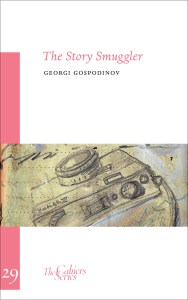 When I first read Gospodinov’s novel

 A sampling of some of my most cherished classics books; the Loebs are nestled snugly on the bottom shelf.
 The cozy spot where much of my reading takes place. It is overlooked by a print of The Roving Shadows cover done by Sunandini Banerjee, Seagull Books artist.


 The Book Binder's Daughter