
 ἀρετή τιμὴν φέρει, (excellence brings honor), are the first words spoken by Magris’s protagonist in A Different Sea. Enrico has graduated from the Royal Imperial Staatsgymnasium of Gorizia and has decided to set sail for Patagonia in an attempt to live an authentic life, free from material items, worry, and The Great War which is about to break out in Europe. His mind has been shaped by the Ancient Greek texts that he and his friends Nino and Carlo are so fond of reading in Nino’s attic room:
Up in Nino’s attic in Gorizia they would read Homer, the tragedians, the Pre-Socratics, Plato, and the New Testament in the original Greek, and Schopenhauer—also, of course, in the original; the Vedas, the Upanishads, the Sermon of Benares and the other teachings of Buddha; Ibsen, Leopardi, and Tolstoy. They used to exchange their thoughts and describe the day’s events, like that story of Carlo and the dog, in ancient Greek, and then translate them into Latin for fun.
Enrico has an existential crisis in his youth as he is trying to decide what, for him, constitutes excellence in his life. To the Homeric heroes he is so fond of studying, excellence comes in the form of success on the battlefield which, in turn, brings them honor. Enrico’s search for purpose in life seems to have more elements of Epicurean philosophy than Homeric values. He feels the most content when he is with his friends, in the attic, discussing life and Greek philosophy. Epicurus himself achieved ἀταραξία (a lack of disturbance) sitting in his garden and contemplating human existence with his friends.
The Epicurean elements of Magris’s text continue as Enrico traverses the ocean in order to reach South America. Enrico craves simplicity, has no interest in politics, avoids pain and has no fear of death. On board the ship, when he is told the story of a famous captain who dies at sea Enrico remarks: “Nil de nilo fit et nil in nilum abit” (nothing happens from nothing and nothing will go into nothing). Once he reaches Argentina he spends weeks and months alone herding his flocks and living in a modest hut with only a bed and a few Greek books.
When Enrico finally returns home he settles in Salvore and also lives a modest life in a small house and rents his land out to tenants. But he still remains unhappy and unfulfilled since his friends have all died and he fails to make connections with anyone else in his life. Every time he has the chance to get close to someone, especially a woman, he ends up driving them away. His poor relationship with women begins early in his life with his mother whom he feels favors his younger brother. He finds comfort in having a woman with him who can also fulfill his sexual needs but he treats each woman he lives with very badly. Even his niece, for whom he at first develops a fondness, is treated poorly and verbally abused by Enrico. In the end Enrico’s loneliness and his failure to achieve ἀταραξία are due to his inability to make emotional connections with other people in his life. He never finds his excellence, his reason for living, something that can bring him honor and self-satisfaction.
I found Magris’s writing in A Different Sea as enjoyable as his longer novel Blameless which I recently reviewed. He is fond of weaving images of the sea into his stories, imbedding stories within stories in his texts, and portraying flawed characters who are searching for meaning in this random, crazy life.
Here is a link to a recent interview with Claudio Magris whose English translation of Blameless has just been published by Yale University Press: http://blog.yupnet.org/2017/04/13/writing-as-witness-a-conversation-with-claudio-magris/
For a more detailed discussion of excellence and honor in Homer see my thoughts on Logue’s War Music: https://thebookbindersdaughter.com/2017/03/23/excellence-and-honor-in-logues-war-music/
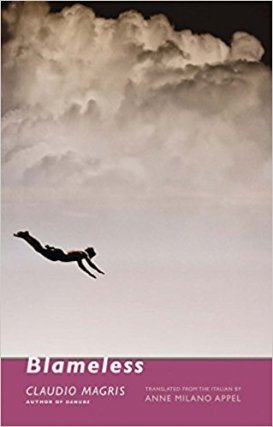 The unnamed protagonist in Blameless has been obsessively collecting items associated with fighting and warfare for decades in order to establish a war museum in his native home of Triste. His collecting began shortly after World War II, during which time he helped negotiate the liberation of Triste. He gathered so many items throughout the course of these post-World War II years that they could only be stored in a hangar. His entire life was consumed with establishing his museum to the point that he even slept among his objects and papers. When he dies in a fire that consumes him and some of his precious objects in the hangar, it is a woman named Luisa that is tasked with curating the museum and organizing his notes, objects and stories.





 A sampling of some of my most cherished classics books; the Loebs are nestled snugly on the bottom shelf.
 The cozy spot where much of my reading takes place. It is overlooked by a print of The Roving Shadows cover done by Sunandini Banerjee, Seagull Books artist.
 This is a short yet powerful book that raises many more questions about the mental state of the main character than it answers. We are led to understand from the beginning that the narrator is living alone in the mountains in what is now an abandoned village. The only time he has interaction with other human beings is when he drives his car down the mountain to another small village. He seems to do this only when he needs food or supplies.
 Antonio Moresco did not find a publisher until late in his career, after being turned down by several editors. His output is centred on the monumental trilogy L’increato, whose three volumes are: Gli esordi (Feltrinelli 1998, republished by Mondadori in 2011 – 673 pages), Canti del caos (part 1 by Feltrinelli in 2001, part 2 by Rizzoli in 2003; republished by Mondadori in 2009 – 1072 pages), and Gli increati (Mondadori 2015).


 The Book Binder's Daughter