
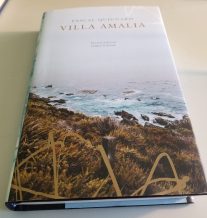
 Anne Hidden, Quignard’s protagonist in Villa Amalia, is a musician and composer who has made a name for herself by condensing, paring down, and reinventing scores of music. He writes about her process:
What she did was incredibly stark.
She read the score first, far from the piano, then put it back down. She went and sat at the keyboard and—suddenly—delivered the whole thing in the form of a rapid, whirling resume. She didn’t interpret the music. She re-improvised what she had read or what she had chosen to retain of it, de-ornamenting, de-harmonizing, searching anxiously for the lost theme, seeking out the essence of the theme with minimal harmony.”
Quignard’s description of his artist is a metaphor for his own writing. One would expect from this author’s novellas, A Terrace in Rome and All the World’s Mornings, sparse storylines; but Villa Amalia also requires, even demands, an astute reader, who must seek out the essence of his themes amidst a minimal plot that is beautifully poetic.
Ann Hidden discovers that her boyfriend of sixteen years is seeing another woman, so she decides to jettison and erase anything that has to do with their relationship: she sells the house in Paris they were living in, gets rid of all her furniture, including her three prize pianos, and even throws away her clothes. We are given small hints in the text that, like her father before her, she deals with grief or loss by running away. There are few details about Ann’s life and long relationship with Thomas anywhere in the story; as she is fleeing Paris for Italy after the sale of her house, there is a brief, universal description of lovers , one of Quignard’s typical passages, that says nothing yet everything at the same time:
Those who aren’t worthy of us aren’t faithful to us.
This is what she was telling herself in the dream she was having.
It wasn’t their commitment at our sides that led to their fear or laziness, their carelessness or slackness, their regression or silliness.
Sitting in our armchairs, stretched out in our bathtubs or lying in our beds, we see absent, numb people for whom we no longer exist.
We don’t betray them by abandoning them.
Their inertia or their complaining abandoned us before we though of separating from them.
Ann settles on the island of Ischia where she falls in love with a doctor, his young daughter, and a villa by the sea. But even at this point in Ann’s story, Quignard intervenes to remind us of his style: “I could fill the months that followed with details. They were busy, amorous, constructive. But I shall skip over this. And more. And yet more.”
When a tragedy occurs at the villa that deeply affects her, Ann flees yet again, this time back to France to live with an old childhood friend that has helped her through her breakup with Thomas. The artists in Quignard’s fiction are like wounded animals who, when they are hurt, run and hide and try to nurse their wounds in solitude. But what sets Ann apart from the other eccentric and emotionally distant artists in A Terrace in Rome and All the World’s Mornings is that Anne, no matter how many times she is hurt, is still open to love. Time and again she takes a risk and offers her heart to new people in her life. At the end of the novel, Quignard writes:
In the eyes of children, to love is to watch over. To watch over sleep, allay fears, give consolation where there are tears, care where there is illness, caress the skin, wash it, wipe it, clothe it.
To love the way one loves children is to save from death.
Not dying means feeding.
I will end with one final thought–that is really more like an unanswerable question— I keep having about Quingard’s fiction. When I translate and interpret Ovid’s Pygmalion and Daedalus and Icarus myths with my fourth year Latin students, we debate about Ovid’s commentary on role of the artist. Ovid depicts his artists as lonely men who use their talent, in unnatural ways, to improve their lives but also to flee from others. Does an artist have to suffer to be creative? Would these characters be as successful in their art without grief and loss? What would Quignard say about his artists?

 The Modiano titles that I’ve read so far, Little Jewel, Suspended Sentences, and this latest novel published by Yale University Press, all have a mysterious yet emotionally languid quality to them. It is both odd and compelling to mix these tones in a narrative but the author does it, quite successfully, in all three of these books.
 Olivier Bertin is a painter in late nineteenth century Paris and his most famous work, his Cleopatra, has earned him enough fame to be sought out by the rich and famous of high society. He is not interested in any romantic relationships with the bourgeois women he paints because he feels that are insipid and boring. At a party one night, however, he meets the Countess Ann de Guilleroy and is immediately captivated by her beauty and charm and decides he must do her portrait. As Bertin paints the Countess in his studio, the two have stimulating conversations and enjoy one another’s company more and more.
 The Heart of the Leopard Children is Wilfried N’Sondé’s first book to be translated into English. It was written and published in French and this English edition has been translated by Karen Lindo. This title is part of the Global African Voices series by the Indian University Press whose mission is to publish “the wealth and richness of literature by African authors and authors of African descent in English translation. The series focuses primarily on translations of new works, but seeks to reissue longstanding classics that are currently out-of-print or have yet to reach English-speaking readers.”




 The Book Binder's Daughter