Category Archives: Classics

We Each Create Our Own Labyrinth: Theseus by André Gide

When I teach my second year Latin students about ancient heroes, I always have to begin by explaining the distinctions between the modern and ancient concepts of the term hero.  Nowadays the word hero brings to mind first responders saving children from burning buildings,  a good Samaritan saving another person from drowning, and other selfless and kind acts.  Ancient heroes, however, are much more complex, controversial and are prone to carrying out acts of violence even if the end result is for the benefit of the community.  However, more often than not,  they are acting on their own behalf, they are seeking glory and honor and recognition for themselves.  Homeric heroes, for instance, are fighting at Troy for kleos, to be remembered and revered long after they are dead.  Hercules, Theseus and Jason save communities from various beasts and horrible monsters, but their true motivation is for glory and honor that comes with such brave acts.  But the ancient hero also suffers from loneliness, isolation and difficult relationships.

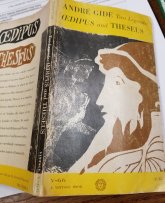
André Gide, in his short story “Theseus” reimagines the myth of the Greek hero Theseus and fills in the gaps where the ancient narratives are lacking.  Gide adeptly captures the pressure to perform that each hero experiences.  In the first chapter, Aegeus, Theseus’s father,  says to his son, “Your childhood is over.  Be a man.  Show your fellow men what one of their kind can be and what he means to become.  There are great things to be done.  Claim yourself.”  After Theseus defeats various, local monsters, he is eager to take on his biggest challenge yet, defeating the Cretan Minotaur.

In Gide’s story, when Theseus lands in Crete he visits the artist Daedalus who explains to him how his labyrinth works and the only way to defeat it.  This passage showcases Gide’s brilliance as a writer, an artist, and even a philosopher:

I thought that the best way of containing a prisoner in the labyrinth was to make it of such a kind, not that he couldn’t get out (try to grasp my meaning here), but that he wouldn’t want to get out.  I therefore assembled in this one place the means to satisfy every kind of appetite.  The Minotaur’s tastes were neither many nor various; but we had to plan for everybody, whosoever it might be, who would enter the labyrinth.  Another and indeed the prime necessity was to fine down the visitor’s will-power to the point of extinction.  To this end I made up some electuaries and had the mixed with the wines that were served.  But that was not enough; I found a better way.  I had noticed that certain plants, when thrown into the fire, gave off, as they burned, semi-narcotic vapors.  These seemed admirably suited to my purpose, and indeed they played exactly the part for which I needed them.  Accordingly I had them fed to the stoves, which are kept alight night and day.  The heavy gases thus distributed not only act upon the will and put it to sleep; they induce a delicious intoxication, rich in flattering delusions, and provoke the mind, filled as this is with voluptuous mirages, to a certain pointless activity; ‘pointless,’ I say, because it has merely an imaginary outcome, in visions and speculations without order, logic or substance.  The effect of these gases is not the same for all of those who breathe them; each is led on by the complexities implicit in his own mind to lose himself, if I may so put it, in a labyrinth of his own devising.

An interesting commentary for the 21st century where many are caught up in a labyrinth of their own choosing, a labyrinth composed of people and things that induce a “delicious intoxication” and are “rich in flattering delusions.”

Daedalus’s advice to Theseus is to keep hold of the thread that Ariadne will give to him and not let it go so she can pull him out of the labyrinth.  But the hero, who is used to fighting his own battles, doesn’t want to be tethered to anyone, especially a woman.  When he arrives in Crete, Ariadne throws herself at him and he views her as a silly girl whom he can use and toss aside.  Ancient heroes, in general, have a very hard time with women; they do not take well to marriage, settling down, domesticity.  In addition to Theseus and Ariadne, the relationships between Jason and Medea, Hercules and Megara end badly.

Gide, however, does linger on the story of one, special woman who is able to captivate Theseus precisely because she poses a challenge for him, the Amazon Antiope.  Theseus says of her, “An accomplished runner and wrestler, she had muscles as firm and sturdy as those of our athletes.  I took her on in single combat.  In my arms she struggled like a leopard.  Disarmed, she brought her teeth and nails into play; enraged by my laughter (for I, too, had no weapons) and because she could not stop herself from loving me.  I have never possessed anyone more virginal.”

Each person in the Theseus-Ariadne-Minotaur myth has his or her own unique point of view.  But, in the end, there really is no happy ending for any of them, is there?

This book has greatly piqued my interest in reading more Gide.  This slim volume that was sitting on my shelf also contains Gide’s Oedipus story, another interesting hero to explore.  Maybe in another post…
 

8 Comments

Filed under Classics, French Literature

When A Man Tells You He’s a Monster: The Ariadne Myth in Analicia Sotelo’s Virgin

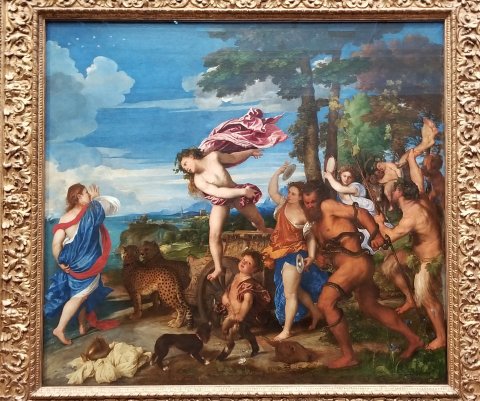
Titian. Bacchus and Ariadne. Oil on Canvas. 1520-3.

In Greek myth, Ariadne is the daughter of Minos, King of Crete, and Pasiphae, whose horrifying union with the Cretan bull produces the legendary monster, the Minotaur. We don’t hear very much about Ariadne’s life in the ancient narratives until her encounter with Theseus; she immediately falls in love with this Athenian hero who is sent to defeat the Minotaur and release Athens from its obligation of sending seven men and seven women every nine years to Crete where they are locked in the labyrinth and devoured by the Minotaur. In her eagerness to capture his attention and secure his affections she stealthily offers him the tools to defeat the labyrinth and the Minotaur: a ball of thread and a sword. But through the act of helping this hero she also betrays her home and her family. Theseus professes his love and appreciation for Ariadne and takes her with him when he sails home to Athens. After a brief stop, however, on the island of Naxos, Theseus “forgets” Ariadne on the shores of the island and sets sail to Athens without her.

The Roman poet Catullus writes an epyllion, his longest poem, Carmen 64, in which Ariadne is given her own voice and tells her own side of the story. When she is abandoned on Naxos, she immediately realizes her mistake in trusting this man who was supposed to be a hero. In Carmen 64.132-148 Ariadne speaks to a now absent Theseus and gives full vent to her anger, her heartache and her grief (translation is my own):

You treacherous and dishonest man, Theseus! Have you really carried me away from my father’s home and abandoned me on this deserted shore? Are you really being so forgetful and leaving me behind, completely neglecting the divine will of the gods, and carrying the curse of such false oaths back to your own home? Is there nothing that could change this decision of your cruel mind? Do you truly possess no mercy that would have allowed your ruthless heart to take pity on me? You certainly didn’t act this way when you were lavishing promises on me with your flattering voice. And you certainly didn’t act like this when you were giving me hope of a happy marriage and wedded bliss, all of which futile promises are now dispersed by the light winds. From now on may no woman ever put her trust in any man who makes promises; from now on may no women believe that the words of any man can be trusted. While a man’s mind is set on getting something and his mind eagerly longs to gain that thing, then he will swear to anything, he will promise anything. But as soon as the desire of his greedy mind is sated, he remembers none of his previous words, he cares nothing about his false promises.

Many of the poems in Analicia Sotelo’s new collection of poems, entitled Virgin, drawn on the plot, theme and point of view of the Ariadne and Theseus myth as it is described by Catullus. As I was reading Sotelo’s poems throughout the course of the last few days I was captivated by her interpretation of this myth for a 21st century audience. Ariadne’s rejection, self-doubt, and heartbreak are placed into contexts that make her story meaningful for a modern reader. In “Ariadne Discusses Theseus in Relation to the Minotaur,” Sotelo’s Ariadne, similar to the character we hear from in Catullus, also has a dire warning for other women:

When a man tells you he’s a monster,
believe him.

When a man says you will get hurt

leave…

Sotelo’s Ariadne also has trust issues after being abandoned by a lover. But, if she could do things over again, would she really be able to resist this man? Once again reminiscent of the laments expressed by Catullus’s Ariadne, Sotelo’s poem “Ariadne’s Guide to Getting a Man” incisively describes the tension that one suffers in a lost love, the alternating feelings of remorse and a longing to continue that human connection. Catullus’s Ariadne dreams of wedded bliss, Sotelo’s Ariadne remembers the feel of her lover’s body under her hands. The last line of this stanza is like a punch in the face when Ariadne is brought back to the reality of her situation when she remembers what love did to her mother:

Do you trust him? No, but everyone has left you
to take in the country air.
Three nights later you see him again—
his tall, crepuscular body separates itself from the lilies.
And you realize the body is not grotesque—that it is, in fact,
like a bolt of fine batiste gathered in your hand,
but first you must give up
a willingness to be right about the world.
Your brother is howling.
Your brother is howling
because your mother chose love and look where it left her.

And in one of my favorite poems in the collection Ariadne is viewed through the eyes of her brother, the Minotaur. Catullus’s Ariadne also expresses deep remorse for what she does to him even though he is a monster. Similar to Georgi Gospodinov”s novel The Physics of Sorrow and Jorge Luis Borges’s short story “The House of Asterion,” Sotelo’s poetry shows pity for the Minotaur and she gives him his own story. After all, he, too, is a victim of fate. In “The Minotaur’s Letter to Ariadne,” Sotelo’s monster tugs at the heart strings:

Like a buttercup was your heart in my hand
in the field when we were children
Crown myrtle in your hair,
a gurgling song
Then you grew
delicate as an ox,
obstinate as a—It was you
who taught me metaphor,
said, Mother is a door
I said, What does that mean?
All those years I misheard the men
say, Your mother is a whore,
thinking it was
something that swung open
so almost anything could enter
Oh sister, do not go
Like a buttercup was your heart in my hand.

But through the raw emotions, self-doubt, grief and heartache, Sotelo does offer small glimpses of hope for the abandoned. In Catullus’s version, Ariadne is saved by the god Bacchus who finds her wandering the shores of Naxos and whisks her away to heaven where she also becomes divine. In Sotelo’s version, “Ariadne plays the Physician”, she attempts to heal her own wounds:

We must set this story straight
We must say there is another angle

to this foreign particle

lodged in my ribs like a small ivory
tiger or a Chinese lamp, the oil

coating my bones. Theseus,
you know you didn’t break me.

Sotelo’s collection includes additional, brilliant reworkings of myth. Another of my favorites is “South Texas Persephone” which is a rather sad commentary on marriage that uses inspiration from the Demeter, Persephone and Hades myth. I am glad to have encountered such a raw, emotional, and passionate collection like Sotelo’s that makes Greek and Roman myth accessible to and relevant for a current audience.

6 Comments

Filed under Classics, Poetry

The Vital Force of the Kore: The Unspeakable Girl by Giorgio Agamben and Monica Ferrando

The Ancient Greek goddess Demeter (Ceres to the Romans) was associated with the harvest and agriculture and was worshipped at her temple in Eleusis.  The Homeric Hymn to Demeter tells us that the goddess has a daughter, Persephone or Kore, fathered by Zeus, who was abducted by Hades and forced to live in the underworld with her husband for part of the year.  The story of Demeter and Persephone can be viewed as a nature myth—Persephone represents the seed, planted under the ground and fertilized by Zeus, that grows in the spring as the harvest and whose maturity is represented by Demeter herself.  The story can also be viewed as an etiological myth whereby the seasons are explained—the months in which Persephone spends with her husband in Hades Demeter does not let anything grow and thus it is winter.  Finally, the story of Demeter can be viewed as a charter myth that explains the origins for the rituals that take place during the Eleusinian Mysteries at the temple of Demeter.

During the autumnal celebration of the Eleusinian Mysteries, which were organized by the Athenian polis, there were rituals that involved fasting, a procession with sacrificial pigs, purification in the sea, and the consumption of a sacred drink.  The nocturnal procession went from Athens to the Temple of Demeter at Eleusis where initiates would gather in the Hall of Initiations, the Telesterion, where the hierophant (sacred revealer) revealed the “holy things.”  It was said that Demeter bestowed two gifts to her initiates: a stalk of grain and the mysteries that were said to hold a promise to a happier afterlife.  The mysteries that took place at the annual celebration were kept secret by all participants.

In his essay, The Unspeakable Girl,  published in English by Seagull Books and translated by Leland De La Durantaye and Annie Julia Wyman, Italian philosopher and author Giorgio Agamben begins with a discussion of the Ancient Greek word Kore.  Agamben’s writing is challenging but of the few things I read so far, he begins with the etymology of important words, which makes his narrative, for me, more accessible.  He writes:

The Greek term kore (masculine form: koros) does not refer to a precise chronological age.  Derived from a root meaning ‘vital force’, it refers to the principle that makes both plants and animals grow (koros also means ‘offshoot’ in the botanical sense.)  A kore, can thus be old, like the Phorcydes, called denaiai korai, the ‘long-lived girls’ and the graiai, ‘those with white hair.’ Aeschylus calls the terrifying avengers of blood crime Erinyes (or Furies), korai, as well as graiai palaiai pades (ancient children with white hair.)

Agamben concludes that “Kore is life in so much as it does not allow itself to be ‘spoken’, in so much as it cannot be defined by age, family, sexual identity or social role.”  The philosopher uses this idea of Kore as the unspeakable for a further discussion of the mysteries involving Demeter and Kore that take place during the Eleusinian rituals.  His thesis is that the mystery is not so much a sacred object that is revealed or an event that happens during the ritual, but a mystical transformation which the initiates experience that is unspeakable—not unspeakable in the sense that it is prohibited to be spoken about but in the sense that there is no language that adequately expresses the experience.  Agamben cites and discusses key passages from Aristotle and Plato who describe the acquisition of philosophical knowledge as a mystic experience or initiation.  Agamben concludes, “When she was abducted by Hades, Kore was ‘playing (paizousan) with the girls of Ocean’ (kouresi syn Okeanou; Homeri Hymnus in Cecerem 5.5).  That a girl at play became the ideal figure for the supreme initiation and the completion of philosophy, the figure for something that is at once thought and initiation and thus unspeakable—this is the ‘mystery.'”

And why should the modern reader care about initiation into ancient mystery cults.  This is, perhaps, my favorite part of Agamben’s argument; he makes this ancient thought and practice relevant to a 21st century audience: “Whether it be Lucius in The Golden Ass or Isabel Archer in Henry James’ Portrait of a Lady, the novel places us before a mysterion to which life itself is at once that which initiates us and that into which we are initiated.”

“The goddess threw herself like a maenad down the woody mountainside.” Pastel on recycled paper. Monica Ferrando.

This Seagull edition also includes gorgeous paintings by artist Monica Ferrando as well as her translations of Ancient Greek and Latin text sources for Demeter, Persephone and the Eleusinian Mysteries.


1 Comment

Filed under Classics, Italian Literature, Literature in Translation, Philosophy

Full of Delights, of Pleasure, Of Tenderness: The Poets’ Dante

I have been reading some of the essays from The Poets’ Dante which arrived in the mail yesterday. It is a collection of writing from some of the most prominent 20th century poets who reflect on how Dante has shaped their own verses. I offer here a few passages from some of my favorite essays so far:

Ezra Pound comments on the genre and classification of the Divine Comedy:

The Divine Comedy must not be considered as an epic; to compare it with epic poems is usually unprofitable. It is in a sense lyric, the tremendous lyric of the subjective Dante; but the soundest classification of the poem is Dante’s own, ‘as a comedy which differs from tragedy in its content,’ for ‘tragedy begins admirably and tranquilly,’ and the end is terrible, ‘whereas comedy introduces some harsh complication, but brings the matter to a prosperous end.’ The is, in fact, a great mystery play, or better, a cycle of mystery plays.

Jorge Luis Borges on the intensity and gentleness of Dante:

Carlyle and other critics have observed that the most notable characteristic of Dante is intensity. If we think of the hundred cantos of the poem, it seems a miracle that that intensity never lets up, except in a few places in the Paradiso which for the poet were light and for us are shadow. I can’t think of another example, except perhaps Macbeth, which begins with the three witches and continues to the death of the hero without a weak moment.

I would like to mention another aspect: the gentleness of Dante. We always think of the somber and sententious Florentine poem, and we forget that the work is full of delights, of pleasure, of tenderness. That tenderness is part of the structure of the work. For example, Dante must have read somewhere that the cube is the most solid of volumes. It was a current, unpoetical observation, and yet Dante used it as a metaphor for man, who must support misfortune: ‘ben tetragono ai colpi di fortuna,’ man is a good tetragon, a cube. That is truly rare.

And Seamus Heaney’s personal reflection on his experiences with the Divine Comedy:

What I first loved in the Commedia was the local intensity, the vehemence and fondness attaching to individual shades, the way personalities and values were emotionally soldered together, the strong strain of what has been called personal realism in the celebration of bonds of friendship and bonds of enmity. The way in which Dante could place himself in an historical world yet submit that world to a scrutiny from a perspective beyond history, the way he could accommodate the political and the transcendent, this too encouraged my attempt at a sequence of poems which would explore the typical strains which the consciousness labours under in this country. The main tension is between two often contradictory commands: to be faithful to the collective historical experience and to be true to the recognitions of the emerging self.

This is only a very small sampling of the book and I will, no doubt, spend some time with this volume as I pick my way through the variety of essays it contains.

Earlier today my husband noticed, with a wry comment and smirk, that I had acquired yet two more books on Dante. The intensity with which I throw myself into things has become a bit of a family joke—books, blogging, gift wrapping, acquiring the best coffee/teas, fashion/shoes, etc. (a small selection of my “obsessions” that my husband has pointed out, for which he claims he loves me dearly). And, yes, I have applied the same intensity to reading Dante and everything I can get my hands on about Dante. I have, I think, one final post left in me—a wrap up of sorts with a list of various books, essays, and translations I have acquired along the way. The journey from Hell, to Purgatory to Heaven has been a truly rich, rewarding and intense reading experience for me—an intense book, indeed, to match the intense person I can be. If you’ve enjoyed my posts then thanks for paying attention; if you are sick of me going on about the Divine Comedy then I promise the end is nigh and I will be reading different authors this week!

9 Comments

Filed under British Literature, Classics, Italian Literature

Open Your Eyes and See What I am Now: Beatrice and Dante in Paradise

Beata Beatrix. Dante Gabriel Rossetti Oil on Canvas. 1864-1870.

This has already proven to be a long, tough week but I have been elevated by reading Dante’s Paradise. My favorite experience in reading this final book in the Divine Comedy has been the interaction between Dante and Beatrice as they journey through heaven.  The respect and awe the poet has for Beatrice, his muse and inspiration, even when she is scolding him, is moving. One of my favorite passages of Paradise is Canto XXI where Beatrice explains to him that she can’t smile at Dante because he would burst into flames, like Semele did when she looks at the god Jupiter in all of his celestial splendor (trans. Mandelbaum):

By now my eyes were set again upon
my lady’s face, and with my eyes, my mind:
from every other thought, it was withdrawn.
She did not smile. Instead her speech to me
began: “Were I to smile, then you would be
like Semele when she was turned to ashes,
because, as you have seen, my loveliness—
which, even as we climb the steps of this
eternal palace, blazes with more brightness—
were it not tempered here, would be so brilliant
that, as it flashed, your mortal faculty
would see a branch a lightning bolt has cracked.

Dante follows Beatrice’s guidance through one stage after the next of heaven and takes her chiding seriously because he knows it is for his benefit. His reward is that, in a few spheres later, he is able, through his ordeal and his learning, to bear her smile:

Open your eyes and see what I now am;
the things you witnessed will have made you strong
enough to bear the power of my smile.

That spine tingling, lover’s gaze which occurs over and over; a lover who not only teaches, but challenges you to become a better person. How could this not be a love story?  It is, I think, an ideal love towards which it is nice to aspire.

9 Comments

Filed under Classics, Italian Literature
