Category Archives: Classics

An Addendum to my Personal Canon

When I recently wrote a list of the books that have had the greatest impact on my life, I naturally included several ancient authors.  Each work on the list is something I have translated myself and I was thinking about those texts in the original Latin or Ancient Greek.  But I have had many inquires about my favorite translations of these texts, so here is my addendum.  This is by no means an exhaustive list, but these are the old chestnuts that I return to time and again:

Homer, Iliad: The Robert Fagles translation is still my favorite (the intro. to this text written by Bernard Knox is worth the price of the book alone).  For those who want something more daring, Chapman’s translation of Homer is also something I have really enjoyed.  And for those who want something really daring, Christopher Logue’s interpretation of the Iliad, entitled War Music, is stunning (regular readers of my blog will know that I flipped my lid over this and wrote four different posts about it.)

Presocratic Philosophers: Since these authors are in fragments, the best book I have found that includes both interpretations as well as translations is The Presocratic Philosophers by G.S. Kirk, J.E. Raven and M. Schofield.

Aeschylus, Agamemnon: Once again, I have to go with the Robert Fagles translation of this which is a Penguin Edition.  This edition also includes translations of the Libation Bearers and the Eumenides.

Euripides, Trojan Women, Medea: The Oxford World’s Classics editions translated by James Morwood are my staple translations for all of Euripides. The Trojan Women and Medea are in separate volumes.  The edition with Medea also includes Hippolytus, Electra and Helen.  The edition with Trojan Women also includes translations of Hecuba and Andromache.

Sopocles, Oedipus, Antigone: The Penguin edition is my favorite which is translated by Robert Fagles and includes all three of the Theban plays. (Can you tell that I am partial to the translations of Fagles?)

Plato, Symposium: The Tom Griffith translation by the University of California Press is still my favored edition and also includes engravings by Peter Forster.

Aristotle, Poetics: I still go back to the first translation of this I’ve ever read by Leon Golden published in 1968 by Florida State University Press.  It also includes an excellent running commentary.

Catullus, Carmina: Although the English is a bit Archaic since it was originally published in 1913, I still love the Loeb translation edited and revised by G.P. Gould.  This edition also includes the poems of Tibullus which I also highly recommend.  Tom, whose erudite writing about classic literature can be found at Wuthering Expectations, recommended the Horace Gregory translation published in 1952 which I am thoroughly enjoying!  I have been reading the translations from Gregory this semester as I translate the Latin text with my students and it has been a most enjoyable experience.  Sometimes a different translation, even an older one, gives us fresh eyes.

Vergil, Aeneid: I’ve always loved the Robert Fitzgerald translation of the Aeneid which is the Vintage Classics edition, that is, until Robert Fagles published his. I also am excited to read the new translation of it that will be published by the University of Chicago Press in the fall of 2017.  Word on the street is that David Ferry’s new translation is fabulous.  Stayed tuned for my official opinion.

Seneca, everything he wrote, especially The Trojan Women: I love the dual language edition by Elaine Fantham which has been out-of-print for quite a while.  The introduction and the commentary are extraordinary.  There is also a new translation of all of Seneca’s plays that was just published by The University of Chicago Press.  Elaine Fantham was part of the team of editors and translators on this project before she passed away and I am very eager to devote my full attention to these new translations.  Stay tuned for my thoughts!

Cicero, De Senectute, Pro Caelio: The Penguin Editions of both of these translations are excellent. Cicero: Selected Works, translated by Michael Grant includes De SenectuteCicero: Selected Political Speeches includes the Pro Caelio. These are the editions that I use to teach Cicero in my classes.

Ovid, Metamorphoses, Heroides: For the Metamorphoses I have always loved Rolfe Humphries’s translation that was originally published by The University of Indiana Press in 1960.  The translation by Allen Mandelbaum published in 1995 is also excellent.  Finally, the A.S. Kline translation is also very good and is available online here: http://ovid.lib.virginia.edu/trans/Ovhome.htm

The Loeb edition of the Heroides, translated in 1914 by Grant Showerman and revised by G.P. Gould, is still my favorite. This edition also includes the Amores which I very highly recommend.  Maybe I also should have included the Amores on my personal canon?

Propertius, Elegies: (Many read Catullus and Ovid and unfortunately bypass Propertius.  But his poems are just as good and important.)  Once again, I have to go with the trustworthy Loeb edition translation by G.P. Gould.

Lucan The Civil War: (A very underappreciated epic from the Latin Silver Age)  And yet again, I have to go with the Loeb edition of Lucan translated by J.D. Duff and originally published in 1928.

I realize that there are quite a few Loeb editions on the list, but the dual text and the older translations have always appealed to me.  Please leave further suggested translations for any of these authors in the comments!
13 Comments

Filed under Classics, Opinion Posts

Venit Ver (Spring Arrives)

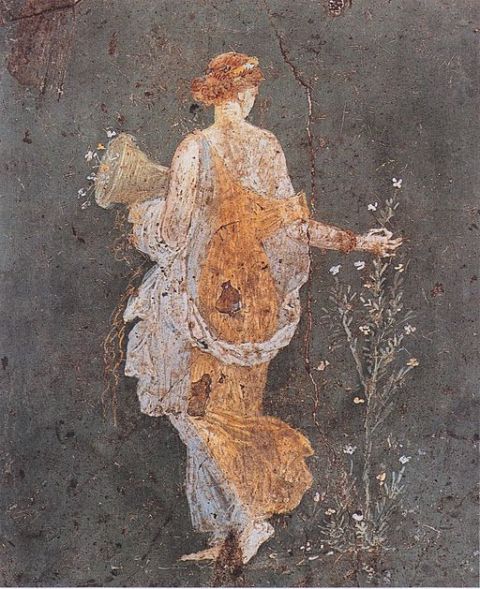
Fresco, The Roman Goddess Flora

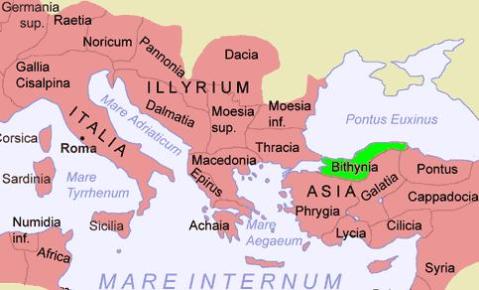
The Latin poet Catullus had a passionate yet turbulent love affair with a prominent married woman named Clodia. When Clodia finally releases him for good, Catullus accepts a position on the staff of the Roman governor of Bithynia to get out of town for a while and away from any painful reminders of his love affair. He chooses this long and tedious journey to get as far away as possible from Rome in order to nurse his sore wounds. But as we learn from poem 10, the governor of Bithynia was a crook and Catullus did not make any profit there. After a year in this outpost in Asia Minor, Catullus writes a poem in 56 B.C. as he is about to embark on his journey home. It is springtime and Catullus has that renewed sense of hope which comes with the warmer air and the fresh breezes. The meter is hendecasyllabic:

Catullus, Carmen 46:

Iam ver egelidos refert tepores,
iam caeli furor aequinoctialis
iucundis Zephyri silescit aureis.
Linquantur Phrygii, Catulle, campi
nicaeaeque ager uber aestuosae:
ad claras asiae volemus urbes.
Iam mens praetrepidans avet vagari,
iam laeti studio pedes vigescunt.
O dulces comitum valete coetus,
longe quos simul a domo profectos
diversae varie viae reportant.

My Translation of Carmen 46:

Now spring returns the mild warmth
now the fury of the equinoctial sky is silenced
by the pleasant breezes of the west-wind.
Let the Phrygian plains, Catullus,
and the fertile fields of Nicaea be left behind:
Let us fly through the well-known cities of Asia.
Now my mind, trembling with anticipation, strongly desires to roam,
now my happy feet become lively with eagerness.
Take care, oh cherished group of friends
who, having traveled together far from our homes,
are now being carried back on different roads.

I find this time of the year, May in particular, to be the most difficult to get through as far as teaching my classes are concerned. The springtime causes the students to become increasingly impatient because they are trapped in a classroom as the weather is becoming warmer.  Who could blame them! The spring has mixed blessings for me: I enjoy the warmth of the sun and the budding flowers but I don’t look forward to fidgety students who are increasingly eager to carry their laeti pedes (happy feet) away from these halls of learning for summer.

Fresco from the Villa di Livia

9 Comments

Filed under Classics, Opinion Posts

Review: Blindness by Henry Green

Blindness is the first of Henry Green’s nine novels and has elements of autobiography woven into the character sketch of seventeen-year-old John Haye, a student attending British public school in the early twentieth century. The first part of Blindness is written as a series of diary entries by John who is attending Noat, a school that closely resembles Green’s alma mater, Eton. John’s diaries are filled with entries about his keen interest in writing, stories of his silly friends, anecdotes about public school life and the various duties of his important role as the secretary of the Noat art society. During one of his trips home, John is injured in a horrendous, freak accident and he is permanently blinded. Forced to leave school and live at Barwood with his stepmother and old Nanny, John’s carefree life comes to a dramatic end. In Green’s unique presentation of a Bildungsroman, young John must reexamine the world through the use of his other senses and learn to deal with his new version of reality as he moves forward with his life.

Green’s use of diary entries for part one of his book, the single chapter of which is aptly called “Laugh,” is a subtle way of showing us the humor and quirks of John’s easy existence but without turning his protagonist into a ridiculous caricature of a British school boy. John’s entry for October 1 reads:

Brown, a friend of mine, has hit Billing, who keeps the food shop where you get rat poison, in the stomach so that he crumpled up behind the counter: the best thing that has happened for years.

Billing had apparently hit Brown previously, and had sent him to the Headmaster for being rude, and he, instead of backing Billing up, had asked Brown why he had not hit back: so when Billing hit Rockfeller today, Rockfeller being with Brown was rude to Billing, who attacked Brown, who laid Billing out. Meanwhile Brown has gone to his House master to ask that Billing’s shop may be put out of bounds, and Billing presumably is going to the Headmaster. There will be a fine flare-up.

John’s diary is replete with these seemingly mundane stories that Green’s writing style manages to make witty and charming. John takes his role as secretary of the Noat art society very seriously and is oftentimes stressed out because of the various shows and lectures the he helps to organize. Social ostracism, wearing the right clothes and hats, thoughts on his favorite books and his interest in a writing career are topics that fill up the pages of this entertaining diary. We also get a glimpse of John’s fussy stepmother who is consumed with running her household, fighting with the Town Council and making certain that everyone in the village is behaving properly. John thinks that she doesn’t really understand him on any kind of a deep level, but he acknowledges that she is a concerned and loving mother figure to him.

Although the rest of the book is not written in diary form, Green continues to narrate the actions through the intimate thoughts of various characters. Green’s strength as an author begins in this first book with his ability to allow his audience to experience the events and images of the book right alongside with his characters. For example, we learn through her rambling thoughts that Nanny has raised John since he was born and that she is completely distraught over the accident; Mamma is concerned that John will never have anything to do with his life and will be in danger of staying a bachelor. Mamma dearly misses her husband, John’s father, whom she is certain would have know the right courses of action to deal with this tragedy.

Parts two and three have a marked change of tone from the humorous to the more serious. But Green manages to do this without turning the story into a banal tragedy. What ties the three parts of this book together is John’s optimism even when he can no longer see. As he learns that there is no chance that he will ever have his vision back, he absorbs this bad news with a stoicism that developed in him while he was a student at Noat. He tries to console his mother and his nanny who seem much more distraught at the news of his blindness than John himself. While he is getting used to the darkness that has permanently set in we see the first glimpses of his optimism:

But he was blind, everyone would be sorry for him, everyone would try to help him, and everyone would be at his beck and call; it was very nice, it was comfortable. He would take full advantage, after all he deserved it in a conscience. He would enjoy life. Why not? But he was blind.

Another strength of Green’s writing that shines through in Blindness is his ability to describe in great detail images that beautifully capture the splendor of the English countryside. Green weaves these different images throughout his story so that they are fitting for John’s metamorphosis from Caterpillar, to Chrysalis, to Butterfly, as the three parts of the novel are fittingly named. When John is first blinded he is still trying to experience the beauty of Barwood estate through memories of vision. Green writes:

So much of life had been made up of seeing things. The country he had always looked to for something. He had seen so much in line, so much in colour, so much in everything he had seen. And he had noticed more than anyone else, of course he had.

But when he had seen, how much it had meant. Everything was abstract now personality had gone. Flashs came back of things seen and remembered, but they were not clear-cut. Little bits in a wood, a pool in a hedge with red flowers everywhere, a red-coated man in the distance on a white horse galloping, the sea with violet patches over grey where the seaweed stained it, silver where the sun rays met it. A gull coming up from beneath a cliff. There was a certain comfort in remembering.

As John adjusts to his new world, Green shifts his imagery in the final part of the book from an emphasis on the visual to the aural and the tangible:

He was in the summer house. Light rain crackled as it fell on the wooden roof, and winds swept up, one after the other, to rustle the trees. A pigeon hurried rather through his phrase that was no longer now a call. Cries of rooks came down tohim from where they would be floating, whirling in the air like dead leaves, over the lawn. The winds kept coming back, growing out of each other and when a stronger one had gone by there would be left cool eddies slipping by his cheek, while a tree further on would thunder softly.

John’s newfound outlook on life coincides with a bizarre relationship he has with a woman named Joan who lives in a dilapidated cottage with her drunken father. Green’s insertion of this storyline and character has a mixed success in the overall narrative structure of the story. There is a long interlude at the end of part two that describes Joan and her miserable life with her father who was once the village parson but has been ostracized because of his alcoholism and the rumors that he deceased wife was cheating on him. The abrupt change from John and his family’s perspective to Joan and her father seemed out of place especially since her story was given no real ending by Green. At best Joan serves as a catalyst for John to explore the world through other senses as he and Joan take long walks in the woods together. But it is evident that their different social classes and upbringing is too much of an obstacle for them to have any long-term commitment to one another.

The Joan episode is not completely devoid of its merits within the framework of the book, however. Green could have been easily turned their story into the cliché blind-rich-boy meets and marries poor-downtrodden-scared girl who live happily ever after. Even in his first novel Green writes an unexpected ending; John’s optimism wins over and an unlikely character, who isn’t Joan, helps him embrace a new life and become the adventurous, independent butterfly he is meant to be.

About the Author:
Henry Green was the nom de plume of Henry Vincent Yorke. Green was born near Tewkesbury, Gloucestershire, into an educated family with successful business interests. His father Vincent Wodehouse Yorke, the son of John Reginald Yorke and Sophia Matilda de Tuyll de Serooskerken, was a wealthy landowner and industrialist in Birmingham. His mother, Hon. Maud Evelyn Wyndham, was daughter of the second Baron Leconfield. Green grew up in Gloucestershire and attended Eton College, where he became friends with fellow pupil Anthony Powell and wrote most of his first novel, Blindness. He studied at Oxford University and there began a friendship and literary rivalry with Evelyn Waugh.

Green left Oxford in 1926 without taking a degree and returned to Birmingham to engage in his family business. He started by working with the ordinary workers on the factory floor of his family’s factory, which produced beer-bottling machines, and later became the managing director. During this time he gained the experience to write Living, his second novel, which he worked on during 1927 and 1928. In 1929, he married his second cousin, the Hon. Adelaide Biddulph, also known as ‘Dig’. They were both great-grandchildren of the 1st Baron Leconfield. Their son Sebastian was born in 1934. In 1940, Green published Pack My Bag, which he regarded as a nearly-accurate autobiography. During World War II Green served as a fireman in the Auxiliary Fire Service and these wartime experiences are echoed in his novel Caught; they were also a strong influence on his subsequent novel, Back.

Green’s last published novel was Doting (1952); this was the end of his writing career. In his later years, until his death in 1973, he became increasingly focused on studies of the Ottoman Empire, and became alcoholic and reclusive. Politically, Green was a traditional Tory throughout his life.

10 Comments

Filed under British Literature, Classics, New York Review of Books

Review: Down Below by Leonora Carrington

When I gave birth to my daughter eleven years ago I suffered from a severe bout of post-partum depression.  About two weeks after she was born it was as if a cloud or a thick fog had descended over me and I no longer felt like myself.  I could barely move except to do the most essential tasks to take care of my newborn and was silent for most of the day.  I also felt a deep sense of embarrassment over experiencing this depression because what should have been one of the happiest times of my life was one of the saddest.  Talking about one’s physical health seemed far more socially acceptable than discussing ones struggle with mental health.  The New York Review of books reissuing of Down Below helps to ease this stigma and to begin much needed conversations about the importance of mental health.

While reading Down Below, Leonora Carrington’s autobiographical account of her nervous breakdown during World War II and her resulting admission into a sanitarium in Spain I couldn’t help but think about my own bout with mental illness.  There were two themes throughout her account with which I particularly identified: her fear of a relapse and her determined and constant struggle against her demons.  The mental health issues I experienced with post-partum were no where near the severity of the nervous breakdown that Leonora Carrington suffered in 1940.  But the fear of lapsing back into that fog of depression, a fear that is not uncommon to anyone with an illness,  has always haunted me.  Carrington’s recollection of these harrowing events felt to me like they were her attempt at catharsis to rid herself of the fear that she would someday, once again, lose her grip on reality.  She writes, “I am in terrible anguish, yet I cannot continue living alone with such a memory…I know that once I have written it down, I shall be delivered.”

Carrington originally wrote out this short memoir herself a few years after the breakdown but the original manuscript was lost.  She then dictated in French this version we have now to the wife of a friend in 1943 which was translated into English and published in 1944.  As she speaks about these events to her friend’s wife it becomes evident that her motive for bringing forth these horrible memories is to cleanse her mind of these awful events, to unburden herself and to allow her friends to know the full story so they can help her stay whole.  She begins her dictation of this period in her life with:

I must live through that experience all over again, because, by doing so, I believe that I may be of use to you, just as I believe that you will be of help in my journey beyond that frontier by keeping me lucid and by enabling me to put on and to take off at will the mask which will be my shield against the hostility of Conformism.

As she gets deeper into the more disturbing events of her commitment to an asylum Carrington never pities herself or asks her audience to pity her.  She is able to recall the broken and fractured thoughts of a tormented mind with the detached style of writing that seems more fitting for a journalist.  But her lack of emotional response, I felt, was due to the fact that if she stopped and allowed herself to become awash in her feelings, she would never have been able to make it through her entire story.  She continues to stave off her fear as she gets farther into her memoir:

I have been writing for three days, though I had expected to deliver myself in a few hours; this is painful, because I am living this period all over again and sleeping badly, troubled and anxious as I am about the usefulness of what I am doing.  However, I must go on with my story in order to come out of my anguish.  My ancestors, malevolent and smug, are trying to frighten me.

The cover that the New York Review of Books chose for this reissue of Down Below evokes the thoughts in these lines.  It features the center image of Carrington’s painting Crookhey Hall, which was also the name of her childhood home in Britain, with a ghost-like figure dressed in white fleeing other ghostly images that surround a gothic style house.   This painting can be viewed as Carrington’s representation of her escape from her childhood home in Britain and the grip of her wealthy, industrialist family; but it is also a fitting image to portray her never ending struggle to keep her mental demons which describes in Down Below at bay.

The other theme that appears on every page of Down Below is Carrington’s struggle against her illness.  There were many times throughout her experience where it would have been easier for her to give up and succumb to her disease but she never allows this to happen.  Carrington’s breakdown begins when Max Ernst, the surrealist painter with whom she was living in France, was captured by the Germans and brought to a concentration camp.  Even at the very beginning of this episode she fights against the sadness and anxiety that threatens to overwhelm her:  She describes the first few hours after which Max was taken away,

I wept for several hours down in the village; then I went up again to my house where, for twenty-four hours, I indulged in voluntary vomitings induced by drinking orange blossom water and interrupted by a short nap.  I hoped that my sorrow would be diminished by these spasms, which tore at my stomach like earthquakes.

An old friend from England arrives in France to help her escape to Spain where the symptoms of her illness become more severe.  Carrington is committed to Dr. Morales’s sanatorium in Santander, Spain which she believes at the time was a “god-send” because of her increasingly disturbing thoughts and behavior.  Once at the asylum she is tied down to her bed because her fighting against the doctors, which is described as animalistic, is constant.  “I learned later that I entered that place fighting like a tigress,” she says.  The descriptions of her restraints and her injections with the drug Cardiazol, a common treatment for mental disorders at the time, are especially difficult to read.  The indignities she suffers at Santander, instead of mitigating her disease, only add to her trauma:

I don’t know how long I remained bound and naked.  Several days and nights, lying in my own excrement, urine and sweat, tortured by mosquitoes whose stings made my body hideous—I believed that they were the spirits of all the crushed Spaniards who blamed me for my internment, my lack of intelligence and my submissiveness.

Carrington’s delusions are numerous while she is confined to Santander; she believes that Dr. Morales is the supreme commander of the Universe, that she is part of the Holy Trinity, and that there is a paradise at the sanatorium the she calls “Down Below.”  She feels that gaining admission into what she believes is the paradise of “Down Below” will help her to heal and she constantly struggles to make it to this magical place.  When she is injected with Cardiazol which induces painful episodes of epileptic seizures she still continues with her fight to make it through this illness.  She recalls her second injection of this awful drug: “Keeping my eyes closed enabled me to endure the second Cardiazol ordeal much less badly, and I got up very quickly, saying to Frau Aseguardo, ‘Dress me, I must go to Jerusalem to tell them what I have learned.'”

Carrington’s delusions gradually subside to the point where she is able to be released from Santander.  Her parents decide that they want to send her far away to another asylum in South Africa.  But as her last act of defiance in this memoir, she escapes to the Mexican embassy where she eventually meets Renato Leduc who marries her and brings her to Mexico.  She knows that she cannot endure another stay at an asylum that would undoubtedly use the same harsh treatments that she received in Spain.  She decides she has had enough and her last act of struggle, of fighting is what most likely saves her sanity.

After her marriage of convenience with Leduc falls apart, Carrington goes on to marry Imre Weisz with whom she had two sons.  She lives with her family very happily in Mexico for the rest of her 94 years and has a successful career as a Surrealist painter and an author.  Carrington’s memoir not only serves as a testament to her strong will but it also provides us with a brave example of the ability to overcome the struggle with mental illness and the resulting fear of relapse.

This month was the 100th year of Leonora Carrington’s birth and many commemorative articles have been written about her life, her writing and her art.  I have collected a few of these links here:

An article in the Guardian: https://www.theguardian.com/books/2017/apr/06/leonora-carrington-from-high-society-to-surrealism-in-praise-of-100-years-on

A review of her short stories from NPR News: http://www.npr.org/2017/04/08/521959754/rediscovering-surrealist-leonora-carringtons-delights-and-disturbances

An article written by author Joanna Walsh for the Verso Blog: http://www.versobooks.com/blogs/2275-i-have-no-delusions-i-am-playing-leonora-carrington-s-madness-and-art


18 Comments

Filed under Classics, New York Review of Books, Nonfiction

Molloy by Samuel Beckett: My Contribution to the #1951 Club

Karin at Kaggsy’s Bookish Ramblings and Simon at  Stuck in a Book are hosting a readlong of books that were published in 1951.  As I was looking through the list I realized that I had a nice collection of Beckett’s writing which included his novel Molloy.  At first I hesitated to write anything about Beckett.  I mean, really, what more can be said about Beckett and one of his most popular and well-known novels?  But here are the results of some feeble attempts at putting together a few words about this masterpiece.

The first part of Molloy consists of two paragraphs, the first of which is two pages long.  Molloy is living in his mother’s room and he is not sure how he got there or when she died.  The second paragraph takes up the next eighty pages of text and is written in the first person by Molloy who has embarked on the archetypal journey of a literary or mythological hero.  He sets out on his bicycle and has random encounters with a plethora of characters that include an elderly man with a stick, a police officer, a woman named Lousse whose dog he runs over and another woman named Ruth or Edith (like many other details he is unsure of her name) who shows him the meaning of love (i.e. she has sex with him.)  His thoughts and internal dialogue are as meandering as his physical journey.

In addition to the nature of his epic journey that brings him to strange places, there were two other strong parallels I noted between Molloy’s journey and that of Odysseus.   Molloy is stopped by a police officer when he is riding on his bicycle and when he is taken to the police station he can’t remember his name.  When it finally comes to him, he can’t stop saying it and shouts, “Molloy, Molloy,” which is evocative of the scene between Odysseus and the Cyclops.  In the Odyssey it is the Cyclops, Polyphemus who is representation of everything that is uncivilized, uncouth and disordered.  But through Molloy’s rambling thoughts and rambling journey, Beckett seems to be putting his narrator in the role of the outsider.  Molloy isn’t quite sure where he fits in, he is never certain of his final destination, and he has no Penelope towards whom he is drawn.  Molloy keeps bringing up his mother and is desperate to find her and find out whether or not she is dead; this is a psychologically interesting twist on the Homeric role of Penelope faithfully waiting for her husband.

An additional scene in Molloy which for me was even more evocative of the Odyssey is Molloy’s extended stay with a woman named Lousse who resembles Homer’s Circe.  Molloy runs over and kills Lousse’s dog and after he helps her bury the dog in the backyard he can’t seem to muster the strength to leave her home.  It is unclear how much time passes, but he is in a vague stupor which is imposed on him by herbs that Lousse slips him in his food and drink.  He doesn’t seem unhappy or very eager to escape.  During his stay with Lousse he also recalls visions of his mother and another woman named Ruth with whom he has sex for the first time.  Overall, Molloy seems to have a positive view of women who may, like Lousse, put a spell on him for a time, but he always manages to escape when he wants.

The second part of the book is narrated by a man named Jacques Moran who is some type of investigator hired by his boss to find Molloy.  The change in narrative structure, from the rambling story of Molloy in the first part to the more traditional method of straightforward narrative, felt rather abrupt.  At first Molloy and Moran seem to be polar opposites.  Moran is obsessed with order and structure; he eats at the same time every day, goes to church every Sunday and demands the same structure from his maid and his son.  As he prepares for his journey to find Molloy, he forces his son to pack his things so he can go along with his father.  Moran is emotionally cold, mistrustful, and condescending to his son.  At one point in the story Moran’s son complains of a stomach ache and Moran forces the boy to endure an enema which appeared to be more about control and humiliation of his son rather than trying to cure him of intestinal distress.  I suspect Beckett did not have a very favorable view of fathers or the father/son relationship, to say the least.

As Moran sets out on foot through the woods with his son he becomes more and more like Molloy.  Moran, just as Molloy in part one, becomes physically feeble and can’t walk.  The farther he goes on his journey, the more rambling and incohesive his thoughts also become.  Is Moran turning into Molloy?  Is Moran going on a figurative process of discovery and an existential crisis of identity during which he is transformed into Molloy?   Needless to say, this book is not for the faint of heart who want a light, straightforward, read.  Beckett’s trilogy which includes Molloy, Malone Dies and The Unnamable has rightfully been called one of the most important pieces of literature in the 20th century.  Be prepared to encounter thoughts on life, death, identity, and relationships while taking a trip with Molloy and Moran (or Molloy/Moran.)


23 Comments

Filed under British Literature, Classics, Literary Fiction