
There are three books I read over the summer that didn’t inspire me to write complete reviews or posts. If a book is really not resonating with me then I will abandon it, and I really don’t have the time or energy to waste on negative reviews. These three titles kept my attention until the end but I would call them mediocre and could not muster enough enthusiasm or words for a full post. I am very curious to see how other bloggers handle such middle-of-the-road books.
 Adua, written by the Somali, Italian author Igiaba Scego and translated by Jamie Richards, moves among three different time periods and two different settings. The main character, Adua, emigrates from Somalia to Italy and her own story is a mix of her current, unhappy life and flashbacks to her childhood in Somalia. The third thread in the book deals with the protagonist’s father and his time spent as a servant for a rich Italian who is part of the Italian attempt at colonialism in East Africa just before World War II. My issue with the book is that I wanted more details about Adua and her father but the plot was too brief to provide the depth of plot and characterization that I craved. The author could have easily turned this story into three large volumes about Adua’s childhood, her father, and her adult life as an immigrant in Italy. Adua did prompt me to research and learn more about Italian colonialism in the 20th century but other than that I didn’t have strong feelings about the title after I finished it.
 Late Fame, written by Arthur Schnitzler and translated by Alexander Starritt, involves an episode in the life of an older man named Eduard Saxberger who is suddenly reminded of a collection of poetry entitled Wanderings that he had written thirty years earlier and has long forgotten. A group of Viennese aspiring writers stumble upon Saxberger’s volume in a second hand bookshop and invite him to join their literary discussions at a local café. Saxberger, although he never married or had a family, considers his life as a civil servant very successful. The young poets, whom Schnitzler satirizes as bombastic and overly self-important, stage an evening of poetry readings and drama at which event Saxberger is invited to participate. Saxberger learns that although it is nice to get a little bit of late fame and recognition from this ridiculous group of writers, he made the correct decision in pursuring a different career. Trevor at Mookse and The Gripes has written a much better review of this book than I could have done and I highly encourage everyone to read his thoughts: http://mookseandgripes.com/reviews/2017/08/08/arthur-schnitzler-late-fame/
 Party Going by Henry Green describes exactly what the title suggests: a group of British upper class men and women are attempting to get to a house party in France but are stuck at the train station in London because of thick fog. Green’s narrative starts out on a rather humorous note as he describes these ridiculously fussy, British youth. They panic with what Green calls “train fever” every time they think they are in danger of missing their train. They fret over their clothes, their accessories, their luggage, their tea and their baths. As the story progresses they become increasingly mean and petty towards one another which made me especially uncomfortable. The men are portrayed as idiots and dolts who are easily manipulated by the vain and churlish women. In the end I found Green’s characters so unpleasant that I couldn’t write an entire post about them. I’ve read and written some words about his novels Back and Blindness both of which I thoroughly enjoyed. I still intend to read all of the reissues of his books from the NYRB Classics selections even though I wasn’t thrilled with Party Going.
So which titles have my fellow readers found mediocre? Do you bother to write anything about the ones that are just okay?
 The setting of Patrick Leigh Fermor’s only novel entitled The Violins of Saint-Jacques is a tropical, volcanic island in the Antilles which is dominated by an old, French, aristocratic family that is holding onto their traditional, Jacobean politics. Not surprisingly, Fermor, most famous for his travel writing, begins his story with a detailed history and geographical description of his fictional island. He imagines it being occupied by Arawaks and Carib natives and eventually being discovered by Columbus who annexed it for the Spanish crown; he further envisages the island being neglected by Spain and later taken over by the French whose noble families settle on the island and make it as prosperous as Martinique. Fermor says that his island was little known and that “Cartographer and historian unconsciously conspired to ignore it.” But he does, however, include an obscure passage, written in Latin, by an Franciscan missionary who is not at all complimentary about this tropical location. In this addition of the text from NYRB Classics, the Latin is not translated. I offer my own translation here because it sets up a structure for the important themes and ideas that Fermor explores throughout his narrative:
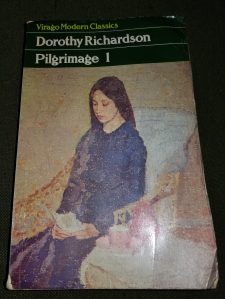 I was immediately drawn into the world that Dorothy Richardson creates for her heroine, Miriam Henderson, in Pilgrimage. Miriam is the third in line of four girls in a middle class English family who has fallen on hard times. When Pointed Roofs begins, Miriam is nervous about her impending trip to a German finishing school where she will teach English to wealthy, upper class English and German girls. She has accepted the position in order to relieve some of her family’s monetary woes, but at seventeen she is frightened to leave her safe environment that includes the constant love, support and guidance of her sisters.


 The Book Binder's Daughter