Monthly Archives: January 2017

Review: Justine by Iben Mondrup

My Review:
justine-front_frame_largeJustine is another example of the cutting-edge, fascinating, and experimental writing that Open Letter seeks out and publishes from authors around the world.  Originally written and published in 2012 in Danish, it has taken a few years for Mondrup’s work to become available in English.  It is just the type of creative, sensual, interesting book that was screaming out for Open Letter to translate and publish.

When the book opens, Justine’s house has just burned down and along with the house all of her artwork for an upcoming exhibition has gone up in flames.  Justine inherited the house and her artist sensibilities from her grandfather.  We are given some vague hints about what started the fire and whether or not Justine herself is to blame.  Most of the book is taken up with  Justine’s jumbled thoughts about her life past and present, about her experimentations with her art, about the sexist world of the Dutch art school, about her varied sexual relationships and about her disintegrating state of mind.

Sex is available to Justine no matter whom she encounters in art school; professors, graduates and students alike, male or female, will sleep with her.  I can’t help but think that the author chose the name for her title and main character, Justine, as a literary nod to de Sade who also penned a book with this title.  Justine is officially dating a woman named Vita, whom she appears to have genuine affection for: “I love her,” she writes, “I already loved her that New Year’s Eve when the light had long since departed, everyone had gone home, it was only us tough dogs left.”  Notice the interesting mix of past and present tense—the polyptoton love and loved is especially fitting— even in this one short sentence spoken by Justine.

But despite her feelings for Vita,  Justine keeps cheating on Vita with an interesting variety of men.  It turns out that Vita has also been seeing another woman behind Justine’s back and Justine becomes extremely jealous when she finds out.  Like the writing and some of the plot in the book, Justine’s sexual orientation is ambiguous.  Her sexual encounters with men and women are, like her state of mind, frenzied, intense, dark and highly erotic.  She describes a drunken escapade with a man named Bo she regularly meets for sex:

I can perch atop him and ride.  In my hand he’s an animal I’m bringing down.  I’ll ride him like he’s never been ridden, until he spurts until he dies.  I unzip his pants.  There’s softness in the warmth between the hairs.  I ride him with my hand.  I transform him to a fountain that shoots high in the air.

When her Grandfather and Ane, a good friend from art school, are described the narrative is more straightforward, more traditional.  But when she tells us about her various erotic interludes the text becomes poetic, scattered, broken.  Grandfather, who was himself a painter, discusses art, life and family history with Justine.  Grandfather himself has not had an easy existence because his wife, Justine’s grandmother, suffered from a nervous breakdown after she gave birth to Justine’s mother.  Justine’s mother is also mentally unstable and a drunk who accidentally burns herself to death.  Mondrup subtly weaves patterns of images throughout Justine’s scattered narrative: fire, burning, passion and madness.

Another significant stylist detail to note about the book is that several of the pages of the text are very short, a paragraph or even a sentence in length.  Since Justine jumps back and forth between past and present sometimes we are thrust into the midst of one of these short meditations and we aren’t sure if she is talking about past or present.  Many of her thoughts are eerily foreboding:

Is it even possible to find a cut-off?  An exact moment when it all went wrong?  A point around which all events are distributed?  Before and after?  A crime scene?  A weapon cast in a backyard?  The road to murder is a slippery slope of things that are said and done.  An eye that saw amiss.  Something that should’ve remained hidden.  Or something that  didn’t happen.  After the murder there’s the clean-up.  The cover up.  Someone must pay the penalty.  Others must receive it.

Justine finally manages to pull enough of her art work together to have a successful showing at a local gallery.  But the ending of the book can only be described as ambiguous.  Normally I would find this frustrating, but it is a fitting end for Justine whose own ambiguities abound throughout the novel.

About the Author:
mondrupIben Mondrup is a trained visual artist from The Royal Danish Academy of Fine Arts who is also the author of four novels, including Justine, its sequel, and Godhavn.

Read an conversation with Mondrup from The Rumpus: http://therumpus.net/2016/12/the-rumpus-book-club-chat-with-iben-mondrup-and-kerri-pierce/

3 Comments

Filed under Art, Literature in Translation

Hero-Shaming: Aidos and Nemesis in Logue’s War Music

Nemesis and Tyche

Nemesis and Tyche

Fat-shaming, slut-shaming, body-shaming, teen-shaming, pet-shaming.  In the blogging and book world I have even seen list-shaming recently.  There has been an explosion of attempts in the 21st century to shame one another into appropriate behavior via social media.  But what do these online exchanges really accomplish?  Have they really made us a more moral and ethical society?  Or is all of this shaming a badly veiled form of bullying and harassment?

It seems that we have come a very long way from the Homeric concept of shame, aidos, which was a quality a man or woman possessed that was a motivation for him or her to follow what was considered the correct behavior.  Aidos is the feeling of shame, humility or modesty that is specifically related to three aspects of Homeric society: situations involving sexuality, the entertainment of guests, and standing one’s ground in battle.  This last category especially pertains to the heroes in the Iliad Aidos, or shame, is what keeps a Homeric hero on the battlefield despite the horrors of warfare.  If a man flees from the battlefield due to fear or cowardice he feels great aidos, shame, in front of his fellow warriors.  James Redfield in his pivotal book “Nature and Culture in the Iliad” sums up aidos and its impact on the Homeric hero: “Combat is the crucial social act, for in combat the survival of the collectivity is at stake.  The aidos felt in battle is an experience of the collectivity; a man stands his ground because he shrinks from betraying his fellows.”

The exemplar of a hero with the most acute sense of aidos in The Iliad is Hector.  He goes into fierce battles brought on by his brother because to hide away from war would cause him great aidos. In Book VI of The Iliad, Hector returns home in the midst of fighting the Greeks in order to speak with his wife Andromache and see his infant son Astyanax.  In this beautiful yet deeply sad exchange between husband and wife, Andromache begs Hector not to go back into battle and she appeals to his sense of pity to persuade him.  She argues that when Hector dies she will be a lonely widow and their son will be a fatherless orphan.  Hector greatly pities his beloved wife as he contemplates with horror the aftermath of Troy’s destruction when she will be carried off as a slave to serve in a Greek man’s home.  But not even the thought of his wife as a captive will keep him from rejoining the battle.  What does keep him fighting and risking his life is his sense of aidos; he will die of shame, he says, if he does not return to battle and has to face the men or women of Troy who will think him a coward who shrinks from battle.  As with the concept of kleos, Homeric aidos is deeply rooted within community, something that is dependent on one’s society.

Paris is a flawed Homeric hero, the antithesis to his brother Prince Hector.  When Paris is saved from battle by the goddess Aphrodite, he feels no aidos at leaving the battlefield.  He is happy to sit in his rooms and drink in Helen’s beauty.  Paris’s sense of aidos is never fully developed and his lack of aidos makes him impervious to any nemesis he might incur.

I am disappointed that Logue did not recreate the scene in Book VI between Hector and Andromache because it is one of my favorite parts of the Iliad.  Logue does, however,  in his account of Iliad Books 3 and 4, approach the subject of Hector’s sense of aidos when the Prince volunteers himself to the Trojans who are trying to decide which man will fight Menelaus one on one.  The Trojans say about Hector’s offer:

Hector has fought and fought, has given blood and now—
Breathtaking grace,—offers his life and his armour to end
The hostilities he did not cause.

In this simply stated line, Logue alludes to one of Hector’s primary motivations for fighting a war against men who have not personally wronged him: his sense of aidos.  But the Trojans decide that it should be Paris who fights Menelaus since he started this mess in the first place.  Logue primarily deals with the Homeric idea of aidos through the character of Paris as an example of how a hero ought not to behave.  In Logue’s account, which is faithful to the Homeric plot, Aphrodite swoops in and saves Paris just before Menelaus is able to slaughter him.  When Paris reappears back in their palatial bedroom, Helen attempts to persuade Paris to go back out onto the battlefield and fight for her.  She is trying to appeal to Paris’s sense of aidos which is futile become he completely lacks this Homeric quality.  He is a defective Homeric hero:

Your death will be the best for everyone
Troy will reopen.  I shall sail for Greece.
And you will not survive your cowardice.

And later in Logue’s account of Iliad Books 7-9,  when the Greeks are beaten back to their ships and suffer horrible loses, the heroes appeal to one another’s sense of aidos to keep them on the battlefield.  The Greek men shout to one another:

Stand still and fight.
Feel shame in one another’s eyes.
I curse you, God.  You are a liar, God.
Troy will be yours by dark—immortal lies!
Home!
Home!
There’s no such place!
You can’t launch burning ships.
More men survive if no one runs.

In typical, short burst, hard hitting sentences Logue perfectly captures the Homeric ideal of aidos.  Logue’s last line of this quote in particular is reminiscent of Iliad V.531 and XV.563 when the Greeks and Trojans, in the midst of battle, are shouting to each other that when men feel aidos, more of them are likely to be saved in combat than perish.  So the Greek heroes’ need for kleos (fame) is what made them follow Agamemnon and Menelaus across the Aegean in the first place, but aidos is what keeps them from fleeing in horror every time they take their places on the battlefield.

The Greek concept of Nemesis, “righteous indignation  or “retribution” is closely related to aidos.  If a man acts improperly then he will incur the nemesis of his community;  it is aidos that keeps a man from behaving badly and attracting nemesis.  Redfield says about this Homeric concept:  “But nemesis is provoked by any act which is both improper and unexpected, ranging from failures of tact to cowardice and  betrayal.”  The outlandish behavior of the suitors, for instance, evokes nemesis in those who witness their bad manners.  Paris’s lack of aidos when he is carried off the battlefield is something that brings out nemesis in Hector who tries to persuade Paris to do the right thing.

I have found Logue’s insertion of nemesis into his poem especially interesting.  As Helen appears on the wall at Troy and looks down at the assembled armies, there is a hush over the warriors as they stare at her in awe.  And one after the other says about her:

Ou nem’me’sis…
Ou nem’me’sis…

There is some behavior that, while not ideal, is still within the acceptable social norm.  Such behavior is considered ou nemesis (ou meaning “no,” “not”).  Running from mortal danger (except on the battlefield), for instance, is ou nemesis.  I thought for a long time about Logue’s use of this phrase in relation to Helen and I believe it is his way of explaining the unfortunate circumstances under which Helen arrived in Troy.  Logue points out that it was Aphrodite that gave Helen to Paris, so Helen herself really can’t be shamed for causing this war that was not entirely her fault.  Thus, her situation is ou nemesis, even from a Greek fighter’s standpoint.  It’s also interesting to note that if it were not for her, then these heroes would not have this prime opportunity for kleos (fame).  So, another reason for ou nemesis.

In my next Logue post I will turn my attention to what, exactly, happens on the battlefield.  What makes a fighter or a man excellent?  How is honor related to a hero’s excellence?

6 Comments

Filed under British Literature, Classics

Review: The Underground By Hamid Ismailov

My Review:
the-undergroundCaveat lector.  Let the reader beware.  This book is deeply sad and does not have a happy ending.  But for many readers a happy ending is not a necessary factor for a book to be considered successful  The narrator of Ismailov’s novel is a child nicknamed Mbobo whose mother is from Siberia and whose father is an unknown African athlete that visited Moscow, and his mother, during the Olympics in 1980.  The boy’s sad story of a tumultuous childhood fraught with domestic violence and racism is told posthumously: “My mother died when I was eight, and I died four years later.”

As a boy, Mbobo oftentimes finds himself being taken from one part of Moscow to another via the city’s subway.  Each of the title chapters in the book is a station from the Moscow underground which is appropriate for the themes of darkness and death that are woven throughout the narrative.  The chapter entitled “Kropotkinskaya Station” begins:

If I ever wanted a tomb for my dead body, I would have picked the Kropotkinskaya Station. That is my vault: elegant and airy, impractical and absurd, standing all by itself, in the middle of the road, like an arch from nowhere to nowhere. If you find yourself on Volkhonk Street and pass under this frilly gape of an arch, you should turn left, you’ll end up in my underground hell, the very station where I, the stoker-imp, am covered in soot. There fountains of flames spurt up toward the hot ceiling from the torch-like pillars, where the light of day is never seen.

Because Mbobo is black he suffers from horrible, daily episodes of racism throughout his young life.  His nickname, Pushkin–the poet’s maternal great- grandfather came to Russia from Ethiopia with Peter the Great— is even a cruel reminder that he is not like everyone else.  When he is at school he is pushed by a bully and he suffers a severe concussion.  While recovering at the hospital, which should have been a safe resting place for him, two other boys tie him up and call him awful, racist names.

The only real solace in his life is the unconditional love shown to him by his mother, whose name is Moscow. He calls her “Mommy Moscow.”  But she has her own issues with alcohol and promiscuity which also affect Mbobo’s life.  Her husband,  whom the child calls Uncle Gleb, is a struggling writer.  On the rare occasions when he does get paid he spends his earnings on vodka and then beats his wife.  Mbobo witnesses regular episodes of domestic violence and oftentimes tries to intervene to stop Uncle Gleb from killing his mother.  When she finally gets tired of his drunken beatings, Mbobo’s mother takes up with a railway police officer named Uncle Nazar.  Even though his second stepfather is kinder to his mother, he is stern and distant with the boy.

When Mbobo’s mother succumbs to her intemperate lifestyle, he is left orphaned.  He bounces between his uncles who attempt to care for him but with the loss of the unconditional love of his mother he is drowned in his feelings of utter and complete loneliness.  These tragedies happen to Mbobo with the imminent collapse of the Soviet Union as the backdrop.  One of the final tragedies that the boy experiences is the renaming of his underground stations that had been one of the few constants in his short life.

The book is fused with literary allusions to the Russian greats: Pushkin, Dostoevsky, Nabokov and Platonov all peak through Ismailov’s text.  The greatest of greats, Tolstoy himself, makes his appearance at the end of the novel which has a conclusion similar to that of Anna Karenina.  Despite the melancholy ending, Ismailov’s talented writing about identity, race, loneliness and the collapse of a government make it a highly successful literary novel.

Ben Winston, who has founded the site Vibrant Margins which is dedicated to bringing small press books to readers through a subscription service, has agreed to give a copy of The Underground as well as Country Life by Ken Edwards to one of my readers. Both of these books, which are great literary reads,  are included in the first subscription season of Vibrant Margins.   If you would like a copy of these books then just leave me a comment and I will randomly pick one US reader.   So that my friends outside the US will also have a chance to read these books,  I will also pick one International reader to win my own copies of these books.

About the Author:
hamidismailovBorn in an ancient city in what is now Kyrgyzstan, Hamid Ismailov is an Uzbek novelist and poet who was forced to leave his home in Tashkent when his writing brought him to the attention of government officials. Under threat of arrest, he moved to London and joined the BBC World Service, where he is now Head of the Central Asian Service. In addition to journalism, Ismailov is a prolific writer of poetry and prose, and his books have been published in Uzbek, Russian, French, German, Turkish, English and other languages. His work is still banned in Uzbekistan. He is the author of many novels, including Sobranie UtonchyonnyhLe Vagabond Flamboyant, Two Lost to LifeThe RailwayHostage to Celestial TurksGoogling for SoulThe UndergroundA Poet and Bin-Laden, and The Dead Lake; poetry collections including Sad (Garden) and Pustynya (Desert); and books of visual poetry including Post Faustum and Kniga Otsutstvi. He has translated Russian and Western classics into Uzbek, and Uzbek and Persian classics into Russian and several Western languages.


21 Comments

Filed under Literary Fiction, Literature in Translation, Russian Literature

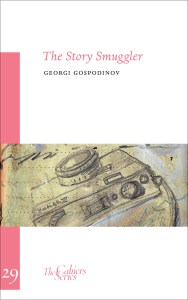
Review: The Story Smuggler by Georgi Gospodinov

the-story-smugglerWhen I first read Gospodinov’s novel The Physics of Sorrow I was completely captivated by his poetic language, insightful metaphors and riveting storyline.  Despite its brevity, Gospodinov’s writing in The Story Smuggler, #29 in the Cahiers Series, is as equally lyrical and absorbing as his longer novel.  He begins his narrative with a discussion of the Bulgarian word тъга which is usually translated as “sorrow, melancholy.”  But he explains that it is really a word that means much more than “sorrow” or “melancholy” because this noun also encompasses a “longing, something unrealized, a dream of what has been lost forever or of what has never been achieved.”  Finally, he adds that this feminine noun doesn’t overwhelm us immediately, but instead creeps up on us as, “her waters are placid, her poison is slow, enfeebling.”

Gospodinov uses this Bulgarian word as a starting off point from which to reflect on all of the freedoms that he and other Bulgarians weren’t allowed to experience under a totalitarian regime.  There is a melancholic beauty to Gospodinov’s language as he describes his childhood filled with repressed and hidden sorrows:

Some smuggle cigarettes, others alcohol,—or weapons.  Our contraband, being invisible, is more dangerous.  Our contraband is undetectable by scanners.  The excess baggage that we conceal is stories, our own and those of others.  I come from a place where people are accustomed to holding their peace, or to recounting their stories in secret.  A place of unarticulated тъга—vast, hidden fields of it.

Gospodinov gives numerous examples of a longing for things that are forbidden during his boyhood in Bulgaria: cakes, chocolate, trips abroad, jeans, and pop music.  Each school child, he tells us, had an “illicit secret” notebook called a lexicon which was wrapped in colorful paper and written in with a multitude of colorful pens.  All school books were wrapped in the same white color and all notebooks were written with the same blue ink, so the decorating of their lexicons was a kind of rebellion in itself.  They would also leaving drawings, quotations, or the highly coveted images cut out from Western magazines in one another’s books.

The children would have questions listed in their lexicons and secretly pass around and answer each other’s questions.  The questions might seem rather mundane or unimportant to those of us who grew up in the West but these were all topics that Bulgarian teenagers living under Communism were not able to discuss openly: What country would you like to live in?  Do you listen to rock music? What is your favorite movie/actor/actress?  Do you have a boyfriend/girlfriend?  These lexicons were the primary means of teenagers attempting to smuggle their own stories among one another:

The lexicon was a place of escape, a refuge, a territory of not fully conscious teenage resistance and struggle for an identity of one’s own, for a profile different from the one imposed by the system.  A small personal niche, a private chamber, a secret enclave where you could see yourself wearing jeans, illegally smuggled by some long-distance lorry-driver; where you could flip through a contraband copy of Rolling Stone; where you could be a world traveler and a happy visitor of beloved Italy, France or Japan.

There is a sense that Gospondinov spends the rest of his life traveling around the world and writing in an attempt to make up for the sorrow, the  тъга, from his early years.  In the 25 short yet description chapters of The Story Smuggler he writes about trips to Germany, Iceland and England.  And he writes about his urge to write—poetry, fiction, diary entries— from a very early age. But there is a underlying feeling that he can never really recover the simple pleasures and freedoms that were denied to him throughout his formative years.

This volume was translated from the Bulgarian by Kristina Kovacheva and Dan Gunn.  The illustrations, which are also quite intriguing, are done by the Bulgarian graphic artist Theodore Ushev.

This is the first selection I have read from the Cahiers Series and I am was so impressed with the quality of writing and art work in this slim book that I ordered six more publications from the series.  I would love to know what other Cahiers that readers have enjoyed.  I would like to make my way through the entire series if all of the volumes are all as well-written as this one.

story-smuggler

A sample illustration by Theodore Uskev from The Story Smuggler


12 Comments

Filed under Cahier Series, Literary Fiction, Literature in Translation, Nonfiction

Respice Futurum: Reading Plans for 2017

books-2017

I have the privilege every day of going to work at a place that I love and that has a long and rich tradition of education.  The Woodstock Academy, founded in 1801, is one of the oldest public schools in the United States and it has a simple yet profound Latin motto which reflects and respects this tradition: Respice Futurum– “Look back at your future.” (For the philologists out there, respice is a present active imperative, a compound made up of the prefix re (back, again) and the verb spicio (to look) and futurum is the accusative, singular of the noun futurum which is formed from the future active participle of sum.)

These two simple Latin words capture the idea that one moves towards the future while also reflecting on the past.  My husband likes to say that this motto is the equivalent of moving forward on a train while sitting in a seat that is facing backward.  I thought Respice Futurum is apt for a reflection on books as well;  it seems fitting to look ahead to my reading plans for 2017 while also reflecting on the types of books I have encountered over the past year and how they will influence my reading choices moving forward.

According to my list on Goodreads I read 105 books, a total of 24, 484 pages in 2016.  A few books were left off this list such as Pascal Quignard’s Roving Shadows and The Sexual Night. The Goodreads list also doesn’t include a few volumes of poetry I’ve read and some collections of essays.  And my list does not include any of the Latin or Greek authors I’ve translated or retranslated in 2016.   This was not a bad year for me, but not my best either.   The books in translation I have read have come from the following languages:  French, German, Spanish, Estonian, Russian, Italian, Bulgarian, Korean, Malayalam, Kannada, Hungarian, Swedish, Turkish, Slovene, Icelandic, Hebrew, Norwegian, Portuguese.

In looking at this list of lit in translation, I would like to explore more books from Asia and Africa which are not well-represented on my list.  I would also love to explore more books translated from Arabic which is a huge gap in my translated fiction.  If anyone has suggestions, please leave them in the comments!

Almost all of the books I have read have been published by small presses which will continue to be my main source of reading: Seagull Books, New Vessel Press, Open Letter and Deep Vellum, Archipelago, New York Review of Books and Persephone Books. 

My first read of 2017 has been The Story Smuggler by Georgi Gospondinov.  This is #29 in the Cahier Series and the first one I’ve read from this series.  I loved it so much that I went back and bought six more titles from the series, so there will be more Cahier titles in my future.

Gospondinov’s book The Physics of Sorrow is my favorite book from the Open Letter Catalog and one of my first reads in 2017 that I just started is another title from Open Letter, Justine by Iben Mondrup. 

A book that I have already started in 2016 and will finish in 2017 is The Collected Prose of Kafka from Archipelago Press.  This is a title that I am slowly making my way through and savoring.  Archipelago has managed to collect some of Kafka’s best short pieces into one volume.

I have discovered the works of French philosopher Jean-Luc Nancy this year and reading his extensive backlist published in English should keep me busy for a very long time.  Next up on my list of books written by him is his title on Sleeping.

Speaking of French writers, I am eager to read Pascal Quignard’s Terrace in Rome and All the World’s Mornings in 2017.

I was lucky enough to get an advance review copy of  Russian author Sergei Lebedev’s The Year of the Comet which is being published in 2017 by New Vessel Press.  I am very excited that I will have an interview with Lebedev coming up in an issue of Numero Cinq, for which literary magazine I am also privileged to continue to do production editing, to scout and recruit translators and to write reviews.   I am also looking forward to two additional lit in translation titles from New Vessel:  Moving the Palace (from Lebanon) and Adua (from Italy.)

I am always eager to read whatever Seagull Books publishes and thanks to their wonderful catalog I have discovered some classics of Indian literature.  I am also looking forward to reading Goat Days by Benyamin which is already sitting on my bookshelf.  I also understand that Seagull is publishing more works from Tomas Espedal in English translation which I am very eager to get my hands on.  A long-term, very long-term goal of mine is to read the entire backlist from Seagull Books.  I will do my best to put a large dent in that list this year.

This year I discovered Ugly Duckling Presse and I am eager to explore their backlist of poetry as well as their essays.  I have a copy of To Grieve by Will Daddario on my shelf already.  I would like to read more essays this year, so please leave suggestions for essays in the comments!

Finally, I would like to read more classics in 2017, especially Tolstoy, Pushkin and other Russian masters.  I have a collection of Tolstoy’s short stories and a copy of The Complete Prose of Pushkin sitting on my shelf that I have yet to read.  I also look forward to the reissues of classics from NYRB who is publishing more books my Henry Green.  I am hoping to have read all six reissued Green books by the end of 2017.  And, as always, I look forward to whatever classics from British, (mostly) female authors that Persephone Books has in store.

And as far as posts on my blog are concerned, I have always shied away from writing about Latin and Greek and classics, but my reading of Logue’s War Music has inspired me to continue writing about The Iliad and to do some of my own translations and interpretations of various Latin authors.

classics-booksA sampling of some of my most cherished classics books; the Loebs are nestled snugly on the bottom shelf.

Well, I could go on and on about my reading plans for 2017 or I could just go and actually get to reading.  Happy new year to all of my fellow bibliophiles.  I hope you also get a chance to Respice Futurum.

chair-bookroomThe cozy spot where much of my reading takes place.  It is overlooked by a print of The Roving Shadows cover done by Sunandini Banerjee, Seagull Books artist.

 

36 Comments

Filed under British Literature, Classics, Favorites, French Literature, German Literature, Hungarian Literature, Italian Literature, Literary Fiction, Literature in Translation, New York Review of Books, Opinion Posts, Persephone Books, Seagull Books