
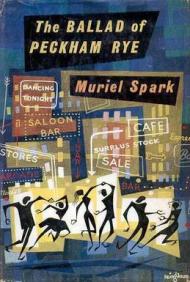
 This is my first Muriel Spark book (thanks to Grant at 1st Reading for giving me the nudge to try her) and I knew from these opening sentences that I would enjoy her writing very much:
‘Get away from here, you dirty swine,’ she said.
‘There’s a dirty swine in every man,’ he said.
‘Showing your face round here again,’ she said.
The “he” is Humphrey, who has recently jilted his bride-to-be, Dixie, at the altar and the “she” is Dixie’s mother. Spark’s narrative is full of surprises, the first, and most obvious of which, is that the author begins her story at the end. My impression after reading the first page was poor Dixie, what an awful thing to happen to her. But over the course of the next 140 pages Spark convinces me that Humphrey probably made the right decision. Men might have something of the dirty swine in them, but the ladies don’t fair much better in this humorous and strange book.
Dougal Douglas, the new guy in town, is blamed not only for the failed wedding, but also for the other mayhem that has recently broken out in town—fighting, absenteeism at the local textile factory, and even murder. He keeps showing everyone that he used to have two horns on his head that were surgically removed and so many people believe that he is, physically and mentally, a devil. Although Dougal is shrewd and quirky, his intentions are not really evil. And, unlike everyone else in Peckham, he is rather forthcoming about his greatest weakness—he can’t stand any type of sickness. At the first sign of a disease he will flee as fast as he possibly can.
The two subplots in the text that entertained and intrigued me the most were those that involved Mr. Druce, a manager at the local factory and Dixie’s thirteen year-old brother, Leslie. Mr. Druce is in a rather unhappy marriage of twenty years and is having a an affair with the head of the typing pool. When Dougal questions Druce about his reasons for staying in the marriage, it seems that the wife has some sort of secret that she is holding over her husband. And what is even more interesting is that the pair having spoken in a few years, only communicating through notes. Mr. Druce and his odd behavior keep the tension building in this bizarre narrative right up to the final page.
Leslie, at first, seems like a typical, sulky teenager who is withdrawn from his family. But as the story goes on we learn that this boy has a much more sinister side and is involved with gangs, blackmail and roughing up old ladies. His parents argue over his upbringing, or lack thereof; his father thinks that since he works all day that the responsibility of childrearing falls on the maternal parent and his mother thinks that his father ought to take more of an interest in his son’s life. So the result of this parental stalemate is a wild boy who tortures his sister and his neighbors and never suffers any consequences for his bad behavior.
This was just the perfect book to enjoy poolside on a hot Sunday afternoon. I look forward to reading more of Spark over my summer holidays. I have Open to the Public, The Mandelbaum Gate and Memento Mori sitting on my TBR piles. Please let me know what other books of hers you would also recommend.
 There are some intriguing and surprising personal stories and anecdotes that George Steiner weaves into the essays in My Unwritten Books. In his essay on his political and religious beliefs, for instance, he admits that he has never once in his life voted in any election, local or national. He is an avid dog lover and the emotion he shows towards his pets, he admits in the essay “On Man and Beasts,” sometimes runs deeper than that which he feels for his family. And, perhaps the most intriguing statement in the book, comes in his writing about Eros: “I have been privileged to speak and make love in four languages. Also in the interstices, sometimes inhibiting, sometimes playful, between them.”
 What more can really be said about Kafka’s writing? I feel almost embarrassed to share my thoughts about this new volume of translations by Michael Hofmann; there will be nothing new or earthshattering here, but I am hoping that fellow Kafka lovers will at least be happy to stumble across another devotee. Please go easy on me as I offer my humble observations on this collection!
 Nox
Nox


 Compass takes place over the course of one, long night during which Franz Ritter, a Viennese musicologist, suffers from a terrible bout of insomnia. The symptoms from his recently diagnosed illness, the memories of an unrequited love, and the dissatisfaction at his mediocre academic career all contribute to his sleepless night. Instead of chapters, Énard uses time stamps to denote the hours that are slowly ticking away as Franz runs through years of memories. Sarah, a French Academic with whom Franz has spent many years in love, sends him an article she has written from Sarawak, in Malaysia, which is her current place of residence. It is unclear at the beginning what Franz and Sarah mean or have meant to each other, but Franz slowly unravels their complicated history throughout the course of his sleepless night.


 The Book Binder's Daughter