Tag Archives: Literature in Translation

Review: August by Christa Wolf

I received a review copy of this title from Seagull Books.  This book was originally published in German and this edition has been translated by Katy Derbyshire.  This is my final contribution to German Literature Month.  This has been a fantastic event with over 130 titles reviewed by bloggers.

My Review:
Layout 1The author, Christa Wolf, wrote this 74 page book in a single sitting as an anniversary gift to her husband.  It is a beautiful, heartwarming story that shows us that even in the most extreme and unfortunate circumstances love and kindness can make everything tolerable.  August and his mother were forced from their home in East Prussia at the end of World War II and as these refugees were traveling by train to escape the atrocities of war, an accident takes August’s mother.  As an orphan August is placed in a hospital, which is actually a former castle turned into a hospital that treats tubercular and consumptive patients.

August is surrounded by sickness and death and sorrow but what he remembers most about his time at the hospital is an older girl named Lilo.  Lilo is a teenager, so she is a bit older than August, but her warmth and kindness are something that August constantly wants to be around.  Her songs and stories make him forget, at least for a little while, that he is an orphan living in a hospital.  No matter how sick or close to death another patient might be, Lilo still visits and tenderly cares for many of the children at the hospital.

August is now a sixty-year-old man looking back on his life and remembering his time in the hospital after the war.  It is a testament to the resilency of the human spirit that August doesn’t remember all of the death and destruction around him, but what stands out in his mind is the compassion and generosity of Lilo.  August has lived a full and happy life and he is able to look back on it with a warm feeling in his heart and no regrets.  August is also very thankful for the wonderful life he has shared with his wife and for his job of driving tourists back and forth from Prague to Dresden.  He is a simple man and is so grateful for what might seem to many as insignificant memories.

Written in beautiful, concise prose, Wolf is the perfect example of the fact that even a very short novella can have a powerful and far reaching impact on readers.

About the Author:
C WolfA citizen of East Germany and a committed socialist, Mrs. Wolf managed to keep a critical distance from the communist regime. Her best-known novels included “Der geteilte Himmel” (“Divided Heaven,” 1963), addressing the divisions of Germany, and “Kassandra” (“Cassandra,” 1983), which depicted the Trojan War.

She won awards in East Germany and West Germany for her work, including the Thomas Mann Prize in 2010. The jury praised her life’s work for “critically questioning the hopes and errors of her time, and portraying them with deep moral seriousness and narrative power.”

Christa Ihlenfeld was born March 18, 1929, in Landsberg an der Warthe, a part of Germany that is now in Poland. She moved to East Germany in 1945 and joined the Socialist Unity Party in 1949. She studied German literature in Jena and Leipzig and became a publisher and editor.

In 1951, she married Gerhard Wolf, an essayist. They had two children.


4 Comments

Filed under German Literature, Literature in Translation, Novella

Review: Zbinden’s Progress by Christoph Simon

This is my third contribution to German Literature Month.  This has been such a fun event with so many bloggers reviewing great German books.  To see a complete list go to the #GermanLitMonth hash tag on Twitter.  This title was originally published in German in 2010 and this version is translated into English by Donal McLaughlin.

My Review:
Zbinden's ProgressLukas Zbinden lives in a nursing home in Germany and even though he isn’t as fast as he used to be, one of his favorite activities is still taking his daily walk.  Most of the book entails Lukas taking walks with Kazim, one of the newly-hired caretakers at the home.  On their walks Lukas describes to Kazim the other inhabitants of the home, Lukas’ former life before the nursing home, and Lukas’ philosophical musings on the importance of walking.

Lukas and his deceased wife, Emilie, have one son named Markus and much of Lukas’ story deals with his son and his inability to connect with Markus even as an adult.  Markus is a chemist and when Lukas asks him about his work and his lab Markus’ answers are short and nondescript.  Lukas stretches his memory back to Markus’ childhood during which Emilie did most of the parental nurturing.  But Lukas was by no means a distant father; he oftentimes tries to get involved in his son’s life, such as the time he tries to console Markus after his first love breaks his heart.  For whatever reason, Lukas and Markus are never able to connect on a deeper, emotional level.

Lukas had a long and successful career as a teacher and his stories about his students and his various jobs are very funny.  After an episode in which his wife tells him to be quiet, she even slaps him to get her point across, Lukas decides to be completely silent in his classroom.  The situation that unfolds is at first uncomfortable as the students can’t decide what is going on with Herr Zbinden.  But as they try to take control of the learning environment themselves, chaos ensues.  Lukas has to break his silence to stop the fighting and excessive swearing of his out-of-control students.

One of the things I liked most about Lukas is his ability to talk to and make friends with anyone.  He even tries to reach out to and chat with the more reticent and crabby members of the nursing home.  He makes friends with all sorts of people on his daily walks.  There is not very much substance to the plot of this book, but instead it is one of those stories that is driven by a single, strong and heartwarming character.  It was a pleasure to accompany Herr Zbinden on his literal walk down the stairs of the nursing home and his metaphorical walk through the memories of his full and rich life.

About the Author:
Christoph-SimonChristoph Simon was born in 1972 in Emmental, Switzerland. After travels through the Middle East, Poland, South America, London and New York, he has settled in Bern. His first novel, Franz, or Why Antelopes Run in Herds (2001) has sold over 10,000 copies, while Planet Obrist (2005) was nominated for the Ingeborg Bachmann Prize. Zbinden’s Progress is his fourth novel and won the 2010 Bern Literature Prize.

German Lit Month

4 Comments

Filed under German Literature, Literature in Translation

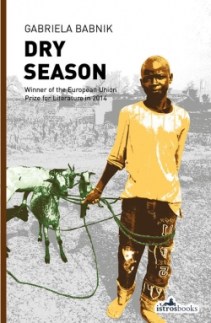
Review: Dry Season by Gabriela Babnik

I received an advanced review copy of this title from Istros Books.  Dry Season was the winner of the European Union Prize for Literature in 2013.  This book was originally written in Slovene and this English translation has been done by Rawley Grau.

My Review:
dry-season-cover_54aff6fb99d92_250x800rI have to admit that before I read this book I really knew nothing about the small West African nation of Burkina Faso.  The setting alone of this story in this small and politically volatile country taught me so many things, but the book as a whole is also a fantastic read.

From all outward appearances, the two main characters of this story could not be more different.  Anna is a 62-year-old white woman from Slovenia who has had a successful career as a textile artist.  Ismael is a 27-year-old black man from Burkina Faso who has grown up on the streets and has never had any real job or career.  It is surprising, even shocking that Anna and Ismael become lovers, but the author weaves their tales together so perfectly that in the end we are convinced that this relationship has had a powerful impact on both of them.

The narrative alternates between the point of view of both main characters.  We learn that Anna was rescued from an orphanage by her parents who, in a last ditch effort to save their marriage, agree to adopt a child since they cannot have one of their own.  But her parent’s strained relationship takes an emotional toll on her as a little girl as she is mostly left to be raised by a housekeeper.  Anna’s father is busy with his multitude of extramarital affairs and Anna’s mother remains aloof from her daughter while she constantly works at her sewing machine making women’s lingerie.  Anna eventually falls into an unhappy marriage with a man whom her mother chose for her and her only son from this marriage ends up in a mental institution.  Anna abandons her home, her family and her past to find some peace and quiet in Africa.

Ismael, when he was very young, lived in a remote African village with his mother who was an outcast.  Ismael never knew who his father was and he is constantly witnessing his mother being abused by fellow villagers as she is tied to the “shaming pole” and spit upon.  We are never told exactly what his mother’s sin is in the eyes of the villagers, but there is reason to suspect it has something to do with Ismael’s lack of a father.  Ismael and his mother eventually migrate to the streets of Ouagadougou, the capital city of Burkina Faso, where they live in cardboard boxes under a bridge.  When Ismael’s mother is killed and he is left alone in a city full of dangerous people, he is taken in by strangers who never really fulfill the role of a family for him.  He stays with an “ebony” woman and her husband for a while who have lost their own son and are trying to keep Ismael as their surrogate child.  Ismael also stays with a man named Baba who has been the only positive male role model in his life.  But Ismael gets pulled into the illegal and dangerous activities of Baba’s son Malik.

Even though they are born on different continents and decades apart there are some important ties that bind Anna and Ismael together.   They both feel abandoned and isolated, neither of them knows their real father and both of their mothers are emotionally distant. Anna and Ismael have separate and distinct stories told in alternating chapters, but the way in which the author gradually weaves together their stories is brilliant.  At first appearance it would seem that Anna and Ismael are using their sexual relationship to suppress their feelings of abandonment and isolation.  But as they share their stories with one another a deeper, emotional bond is forged.

Set against the backdrop of the harmattan, the dry season in West Africa, this novel  is a must read for anyone who enjoys brilliant literary writing with strong and intense characters.  I kept asking myself throughout the novel why, of all places on earth, Anna would pick this obscure West African country to flee to.  The dry season is one of extremes: extreme amounts of dust, extreme changes in temperatures, extreme fog and eventually extreme downpours of rain when the season ends.  This is the perfect setting for two characters who are, much like the dry season itself, both going through the extremes experiences of human existence.

This is my first title from Istros Books, an Independent British publisher that specializes in translating books from Eastern Europe into English,  and I am very excited to see what else they have in their catalogue.

About the Author:
gabriela-babnik_54d0fce19b0a4_250x800rGabriela Babnik was born in 1979 in Göppingen, Germany. After finishing her studies at Ljubljana University, she spent some time in Nigeria before working on a master’s degree on the modern Nigerian novel. Since 2002, she has regularly contributed articles to all major daily and weekly publications in Slovenia. In 2005, Babnik graduated in Comparative Literature and Literary Theory at the University of Ljubljana.

Her first novel Koža iz bombaža (Cotton Skin) was published in 2007 and was awarded the Best Debut Novel by the Union of Slovenian Publishers at the Slovenian Book Fair. In 2009, her second novel V visoki travi (In the Tall Grass) was published, which was shortlisted for the Kresnik Award in 2010.

Babnik lives with her family in Ljubljana.

13 Comments

Filed under Literary Fiction, Literature in Translation

Review: Montaigne by Stefan Zweig

I received an advanced review copy of this title from Pushkin Press through Edelweiss.  Montaigne was originally written in German in 1941 and this English translation is done by Will Stone. This is my second contribution to German Literature Month, hosted by Lizzy’s Literary Life and Beauty is a Sleeping Cat.  Please visit their blogs for more great German Literature in translation and to see the full list of blogs that are participating.

My Review:
MontaigneStefan Zweig was forced to flee his home in Austria as the Nazis were taking control of his motherland.  For years he wandered around Europe as a nomad with no real place to call home.  As Europe is ravaged by war, he finds his way to the German community of Petropolis in Brazil and in 1941 he decides to write this brief biography of Michel de Montaigne with whose life he identifies on many levels.

Montaigne comes from a long line of hardworking ancestors.   His father’s family were fishermen and made their fortune by eventually owning their own fleet of ships.  His mother’s family were Jewish bankers from Spain who fled that county to avoid the Inquisition.  Montaigne’s grandfather buys a chateau and a vast estate in Bordeaux and intends to further the family’s aristocratic status through his purchase of land and a title.

Montaigne is brought up in the lap of luxury and it was very important to his father that his eldest son receive the best education possible.  As a result it was mandatory that Montaigne be fluent in Latin, for which purpose his father hired a German tutor when Montaigne was only four years old.  Montaigne was only allowed to speak in Latin and even the rest of the family and the household servants were required to learn some basic Latin phrases in order to communicate with the young boy.  As a result of this immersion in the language Montaigne is said to have been more comfortable speaking and writing in Latin than in his native French.  As a classicist I couldn’t help but simile at and appreciate this part of Montaigne’s story.  If only it were possible to educate all of my students in this way!

When Montaigne’s father dies he takes over as the head of household..  This foists a large responsibility on a man who sees his familial and civic responsibilities as mundane and tiresome occupations.  Zweig highlights Montaigne’s detachment from his family whom he even seems to view at times as a burden.  He never has fond words for his wife or the institution of marriage and at one point Zweig says that Montaigne is not even really sure how many children he has that are still alive.  Montaigne’s isolation from his family is further deepended when, at the age of thirty-eight, he decides that he wants to retire from his life, lock himself in the study in his tower, and read the precious books with which he has surrounded himself.

Montaigne’s view of books and reading is also noteworthy in Zweig’s account of his life.  Montaigne wants to absorb as much information and knowledge as possible and he scribbles notes in his books as various thoughts occur to him.  Montaigne states about his collection: “Books are my kingdom.  And here I seek to reign as absolute lord.”  It is during this time of self-imposed retreat and isolation that Montaigne tries to attain individual freedom and seeks to know himself as a man and as a human being on a deeper level.  His intentions, like other philosophers, is not to give his readers a specific ideology to follow.  Instead his thoughts and writings are introspective and intensely personal.

Ten years later, at the age of forty-eight, Zweig decides that he has had enough of his retirement and so decides to travel across Europe.  This journey becomes very painful for him since he suffers debilitating pain from kidney stones.  While he is away on his journey, the citizens of Bordeaux elect him in absentia as their mayor so at this point he decides to go back and serve his people.  Zweig reminds us, though, that Montaigne is no hero and his selfish habits come to the forefront once again when the plague breaks out in Bordeaux and he abandons his people to find for themselves.

Whether or not one is familiar with Montaigne, Zweig’s account of him is definitely worth a read.  Zweig was at a critical point in his life where he saw the world erupt in violence because of fascism and communism.  He commiserated with Montaigne who also saw his world torn apart by religious wars and fanaticism.  Zweig commits suicide in 1942 and this was one of the last things that he wrote.  Many believe that Zweig took Montaigne’s advice as far as death is concerned and decided to die on his own terms instead of living through a miserable exile imposed on him by outside forces.

About The Author:
Stefan Zweig was one of the world’s most famous writers during the 1920s and 1930s, especially in the U.S., South America and Europe. He produced novels, plays, biographies and journalist pieces. Among his most famous works are Beware of Pity, Letter from and Unknown Woman and Mary, Queen of Scotland and the Isles. He and his second wife committed suicide in 1942.

Zweig studied in Austria, France, and Germany before settling in Salzburg in 1913. In 1934, driven into exile by the Nazis, he emigrated to England and then, in 1940, to Brazil by way of New York. Finding only growing loneliness and disillusionment in their new surroundings, he and his second wife committed suicide.

Zweig’s interest in psychology and the teachings of Sigmund Freud led to his most characteristic work, the subtle portrayal of character. Zweig’s essays include studies of Honoré de Balzac, Charles Dickens, and Fyodor Dostoyevsky (Drei Meister, 1920; Three Masters) and of Friedrich Hlderlin, Heinrich von Kleist, and Friedrich Nietzsche (Der Kampf mit dem Dmon, 1925; Master Builders). He achieved popularity with Sternstunden der Menschheit (1928; The Tide of Fortune), five historical portraits in miniature. He wrote full-scale, intuitive rather than objective, biographies of the French statesman Joseph Fouché (1929), Mary Stuart (1935), and others. His stories include those in Verwirrung der Gefhle (1925; Conflicts). He also wrote a psychological novel, Ungeduld des Herzens (1938; Beware of Pity), and translated works of Charles Baudelaire, Paul Verlaine, and mile Verhaeren.

Most recently, his works provided inspiration for the 2014 film ‘The Grand Budapest Hotel’.

German Lit Month

9 Comments

Filed under German Literature, Literature in Translation, Nonfiction

Review: Nagasaki by Éric Faye

I received an advanced review copy of this title from Gallic Books through NetGalley. This book was originally published in French and this English translation is done by Emily Boyce.  This is also my first post for Novella November hosted by Poppy Peacock Pens.  Please visit her site for more great reviews of novellas throughout the month.

My Review:
NagasakiShimura Kobo leads a very quiet and regimented life in the suburbs of Nagasaki.  He is a meteorologist who avoids the company of his coworkers and every night returns to his neat, orderly and lonely apartment.  When food starts to disappear from his refrigerator and items appear out of place in his apartment he takes notice and is really bothered by this disruption in his organized life.  At first he thinks that he is just going crazy but in order to verify his missing items he starts cataloguing the contents of his refrigerator and measuring the liquid in his juice containers.  He finally decides to buy a webcam which is linked to his laptop so he can spy on his visitor while he is at work.

Shimura eagerly watches his laptop at work waiting for the intruder to appear on his screen.  He has to wait several days but he finally glimpses a woman standing in his kitchen, enjoying the sunlight and making herself a cup of tea.  He immediately calls the police who go over to his apartment to catch the suspected intruder.  But when the police arrive, there are no signs of a break in.  The doors and windows are locked and the police are about to give up their search when they discover a woman hiding in the closet in Shimura’s spare bedroom.

The woman, as it turns out, had lost her job in the economic recession and had to give up her apartment.  She was living on the streets of Nagasaki until one day she noticed Shimura leave for work.  She also noticed that he left the door to his house unlocked and so she let herself in, just intending to have a warm and dry place to stay for a few hours.  But when she discovers Shimura’s extra bedroom which is rarely used, she basically lives with him unnoticed for the better part of a year.

The most fascinating part of the story is the lasting psychological impacts that their inadvertent cohabitation has on both of them.  Shimura is forced to contemplate his lonely and solitary existence and he never feels comfortable again living in his apartment.   The woman does a short stint in jail and writes Shimura a very detailed letter about why she chose his house to stay in.  But she too is changed from her sojourn at Shimura’s home.  Their individual isolation and loneliness is cast into sharp relief when they each see how the other one lives.

This is a quick yet powerful read that I highly recommend. My only complaint is that I didn’t want the book to end; I wanted to know more about the fate of Shimura and his secret roommate.   This is a fantastic choice to kick off Novella November!

About The Author:
Eric FayeBorn in Limoges, Éric Faye is a journalist and the prize-winning author of more than twenty books, including novels and travel memoirs. He was awarded the Académie Française Grand Prix du Roman in 2010 for Nagasaki.


13 Comments

Filed under Literature in Translation, Novella
