Tag Archives: British Literature

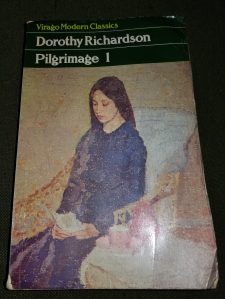
Pointed Roofs: Some initial thoughts on Pilgrimage by Dorothy Richardson

I was immediately drawn into the world that Dorothy Richardson creates for her heroine, Miriam Henderson, in Pilgrimage.  Miriam is the third in line of four girls in a middle class English family who has fallen on hard times.  When Pointed Roofs begins, Miriam is nervous about her impending trip to a German finishing school where she will teach English to wealthy, upper class English and German girls.  She has accepted the position in order to relieve some of her family’s monetary woes, but at seventeen she is frightened to leave her safe environment that includes the constant love, support and guidance of her sisters.

Pointed Roofs is the first of thirteen chapters in Richardson’s semi-autobiographical novel that follows the life of Miriam Henderson.  The thirteen chapters, published between 1915 and 1967, are rather lengthy—Pointed Roofs is 185 pages— and are self-contained volumes or novellas that describe different periods in Miriam’s life.   Even though the book is written in the third person, May Sinclair famously labeled Richardson’s style of prose as “stream-of-consciousness.”  We see the finishing school, her students, her supervisor at the school, and Germany from Miriam’s perspective which always contains a charming innocence.

One of the first things she notices at the German school, which comes as a great surprise to her, is the distinct lack of a daily schedule.  Classes, outings, music performances, and baths are all announced spontaneously at the whim of the headmistress, Fräulein Pfaff.  During her time as the English instructor at the school she only teaches one formal class to her students and after her single performance as an instructor there is an unspoken expectation that Miriam is to teach the girls English whenever they go on walks through town.  Miriam comes to realize that the so-called education that these girls are to receive is rather light since all of them will end up as the wives of wealthy German men and will not have much use for a rigorous, academic curriculum.  It makes her appreciate the education that she received at her English school which she realizes was muchmore serious and valuable.

The strength of Richardson’s narrative lies in her ability to make the most mundane tasks seem interesting and new as they are viewed through the eyes of young and insecure Miriam.  Because she is shy and painfully self-conscious, the simple activities of sitting at meals, making eye contact and polite chit chat with the other girls become ordeals for her.  She immediately notices that her pupils, especially the German girls, play the piano more beautifully than her because of their ability to relax and give themselves over to the enjoyment of music.  One of the funniest scenes, as well as one of the most-telling of Miriam’s timorous character, is when she is summoned to have her hair washed.  Leaning her head over the basin while she has eggs cracked and massaged into her hair is the ultimate indignity for her.  She is trying to establish herself as an authority figure among the girls, some of whom she is only two or three years older; when she is lined up to have herself cleaned like the rest of them she feels she has taken a step back and her humiliation is further increased when she has to show up to tea with a wet, unruly mop of hair.

Richardson, through additional symbols and storylines subtly woven throughout the text, highlights the tension Miriam feels between her formerly, isolated life as a child in England and her new experiences as she attempts to become an adult in Germany.  For example, her parents and sisters send her new, stylish blouses and a skirt which make her terribly uncomfortable because she is so used to the confined feel of a corset.  As she is evolving into a different, more mature young woman, her clothes mimic the loosening of her previously, restrained life which has been given up for this new, freeing adventure.  In addition, she finds herself alone in the saal with Pastor Lahmann who, by asking to see her glasses, makes a pathetic attempt at flirting with her.  Miriam completely misses the reason for the Pastor’s attention and she is further baffled when  Fräulein Pfaff, who comes upon them in the saal, appears angry and irritated with her.  Even though she is an adult, on her own, in a foreign land, earning her own living, her charming innocence still lingers over all of her experiences.

Even though Richardson wrote this first volume more than 100 years ago, I identified with Miriam’s character on multiple levels.  I am excited to see where the rest of Pilgrimage takes her and I look forward to reading the novel (I am actually reading the Virago editions which are divided into four volumes) going into autumn.

Please visit Times Flow Stemmed (special thanks go to Anthony whose enthusiasm for Richardson prompted me to being reading Pilgrimage)  and  Beyond Eden Rock for more detailed insights into and discussions of Dorothy Richardson.

6 Comments

Filed under British Literature, Classics

Review: Blindness by Henry Green

Blindness is the first of Henry Green’s nine novels and has elements of autobiography woven into the character sketch of seventeen-year-old John Haye, a student attending British public school in the early twentieth century. The first part of Blindness is written as a series of diary entries by John who is attending Noat, a school that closely resembles Green’s alma mater, Eton. John’s diaries are filled with entries about his keen interest in writing, stories of his silly friends, anecdotes about public school life and the various duties of his important role as the secretary of the Noat art society. During one of his trips home, John is injured in a horrendous, freak accident and he is permanently blinded. Forced to leave school and live at Barwood with his stepmother and old Nanny, John’s carefree life comes to a dramatic end. In Green’s unique presentation of a Bildungsroman, young John must reexamine the world through the use of his other senses and learn to deal with his new version of reality as he moves forward with his life.

Green’s use of diary entries for part one of his book, the single chapter of which is aptly called “Laugh,” is a subtle way of showing us the humor and quirks of John’s easy existence but without turning his protagonist into a ridiculous caricature of a British school boy. John’s entry for October 1 reads:

Brown, a friend of mine, has hit Billing, who keeps the food shop where you get rat poison, in the stomach so that he crumpled up behind the counter: the best thing that has happened for years.

Billing had apparently hit Brown previously, and had sent him to the Headmaster for being rude, and he, instead of backing Billing up, had asked Brown why he had not hit back: so when Billing hit Rockfeller today, Rockfeller being with Brown was rude to Billing, who attacked Brown, who laid Billing out. Meanwhile Brown has gone to his House master to ask that Billing’s shop may be put out of bounds, and Billing presumably is going to the Headmaster. There will be a fine flare-up.

John’s diary is replete with these seemingly mundane stories that Green’s writing style manages to make witty and charming. John takes his role as secretary of the Noat art society very seriously and is oftentimes stressed out because of the various shows and lectures the he helps to organize. Social ostracism, wearing the right clothes and hats, thoughts on his favorite books and his interest in a writing career are topics that fill up the pages of this entertaining diary. We also get a glimpse of John’s fussy stepmother who is consumed with running her household, fighting with the Town Council and making certain that everyone in the village is behaving properly. John thinks that she doesn’t really understand him on any kind of a deep level, but he acknowledges that she is a concerned and loving mother figure to him.

Although the rest of the book is not written in diary form, Green continues to narrate the actions through the intimate thoughts of various characters. Green’s strength as an author begins in this first book with his ability to allow his audience to experience the events and images of the book right alongside with his characters. For example, we learn through her rambling thoughts that Nanny has raised John since he was born and that she is completely distraught over the accident; Mamma is concerned that John will never have anything to do with his life and will be in danger of staying a bachelor. Mamma dearly misses her husband, John’s father, whom she is certain would have know the right courses of action to deal with this tragedy.

Parts two and three have a marked change of tone from the humorous to the more serious. But Green manages to do this without turning the story into a banal tragedy. What ties the three parts of this book together is John’s optimism even when he can no longer see. As he learns that there is no chance that he will ever have his vision back, he absorbs this bad news with a stoicism that developed in him while he was a student at Noat. He tries to console his mother and his nanny who seem much more distraught at the news of his blindness than John himself. While he is getting used to the darkness that has permanently set in we see the first glimpses of his optimism:

But he was blind, everyone would be sorry for him, everyone would try to help him, and everyone would be at his beck and call; it was very nice, it was comfortable. He would take full advantage, after all he deserved it in a conscience. He would enjoy life. Why not? But he was blind.

Another strength of Green’s writing that shines through in Blindness is his ability to describe in great detail images that beautifully capture the splendor of the English countryside. Green weaves these different images throughout his story so that they are fitting for John’s metamorphosis from Caterpillar, to Chrysalis, to Butterfly, as the three parts of the novel are fittingly named. When John is first blinded he is still trying to experience the beauty of Barwood estate through memories of vision. Green writes:

So much of life had been made up of seeing things. The country he had always looked to for something. He had seen so much in line, so much in colour, so much in everything he had seen. And he had noticed more than anyone else, of course he had.

But when he had seen, how much it had meant. Everything was abstract now personality had gone. Flashs came back of things seen and remembered, but they were not clear-cut. Little bits in a wood, a pool in a hedge with red flowers everywhere, a red-coated man in the distance on a white horse galloping, the sea with violet patches over grey where the seaweed stained it, silver where the sun rays met it. A gull coming up from beneath a cliff. There was a certain comfort in remembering.

As John adjusts to his new world, Green shifts his imagery in the final part of the book from an emphasis on the visual to the aural and the tangible:

He was in the summer house. Light rain crackled as it fell on the wooden roof, and winds swept up, one after the other, to rustle the trees. A pigeon hurried rather through his phrase that was no longer now a call. Cries of rooks came down tohim from where they would be floating, whirling in the air like dead leaves, over the lawn. The winds kept coming back, growing out of each other and when a stronger one had gone by there would be left cool eddies slipping by his cheek, while a tree further on would thunder softly.

John’s newfound outlook on life coincides with a bizarre relationship he has with a woman named Joan who lives in a dilapidated cottage with her drunken father. Green’s insertion of this storyline and character has a mixed success in the overall narrative structure of the story. There is a long interlude at the end of part two that describes Joan and her miserable life with her father who was once the village parson but has been ostracized because of his alcoholism and the rumors that he deceased wife was cheating on him. The abrupt change from John and his family’s perspective to Joan and her father seemed out of place especially since her story was given no real ending by Green. At best Joan serves as a catalyst for John to explore the world through other senses as he and Joan take long walks in the woods together. But it is evident that their different social classes and upbringing is too much of an obstacle for them to have any long-term commitment to one another.

The Joan episode is not completely devoid of its merits within the framework of the book, however. Green could have been easily turned their story into the cliché blind-rich-boy meets and marries poor-downtrodden-scared girl who live happily ever after. Even in his first novel Green writes an unexpected ending; John’s optimism wins over and an unlikely character, who isn’t Joan, helps him embrace a new life and become the adventurous, independent butterfly he is meant to be.

About the Author:
Henry Green was the nom de plume of Henry Vincent Yorke. Green was born near Tewkesbury, Gloucestershire, into an educated family with successful business interests. His father Vincent Wodehouse Yorke, the son of John Reginald Yorke and Sophia Matilda de Tuyll de Serooskerken, was a wealthy landowner and industrialist in Birmingham. His mother, Hon. Maud Evelyn Wyndham, was daughter of the second Baron Leconfield. Green grew up in Gloucestershire and attended Eton College, where he became friends with fellow pupil Anthony Powell and wrote most of his first novel, Blindness. He studied at Oxford University and there began a friendship and literary rivalry with Evelyn Waugh.

Green left Oxford in 1926 without taking a degree and returned to Birmingham to engage in his family business. He started by working with the ordinary workers on the factory floor of his family’s factory, which produced beer-bottling machines, and later became the managing director. During this time he gained the experience to write Living, his second novel, which he worked on during 1927 and 1928. In 1929, he married his second cousin, the Hon. Adelaide Biddulph, also known as ‘Dig’. They were both great-grandchildren of the 1st Baron Leconfield. Their son Sebastian was born in 1934. In 1940, Green published Pack My Bag, which he regarded as a nearly-accurate autobiography. During World War II Green served as a fireman in the Auxiliary Fire Service and these wartime experiences are echoed in his novel Caught; they were also a strong influence on his subsequent novel, Back.

Green’s last published novel was Doting (1952); this was the end of his writing career. In his later years, until his death in 1973, he became increasingly focused on studies of the Ottoman Empire, and became alcoholic and reclusive. Politically, Green was a traditional Tory throughout his life.

10 Comments

Filed under British Literature, Classics, New York Review of Books

Molloy by Samuel Beckett: My Contribution to the #1951 Club

Karin at Kaggsy’s Bookish Ramblings and Simon at  Stuck in a Book are hosting a readlong of books that were published in 1951.  As I was looking through the list I realized that I had a nice collection of Beckett’s writing which included his novel Molloy.  At first I hesitated to write anything about Beckett.  I mean, really, what more can be said about Beckett and one of his most popular and well-known novels?  But here are the results of some feeble attempts at putting together a few words about this masterpiece.

The first part of Molloy consists of two paragraphs, the first of which is two pages long.  Molloy is living in his mother’s room and he is not sure how he got there or when she died.  The second paragraph takes up the next eighty pages of text and is written in the first person by Molloy who has embarked on the archetypal journey of a literary or mythological hero.  He sets out on his bicycle and has random encounters with a plethora of characters that include an elderly man with a stick, a police officer, a woman named Lousse whose dog he runs over and another woman named Ruth or Edith (like many other details he is unsure of her name) who shows him the meaning of love (i.e. she has sex with him.)  His thoughts and internal dialogue are as meandering as his physical journey.

In addition to the nature of his epic journey that brings him to strange places, there were two other strong parallels I noted between Molloy’s journey and that of Odysseus.   Molloy is stopped by a police officer when he is riding on his bicycle and when he is taken to the police station he can’t remember his name.  When it finally comes to him, he can’t stop saying it and shouts, “Molloy, Molloy,” which is evocative of the scene between Odysseus and the Cyclops.  In the Odyssey it is the Cyclops, Polyphemus who is representation of everything that is uncivilized, uncouth and disordered.  But through Molloy’s rambling thoughts and rambling journey, Beckett seems to be putting his narrator in the role of the outsider.  Molloy isn’t quite sure where he fits in, he is never certain of his final destination, and he has no Penelope towards whom he is drawn.  Molloy keeps bringing up his mother and is desperate to find her and find out whether or not she is dead; this is a psychologically interesting twist on the Homeric role of Penelope faithfully waiting for her husband.

An additional scene in Molloy which for me was even more evocative of the Odyssey is Molloy’s extended stay with a woman named Lousse who resembles Homer’s Circe.  Molloy runs over and kills Lousse’s dog and after he helps her bury the dog in the backyard he can’t seem to muster the strength to leave her home.  It is unclear how much time passes, but he is in a vague stupor which is imposed on him by herbs that Lousse slips him in his food and drink.  He doesn’t seem unhappy or very eager to escape.  During his stay with Lousse he also recalls visions of his mother and another woman named Ruth with whom he has sex for the first time.  Overall, Molloy seems to have a positive view of women who may, like Lousse, put a spell on him for a time, but he always manages to escape when he wants.

The second part of the book is narrated by a man named Jacques Moran who is some type of investigator hired by his boss to find Molloy.  The change in narrative structure, from the rambling story of Molloy in the first part to the more traditional method of straightforward narrative, felt rather abrupt.  At first Molloy and Moran seem to be polar opposites.  Moran is obsessed with order and structure; he eats at the same time every day, goes to church every Sunday and demands the same structure from his maid and his son.  As he prepares for his journey to find Molloy, he forces his son to pack his things so he can go along with his father.  Moran is emotionally cold, mistrustful, and condescending to his son.  At one point in the story Moran’s son complains of a stomach ache and Moran forces the boy to endure an enema which appeared to be more about control and humiliation of his son rather than trying to cure him of intestinal distress.  I suspect Beckett did not have a very favorable view of fathers or the father/son relationship, to say the least.

As Moran sets out on foot through the woods with his son he becomes more and more like Molloy.  Moran, just as Molloy in part one, becomes physically feeble and can’t walk.  The farther he goes on his journey, the more rambling and incohesive his thoughts also become.  Is Moran turning into Molloy?  Is Moran going on a figurative process of discovery and an existential crisis of identity during which he is transformed into Molloy?   Needless to say, this book is not for the faint of heart who want a light, straightforward, read.  Beckett’s trilogy which includes Molloy, Malone Dies and The Unnamable has rightfully been called one of the most important pieces of literature in the 20th century.  Be prepared to encounter thoughts on life, death, identity, and relationships while taking a trip with Molloy and Moran (or Molloy/Moran.)


23 Comments

Filed under British Literature, Classics, Literary Fiction

Review: Transit by Rachel Cusk

transitTransit, Cusk’s second book in what will be a trilogy of fictional autobiographies about the aftermath of her divorce, begins with an unsolicited email that Faye, the narrator, receives from a psychic.  The self-proclaimed astrologist says  that she is in possession of specific details about Faye’s life: “She wished me to know that a major transit was due to occur shortly in my sky.”  Just as in Outline, the narrator deliberately leaves details about herself out of the narrative; we only get passing glimpses of her life through her interactions with others.  A visit to the hairdresser, a trip to a literary festival, a date, and a party at a friend’s home all become the backdrop for intriguing conversations and interactions that partly reveal Faye’s own story.

At the beginning of this story, Faye has moved back to London with her boys after her divorce and has bought an apartment that is a disaster.  It requires a complete overhaul and the demolition of her apartment by the contractors becomes a metaphor for her own life.  She sends her boys away to spend a few weeks with their father while her surroundings are being dismantled.  She describes her house to a man with whom she agrees to go on a date:

I felt cold.  There were builders in my house, I added.  The doors and windows were constantly open and the heating had been turned off.  The house had become a tomb, a place of dust and chill.  It was impossible to eat or sleep or work—there wasn’t even anywhere to sit down.  Everywhere I looked I saw skeletons, the skeletons of walls and floors, so that the house felt unshielded, permeable, as though all the things those walls and floors ought normally to keep out were free to enter.

There is always the feeling in a Cusk novel that a simple description, like this one about her renovated home, has a much heavier and deeper meaning than what we encounter at first glance.  There are several passages that I found throughout the book that I underlined and were worthy of multiple reads.

One additional aspect of Transit that I found particularly intriguing were the descriptions of Faye’s children.  Similar to Outline they are never physically present with Faye in the book.  We only get descriptions of them when they call her from their father’s home.  When the boys call her they are lost, or locked out of the house, or feeling alone; they are still in need of her maternal love and I felt sad that they were separated from her, even if only for a little while.  At the end of the book Faye is at a party and the boys call her cell phone because they are fighting and cannot solve their conflict.  They ask her for help and admit that their father is nowhere to be found.  There are additional hints at the father’s anger, maltreatment of Faye and lack of involvement in the boys’ lives.  I am very interested to see if Cusk will further explore the post-divorce family dynamic in the final book of the trilogy.

Fate, identity, love, marriage and transitions are all themes that Cusk explores though the interesting conversations she writes for her characters.  Cusk’s writing is both compelling and philosophical, a combination which so few writers are successfully able to achieve.

11 Comments

Filed under British Literature, Literary Fiction

Conversations with Faye: My Thoughts on Outline by Rachel Cusk

My Review:

outlineWhen my daughter was in preschool and I started taking her to various birthday parties and playdates to which she would be invited by her friends I always felt awkward and out-of-place. I was oftentimes the only mother at these gatherings who had a career and an only child.  When I would confirm that my daughter is an only child I would get a look, a comment:  “Oh you only have one child.”  I felt as if having a single child made me a mother, but not enough of a mother to be considered a part of their club.  And after my daughter was born I remember various family members asking not if we were having more children but when.   Of the various people portrayed in Cusk’s Outline, I identified most with Angeliki, a writer of contemporary women’s fiction, who describes her marriage and her reasons for having one child with her husband.  Because of my experiences with how people react to my decision to have an only child ,Angeliki’s story and her words particularly resonated with me.  Her remark at the thought of having more than one child is startlingly honest, “I would have been completely submerged.”
In Rachel Cusk’s first book of a trilogy that is loosely autobiographical, a recently divorced author named Faye is traveling to London from Greece where she will teach a short writing workshop.  While on her travels she encounters various people like Angeliki who share the stories of their lives, their loves, their identities and their perceptions of the world.  It is through their stories that the author starts to realize how her own identity and perception of the world have had a dramatic shift since the dissolution of her marriage.  On the plane ride to Athens, she meets a man who was raised in Greece but was educated in English boarding schools.  She simply refers to him as “her neighbor” throughout the narrative as he proceeds to give her the details about the passion, progress and dissolution of two of his marriages.

While in Athens, Faye meets others—a writer, a publisher, a fellow teacher, her students—with whom she has lengthy conversations.  She goes on a boat ride and a swim with her neighbor from the plane where she observes another family having an outing.  As she notices the ways in which father, mother and children interact with one another in a mundane setting Faye observes:  “I was beginning to see in other people’s lives a commentary on my own.”  This simple yet profound statement signifies that the discussions with her friends and her acquaintances are continually reshaping and reforming her own identity and her own views of the world as a single woman, a single mother, and as a person that is no longer half of a couple.

Cusk’s writing is philosophical and meditative and she uses her talents to make simple settings appear unique and intriguing.  An airplane ride, a swim in the ocean, dinner at a seedy Greek restaurant are all seen from a new point-of-view and become vivid backdrops for Faye’s conversations during which people share the most intimate details about their lives.  Her description of the atmosphere on the plane also appears to be a commentary on the various lenses through which we view others:

The plane seemed stilled, almost motionless; there was so little interface between inside and outside, so little friction, that it was hard to believe we were moving forward.  The electric light, with the absolute darkness outside, made people look very fleshy and real, their detail so unmeditated, so impersonal, so infinite.

One subject, in particular, that runs throughout all of the conversations is marriage and family life.  Cusk’s book could have easily turned into a typical narrative oftentimes found in contemporary women’s fiction that presents one lamentation after another condemning marriage and lauding the single woman as a heroine of strength and fortitude despite the horrible personality flaws of an ex.  Cusk’s approach to writing about marriage is more intelligent and philosophical; she understands that life is complex and she reaches beyond the usual, fictional narrative to underscore these complexities.  Faye offers little detail about her own life to her various acquaintances, but when she does voice her opinions during theses conversations they are thought-provoking and profound.  She says to her neighbor on the plane,   “Among other things, a marriage is a system of belief, a story, and though it manifests itself in things that are real enough, the impulse that drives it is ultimately mysterious.”

Cusk’s novel  is a meditation on life, love, relationships and our multilayered and ever-evolving perceptions of these things.  It will be very interesting to see how she continues her conversations about these topics in the next book of the trilogy entitled Transit.

For more interesting reviews and comments on Cusk’s books visit: Times Flow Stemmed and flowerville.

About the Author:

cuskRachel Cusk was born in Canada, and spent some of her childhood in Los Angeles, before her family returned to England, in 1974, when Cusk was 8 years old. She read English at New College, Oxford.

Cusk is the Whitbread Award–winning author of two memoirs, including The Last Supper, and seven novels, including Arlington Park, Saving Agnes, The Temporary, The Country Life, and The Lucky Ones.

She has won and been shortlisted for numerous prizes: her most recent novel, Outline (2014), was shortlisted for the Folio Prize, the Goldsmith’s Prize and the Bailey’s prize, and longlisted for Canada’s Giller Prize. In 2003, Rachel Cusk was nominated by Granta magazine as one of 20 ‘Best of Young British Novelists’

She lives in Brighton, England.

15 Comments

Filed under British Literature
