Tag Archives: 20th Century

Review: Circling the Sun by Paula McLain

I received an advanced review copy of this title from the publisher through NetGalley

My Review:
Circling the Sun Few people know that Beryl Markham was the first female to fly solo across the Atlantic Ocean from east to west.  I had no idea what a trailblazer she was for women’s accomplishments in the 20th century until I read McLain’s book.  Some might know her because of her friends, Karen Blixen and Denys Finch Hatton who were made famous in the movie Out of Africa.

Beryl’s father, Charles Clutterbuck,  buys a plot of land on which to raise and train race horses in the British colony of Kenya at the turn of the century.  Beryl’s mother leaves the Colony after a year and Beryl is raised by her father and has an unconventional childhood as far as British, aristocratic children are concerned.  Despite his best efforts to educate her and make her become a “proper” English girl, Beryl is most content to ride horses on her father’s farm and hunt with the local tribes.  Throughout the novel she is constantly striving to regain the freedom she had as a child but which is so elusive for a female in the early 20th century.

When the Clutterbuck farm fails, seventeen year old Beryl feels lost and is not sure what to do with her life.  She can follow her father to Cape Town but she desperately wants to stay in Kenya, the only home she has ever truly known.  She feels that her only choice is to marry a local farmer and horse trainer named Jock who is twice her age and whom she barely knows.  Beryl seems to be looking for love, companionship and someone who truly understands her and will let her be herself.  When she doesn’t conform to Jock’s idea of a domestic wife, the marriage fails and ends in divorce.  Beryl marries two more times; her failed second marriage to a British aristocrat named Mansfield Markham, is also chronicled in the book.  The one man that she seems to truly love and want to be with is Denys Finch Hatton, a man who himself cannot be tamed and whom she can never truly possess.

Even though her personal life and numerous love affairs end up in failure, Beryl seems to put her energy into succeeding as a horse trainer.  Most of the book deals with her early life as she trains horses and works among men on farms.  When her first marriage fails she is determined to make her own way in life and lives and works on a friend’s horse farm in her attempt to become the first licensed female horse trainer.  She is trying to break through in a field dominated by men and she is subjected to constant disappointments and setbacks because of her gender.

One final aspect of the book that must be mentioned is the author’s beautiful and detailed descriptions of colonial Kenya.  The topic of big game hunting has been a prominent topic in the news lately and McLain’s descriptions of British aristocrats going out on safari so they can possess one of these beautiful animals is an interesting glimpse into the origins of this sport.  At one point in the book the British royal family goes out on a safari to hunt animals and the press glorifies this barbaric activity.

CIRCLING THE SUN is a great summer read for its lush settings and inspiring tale of a little-known female trailblazer from the early 20th Century.

About The Author:
Paula McLainPaula McLain has published two collections of poetry, “Less of Her” and “Stumble, Gorgeous,” both from New Issues Poetry Press, and a memoir entitled “Like Family: Growing Up in Other People’s Houses” (Little, Brown, 2003). “A Ticket to Ride,” is her debut novel from Ecco/HarperCollins. She received her MFA in poetry from the University of Michigan in 1996, and has since been a writer-in-residence at Yaddo, The MacDowell Colony, and The Ucross Foundation Residency Program, and received fellowships from the National Endowment for the Arts and the Ohio Arts Council. Individual poems and essays have appeared in numerous journals, including the Gettysburg Review, Antioch Review, and The New York Times Sunday Magazine. As well as teaching part-time at John Carroll University, she is a core faculty member in the low-residency MFA Program in Poetry at New England College


7 Comments

Filed under Historical Fiction, Literary Fiction

Review: A Game of Hide and Seek by Elizabeth Taylor

I bought this title a few months back when the New York Review of Books had a fantastic winter sale.  Please visit their website for a full list of their amazing titles: http://www.nybooks.com/books/imprints/classics/

My Review:
A Game of Hide and SeekHarriet and Vessey have known each other for their entire lives.  When they turn eighteen there is a physical and emotional attraction between them which neither one feels comfortable or mature enough to acknowledge.  When they babysit Vessey’s younger cousins, they play hide and seek with the children so they can be together; they are so shy and naive that they don’t take advantage of this time alone while they are hiding to reveal their true feelings.

When Vessey moves away and goes to college and eventually begins his second rate acting career, Harriet settles down with a comfortable and safe man named Charles.  But for the duration of her married life she holds Charles up to her ideal image of Vessey against which fantasy Charles could never compete.  Harriet tries to make the most of her marriage by keeping a tidy home and taking care of their daughter Betsey.  But there is a feeling of loneliness and isolation that pervades Harriet’s life.

Taylor also shows us her comedic side in this otherwise serious novel through the introduction of a group of spinster ladies with whom Harriet works at a local dress shop.  They spend their days avoiding work, gossiping, primping themselves and discussing their latest male conquests.  They give Harriet who at this point is still unmarried, the worst relationship advice.

An aspect of Taylor’s writing style in this book that is worth mentioning is her transitions both within chapters and between chapters; time shifts very abruptly in the novel which is fitting for the topics of love, marriage and how our opinions of these things change, sometimes rather drastically, as we grow older.  When Vessey reappears in Harriet’s life she is middle-aged and well-settled in her marriage.  Will she choose a life with Vessey that she has idealized for so many years or will she stay with her husband and daughter and keep her family together.

A GAME OF HIDE AND SEEK is a wonderful novel to begin with if you want to sample Elizabeth Taylor’s work.  In June I will be reading and reviewing her novel A View of the Harbour, which is another reissue from The New York Review of Books.

About The Author:
Elizabeth TaylorElizabeth Taylor (née Coles) was a popular English novelist and short story writer. Elizabeth Coles was born in Reading, Berkshire in 1912. She was educated at The Abbey School, Reading, and worked as a governess, as a tutor and as a librarian.

In 1936, she married John Micael, a businessman. She lived in Penn, Buckinghamshire, for almost all her married life.

Her first novel, At Mrs. Lippincote’s, was published in 1945 and was followed by eleven more. Her short stories were published in various magazines and collected in four volumes. She also wrote a children’s book.

Taylor’s work is mainly concerned with the nuances of “everyday” life and situations, which she writes about with dexterity. Her shrewd but affectionate portrayals of middle class and upper middle class English life won her an audience of discriminating readers, as well as loyal friends in the world of letters.

She was a friend of the novelist Ivy Compton-Burnett and of the novelist and critic Robert Liddell.

Elizabeth Taylor died at age 63 of cancer.


7 Comments

Filed under Classics, Literary Fiction, New York Review of Books

Review: The Edith Wharton Dover Reader

Dover publications has a fantastic list of books that are anthologies of famous authors.  I love this series because it allows us to get the various works of an author all in one, cost-friendly volume.  This particular book of Edith Wharton’s writings contains short stories, poems, two novels and a work of non-fiction.  Since it is poetry month I have decided to review and comment on the poems that are contained in the collection.

My Review:
Edith WhartonThe first aspect of Edith Wharton’s poetry that I noticed are the vivid descriptions of natural phenomenon.  Nine of her poems are included in this anthology.  One of her most famous and recognizable, “An Autumn Sunset” is a commentary on the yearly cycle of nature but she also extends the metaphor and applies it to all life.  As the sun sets on the outposts of the earth, she questions whether or not she, too, will be carried to some distance shore where all things, good and bad, in life are forgotten.

The second poem in the collection, entitled “Life” picks up on this idea of the soul being carried to another world that is reminiscent of the Underworld in Greek and Roman mythology.  She seems to be standing on the banks of the river Lethe, the river of “forgetfulness, from which souls drink before they come back to life.  Life if breathed back into her in the form of music and she is transported across a vibrant world of birds, insects, meadows and storms.

One of the poems that surprised me the most is the poem about marriage.  Edith Wharton was trapped in what seemed like a loveless marriage with her husband Teddy Wharton.  When she finally dissolved the marriage it was due to his philandering and extramarital activities.  Yet, Edith Wharton did have high hopes and high praise for the institution of marriage in the poem included in this collection.  “The Last Giustiniani” was written in 1889, three years after her marriage to Teddy, so perhaps she still was still happy in her own domestic situation.  In the poem, a soon-to-be-ordained monk is summoned by the abbot to tell him that he is the last of the House of Giustiniani so he cannot take a vow of chastity, but instead must be married so that he can extend his family lineage.  The former monk’s sense of freedom at this news is unbridled euphoria.  He takes his new vows of marriage very seriously and is proud and blissful as he is standing at the altar with his bride.  The poems ends on a lovely and hopeful note:

Without a prayer to keep our
Lips apart
I turned about and kissed
You where you stood,
And gathering all the
gladness of my life
Into a new-found word, I
Called you “wife!”

The Edith Wharton Dover reader is wonderful collection of her best works.  I hope you enjoyed learning about some of her poetry.  If you pick up this book you will also be treated to her well-known novels Ethan Frome and The Age of Innocence.  There is a work of non-fiction she wrote about how to decorate a home which I found fascinating.  Thanks to Dover Publications for bringing us another great collection of classics at a very affordable price.

About The Author:

Edith Newbold Jones was born into such wealth and privilege that her family inspired the phrase “keeping up with the Joneses.” The youngest of three children, Edith spent her early years touring Europe with her parents and, upon the family’s return to the United States, enjoyed a privileged childhood in New York and Newport, Rhode Island. Edith’s creativity and talent soon became obvious: By the age of eighteen she had written a novella, (as well as witty reviews of it) and published poetry in the Atlantic Monthly.

After a failed engagement, Edith married a wealthy sportsman, Edward Wharton. Despite similar backgrounds and a shared taste for travel, the marriage was not a success. Many of Wharton’s novels chronicle unhappy marriages, in which the demands of love and vocation often conflict with the expectations of society. Wharton’s first major novel, The House of Mirth, published in 1905, enjoyed considerable literary success. Ethan Frome appeared six years later, solidifying Wharton’s reputation as an important novelist. Often in the company of her close friend, Henry James, Wharton mingled with some of the most famous writers and artists of the day, including F. Scott Fitzgerald, André Gide, Sinclair Lewis, Jean Cocteau, and Jack London.

In 1913 Edith divorced Edward. She lived mostly in France for the remainder of her life. When World War I broke out, she organized hostels for refugees, worked as a fund-raiser, and wrote for American publications from battlefield frontlines. She was awarded the French Legion of Honor for her courage and distinguished work.

The Age of Innocence, a novel about New York in the 1870s, earned Wharton the Pulitzer Prize for fiction in 1921 — the first time the award had been bestowed upon a woman. Wharton traveled throughout Europe to encourage young authors. She also continued to write, lying in her bed every morning, as she had always done, dropping each newly penned page on the floor to be collected and arranged when she was finished. Wharton suffered a stroke and died on August 11, 1937. She is buried in the American Cemetery in Versailles, France.
– Barnesandnoble.com

3 Comments

Filed under Classics, Literature/Fiction, Poetry, Short Stories

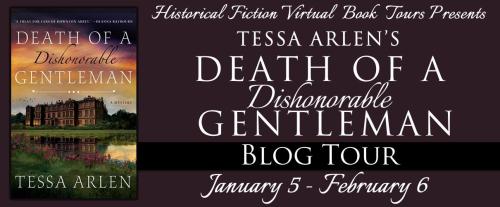
Review and Giveaway: Death of a Dishonorable Gentleman by Tessa Arlen

Today I welcome Historical Fiction Virtual Book Tours back to the blog with an historical fiction mystery.  I invite you to read my review and enter to win your own copy of the book (US only).

My Review:
01_Death of a Dishonorable GentlemanSet at the turn of the 20th Century, just before the Great War, this mystery takes place on the lavish estate of Lord and Lady Montfort after their annual summertime ball.  I have read many reviews that have compared the setting of this book with that of Downton Abbey and I would say that is a very accurate assessment.  The narrative jumps back and forth between Lord and Lady Montfort and their privileged class, and the servants which include maids, footmen, cooks, and butlers,  who are “below stairs.”

After the traditional summer costume ball, Lord Montfort’s reprobate nephew, Teddy, is found murdered and everyone who is at the ball becomes a suspect.  All of the guests are required to stay on the estate while the authorities conduct their investigation.   As the story unfolds, it seems that many people had a reason to want Teddy out of the way.

The author spends a lot of time describing the British upper class and their insistence on observing traditional roles and divisions of class that have existed in that country for centures.  When the Lady of the house and her housekeeper, Mrs. Jackson, team up together to solve the murder mystery, they are both uncomfortable with breaking of the traditional servant-master relationship.

The strongest part of the book was the last quarter of it in which Mrs. Jackson is actively conducting her investigation and more details are revealed about the last hours of Teddy’s life.  Is it one of the nobility that could have pulled off such a heinous crime, or could one of the servants have had a grudge against this dishonorable man?

About The Author:
02_Tessa ArlenTessa Arlen, the daughter of a British diplomat, had lived in or visited her parents in Singapore, Cairo, Berlin, the Persian Gulf, Beijing, Delhi and Warsaw by the time she was sixteen. She came to the U.S. in 1980 and worked as an H.R. recruiter for the Los Angeles Olympic Organizing Committee for the 1984 Olympic Games, where she interviewed her future husband for a job. DEATH OF A DISHONORABLE GENTLEMAN is Tessa’s first novel. She lives in Bainbridge Island, Washington.

Giveaway:
Open to US residents only. Giveaway ends 2/6
– Must be 18 or older to enter.
– Giveaway is open to US residents only.
– Only one entry per household.
– All giveaway entrants agree to be honest and not cheat the systems; any suspect of fraud is decided upon by blog/site owner and the sponsor, and entrants may be disqualified at our discretion
-To enter, leave a comment below and let me know you want to win! The winner will be notified via email and will have 48 hours to respond.

The Winner of the Giveaway is: Carl S.

Click on the tour banner below to visit all of the stops on the tour.

03_DOADG_Blog Tour Banner_FINAL


24 Comments

Filed under Historical Fiction, Mystery/Thriller

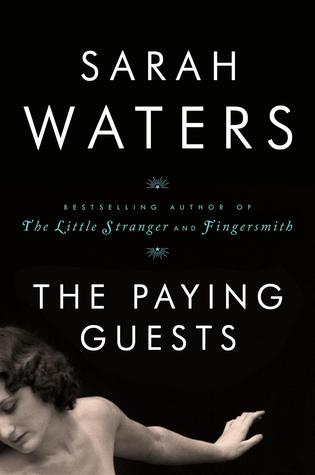
Review: The Paying Guests by Sarah Waters

I received and Advanced Reader’s Copy of this book through the Penguin First To Read site.

The Paying GuestsWhen I write a review I like to give a bit of a summary to allow my readers to judge whether or not they would enjoy the setting and the characters of a book.  THE PAYING GUESTS is hard to give a summary for without giving away the plot, so I will be a little more vague than I usually am with my comments.  This is a very emotional read and makes the reader think about various social issues that are still controversial in the world today.

Frances Wray and her mother live in London in the early 1920’s in a large house but are barely making ends meet.  Both of Frances’ brothers died in World War I and her father succumbed to apoplexy shortly thereafter.  As a way to bring in more income, Frances and her mother decide to rent out the second floor of their house to tenants.  This decision to open their house to a young couple, Leonard and Lillian Barber, drastically changes all of their lives forever.  Frances is ashamed that she has to rent out her house to strangers, so she calls them “paying guests” to make herself feel better about the situation.

THE PAYING GUESTS  reminds us that just because the Great War had ended, doesn’t mean that people weren’t still suffering from its far-reaching consequences.  Many families, like Frances’, had multiple men, fathers, brothers, cousins, that were lost in battle.  The women who are left behind are forced to pick up the emotional and financial pieces of their broken lives.  Many of the men who were lucky enough to return home after the war are injured physically and emotionally and have a hard time finding employment.

Some of the themes that Sarah Waters explores in this novel are bold and just as relevant and controversial in the 21st century as they were in the 20th century.  People are constantly trying to conform to what they think are acceptable norms in society.   With whom are we ever truly ourselves?  Do we put on different personas and acts for different types of relationships?  This book makes us realize that when people are not allowed to be themselves, it forces them to do things they would not under ordinary circumstances. two major issues with the book were with the third part.  The first two parts of the book we

The two major issues that I had with the book occurred in the third part.  The first two parts were page-turners and there were so many unexpected plot turns.  However, I felt that the story became much slower in the third part and the book could have been about 150 pages shorter.  The author chose such controversial themes to explore and provided us with brave and courageous female characters.  The ending, however, did not match the audacity of the rest of the novel.

Despite my issues with the last third of the book, I still think that THE PAYING GUESTS is worth a read if you like historical fiction set in the 1920’s.  Maybe others won’t mind the ending.  If you read this book let me know what you think in the comments.

add-to-goodreads-button3

6 Comments

Filed under Historical Fiction, World War I