You Listening?: JR by William Gaddis

On August 27th, 1956 William Gaddis sent a registered letter to himself in order to protect his idea for his novel JR against any possible copyright infringement.  The idea for JR, he states in the letter, first came to him in the winter of 1956 and he remarks about its plot and themes: “This book is projected as essentially a satire on business and money matters as they occur and are handled here in America today; and on the people who handle them; it is also a morality study of a straightforward boy reared in our culture, of a man with an artist’s conscience, and of the figures who surround them in such a competetive (sic) and material economy as ours.”

The eponymous character of the novel is a clever and enterprising eleven year-old boy who is able to build a multi-million dollar corporate empire because the adults around him don’t supervise him or pay very much attention to him.  He starts out by getting in the mail odd, free items he writes away for that are advertised in magazines.  Broken clocks, forks, personal business cards, and free banquet meals are among the things he collects.  When his social studies teacher takes JR’s class on a field trip to Manhattan in order to understand the stock market and buy a share of a company, JR gets a taste for this “competitive, material economy.”  The boy reads enough about the market and corporate and tax laws to acquire a textile company in a small town in upstate New York.  He then hatches a plot to take the employees’ retirement funds to buy a brewery and from there he builds his portfolio by acquiring a plethora of corporations and businesses which include, among many things,  a magazine, a publishing company, and a group of nursing homes, funeral parlors and a cemetery which he franchises as his “healthcare package.”

JR has a phone booth installed in the hallway of his middle school from which he conducts most of his business.  He is smart enough to disguise the fact that he is a child by holding a tattered, dirty handkerchief over the receiver when he is making his business deals or talking to one of his two lawyers.  He convinces his former music teacher, a naive and gullible man named Edward Bast, to be his front man.  Bast’s dirty, cluttered apartment in the Bronyx becomes the uptown headquarters for the JR family of corporations and a rented room at the Waldorf becomes the downtown headquarters. JR also likes to focus on taking over companies who are losing money so he can write them off as tax breaks. The best and funniest parts of the book are when JR is trying to decide what his next business moves will be and then tries to explain his plans to Bast:

No but see that’s earnings before taxes that’s the whole thing. I mean didn’t you read this part Bast? See because like if you can put it all together and write off all these here losses of Eagle against all these profits of like this here brewery then you get to keep them, I mean like otherwise you get screwed out of everything by these taxes like these two old brothers see they had all these profits which they didn’t collect them on account of this here tax so now when they do collect them they’d have this tremendous tax which is this undistributed profits tax, see? See so now they”re scared if one of them dies the other would really get screwed, but if they just sell the whole thing then all they have to pay is this here capital gains tax which is only like half of a half, I mean don’t you even remember this part hey?

The entire book is written in a dialogue in which speakers are never identified; Gaddis uses em dashes to indicate the change of speaker in a dialogue but sometimes there are several people in a room and the only way to distinguish who is saying what is by the characteristic phrases or verbal ticks that are unique to each person.  For instance, JR’s favorite phrases are “these here,” “holy shit” and “hey.” And the adults who work for him, including Mr. Bast and Mr. Davidoff, JR’s public relations manager, start to use the same phrases as their “Boss.”  The corporate world is taken by storm and surprised at the overnight success of JR Corporation and everyone is fascinated with the  mysterious “man” in charge of the company whom no one, except Bast, has ever met.  Davidoff, JR’s public relations man is running the office at the Waldorf and trying to explain to various parties what the “Boss,” whom no one realizes is a 6th grader, wants:

…the Boss saw that piece in Forbes on this collision course we’re running on these mineral interests wants to move fast got this topflight salesman I brought along from Diamond on that Endo divestiture on his way out there with, Hyde….? Haven’t shown up here yet no had them paged down at the bar but…no if you’re driving better leave without them we’ll get them loaded on the company plane with Mister…what? Six cents a mile companywide yes straight from the Boss not his fault if you drive a Cadillac he…time to get rid of what smell in your car..Because this whole Endo shipment’s on its way out there right now, gets there ahead of you and you’ll have them tearing open the crates won’t know a toaster from a hair dryer be lifting the tops of the washing machines to climb on them and…

This type of scattered, disorganized, broken dialogue, especially when characters are on the phone or there are multiple characters in one scene is typical of the novel. It is not an easy, quick read as Gaddis throws a lot of information out at once and therefore demands our complete attention.  There are no chapters or smooth transitions from one scene to the next and time passes—sometimes several days—within the same paragraph. The scattered and broken dialogue is fitting for the larger world which Gaddis is ridiculing.  All of the adults in the book have messy lives and are dealing with  serious issues such as divorces, child custody, alcoholism and suicide.  One couple featured in the book has an older man living with them and each thinks that it’s the other one’s parent.  No wonder why an eleven year-old boy is able to dupe so many people.  And this is what I found to be the saddest commentary in Gaddis’s satire: this type of moralizing, as he puts it, of a boy neglected by everyone around him who falls through the cracks.  Even Bast, who helps JR build his corporation, doesn’t truly listen to JR or offer him appropriate guidance or support for someone his age.  What I thought especially pathetic is that JR’s mother is a nurse who works crazy shifts so is never around and no father is ever mentioned.

JR’s teacher, who takes him on that pivotal field trip to Manhattan, has the only compassionate and emotional comments about the child: “if we can get in these here bellies he said and I asked him what on earth he was talking about, that bleak liittle Vansant boy and it’s not funny, really. He’s so earnest so, he thinks there’s a millionaire behind everything he sees and that’s all he does see, it’s just so sad really.” Sad, indeed, since no adults in his life give him the appropriate direction a young boy needs. Besides this teacher and Mr. Bast everyone else sees him as a brilliant business man and the contrast between the two descriptions of him—the one by his teacher and the one printed in the newspapers—is astonishing.  JR proudly reads to Bast from a newspaper article what corporate America’s perception of him is:

-Okay wait I’ll read it listen. The small closely held company which rose almost overnight from the ruins of a failing upstate textile mill to become the multimillion dollar multiface, facet, faceted JR Corp appears threatened by a credit squeeze whose dramatic repercussions could be felt throughout the corporate and financial world it was reported here today. I mean that was like Tuesday. Attracted by the smell of here it is listen hey, smell of profits and the corporate daring which have characterized the company’s abrupt entry into such diverse areas as pap wait where does it tell about me down here someplace I thought I marked it, reputation both as a ruthless corporate manipulator with a shrewd see this is me hey, a shrewd eye for tax situations, and a man of vision whose almost clair, clair something see this is still me, clairsomething ability to cut through to the heart of a problem and post an answer in profits before the competition has understood the quest continued on where’s the rest of it wait, I even marked it where I have this here bulldog jaw and all might prove there’s more truth than why’d I mark that for it’s, wait no wait this is you hey listen. You listening?

Much has been written about Gaddis’s scathing, satirical rebuke in JR of capitalism, corporate American, the publishing industry and the educational system.  But what I find most tragic is that question that comes out of the mouth of what is, essentially, an overlooked and forgotten child: “You listening?”

The book ends when JR Corp faces scrutiny from the SEC and IRS and Bast has to spend the night in a hospital because of double pneumonia.  When Bast finally gets back to his messy, disgusting apartment in the Bronx,  JR calls him on the phone with more plans.  JR’s words are the last in the novel and, fittingly, in a smaller font than the rest of the text:

—for all these here letters and offers I been getting because I mean like remember this here book that time where they wanted me to write about success and like free enterprise and all hey? And like remember where I read you on the train that time where there was this big groundswill about leading this here parade and entering public life and all? So I mean listen I got this neat idea hey, you listening? Hey? You listening…?

The text, the subject matter, the characters, and the humor make this a brilliant book but expect to take it in at a slow pace. I also recommend The Letters of William Gaddis which was published a few years ago by Dalkey Archive and williamgaddis.org which was a very useful tool to help keep track of all of the characters in the book.  The site has an extensive dramatis personae which I found to be a necessity.



12 Comments

Filed under American Literature

Survival Is A Style: Poems by Christian Wiman

In the June issue of Poetry Magazine Christian Wiman writes a lovely, thoughtful essay on the poems of William Bronk. Included is a poignant reflection on these lines from Bronk’s collection entitled Life Supports:

I thought you were an anchor in the drift of the world;
but no: there isn’t an anchor anywhere.
There isn’t an anchor in the drift of the word. Oh no.
I thought you were. Oh no. The drift of the world.
The World

This may be the saddest poem I know. As with other Bronk poems it sent me reeling through my own life grasping after my own anchors: my wife and my work, my God. Oh no.

And yet this minor poem brings me major peace. Why? Because it is beautiful, and beauty triggers an instinct for an order beyond the one it enacts.

I’ve spend the week reading Wiman’s latest collection of poems, Survival is a Style, and I shared on Twitter that it is the best one I have read so far this year. Throughout these pieces Wiman contemplates those very anchors that keep him sane and whole. Wiman grew up in a rural part of Texas under the influence of a strict, Christian family. His father died recently of a drug overdose, he has dealt with a crisis of faith, and he is always battling a form of blood cancer that, while not curable, at least is dormant for the moment. One of the most touching poems in the collection is entitled “All You Shining Stars” and describes a simple, spontanous day out with his family—his wife and three children, who are clearly his most important “anchors:

Three kinds of hair in the brush one love
has left on the kitchen counter.
Four kinds of cries when it occurs as one
to blow off school and go to the mountains.
And later, over the river, when the upturned duck
never turns over, five kinds of silence.

Always our elsewheres are also here,
like tributaries so intuitive they seem
almost incidentally literal, tiny trickles
in wildernesses too immense to enter,
the cold clefts and the drastic drops,
cliffs of unthinkable ice.

Three kinds of sleep in the hum home
down the dark valley back to New Haven.
Four kinds of dreams behind the headlights,
the world springing into being ten feet at a time.
Five kinds of time when one love wakes up
and wonders where we are, and one wonder
wakes up another, and another, and another.

A lot has been said about Wiman’s use of alliteration, and in this particular poem lines like “the cold clefts and the drastic drops,” as well as his use of numbers lends to the musicality of his verse. There is a sadness mixed with a type of gratitude for moments like these with his family. Similarly in the poem entitled “Baloney” a simple moment at a summer party with friends is captured eloquently:

Poolside, Belgian beer, the lightly ironized light
and splashy laughter of our perfect suburban summer
when from the water, from a child, comes something like
“Look alive, butt crack!”
“It was either that,” Matt says, “or a whippoorwill.”

Over shrimp and coconut rice that Annie made
I recall my dear donnish friend John
who asked that I please not “entertain company” in his bed.
And Samir, who also survived those years on beans, vagabondage,
and long letters that glittered with hopes and Helens,
wondered if I replied, “Will self-pleasure be ok?”

These verses are also an excellent example of Wiman’s charming and sharp sense of humor. The underlying sadness, in the form of nostalgia, still lingers in these lines but friends and his wife are his anchors here.

The longest poem in the collection entitled “The Parable of Perfect Silence” which is featured in Part III, brings together all of Wiman’s thoughts on family, faith, illness, sadness and hope. This poem reminds me of Robert Hass who also likes to tell personal stories in his longer form poems.

Today I woke and believed in nothing.
A grief at once intimate and unfelt,
like the death of a good friend’s dog.

Tired of the mind tracing back in the past for rescue
I praise the day.
I don’t mean merely some mythical, isolate instant
like the mindless mindfulness specialist
who at the terminal cancer convention
(not that it was called that)
exhorted the new year’s crop of slaughters
(ditto)
to “taste” the day, this one unreplicable instant of being alive.
(The chicken glistened.)
Nor do I mean a day devoid of past and future
as craved that great craze of minds and times Fernando Pessoa,
who wanted not “the present” but reality itself,
things in their thingness rather than the time that measures them.
Time is the table at which I sit and the words I type.
In the red-checked shirt my father’s mother used to wear
when she was gardening and which I kept
because it held her smell (though it does no longer)
there is still plenty of time.

And with Wiman and Hass we are never quite sure where the poet is going—there is always a twist, a surprise, something very unexpected thrown at us: words like “unreplicable” and phrases like “The chicken glistened.” And finally, the plot, if one can call it that in a poem, as Wiman moves in between topics or stories involving his grandmother, his father trying to catch a rat, his diagnosis of cancer and a myriad of other snapshots of memory.

As I was lingering over his collection all week, it occurred to me why it struck such a cord and Alex Caldiero’s poem came to mind: “Poetry is wanted here.” I began to think about my own anchors that have gotten me through the past few months and, just when we thought things couldn’t possibly get worse, the last week. I’ve never been so exhausted in my life—physically, mentally,emotionally. But I have wonderful anchors—my family, friends, fellow readers, students, colleagues, my cats, and poetry, lots and lots of poetry—whose love and support and wisdom and kindness keep me going for another day.

21 Comments

Filed under American Literature, Poetry

Thoughts Need A Master: Paul Valéry’s Gladiator

According to the Roman historian Livy, in 264 B.C. Junius Brutus had his slaves fight to the death with swords in order to commemorate the recent loss of his father; the blood of the slaves was considered munera (gifts) to the manes (spirits) of his deceased parent.  Gladiator combats, which were from this time called munera, lost their religious significance and became, instead, a popular spectator sport that was popular among Romans of every age and social status. Just as in the 21st century we go to an event and root for our favorite football, basketball, rugby, cricket or baseball players, so the Romans would flock to arenas and cheer for different gladiators.  Politicians and, later on Emperors, would sponsor games which were free to everyone and served as clever public relations stunts to keep the masses happy and occupied.

The gladiators themselves, recruited from slave markets, prisoners of war, and criminals lived and trained at ludi (schools.)  The owners of these schools, called lanistae which means “butchers” in Latin, ensured that their investments had a strict diet and exercise routine. High carb diets, strength training and practice with their equipment and weapons were the methods used to build up muscle and a chiseled physique.  Even though they might be in peak physical condition, it was rare for a gladiator to survive more than a few combats—a brutal, harsh and short life for these condemned men.

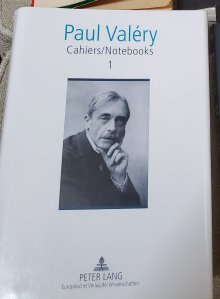
So why does Paul Valéry decide to use the gladiator as a metaphor for the type of mental training he undertakes in his Notebooks/Cahiers?  In the Peter Lang edition, the third section of Cahiers 1 is entitled “Gladiator” and contains all of Valéry’s entries on this topic.  It begins with:

……..I resolved henceforth to evaluate the works of man and other things too, only in relation to the operative processes I could recognize in them: i.e., I assumed, firstly in an unsophisticated way, and then with all my might, that in each case I had to implement myself the construction of each given thing; and I tried to reduce it to successive operations whose primary characteristic was that I knew how to carry them out. In this way, I set aside from my research/my work/, but not from my conscious mind, all uncertain or shifting judgements, restricting myself each time to measure my powers, /my strength/, – or, if you prefer, to measuring the data according to what my mind was capable of accomplishing.

A gladiator trains in the extreme because it’s a matter of life and death. Valéry tries to apply this severe type of discipline—and words like strength, power, exercise—to mental and intellectual training.  But without such high stakes as life and death, is any man really capable of training his mind to such an extent?  Valéry believes that a man like Napoleon certainly made an attempt: “Napoleon had the idea of making use of his mind in its entirety. of directing its movements with order and vigor, instead of submitting to the accidents of memory and impulse. Manoeuvres along internal fronts.” And Valéry speculates how a man ought to accomplish this: “A man skilful in his thinking, knowing it to be naturally irregular and commonplace—Thought needs a master, a desire, a model, habits, without which it’s like dreams—useless, terrible, circular, silly.”

There is also, not surprisingly, an emphasis on the action that is required in the gladiator-style mental activity.  Valéry himself got up every morning for most of his adult life to record and work out his thoughts in these notebooks:

Gladiator’s principle.
Restore (and even develop harmoniously) through sport the qualities which the increase in means leaves idle and risks causing to degenerate.
Muscles, mental calculation, meaning.

In short, Gladiator is the effort expended by one’s being against probability. An effort which is called Art, the transformation of chance into near-certainty-analysis of the fortunate coincidence with a view to reproducing it, or transferring it from one moment in time to stability (or stasis), or from one scale of dimensions (matter, as well) to a larger one.

Another idea, and what at first  I thought to be a more peculiar one, that recurs in “Gladiator” is that of purity.

Gladiator
or the Pure Individual—
or a treatise on purity or on forms of Purity.

How the notion of the pure (pure body-pure geometry)
leads to sport-to virtuosity.

Thus Descartes—Matter and Movement—Categories.

And:

(Treatise on purity)
Purity is a consequence of awareness. Awareness distinguishes as it increasingly develops, what the function of the mind uses indiscriminately at an ordinary level or in its ordinary states. Thus, walking is an indiscriminate act of the legs. But if one practices walking distinctly, as a sports man does, it acquire purity of pace—economy of strength—precise rhythm.

I sense more of a tone of hope in this section of his Cahiers as opposed to the previous one entitled “Ego.” In “Ego” he is grappling with who he is, what his worth is, and how he can contribute original thoughts and ideas to the arts. But in Gladiator he lays out methods with which he believes he can train his mind to the point where he reaches this type of purity of thought—the kind of thought that will lead to those novel contributions.

The Notebooks/Cahiers themselves and their creation of a unique genre of writing is the proof of Valéry’s success Nathaniel Rudavsy Brody, in the introduction to his translation of his poems says about the astonishing achievement that are the Notebooks/Cahiers:

Behind the published works, behind the uneventful life of the almost forgotten and then exceedingly famous poet, there hides another story, a private life of the mind, that has its record in 28,000 pages of notebooks revealed in their entirety only after his death. Their existence had been hinted at, of course, evoked in rumors and literary asides, but once made public it took years for their significance to be fully appreciated. It turned out that the prose fragments published in Valery’s lifetime were not what the had been taken to be: they were not after-the-fact musings of an accomplished poet, nor his occasional sketchbook, nor excerpts from his private journal. They were a disfigured glimpse of a vast and fragmentary ‘exercise of thought,’ a restless intellectual quest as unguided and as persistent, as rigorous, and yet as uncontainable as the sea which is so often their subject.

I’m looking forward to lingering among the pages of these five volumes of Cahiers throughout the summer.

A hand-drawn page from Valery’ Cahiers 1.


3 Comments

Filed under French Literature

La Jeune Parque by Paul Valéry

In Roman myth the three Fates— Parcae in Latin Moirai in Ancient Greek are referred to as sisters: Clotho, the youngest, is the spinner of a person’s life thread, Lachesis measures the final thread of life, and the dreaded Atropos cuts the thread of life.  Because of their absolute and unpredictable authority over all life—even Jupiter is subjected to their decisions—they are feared and rarely spoken about except in passing references.
In Petronius Satyricon, the three anti-heroes of this Ancient Roman novel visit a freedman named Trimalchio who has become filthy rich through his investments in shipping.  Trimalchio himself, as well as his sprawling house, is opulent and tacky.  His villa would be the perfect feature for the Roman version of MTV Cribs. The visitors to his home view a large mosaic installed in his dining room that features  the three fates spinning and measuring out the thread of Trimalchio’s life: praesto erat Fortuna cum cornu abundanti copiosa et tres Parcae aurea pensa torquentes.  “And right there in front of us Fortune was depicted with her horn of plenty and the three Fates spinning their golden threads.”  This is by no means a usual piece of artwork that would appear in any Roman’s home, but Trimalchio is a man obsessed with death and his own mortality.

And Vergil, when describing the hardships that his epic hero Aeneas will suffer, concludes (with the cleverly syncopated verb volverunt) : Sic Parcae volvere  (And that’s how the Fates roll.)

So why does the Paul Valéry write an entire poem about Clotho, the youngest of these fates? After a successful career as a poet he suddenly takes a break from publishing his works for more than 20 years.   La Jeune Parque, a poem as perplexing and enigmatic as the Fates themselves,  is the first piece of writing that he publishes after this extended period of silence.  The 512 line poem, written in Alexandrine rhyming couplets,  is dedicated to his friend Andre Gide, who comes up several times in Valéry”s first part of his first Cahiers/Notebooks.   He oftentimes remarks about his fondness for Gide, but he also likes to complain that in his own Diaries Gide writes incorrect things about him and misunderstands him.  Valéry also doesn’t like the sentimental and moral nature of Gide’s Diaries which are very different from Valery’s own Notebooks.  In Cahiers 1 “Ego,” p. 236 he writes: “Gide is an old tart. His Diary seeks to give value to his slightest moment. What an Anti for me!  Just as I’ve got an obsession for exhausting, for not-repeating, for having done with what seems to cost nothing—as with what is purely and simply exceptional—so he does the opposite—and so on.”

The best way, I think, and really the only way, to make any sense of La Jeune Parque is to read it alongside the poet’s Notebooks.  Valéry, who woke up at 5 a.m. every day for most of his adult life to think and write in his Notebooks,  is very much obsessed in the first part of them with intellect and what he can contribute to society with his thoughts and his intellect.  His writings and his observations were, he felt, his real life’s work and his job as a civil servant, which he needed to support himself and his family, was just a way of making money.  A lot of his time is spent in solitude contemplating his intellectual pursuits and figuring out who he is: “In a positive manner, intelligence is something like hunger, thirst, need—something seeking, demanding to work—to function , and it ruptures my sleep, worries my being and wakes me up too early every morning, whether or not I’m tired (Cahiers 1, p. 187).

When La Jeune Parque begins, the youngest Fate (her never names her directly)  is depicted as a beautiful, and lonely, young woman waking up in the dark after a dream on a shoreline and torn by between passion and duty.  Her silence is punctuated by the fact that she not only addresses but personifies the stars:

Almighty aliens, unavoidable stars!—
Who willingly across the miles of time
Make something pure, higher than nature, shine;
Who into mortals plunge to the source of tears
These lofty glimmerings, these invincible weapons
And shooting pains from your eternal life,
I am alone with you, here on the point
Gnawed by the marvellous ocean, shivering, fresh
From bed; asking my heart what pain has woken it,
What crime committed by me or upon me?

The last line calls to mind Ovid’s Daphne who is trying to fend off Apollo’s unwanted love and who considers any form of romantic love or marriage a “crimen” (crime). An image of a snake is used to signify desire and passion that has bitten her and whose poison now torments her:

Coils of desires, towed by this snake! What a jumble
Of treasures that evade my greedy reach—
And what a dark thirst for limpidity!

So often in myth we encounter immortal forces like the Fates, the Hours, the Seasons, and women like Daphne, Semele and Dido and men like Aeneas who are given a job or a role they must fulfill.  They have duties and obligations assigned to them that they didn’t choose and things like desire, passion and love are inaccessible to them.  It’s a stroke of brilliance that Valery chooses a Fate, who didn’t choose her own Fate, to contemplate choices or lack of choices.  Valéry’s young woman herself cites as an example the oracle at Delphi who also had no choice but to carry out her assigned task:

I think, as he world’s rime turns gold, I weigh
The taste for death of the priestess at Delphi
Inside whom moaned a hope the world would end.

At the tender age of twenty-one Valéry has his own battle with the passions when he falls in love with an inaccessible woman.  He reminisces about it briefly in his Notebooks as a negative part of his life that he would rather forgot.  In Cahiers 1, p. 177 he writes, “The past as a chronological and narrative structure has less existence for me than for others. It seems that my being likes to forget what will only be a picture later on—and keep what can be assimilated into itself so completely that it’s no longer a past, but a functional element of virtual acts.” Memory in general is a concept that Valery despises and feels uncomfortable with. The young woman in his poem also expresses anguish over desire and the memories of desire:

The mind is so pure it never kneels
To idols: lonely ardour does flare up
And drive away the walls of its sad tomb.
Anything can appear with infinite waiting.

The Fate also begins to reminisce about a chance passionate encounter in the woods that leaves a deep impression on her. The young woman’s torment over passion, her early awakening, and her inner turmoil wax and wanes as she falls into a peaceful sleep and wakes up again. But like Valery’s experience earlier in his life, this passion is out of reach. And it’s not only desire and love that are out of reach, but, like other immortals, she can’t even choose death. Death, ironically for her, is something she controls and is all around her but it is out of the question as an option for herself:

But if my tender smell goes to your hollow head,
O Death, breathe in at last this regal slave:
Call me, undo these bonds!..And drive off hope
From me, so tired of self, in this doomed shape!

Finally, I have to say a word about the Bloodaxe Books dual language edition that is translated with an introduction and notes by Alistar Elliot. The text is notoriously difficult and Alistar’s notes are a necessity to understanding Valery’s poem and the etymological interpretations of his translation.


7 Comments

Filed under Classics, French Literature, Literature in Translation

Six Years of Blogging and New Bookshelves

WordPress has reminded me today that I have been blogging on this site for six years now. A small and modest achievement compared to bloggers like Steve at This Space, flowerville, and Stu from Winston’s Dad.

However, there also seems to be a trend of bloggers declaring that the blog and blogosphere are dead, abandoning their blogs and moving on to the latest and greatest forms of media like Instagram, podcasts, and YouTube. I was joking with a writer on Twitter who said the next thing we know there will be literary TikToks.

But especially now, in the area of lockdowns and pandemic, the quiet, kind and interesting corner of the Internet that consists of literary bloggers has been a source of friendship and solace for me. This also includes the wonderful connections I’ve made on Twitter via the bookish and artistic communities. Many of us are in lockdown with only a few family members or even alone—for me the only people I’ve seen are my husband and daughter. Going to work and having social interactions with colleagues and friends has also come to a hault. We are social beings and loss of daily human contact with a variety of people feels like something we took for granted. I am particularly grateful these days for my blog, my book friends and my Twitter friends. And so I carry on with these primitive and so-five-years-ago media platforms despite what the other cool kids have moved on to.

In other news, my Mother’s Day gifts were three new bookshelves for my bookroom. My poetry collection was getting out of control and as my daughter quipped in a Mother’s Day poem she composed for me, “I admire that you count books by the stack.”

It was exciting, albeit exhausting, to load and organize my new shelves and I’ve come up with some new categories with which I have that grouped my books together. I have collected so many books from Carcanet that they now have their own section:

Carcanet Press Collection

And I have been very interested in reading the diaries and notebooks of authors. I’ve been captivated, for instance, by Paul Valéry’s Notebooks which were published in English in 5 volumes. So now I have a section dedicated to such notebooks and diaries:

Diaries and Notebooks

I’ve also collected quite a few titles from Ugly Duckling Presse which publishes some of most aesthetically interesting books and chapbooks:

Ugly Duckling Presse Collection

I described in a post back in January that one if my reading goals for this year is to read a series of books about music so they have been given their own section:

Books about Music

The rest of the poetry books are categorized by country/region— English, American, Italian, Latin American, Russian, etc.

English, American, Italian, Latin American, etc.
More American poetry, Robert Kelly and Michael Hamburger
Russian and French Poets and Poetry Magazines

And finally, I have a shelf of books for my read now stack that used to be covering and stacked underneath the coffee table:

The Read Now Section

Now I’m wondering if maybe these “gifts” were a bit self-serving so that we can all see, and use, the coffee table again.

52 Comments

Filed under Uncategorized