
I hate you and I love you.
You may be wondering why I feel this way.
I have no idea.
But that’s how I feel.
And I. am. tortured.
Odi et amo. quare id faciam, fortasse requiris?
nescio, sed fieri sentio et excrucior.
(Translation is my own.)
I hate you and I love you.
You may be wondering why I feel this way.
I have no idea.
But that’s how I feel.
And I. am. tortured.
Odi et amo. quare id faciam, fortasse requiris?
nescio, sed fieri sentio et excrucior.
(Translation is my own.)
Filed under Classics

In order to prepare them for the selection of “Lesbia” poems that we translate, I ask each of the students in my upper level Catullus class to find a love song, play it for the class and to analyze the song in terms of the theme of love. This specifically is what I ask them to write about and discuss:
I have about 2 or 3 students each day over the course of about a week play their songs and lead a discuss about it with the class. The range of music they choose is always interesting and exciting to me and my students. Discussions about music and culture always take place as a result of their presentations. Since I do this at the beginning of the course it’s also a good way for me to get to know my students better and for them to get more comfortable with each other.
This year some of the artists they chose included Kendrick Lamar, Elvis, Ed Sheeran, The Cure and John Legend. I put together a Spotify list so that we could play it in class throughout the semester and discuss these songs in comparison to the themes we see in Catullus. I inevitably get comments like, “Catullus is so whiny” or “Catullus is too melodramatic” or “Catullus needs to just get over this woman.” But then I remind that the emotions the Roman poet experienced more than 2000 years ago are still an part of human life and I point to specific songs that they played, and sang along to and identified with at the beginning of the class.
In addition, the students are able to recognize in their songs basic poetic devices such as hyperbole, alliteration, simile, etc. But I also use these songs along with the Catullus texts to teach them about and to help them understand more complex poetic devices like chiasmus, synchysis, zeugma, polyptoton, etc.
It is fun to watch them sing along. If you would like to do so, there here is our playlist on Spotify:
Filed under Classics
 Sentimental Education begins with Frederic Moreau, the pupil of said “education”, meeting, by chance, an older woman whose presence affects the rest of his life. Eighteen-year-old Frederic has been visiting a paternal uncle in the hopes of becoming the heir to his fortune when he encounters Madame Arnoux, Monsieur Arnoux and their young daughter on a steamship traveling out of Paris. Although Monsieur Arnoux is a garrulous and outgoing man, it is his wife that captures Frederic’s attention (trans. Robert Baldick): “She was sitting in the middle of the bench all alone; or rather he could not see anybody else in the dazzling light which her eyes cast upon him. As he passed, she looed up; he bowed automatically; and when he had walked a little way along the deck, he looked back at her.” As he walks up and down the deck of the boat, he becomes inert and can concentrate on nothing an no one else but her. But he also hasn’t the courage to speak to such an incredible woman:
Never had he seen anything to compare with the splendour of her dark skin, the seduction of her figure, or the translucent delicacy of her fingers. He looked at her workbasket with eyes full of wonder, as if it were a thing of beauty. What was her name, her home, her life, her past? He longed to know about the furniture in her room, all the dresses she had ever worn, the people she mixed with; even the desire for physical possession gave way to a deeper yearning, an aching curiosity which knew no bounds.
Frederic moves to Paris where he attends law school and insinuates himself into the life Arnoux family. He often visits the object of his desire, but the first half of the novel describes his love for Madame Arnoux, yet his complete inertia, his inability to act in any definitive way to make her his lover. I found the second half of the book more interesting as the pace of the narrative becomes quicker and more initeresting. As the years slip by, this woman continues to be a presence in Frederic’s life and even though he takes up other mistresses he can’t get Madame Arnoux out of his heart or his mind. He is incapable of committing to a marriage because there is always the hope of being with Madame Arnoux. Furthermore, his inertia extends to his career since he doesn’t have the attention span to devote to a political career. He lives on the inheritance from his uncle so he has no real need for a private income. But having a serious occupation would have benefitted his otherwise unoccupied mind. He let’s several professional and business opportunities slip through his hands because of his focus on his love and social life.
In the introduction to the Penguin Edition, Geoffrey Wall explains the autobiographical aspect of Flaubert’s novel and quotes the author’s letter to Amelie Bosquet:
I loved immeasurably, a love that was unrequited, intense and silent. Nights spent gazing at the moon, dreaming of elopements and travels in Italy, dreams of glory for her sake, torments of the body and the soul, spasm at the smell of a shoulder, and turning suddenly pale when I caught her eye, I have known all that, and known it very well. Each one of us has in his heart a royal chamber. I have had mine bricked up, but it is still there.”
The object of Flaubert’s secret desire was an older, married woman named Elisa Schlesinger whom he meets as a teenager while on vacation on the Normandy coast. He, too, would encounter her by chance throughout the years but never confessed his true feelings.
It seemed fitting that this week as I was reading Sentimental Education I was also preparing for my second semester Catullus course for my upper level Latin students. Catullus is also smitten with an inaccessible, older woman and as I was reading about Frederic and Flaubert, Catullus’s Carmen 51 kept coming to mind. It is the first, many argue, in the Roman poet’s series of Clodia (a.k.a. Lesbia) poems; Catullus sees Clodia at a party and the first sight of her instantly captivates him and he can only focus on her. But, like Frederic and Flaubert, he is paralyzed by his feelings and cannot bring himself to approach her. At the end of the poem, Catullus chides himself for his inaction:
Inertia, Catullus, means trouble for you.
You wallow in your inertia, and you carry it too far.
Such inertia has previously brought about the
destruction of kings and grand cities.
The Latin word otium seemed especially fitting, in my mind, for Fredric. I translated it here as “inertia”, but it can also mean “leisure.” It was originally used as a military term to describe the leisure of the army, when soldiers are encamped and experience boredom. If otium is translated as “leisure” in this Catullus poem then, I think, the meaning of the last few stanzas is completely changed, as it implies that too much leisure gets the poet into trouble. But I prefer to translate it as “inertia,” or “inaction” and see these lines as Catullus scolding himself for inaction which keeps him from being with his true love. This translation of otium also makes more sense in the context of the beginning of the poem during which he is literally and figuratively paralyzed by the site of this woman.
Both translations—“leisure” and “inertia” are equally fitting ways to describe Frederic. His inheritance allows him too much leisure time to get into trouble and his inability to act on his feelings for Madame Arnoux affect his entire life. Otium is the true cause of Fredric’s inability to attain true happiness at any point in his life.
Filed under Classics, French Literature
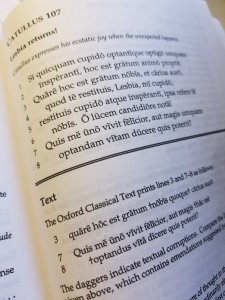
If anything ever happens to someone who is desirous and eager yet not anticipating a surprise,
then the unexpected is especially pleasing to person in such a state of mind.
Therefore, it is particularly dear to me because you have restored yourself
to me, my desire; you restored yourself to an eager and unsuspecting man, and you
did it all yourself. Oh light, more favorable than a lucky day!
What man could possibly live a luckier life than me, or what man could
possibly want to lead a better existence?
(Translation is my own.)
It seems fitting this week that as I begin teaching a Catullus course to my upper level Latin students that I am also reading Flaubert’s Sentimental Education. Catullus and Frederic both receive quite the “sentimental education” at the hands of an older woman. The anticipation of seeing the beloved is palpable in Catullus’s poems and Flaubert’s text.
Filed under Uncategorized
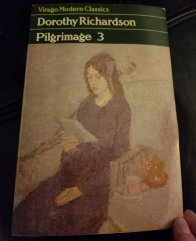
It seemed fitting this week that I was reading a book called Deadlock since both the U.S. and the U.K. are involved in awful, political stalemates. The deadlock, however, to which Dorothy Richardson is referring in her sixth chapter of Pilgrimage, is one that involves gender. Miriam is living on her own in a boarding house in London and fully supporting herself. She does not follow any of the expected norms for a female at the beginning of the 20th century—she is not dependent on any man, via marriage or other means, has no children and does not rely on extended family to assist her. Her life is completely her own and, as such, she makes some important observations about men and how they treat her.
Many of Miriam’s conversations in this book take place between her and a young, Russian Jew that is also staying at Mrs. Bailey’s boarding house in London. Mr. Shatov is an intellectual man who is very curious about English culture and their friendship grows through mutual interests in philosophy, language and literature. In a discussion about the different ways that men and women approach debate and arguments Miriam says to him, “That’s why arguments are so maddening; even small discussions; people go rushing on, getting angrier and angrier, talking about quite different things, especially men, because they never want to get at the truth, only to score a point.” In a different discussion with Mr. Shatov she uses Darwin to make her point about how men argue: “Someone will discover some day that Darwin’s conclusions were wrong, that he left out some little near obvious thing with big results, and his theory, which has worried thousands of people nearly to death, will turn out to be one of those everlasting mannish explanations of everything that explain nothing.” I think nowadays we have coined the phrase “mansplaining” for this sort of things. And when Miriam does speak up for herself against men, she runs into quite a bit of trouble so we can hardly blame her for having such opinions.
Another guest at the boarding house, Mr. Lahitte, a French gentlemen who is an expert of Spanish literature, asks Miriam to read his manuscript for a lecture that he would be delivering to an English audience. Mr. Lahitte’s delivery of his argument is bombastic, overwrought and superficial. Miriam gently tries to suggest that he make his speech appear more natural but she runs into his stubborn male ego. He insists that he is “master” of the subject and that “a certain bravura is imperative.” He pays her for her time and her help but it is unclear whether or not he actually takes any of her suggestions. She appears to be at a deadlock with this rather insistent, pompous, academic.
Miriam also dares to take up an argument with her employer, Dr. Hancock, whom she feels treats his female employees unfairly. She does many extra tasks around the office for the doctors, such looking after their library book lists, for which she receives no acknowledgement. When the doctor chides her for not carrying out one of these extra, non-work related tasks Miriam speaks up for herself and is frank with the doctor in a way that he would never expect from a woman:
I told him that in the future I would have nothing to do with his Mudie books. It was outside my sphere. I also said all sorts of things that came into my head in the train, a whole long speech. About unfairness. And to prove my point to him individually, I told him of things that were unfair to me and their other employees in the practice about the awfulness of having to be there first thing in the morning from the country after a weekend-end. They don’t. They sail off to their expensive week-ends without even saying good-bye, and without even thinking whether we can manage to have any sort of recreation at all on our salaries. I said that, and also that I objected to spend a large part of a busy Monday morning arranging the huge bunches of flowers he brought back from the country.
There has been a lot of debate recently about what has been termed “emotional labor”—the idea that women often take on extra, thankless and unnoticed tasks in the workplace and at home. It’s not surprising that Richardson’s observations about the division of tasks along the lines of gender at home and at work are still relevant in the 21st century. Unfortunately for Miriam, the doctors are so shocked by her blunt speech that they decide to sack her. There is an implication in the text, through her conversations with Mr. Shatov, that English men, in particular, do not appreciate a forward or unreserved woman who speaks her mind. Miriam has to apologize to save her job; she ends up in a deadlock with her employers, and no better off than she was before.
Mr. Shatov, however, is a counterexample to these other men; he is eager to debate with her and encourages her to speak her mind. He takes her to lectures and to his favorite German restaurant where he introduces her to beer. He also encourages her to start work as a translator and to sell her work to a publisher. It is not surprising that they fall in love. But their relationship ends up at an impasse not because of their different cultures or religions, but due to a personal revelation that Mr. Shatov makes to Miriam about his past. Whatever this indiscretion was—it is only hinted at in the text—-Miriam cannot get past it. Her final deadlock in the book is the most heartbreaking of all: “If only she could convey to him all that was in her mind, going back again and again endlessly to some central unanswerable assertion, the truth would be out. Stated. At last one man brought to book, arrested and illuminated. But what was it? That men are not worthy of women? He would agree, and remain pleading. That men never have, never can understand the least thing about even the worst woman in the world?” I did feel deeply sorry for Mr. Shatov who was attempting to be genuinely honest with Miriam and felt that he was doing the right thing by telling her about embarrassing details of his past. Her own prejudices and expectations, I think, turn out to be unrealistic and she loses a good man as a result.
On a final note, I’ve read this week that the death of the book blog has been announced by the Powers that Be. Once again, it seems fitting that I (who study two dead languages) am writing about a largely neglected, dead author, on what has been declared a dead medium.
Filed under British Literature



 The Book Binder's Daughter