Category Archives: Poetry

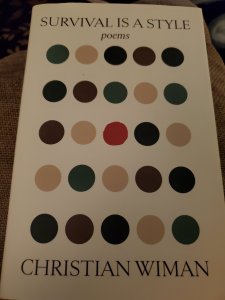
Survival Is A Style: Poems by Christian Wiman

In the June issue of Poetry Magazine Christian Wiman writes a lovely, thoughtful essay on the poems of William Bronk. Included is a poignant reflection on these lines from Bronk’s collection entitled Life Supports:

I thought you were an anchor in the drift of the world;
but no: there isn’t an anchor anywhere.
There isn’t an anchor in the drift of the word. Oh no.
I thought you were. Oh no. The drift of the world.
The World

This may be the saddest poem I know. As with other Bronk poems it sent me reeling through my own life grasping after my own anchors: my wife and my work, my God. Oh no.

And yet this minor poem brings me major peace. Why? Because it is beautiful, and beauty triggers an instinct for an order beyond the one it enacts.

I’ve spend the week reading Wiman’s latest collection of poems, Survival is a Style, and I shared on Twitter that it is the best one I have read so far this year. Throughout these pieces Wiman contemplates those very anchors that keep him sane and whole. Wiman grew up in a rural part of Texas under the influence of a strict, Christian family. His father died recently of a drug overdose, he has dealt with a crisis of faith, and he is always battling a form of blood cancer that, while not curable, at least is dormant for the moment. One of the most touching poems in the collection is entitled “All You Shining Stars” and describes a simple, spontanous day out with his family—his wife and three children, who are clearly his most important “anchors:

Three kinds of hair in the brush one love
has left on the kitchen counter.
Four kinds of cries when it occurs as one
to blow off school and go to the mountains.
And later, over the river, when the upturned duck
never turns over, five kinds of silence.

Always our elsewheres are also here,
like tributaries so intuitive they seem
almost incidentally literal, tiny trickles
in wildernesses too immense to enter,
the cold clefts and the drastic drops,
cliffs of unthinkable ice.

Three kinds of sleep in the hum home
down the dark valley back to New Haven.
Four kinds of dreams behind the headlights,
the world springing into being ten feet at a time.
Five kinds of time when one love wakes up
and wonders where we are, and one wonder
wakes up another, and another, and another.

A lot has been said about Wiman’s use of alliteration, and in this particular poem lines like “the cold clefts and the drastic drops,” as well as his use of numbers lends to the musicality of his verse. There is a sadness mixed with a type of gratitude for moments like these with his family. Similarly in the poem entitled “Baloney” a simple moment at a summer party with friends is captured eloquently:

Poolside, Belgian beer, the lightly ironized light
and splashy laughter of our perfect suburban summer
when from the water, from a child, comes something like
“Look alive, butt crack!”
“It was either that,” Matt says, “or a whippoorwill.”

Over shrimp and coconut rice that Annie made
I recall my dear donnish friend John
who asked that I please not “entertain company” in his bed.
And Samir, who also survived those years on beans, vagabondage,
and long letters that glittered with hopes and Helens,
wondered if I replied, “Will self-pleasure be ok?”

These verses are also an excellent example of Wiman’s charming and sharp sense of humor. The underlying sadness, in the form of nostalgia, still lingers in these lines but friends and his wife are his anchors here.

The longest poem in the collection entitled “The Parable of Perfect Silence” which is featured in Part III, brings together all of Wiman’s thoughts on family, faith, illness, sadness and hope. This poem reminds me of Robert Hass who also likes to tell personal stories in his longer form poems.

Today I woke and believed in nothing.
A grief at once intimate and unfelt,
like the death of a good friend’s dog.

Tired of the mind tracing back in the past for rescue
I praise the day.
I don’t mean merely some mythical, isolate instant
like the mindless mindfulness specialist
who at the terminal cancer convention
(not that it was called that)
exhorted the new year’s crop of slaughters
(ditto)
to “taste” the day, this one unreplicable instant of being alive.
(The chicken glistened.)
Nor do I mean a day devoid of past and future
as craved that great craze of minds and times Fernando Pessoa,
who wanted not “the present” but reality itself,
things in their thingness rather than the time that measures them.
Time is the table at which I sit and the words I type.
In the red-checked shirt my father’s mother used to wear
when she was gardening and which I kept
because it held her smell (though it does no longer)
there is still plenty of time.

And with Wiman and Hass we are never quite sure where the poet is going—there is always a twist, a surprise, something very unexpected thrown at us: words like “unreplicable” and phrases like “The chicken glistened.” And finally, the plot, if one can call it that in a poem, as Wiman moves in between topics or stories involving his grandmother, his father trying to catch a rat, his diagnosis of cancer and a myriad of other snapshots of memory.

As I was lingering over his collection all week, it occurred to me why it struck such a cord and Alex Caldiero’s poem came to mind: “Poetry is wanted here.” I began to think about my own anchors that have gotten me through the past few months and, just when we thought things couldn’t possibly get worse, the last week. I’ve never been so exhausted in my life—physically, mentally,emotionally. But I have wonderful anchors—my family, friends, fellow readers, students, colleagues, my cats, and poetry, lots and lots of poetry—whose love and support and wisdom and kindness keep me going for another day.

21 Comments

Filed under American Literature, Poetry

the idea of a sm. exercise persisted: études by Friederike Mayröcker

Friederike Mayröcker is one of the most important and prolific comtemporary Austrian poets. Even now, well into her nineties, she is composing gorgeous, profound and experimental volumes of poetry like études which was just translated from the German by Donna Stonecipher and published by Seagull Books.  Etudes are small musical compositions, of considerable difficulty, designed to provide practice material in order to master a specific musical skills Mayröcker ‘s composes 200 pages of prose poems, varying in length from a few sentences to a few pages,  that feature her innovative experiments with language, punctuation and grammar.  Her topics are nature, memory, writing and art.  The poems are not given specific titles, but are usually dated and oftentimes dedicated to a friend. In one of the earlier poems she works out her use of  as études exercise books:

exercise of the summer: zenith: with bare feet, magnolia tree, while working on this book the idea of a sm. exercise persisted: étude of a blossoming branch, of a little leaf in my hand, a Swiss pine LINE by the unprepossessing Francis Ponge &c., back then from the living-room window Mother’s head, she waved to be for a long time while I ran down the street turning back again and again to wave, she was already fragile but she smiled in this film &c.

The poet often finds herself wandering through the woods or her garden or opening her window and listening to the sounds of nature.  In this one short excerpt she moves us from the image of a magnolia tree to a blossoming branch, to a leaf; her bucolic surroundings bring about other memories—in this instance the work of Francis Ponge (a French essayist and poet that developed a form of prose poem which explores the minutiae of everyday objects)  and an early memory of her childhood and her mother.

Mayröcker isn’t merely composing études for herself–or her audience–but she recognizes études happening everywhere around her, especially in the natural world.   This French word appears throughout the collection in many contexts:

sm. rain puddles I mean they look like white membranes namely little-petal exercises of the jasmine bush = ‘études.’

birdlet’s practice chirping in early evening (“étude”), practice in the evening before the thunderstorm, in darkened boughs…

your long life passes by you, crosses over you, while the moonshine’s pearls = gleams of tears “études” your memory’s exercises & etc.

night practice=étude: Rhode Island, ’71, in Rhode Island to bed that time America ’71, at his side, I say, exhausted in the CAHIER (Durer’s violet boquet over the bed &c.).

as I awoke, lying on m back with my hands balled into sm. fists and I adventure when we had long forgotten each other namely the ribs of each little leaf (“études”) namely we ADORED each other &c……

There is an underlying nostalgia for romance and love in Mayröcker’s poetry as well.  Ernst Jandl was her long time companion and the poems in her collection Requiem for Ernst, written after his death, have that same tone of sentimental affection and longing. Ernst isn’t mentioned specifically in Etudes, but one of my favorite, romantic poems made me wonder if she were thinking of him.  The rolling waves of the sea become a metaphor for a long relationship, now gone, which has left its “pressure marks” on her like the waves do on the sands:

you know endless infinity symbols in my
hand what does Ajax mean you know the sea ROLLS do you know
how the sea rolls up to your feet and over mountain
and valley your path and past the olive trees
wisteria woods bougainvillea you know the lianas
the lilies the waving cypresses and palm trees to the shores of
the sea you know you are alone (with pressure marks from love)

ach the dark clouds leaning on the window. Don’t see any moon
any stars, but the rod blossomed in the sand……for
our days are just 1 breath &c., for the water
rolling to your feet: bare feet dark blue the waves
roll up to you they take you in their arms so that
it is like 1 crying…..and I screwed up my courage &c.

(inconsolable branchlet you know, am dumbstruck)

Mayröcker’s use of the word “ach” is peculiar but in an intriguing and jarring way.  Many of the poems in the collection have this word at least once.  I’m assuming that the word is the same in the original text since “ach” is a German exclamation.  In one of the earlier poems she explains it was the birds that first inspired her to use this word:

then light blue in the window, natures shifting: murkinesses: Handel’s “Berenice” e.g. bitter oranges namely chirping ACH like the young birdlet in the budding tress whose sawn-off brances in heaps in the wafting grass and purple tones on deepest girl…..

The poet continues to use it as an exclamation and, I think, as a jarring transition between images, thoughts and memories.  I offer few examples from various poems throughout the collection:

After the death of the mother the deep feelings belonged more profoundly to her since the words SOUL and TEARS rose on her face ach shattered her eyes and mouth.

 the cherries ach in our mouth am your adagio the pale hair and pale tears.

1 wan morning meanwhile, I had kept some of my ailments to myself but the doctor could read them in my eyes, he was very magical “and followed me into death” &c. ACH WHAT CUSTOMS.

imperative vegetable I mean from the past I dreamed of the past ach into the river that branched, 1 certain type of field-flower. Fleurs.

ach little heart ran riot with fear circa many years ago, deep-black blueberries, how they grow wild in the woods, or SNACKING on the wood-beauties namely infiltration of a love.

One of my favorite side effects of reading this collection is  the new books and new artists that I’ve discovered.  I read this collection slowly, over the course of the last few weeks while in lockdown–my attention span for reading hasn’t been great–but I’ve have found it very soothing to explore her poetry and various rabbit holes down which she sent me. Mayröcker mentions in one poem, “and everyone asks what are you reading these days &c” and she answers this time and again in just about every poem.  Old favorites, Goethe, Schiller, Musil, and T.S. Eliot, and Handke are comforting to her.  But she also reads widely from different languages (Jean Genet is a favorite French poet of hers) and different periods of time.  For instance, I’ve discovered the poetry of the contemporary German poet Thomas Kling. I’ve also stopped to look at and ponder Cy Twombly’s Orpheus series and Durer’s Violet Bouquet.  Mayröcker ‘s poems and Durer’s painting are both nice reminders of spring, renewal, and rebirth.  I hope everyone is doing well and staying safe.


12 Comments

Filed under German Literature, Poetry, Seagull Books

Pro Eto-That’s What by Vladimir Mayakovsky

Vladimir Mayakovsky had a long, tumultuous affair with Lilya Brik who was married to the poet’s publisher, Osip Brik.  The threesome spent a lot of time together, but in 1923, during a two month separation from Lilya, the poet wrote Pro Eto (About this) and dedicated it to her.   The poem is full of pain, anger, humor, lust, confusion and torment.  In addition to writing about his love affair, Mayakovsky also mixes in his harsh opinions about Lenin and his supposed attempt to implement socialist policies in the Soviet Union.  One of the most striking images that he uses in the first part of the poem is that of a telephone.  It’s an important symbol for both the separation and connection with his lover.  He begins the poem with:
She lies in bed.

While he…

On the table

is the telephone.

“He” and “she are my ballad.

Not terribly original you say.

And he continues his dramatic metaphor by focusing on a description of the workings of the telephone as sounds squeeze through its wires:

Squeezing miraculously

through the thin wire,

stretching the rim

of the mouthpiece funnel,

a thunder of ringings

bangs through the silence,

then the telephone pours out its tinkling lava.

A screaming,

a ringing,

shots slammed into the wall

tried to blow it up.

The juxtaposition of silence with the noise of the phone reminded me of a passage in Proust’s In Search of Lost Time in which he describes talking on the telephone for the first time and the person to whom he speaks is his beloved grandmother. The shock of hearing her voice without seeing her elicits an unexpected emotional response:

And because that voice appeared to me to have altered in its proportions from the moment that it was a whole, and reached me thus alone and without the accompaniment of her face and features, I discovered for the first time how sweet that voice was; perhaps indeed it had never been so sweet as it was now, for my grandmother, thinking of me as being far away and unhappy, felt that she might abandon herself to an outpouring of tenderness which, in accordance with her principles of upbringing, she usually restrained and kept hidden. It was sweet, but also how sad it was, first of all, on account of its very sweetness, a sweetness drained almost—more than any but a few human voices can ever have been—of every element of hardness, of resistance to others, of selfishness! Fragile by reason of its delicacy, it seemed constantly on the verge of breaking, of expiring in a pure flow of tears; then, too, having it alone beside me, seen without the mask of her face, I noticed it for the first time the sorrows that had cracked it in the course of a lifetime.

After this phone conversation the narrator immediately packs his things and runs how to his grandmother. When she is sick, he understands the severity of her illness when her voice changes and he can no longer understand her.  This tension that exists between hearing the loved one’s voice yet being separated is present in Mayakovsky’s poem as well.  As I watch the grim news with people dying alone from this horrible,  invasive virus, it’s become evident that the only way to say goodbye to sick loved ones is through a phone call.  Once again, the phone becomes a symbol for a state of limbo— somewhere between closeness and separation. 

Finally, both Proust and Mayakovsky both suffer from heart sickness, but only Mayakovsky succumbs to it by committing suicide.  There are haunting passages in Pro Eto that foreshadow his tragic end:

If I sacrificed a day

I sacrificed a year

To this dreary nonsense.

I too almost succumbed 

to this delirium.

It ate up my life

with its domestic murk

and the said:

“Go on, jump

from the first floor,

the pavement’s waiting.”


In 1923, after its original publication in the journal LEF, Pro Eto was presented as a separate edition with photomontages done by Aleksandr Rodchenko.  Mayakovsky, Lilya and telephones prominently appear in many of the photos.  


8 Comments

Filed under Poetry, Russian Literature

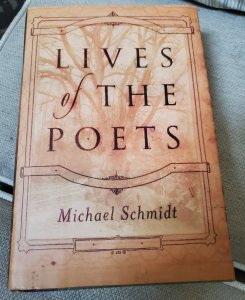
Lives of the Poets by Michael Schmidt: Some Concluding Thoughts

My life, like everyone else’s in the world, has been completely upended this week. I’ve had to learn how to move all of my classes online and I’ve pretty much stayed in my house for the past week. The worst part about this has been my inability to focus on reading. But on the bright side my husband, daughter and I are safe at home and enjoying each other’s company and we are both still very lucky to have jobs. I have found my friends on Twitter, especially those in the literary community, to be particularly soothing at this time. Naveen from Seagull Books has reminded us many times that it’s the books that will save us. Just today he wrote, “Yes. We need compassion. And that old fashioned love for everyone around us. So yes. Books.” I decided to ease my anxiety by forcing myself to concentrate on what has been one of my favorite books since last spring, Michael Schmidt’s Lives of the Poets which I finally finished last night.

Lives of the Poets, at nearly 1,000 pages, is an impressive survey of more than 300 English language poets spanning the last 700 years. Each of the 64 chapters, which proceed in chronological order, have brief biological sketches of poets including their places of birth and their educational backgrounds. What is astonishing about the book is the cumulative nature of poetry and how Schmidt connects poets and generations of poets together. Schmidt lays out his intentions for his survey of these poets in the second chapter:

Poems swim free of their age, but it’s hard to think of a single poem that swims entirely free of its medium, not just language but language used in the particular ways that are poetry. Even the most parthenogenetic-seeming poem has a pedigree. The poet may not know precisely a line’s or a stanza’s parents; indeed, may not be interested in finding out. Yet as readers of poetry we can come to know more about a poem than the poet does and know it more fully. To know more does not imply that we read Freud into an innocent cucumber, or Marx into a poem about daffodils, bu that we read with our ears and hear Chaucer transmuted through Spense, Sidney through Herbert, Milton through Wordsworth, Skelton through Graves, Housman through Larkin, Sappho through H.D. or Adrienne Rich.

This book has had two very personal effects on me which I will focus on in my post. First, Michael Schmidt has made me feel more grateful than I have ever been to have studied classics and have degrees in Latin and Ancient Greek. One of the most obvious threads that emerged for me in the course of reading this book is how much the English language poets have drawn on the materials, language, themes, etc. of the ancient poets. From the earliest instances we have of English language poetry through the 20th century there is a robust tradition of poets using ancient sources. Some of the ones I’ve discovered have been profound and have further enriched my study and teaching of classics.

One of my favorite discoveries in Schmidt’s book is Chapman’s poem “Ovid’s Banquet of Sense.” I have long been familiar with Chapman’s translations of Homer, but he is a brilliant poet when he is composing his own verses. “Ovid’s Banquet of Sense” is a description of the Roman poet’s feast of senses that is triggered when he see Corinna bathing naked in her garden. Chapman explains that Corinna is a pseudonym for Julia, the Emperor Augustus’s daughter, who has walked into the courtyard where she proceeds to bath, play the lute and sing, all of which Ovid observes hidden by an arbor. His first sense that is stimulated by her is his sight:

Then cast she off her robe and stood upright,
As lightning breaks out of a labouring cloud;
Or as the morning heaven casts off the night,
Or as that heaven cast off itself, and show’d
Heaven’s upper light, to which the brightest day
Is but a black and melancholy shroud;
Or as when Venus strived for sovereign sway
Of charmful beauty in young Troy’s desire,
So stood Corinna, vanishing her ‘tire.

Oftentimes poets don’t necessarily dedicate an entire poem to writing about a classical theme, but instead weave allusions to ancient myths into their poems. Another favorite discovery from Schmidt’s book is the poet The Earl of Surrey and his poem “When Raging Love” is an excellent example of this type of classical allusion:

When raging love with extreme pain
Most cruelly distrains my heart;
When that my tears, as floods of rain,
Bear witness of my woeful smart;
When sighs have wasted so my breath
That I lie at the point of death:

I call to mind the navy great
That the Greeks brought to Troy town,
And how the boysteous winds did beat
Their ships and rent their sails adown,
Till Agamemnon’s daughter’s blood
Appeased the gods that them withstood.

And how that in those ten years’ war
Full many a bloody deed was done,
And many a lord, that came full far,
There caught his bane, alas, too soon,
And many a good knight overrun,
Before the Greeks had Helen now.

Then think I thus: since such repair,
So long time war of valiant men,
Was all to win a lady fair,
Shall I not learn to suffer then,
And think my life well spent to be
Serving a worthier wight than she?

Therefore I never will repent,
but pains contented still endure:
For like as when, rough winter spent,
The pleasant spring straight draws in ure,
So after raging storms of care
Joyful at length may be my fare.

And one more example of poets using classics, and another favorite discovery from Schmidt, is the Australian poet A.D. Hope. This is an example of a poet using a myth as a springboard in order to expand the voice of a character that we don’t hear from in the original, ancient sources. In his poem “The Return of Persephone” Hope gives us this myth from Persephone’s point-of-view:

Gliding through the still air, he made no sound;
Wing-shod and deft, dropped almost at her feet,
And searched the ghostly regiments and found
The living eyes, the tremor of breath, the beat
Of blood in all that bodiless underground.

She left her majesty; she loosed the zone
Of darkness and put by the rod of dread.
Standing, she turned her back upon the throne
Where, well she knew, the Ruler of the Dead,
Lord of her body and being, sat like stone;

Stared with his ravenous eyes to see her shake
The midnight drifting from her loosened hair,
The girl once more in all her actions wake,
The blush of colour in her cheeks appear
Lost with her flowers that day beside the lake.

The summer flowers scattering, the shout,
The black manes plunging down to the black pit —
Memory or dream? She stood awhile in doubt,
Then touched the Traveller God’s brown arm and met
His cool, bright glance and heard his words ring out:

“Queen of the Dead and Mistress of the Year!”
— His voice was the ripe ripple of the corn;
The touch of dew, the rush of morning air —
“Remember now the world where you were born;
The month of your return at last is here.”

And still she did not speak, but turned again
Looking for answer, for anger, for command:
The eyes of Dis were shut upon their pain;
Calm as his marble brow, the marble hand
Slept on his knee. Insuperable disdain

Foreknowing all bounds of passion, of power, of art,
Mastered but could not mask his deep despair.
Even as she turned with Hermes to depart,
Looking her last on her grim ravisher
For the first time she loved him from her heart.

The second side effect of reading Schmidt’s book—something that I honestly didn’t think would ever happen—is that I’ve actually begin to appreciate and enjoy American poetry. The only American poetry I had read at any length are those assigned to me in my classes at school and university. But I’ve been reading Walt Whitman, Ezra Pound, e.e. Cummings, Laura Riding, John Berryman, Louise Gluck, Jorie Graham, and Frank O’Hara, just to name a few. Schmidt has single-handedly managed to give me a new understanding of the poets of my own country while putting them in the larger context of the history of English language poetry.

Finally, it has taken me months to read Lives of the Poets, not because it is a difficult text. In fact, as one can tell from the quote I shared at the beginning of the post, Schmidt’s writing is engaging and his sense of humor comes through quite often. But I kept pausing to read more of the poems he mentions and I have ordered an obscene amount of poetry in the last several months. So a bit of a warning if you read this book—you will be tempted to buy loads of poetry books. But can one ever really have too much poetry, especially in these trying times?

12 Comments

Filed under American Literature, British Literature, Poetry

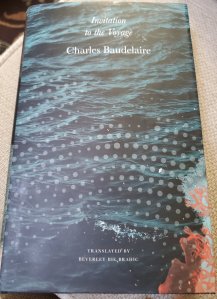
Invitation to the Voyage: Selected Poetry of Charles Baudelaire

Beverly Bie Brahic is not only a talented poet, but she is also a gifted translator.  Her latest work, a series of Baudelaire’s poems selected and translated for this edition entitled Invitation to the Voyage, was chosen from the wide array of the French poet’s oeuvre.  Brahic describes her experience choosing, organizing and translating  of Baudelaire’s work in the introduction to this volume: “When I began to translate Baudelaire, it was as an exercise in reading, visceral, as translation always is. The sensuous poems—dreams of escape to an impossible, often tropical, elsewhere, visions of voluptuousness—drew me first for their descriptive and perceptual richness. But the sensual Baudelaire needs the bitter, compassionate, desolate Baudelaire…”

“I adore you like the starry night sky…” is a favorite from the collection and best illustrates Baudelaire’s tension between the passionate and the bitter:

I adore you like the starry night sky,
O vase of sorrows, taciturn beauty,
And love you all the more as you flee me,
As you appear, oh how ironically,
Rich jewel of my dreams, to increase the waste
Between my arms and the immense blue space.

I rise to the attack, mount the assault,
Like a choir of maggots after a vault,
And cherish, beast cruel and implacable,
Even the coldness that makes you more beautiful.

The beautiful coldness, the taciturn beauty—Baudelaire’s jarring descriptions are still perfect in Brahic’s translation.

My favorite in the collection is a poem entitled “The Cat” not only because of the juxtaposition of the sensual and the bitter but because of the unexpected twist in the poem. The title is almost deceptive:

Come, my fine cat, to my amorous heart;
Keep your claws sheathed,
And let me sink into your eyes that dart
Sparks of metal and agate mixed.

When my fingers can stroke at their leisure
Your head and your elastic
Back, and my hand gets drunk on the pleasure
Of your body electric,

It is my wife I conjure up. Her gaze,
Amiable beast, like yours,
Deep and cold as a spear, penetrates me,

And from her toes to her ebony hair,
A dangerous perfume, a subtle air,
Swims around her brown body.

And the most wonderful thing about the collection is that the prose poems and short essays are paired with the appropriate poems thematically. In “Invitation to the Voyage” he writes,

You now the fevers that assail us in our cold wretchedness, our nostalgia for the country we don’t know, the anguish of curiosity? There’s a land that resembles you, where everything is beautiful, rich, tranquil and honest, where the imagination has constructed and decorated a western China, where life is soft and sweet to breathe, where happiness is wedded to silence. We must go there to live, we must go there to die!

Yes this is where we must go to breathe, dream and while away the hours in an infinity of sensations. A musician has composed an Invitation to the Waltz; who will compose an Invitation to the Voyage, that we may offer it to the woman we love, the sister-elect?

Whether one is familiar with Baudelaire or not this is a lovely volume to have sitting on one’s shelves.  The poems also come with the original French facing the translation and since this published by Seagull Books the cover is a work of art.

14 Comments

Filed under French Literature, Poetry, Seagull Books