Category Archives: Nonfiction

Review: Montaigne by Stefan Zweig

I received an advanced review copy of this title from Pushkin Press through Edelweiss.  Montaigne was originally written in German in 1941 and this English translation is done by Will Stone. This is my second contribution to German Literature Month, hosted by Lizzy’s Literary Life and Beauty is a Sleeping Cat.  Please visit their blogs for more great German Literature in translation and to see the full list of blogs that are participating.

My Review:
MontaigneStefan Zweig was forced to flee his home in Austria as the Nazis were taking control of his motherland.  For years he wandered around Europe as a nomad with no real place to call home.  As Europe is ravaged by war, he finds his way to the German community of Petropolis in Brazil and in 1941 he decides to write this brief biography of Michel de Montaigne with whose life he identifies on many levels.

Montaigne comes from a long line of hardworking ancestors.   His father’s family were fishermen and made their fortune by eventually owning their own fleet of ships.  His mother’s family were Jewish bankers from Spain who fled that county to avoid the Inquisition.  Montaigne’s grandfather buys a chateau and a vast estate in Bordeaux and intends to further the family’s aristocratic status through his purchase of land and a title.

Montaigne is brought up in the lap of luxury and it was very important to his father that his eldest son receive the best education possible.  As a result it was mandatory that Montaigne be fluent in Latin, for which purpose his father hired a German tutor when Montaigne was only four years old.  Montaigne was only allowed to speak in Latin and even the rest of the family and the household servants were required to learn some basic Latin phrases in order to communicate with the young boy.  As a result of this immersion in the language Montaigne is said to have been more comfortable speaking and writing in Latin than in his native French.  As a classicist I couldn’t help but simile at and appreciate this part of Montaigne’s story.  If only it were possible to educate all of my students in this way!

When Montaigne’s father dies he takes over as the head of household..  This foists a large responsibility on a man who sees his familial and civic responsibilities as mundane and tiresome occupations.  Zweig highlights Montaigne’s detachment from his family whom he even seems to view at times as a burden.  He never has fond words for his wife or the institution of marriage and at one point Zweig says that Montaigne is not even really sure how many children he has that are still alive.  Montaigne’s isolation from his family is further deepended when, at the age of thirty-eight, he decides that he wants to retire from his life, lock himself in the study in his tower, and read the precious books with which he has surrounded himself.

Montaigne’s view of books and reading is also noteworthy in Zweig’s account of his life.  Montaigne wants to absorb as much information and knowledge as possible and he scribbles notes in his books as various thoughts occur to him.  Montaigne states about his collection: “Books are my kingdom.  And here I seek to reign as absolute lord.”  It is during this time of self-imposed retreat and isolation that Montaigne tries to attain individual freedom and seeks to know himself as a man and as a human being on a deeper level.  His intentions, like other philosophers, is not to give his readers a specific ideology to follow.  Instead his thoughts and writings are introspective and intensely personal.

Ten years later, at the age of forty-eight, Zweig decides that he has had enough of his retirement and so decides to travel across Europe.  This journey becomes very painful for him since he suffers debilitating pain from kidney stones.  While he is away on his journey, the citizens of Bordeaux elect him in absentia as their mayor so at this point he decides to go back and serve his people.  Zweig reminds us, though, that Montaigne is no hero and his selfish habits come to the forefront once again when the plague breaks out in Bordeaux and he abandons his people to find for themselves.

Whether or not one is familiar with Montaigne, Zweig’s account of him is definitely worth a read.  Zweig was at a critical point in his life where he saw the world erupt in violence because of fascism and communism.  He commiserated with Montaigne who also saw his world torn apart by religious wars and fanaticism.  Zweig commits suicide in 1942 and this was one of the last things that he wrote.  Many believe that Zweig took Montaigne’s advice as far as death is concerned and decided to die on his own terms instead of living through a miserable exile imposed on him by outside forces.

About The Author:
Stefan Zweig was one of the world’s most famous writers during the 1920s and 1930s, especially in the U.S., South America and Europe. He produced novels, plays, biographies and journalist pieces. Among his most famous works are Beware of Pity, Letter from and Unknown Woman and Mary, Queen of Scotland and the Isles. He and his second wife committed suicide in 1942.

Zweig studied in Austria, France, and Germany before settling in Salzburg in 1913. In 1934, driven into exile by the Nazis, he emigrated to England and then, in 1940, to Brazil by way of New York. Finding only growing loneliness and disillusionment in their new surroundings, he and his second wife committed suicide.

Zweig’s interest in psychology and the teachings of Sigmund Freud led to his most characteristic work, the subtle portrayal of character. Zweig’s essays include studies of Honoré de Balzac, Charles Dickens, and Fyodor Dostoyevsky (Drei Meister, 1920; Three Masters) and of Friedrich Hlderlin, Heinrich von Kleist, and Friedrich Nietzsche (Der Kampf mit dem Dmon, 1925; Master Builders). He achieved popularity with Sternstunden der Menschheit (1928; The Tide of Fortune), five historical portraits in miniature. He wrote full-scale, intuitive rather than objective, biographies of the French statesman Joseph Fouché (1929), Mary Stuart (1935), and others. His stories include those in Verwirrung der Gefhle (1925; Conflicts). He also wrote a psychological novel, Ungeduld des Herzens (1938; Beware of Pity), and translated works of Charles Baudelaire, Paul Verlaine, and mile Verhaeren.

Most recently, his works provided inspiration for the 2014 film ‘The Grand Budapest Hotel’.
German Lit Month

9 Comments

Filed under German Literature, Literature in Translation, Nonfiction

Review- Akenfield: Portrait of an English Village by Ronald Blythe

I received and advanced review copy of this title from the New York Review of Books.

My Review:
AkenfieldThis book is a history of the British village of Akenfield in Suffolk, England as told through the stories and narratives of its own citizens.  Blythe interviewed 49 different people from all types of social backgrounds and occupations and recorded their words for this social history.   In 1967, the year in which the villagers are interviewed, the way of life in this small village is changing from one of manual labor to mechanization. Each person from Akenfield that is interviewed by the author highlights different aspects of his or her life in a forthright, honest and stream-of-consciousness narrative.  Blythe groups the book into twenty different sections of the people, some of which include “God,” “The Craftsmen,” “The School,” and “The Law.”

One group in the book that made a particular impression on me were the craftsmen such as the wheelwright, the  blacksmith and the thatcher.  It would seem that with the invention of cars that there would no longer be a need for such talents because of the shrinking reliance on horses and wagons for transportation.  It was inspiring that these hardworking men decide to change with the times and find other uses for their crafts.  The blacksmith, Francis Lambert age twenty-five, is a very talented craftsman and now that there are no longer horses to shoe in order to sustain his business he has diversified by making weather-vanes, gates and fire-screens.  Francis is so talented that he is even sent to Germany to represent England at an international craft festival.  Francis loves his job which is evident by the fact that he usually puts in sixty hours of work per week and he takes a great deal of pride in his masterpieces.

As one would expect, hopes of escaping the village are expressed from some of the residents, but for the most part they seem content to stay in their small part of England.  Several of them mention that their families have resided within the boundaries of Akenfield for generations.  But there are also a fair number of voices we hear from people who, even though that have lived in Akenfield for many years, will always be considered “outsiders” because they were born elsewhere.  Hugh Hambling age thirty who is a schoolmaster tells us that he was born on Norfolk.  He and his wife move to Akenfield when he was twenty because he found a charming cottage that the newly married couple could afford.  Hugh feels that the villagers are very private people and although he tries to engage them in discussions, he only ever is able to talk to them about cursory things like football or the weather.

In the section on the school, Blythe includes the administrative records from the teachers and headmasters which date back to 1875.  One problem, in particular, that teachers have to deal with is poor attendance by the children of farm owners.  There are certain times of the year when even the young ones are needed to be out in the fields helping with the crop and later when a truancy law is passed these guidelines for school attendance are still not enforced.  Outbreaks of health issues such as ringworm, diphtheria and scarlet fever are also recorded and must have certainly worsened the poor attendance issues.

Many of the details that the residents of Akenfield provide are like no other that one would find in any ordinary history book.  The orchard worker, for instance, gives us a detailed accounts of different apples that are best grown in the English climate and what the prime picking time is for each breed.  The thatcher provides a lengthy description of the best way to thatch a roof and which are the best materials to use.  I found the section on the bell-ringers particularly fascinating; these young men are in a way considered talented musicians and go around to village and neighborhood churches in order to practice their craft of bell-ringing.  I had no idea before reading this history that there is such a fine art form to the ringing of church bells.

This is a charming, interesting, candid glimpse into the pulse and essence of an English village in the middle of the 20th century.  If you have any interest in British history, oral history or social history then this latest edition to the New York Review of Books classic titles is a must read.

About The Author:
Ronald Blythe is an English writer, essayist and editor, best known for his work Akenfield: Portrait of an English Village (1969), an account of agricultural life in Suffolk from the turn of the century to the 1960s. He writes a long-running and considerably praised weekly column in the Church Times entitled Word from Wormingford.


10 Comments

Filed under British Literature, Classics, New York Review of Books, Nonfiction

Review: Boswell’s Enlightenment by Robert Zaretsky

My Review:

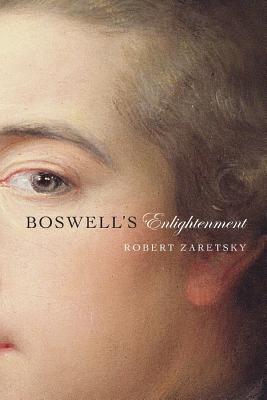
Boswell's EnlightenmentThe 10th Laird of Auchinleck is best known for his comprehensive biography of Samuel Johnson; but James Boswell was an important and interesting figure in his own right.  This book is essentially an account of how Boswell becomes The Boswell we are more familiar with–the writer, the biographer, the lawyer.  This book reveals to us a Boswell who thought deeply about religion, the afterlife and the immortality of the soul and who sought out the greatest thinkers of his days and questioned them relentlessly about these topics.  Zaretsky’s brief biography is an account of Boswell’s Grand Tour of Europe from 1763-1765 as he interviews great men in an attempt to probe the depths of his own soul.

Zaretsky first describes Boswell’s Calvinist roots which laid the foundation for his struggle with religion, worship and the immortality of the soul.  Boswell was born and raised in Edinburgh, Scotland where his parents were very traditional followers of this Christian sect which believed in a harsh and vengeful God.  The long Sundays spent in devotion to such an ever-watchful deity had a lasting influence on Boswell’s psyche.  When he graduates from university and his father expects him to study law, Boswell wants first to travel around Europe and have conversations with the world’s leading Enlightenment thinkers.  Boswell actively pursues and interrogates the likes of Johnson, Rosseau, Voltaire, Wilke and Paoli.

There are some interesting themes that Zaretsky notes about Boswell’s life during this period, the most important of which is his constant battle with melancholy.  When Boswell meets Johnson in London, the two men bond over their respective bouts of depression.  Boswell is constantly plagued by a type of pensive sadness concerning his life and the course which it ought to take.  During these low periods he indulges in two forms of “medication”: drinking and sex.  The self-medication and depression become a cyclical pattern because the more depressed he feels the more he drinks and has sex; after a night of extreme debauchery Boswell has feelings of dread and guilt which further launch him into a depression.  Zaretsky points out that even much later in life, when he is settled down with a wonderful wife and five children he continues to wrestle with these demons.

The most entertaining encounters that Boswell has during his travels are with Rosseau and Voltaire.  At this point, both writers are carrying out reclusive lives as feeble, crusty old men when Boswell overtakes them.  And overtakes them he does as he shows up on both men’s doorsteps and insinuates himself into their homes.  He questions both men about religion, life, and most importantly the immortality of the soul.  Zaretsky provides us with a general overview of Rosseau’s and Voltaire’s important ideas and how these ideas have an impact on young Boswell.  Rosseau is a bit more affable with Boswell and is entertained by Boswell’s gregarious and affable personality.  But neither philosopher is able to give Boswell satisfactory answers about the role of God in this life or what will happen to his soul in the next.

Boswell then moves on to Italy and eventually Corsica where he meets two very different types of men. John Wilkes, the libertine politician, is a free-spirited thinker who embraces life for all it is worth; he, too, loves to drink and whore around but he is unapologetic about his behavior.  Wilkes dismisses Boswell’s questions about religion and mortality and tells Boswell to stop being so serious and to embrace life.  While Boswell is with Wilkes he lets loose with wild abandon as his days and nights are taken up with talking to his friend, drinking and sexual promiscuity.

Sometimes funny, sometimes serious, but always well-written, Boswell’s Enlightenment has given me a much greater appreciation for Johnson’s biographer. Boswell is plagued with self-doubt and depression yet through all of his low points he continues to contemplate the importance of this life and his possible annihilation in the next.  This book covers only a brief span in Boswell’s life, but I enjoyed it so much that I purchased a copy of Boswell’s diaries so I can learn more about this fascinating, Scottish laird.

About The Author:

Robert Zaretsky is a professor of French History at the University of Houston.


9 Comments

Filed under History, Nonfiction

Review and Author Interview: Love in the Elephant Tent by Kathleen Cremonesi

I received an advanced review copy of this title from the publisher, ECW Press.

About The Book:
Elephant TentKathleen’s life has always been an itinerant one and from the time she was seventeen she took off from her small hometown and Oregon and went on the road.  She tries out different things that take her through various parts of the U.S. and Europe.  She finally lands in Spain where she starts to work for a circus and meets the Elephant trainer who completely changes her life.

What is interesting about Kathleen’s story is that there are a lot of bumps on the way to finding her true happiness.  She does immediately have feelings for Stefano but her parent’s rocky marriage has a negative effect on how Kathleen views commitment.  It is interesting to follow Kathleen on her emotional journey.

I also liked the fact that Kathleen talks about animal cruelty and the elephants she encounters.  Stefano tells her that elephants are nomadic animals and should be roaming free.  She does not gloss over or hide the fact that their captivity in a circus is not the best environment for them.

If you love memoirs and travel writing then LOVE IN THE ELEPHANT TENT is a great book to put on your reading list for the summer.

Author Q&A:
1. Can you please tell us a bit about yourself and how you became an author?
I have always aimed to create my own space in this world, and I have been self-employed for most of my adult life, usually in ways that incorporated art and creativity. In part, my inspiration to carve my own pathway through life comes from rebelling against the pain I saw my mother experience when her marriage dissolved, so I steered my life in the opposite direction by running away from any situation that even hinted of domesticity. Instead, I sought out adventure and refused to bend to others’ expectations and desires – which made life exciting but also lonely. It wasn’t until I met Stefano in Spain that I found someone I could imagine sharing a life with – but imagining something and living it are quite different, of course. It took a lot of growing up on my part, and Stefano’s, for us create a life together.

Once we did make that leap and moved from Italy to America, many people were curious about how we met, which of course brings up circus stories. Most people were anxious to hear more. I heard, “You should write a book,” so many times, that I finally decided to do just that. Unfortunately – or perhaps fortunately – I ran away with the Grateful Dead and then the circus instead of pursuing a college education, so I had to learn how to write before I could complete a book-length manuscript. Without any formal training, that took a lot of trial and error, and Love in the Elephant Tent is the product of all those years of work.

2. What is the best book you have read in the past year that you would recommend to my readers?
Oh, boy, does it have to be just one? Off the top of my head, three come to mind: Divine Secrets of the Ya-Ya Sisterhood, which I’ve read before but found myself reading again this year. Great book. Love the deep, sometimes flawed, but always real relationship those women shared and how they pass its essence on to the next generation. I also read Seven Years in Tibet by Heinrich Harrer for the first time. Wow. It’s written in such a straightforward manner but conveys such depth and adventure and willingness – no, need – to put your life on the line to obtain freedom and knowledge and feel fully alive. And last, but certainly not least, is Chiseled, a memoir by Danuta Pfeiffer. Full disclosure: she’s a member of my writing group and I’ve been reading successive versions of her book for about 17 years. She finally published it earlier this year, and reading a finished copy was a moving experience. This woman basically went to hell and back multiple times. In her youth, she wanted to be a nun, but events prevented that. Over the years, she was “saved” by God, rejected by his followers. Grew from being a hard-scrabble youth in rural Minnesota to becoming “the most prominent woman in Christianity” and co-hosting The 700 Club with Pat Robertson – only to walk away from it all, bike 1000 miles from Canada to Mexico with little experience, and finally reconnect with her liberal roots, as well as find love, peace and fulfillment in an Oregon vineyard. Great read, well told, highly recommended.

3. Since your book is an autobiography were you nervous about exposing details about your life for the public?
Absolutely. The thought still wakes me up in the middle of the night sometimes. Close friends who know my story with Stefano well have told me they’ll never look at us the same again. Those types of declarations freak me out as much as they make me smile with relief. As scary as such revelations are, it’s also a shame that we must fear exposing our vulnerabilities and sharing with the world who we truly were and are. Ninety-nine percent of what happened in the book took place over 25 years ago. I’ve grown since then, of course, become stronger and more confident. I look back on those years and judge my own actions, don’t agree with all of them, and sometimes would like to reach back in time and talk some sense into myself, so I won’t be surprised if others express the same desire. However, it is only through those long ago feelings and experiences that I have become the person I am today. A lot has happened between when Stefano and I left Italy and today. Those years we shared in the circus had a strong effect on who we’d become and how we’d deal with adversity and the challenges life threw at us individually and as a couple. Can’t say we would have made it this far without them. Back to your question: Nervous? Sure. Afraid of what might come of the exposure: I’ll meet those challenges as they come. Willing to share in case it could help another young woman find her place in this world or a couple keep their love alive? Definitely!

4. What writing projects are you working on next? Will you stick with non-fiction or will you delve into fiction this time?
I have made some initial strides in both genres, jotting down stories that cover everything from past generations to the twists and turns my life with Stefano took after we left the circus. I also love to write about food and travel, and I have been experimenting with the outline of a mystery. Which of these projects will flourish into a full-fledged manuscript remains to be seen – and I wouldn’t have it any other way at this time. I like to live in the moment as much as possible.

Thanks so much to Kathleen for her thoughtful responses.  To visit all of the stops on her book tour visit the link below.

Elephant Tent Banner


1 Comment

Filed under Author Interviews, Nonfiction, Travel Writing

Review: More Than Words- Illustrated Letters From The Smithsonian’s Archives of American Art by Liza Kirwin

I received an advanced review copy of this book from Princeton Architectural Press. The letters in this collection have been selected by Liza Kirwin and are drawn from the Smithsonian’s Archives of American Art.

My Review:
More Than Words“Letter writing is probably the most beautiful manifestation in human relations, in fact, it is its finest residue.” -John Graham to his third wife Elinor ca. 1958.

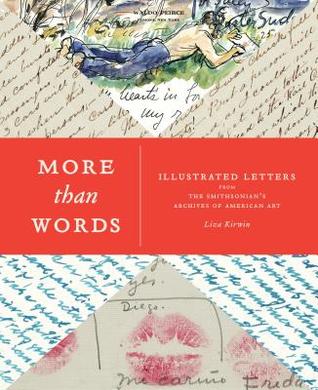
This book is a gorgeous collection of letters written by famous American artists, but, as one would expect, artists are not content to capture their thoughts and experiences with mere words.  More Than Words proves that artists think in visual terms even when they are doing everyday, mundane tasks like writing letters.

The book is divided into six chapters which include travel letters, love letters, letters that are a play on words, letters with illustrated instructions and thank you letters.  Kirwin states in the introduction, “The letters, culled from the collections of the Smithsonian’s Archives of American Art, provide an intimate view of the artists’ world–their family lives and friendships, passions and heartbreaks, business relations, travels and artistic training.”

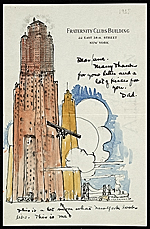
When one is a famous painter and illustrator like Allen Tupper True (1881-1955), no ordinary postcard will do when describing the experience of the skyscrapers while on a trip to New York.  True writes to his daughter: “Dear Jane, Many thanks for your letter and a lot of kisses for you.  Dad.”  True embellishes the hotel stationary by adding his own artistic touch in order to fully capture the New York skyline for his daughter.  He also includes in his illustration a very diminished picture of himself so that she can understand the grandiose nature of these buildings.

Allen Tupper True to Jane True (1927). Photo courtesy of Archives of American Art

Allen Tupper True to Jane True (1927). Photo courtesy of Archives of American Art

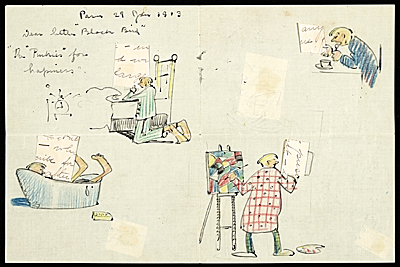
When writing to his finacee, caricaturist Alfred Frueh (1880-1968) depicted his elation at receiving letters from her. He called her letters “Pinkies” because of the pink stationary on which she penned her letters. He actually cuts up the “Pinkies” and incorporates them into his drawings which show him doing various tasks throughout his week while perusing her letters.

Alfred Joseph Frueh to Giuliette Fanciulli (1913). Photo courtesy of Archives of American Art.

Alfred Joseph Frueh to Giuliette Fanciulli (1913). Photo courtesy of Archives of American Art.

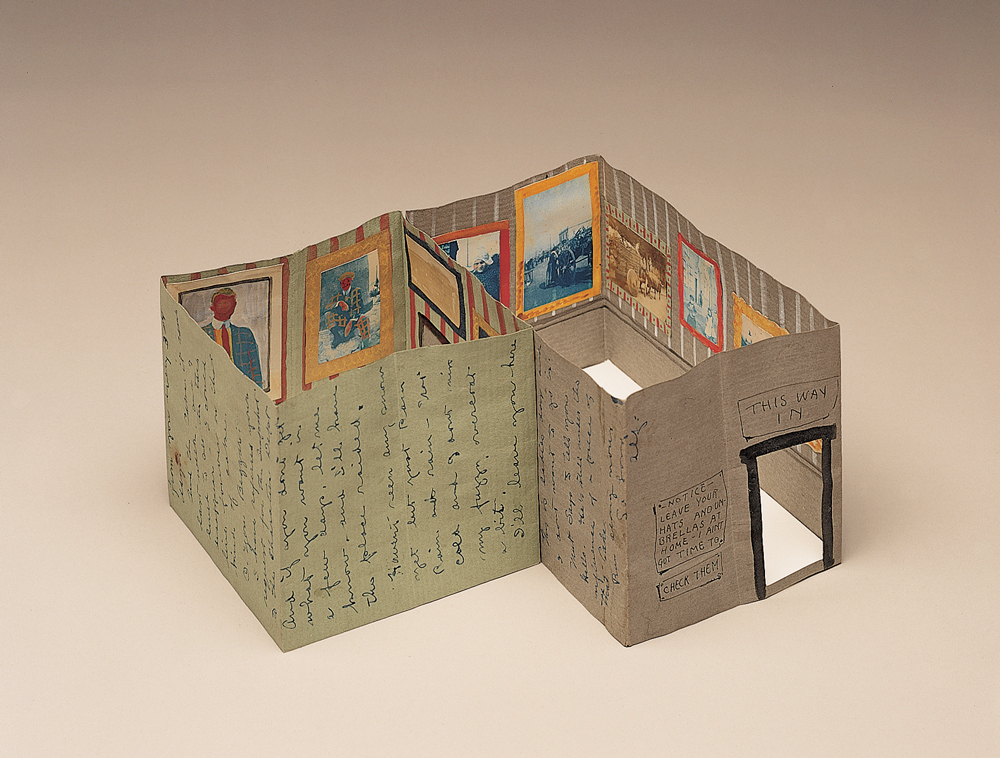
My favorite letter in the collection serves not only as a letter but also as an interactive sculpture. This unique letter is written by Alfred Fruech for his finacee Giuliette. He sends her a letter that, when put together correctly, forms her own art gallery replete with original works of art, so that she can prepare herself for all of the art galleries she is about to see when she arrives in Paris.

Alfred Joseph Frueh to Giuliette Fanciulli (1913). Photo courtesy of The Archives of American Art.

Alfred Joseph Frueh to Giuliette Fanciulli (1913). Photo courtesy of The Archives of American Art.

Illustrated letters from some of the most prominent and celebrated American artists are featured in the book, among which include Winslow Homer, Andrew Wyeth, Dorthea Tanning, Andy Warhol and Frida Kahlo. If you are a lover of letters, American Art, and history then this beautiful book is a must have for your collection.

All photos were obtained from the Archives of American Art at this link: www.aaa.si.edu/exhibitions/illustrated-letters
For more information on this book as well as other titles visit Princeton Architectural Press.

About The Author:
Liza Kirwin is the curator of manuscripts at the Archives of American Art, Smithsonian Institution.

1 Comment

Filed under Art, Nonfiction