Category Archives: New York Review of Books

Review: Girlfriends, Ghosts and Other Stories by Robert Walser

I received an advanced review copy of this title from The New York Review of Books.  Please visit their website for a fantastic selection of titles, including more of Walser’s books in translation.  This collection has been translated by from the German by Tom Whalen, Nicole Kongeter and Annette Wiesner.

My Review:
girlfriends-and-ghostsThis collections defies classification as far as genre is concerned.  The introduction to the book calls the writings a collection of eighty-one “brief texts” that were written throughout the course of Walser’s life.  Some of the writings appear to be fictional short stories but others have a distinctly autobiographical feel to them.  Walser even writes a few short dialogues and a book review.  In addition, he has a wide range of topics and themes and writes about anything from nature, to fashion, to death and dying.  This is a collection best absorbed a few pieces at a time so one can savor his pithy and didactic collection.

Walser makes mundane things seem fascinating.  My favorite piece that falls into this category is entitled, “A Morning” in which he describes a Monday morning in a bookkeeping office as the minutes painfully tick by.   The central figure is man named Helbling who unapologetically walks into work almost thirty minutes late.  Walser’s description of the interaction between Helbling and his boss makes us laugh and cringe:

Totally be-Mondayed, his face pale and bewildered, he shoots in a jiffy to his place and position.  Really, he could have apologized.  Up in Hasler’s pond, I mean head, the following thought pops up like a tree frog: “Now that’s just about enough.”  Quietly he walks over to Helbling and, positioning himself behind him, asks why he, Helbling, can’t, like the others, show up on time.  He, Hasler, is, after all, really starting to wonder.  Helbling doesn’t utter a word in response, for some time now he’s made a habit of simply leaving the questions of his superior unanswered.

Walser makes ordinary events like suffering from a toothache, wearing a fashionable overcoat,  having afternoon tea and observing a beautiful woman absolutely riveting.

Another common and enjoyable theme that occurs frequently in his writing is that of nature.  There are pieces dedicated to the description of a peaceful morning and a walk on a beautiful autumn afternoon.One of my favorite pieces, entitled “Poetry” reads more like poetry than prose.  In this brief and reflective writing we get the sense that Walser is constantly fighting against a deep melancholia and he uses the occasion of a winter day as the inspiration for expressing his emotions. He writes:

I never wrote poems in summer.  The blossoming and resplendence were too sensuous for me.  In summer I was melancholy.  In autumn a melody came over the world.  I was in love with the fog, with the first beginnings of darkness, with the cold.  I found the snow divine, but perhaps even more beautiful, more divine, seemed the dark wild warm storms of early spring.

It is not surprising that Walser fought a deep depression and anxiety for which in 1929 he was voluntarily hospitalized in Waldau, a psychiatric clinic outside Bern.  By the early 1940’s he was permanently confined to the hospital and declared that his writing career was over.  There are hints in this collection that even as early as 1917 Walser is fighting some powerful demons.  In the story entitled “The Forsaken One,” written during that year, Walser pictures himself as a lonely, hopeless vagabond who is wandering around on a gloomy night.  He finds a house that is terrifying but he feels compelled to step inside and wander around until he finds an angelic female figure whom he calls a “celestial outcast.”  He feels an affinity toward her and is relieved that he has found someone that is just a lonely and isolated as himself.

It is truly impossible to cover the scope of this collection unless I were to make my review several pages long.  I have tried to sum up the writings that have made the greatest impression on me.  But I am confident that everyone can find something in this collection that he or she loves.  Thanks to the New York Review of Books for bringing us this brilliant classic in translation.

About the Author:
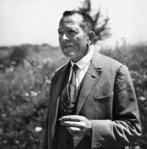
walserRobert Walser (1878–1956) was born into a German-speaking family in Biel, Switzerland. He left school at fourteen and led a wandering, precarious existence while writing his poems, novels, and vast numbers of the “prose pieces” that became his hallmark. In 1933 he was confined to a sanatorium, which marked the end of his writing career. Among Walser’s works available in English are Jakob von Gunten and Berlin Stories (available as NYRB Classics), The Tanners, Microscripts, The Assistant, The Robber, Masquerade and Other Stories, and Speaking to the Rose: Writings, 1912–1932.

10 Comments

Filed under Classics, German Literature, Literature in Translation, New York Review of Books

Review: Slow Days, Fast Company by Eve Babitz

I received a review copy of this title from New York Review Books via Edelweiss.

My Review:

babitz_Slow_Days_hi-res_largeI have to admit that I have never been to Los Angeles and the quiet, New England girl in me has always been afraid to even think about visiting the famed city on the other coast.  Images of the fast life with celebrities, drugs and name dropping via shows like The Kardashians and The Real Housewives are just too much for me.  Eve Babitz was the original glamor girl and in her book Slow Days, Fast Company she describes the Hollywood of the 1960’s and 1970’s that was just as intense, if not more so, as the Hollywood of the 21st century.

Slow Days, Fast Company is a collection of stories about Eve’s life as an artist and a writer living in the heart of Hollywood.  She meets countless celebrities that are the who’s who of L.A. in the 60’s and 70’s, from artists to rock stars and movie execs.   The impression that I got from the casual tone of the book is that she is unfazed by many of the rich and famous characters that she encounters.  In the story entitled, “Heroine” Eve is introduced to Janis Joplin twice but both times Joplin is so strung out on drugs that she is incapable of speech.  Babitz isn’t angry or disappointed that she never gets to speak with the famous rock star, but instead she is sad that drugs have consumed and destroyed another life with so much potential for greatness.  Eve herself drinks quite a bit, does cocaine, and pops a lot of Valium, but she draws the line at taking Heroine because she has seen too many people destroyed by it.

Babitz is open and brutally frank about her sex life throughout the stories.  She manages affairs with multiple men at one time and engages in the occasional ménage à trois.  Her attitude towards sex and these various relationships is also rather laid back, as if balancing several men at a time and sleeping with two men at a time is something that is totally normal and part of every day life.  There is also an undertone of humor as far as her sex life is concerned, especially when it comes to her lover named Shawn.  Shawn was a gay man living in the American south with his partner, and now finds himself in the middle of the Hollywood scene and hanging out with Eve Babitz.  She takes him on as her lover and he features prominently in several of the stories as they go on vacation together, go out to dinner, and do other things that are typical of a romantic couple.

My favorite story in the collection is the one entitled “Bad Day at Palm Springs.”  Eve is introduced to a rich socialite named Nikki Kroenberg who is married to a lawyer and has too much time on her hands.  Nikki invites Eve and Shawn to spend the weekend with her in Palm Springs and Eve jumps at the chance to spend a few quiet days away from the smog and congestion of L.A.  In this story Eve gives us a lesson about the fluidity and imprecise nature of time on the west coast.  Shawn says that he will be ready for their weekend getaway at 7 p.m. but two hours later Eve and Nikki are still sitting in Shawn’s kitchen waiting for him to finish a photo shoot.  Eve deals with the constant waiting by always keeping a paperback book with her; but the pressure of keeping Nikki busy while they wait for Shawn causes Eve to swallow a few extra Valium.  When they finally make it to Palm Springs, the slow pace of life in the sun is just too much for Eve and she is itching to get back to her life in L.A.

In Slow Days, Fast Company Babitz provides an inside look at the life of the rich and famous while at the same time not taking herself too seriously.  I never felt that Babitz was name dropping to make herself sound more important and for this reason the book was a highly entertaining read.  I still don’t have a desire to visit California anytime soon, but experiencing it through the eyes of this writer and artist is amusing.

About the Author:

Eve Babitz is the author of several books of fiction, including Sex and Rage: Advice to Young Ladies Eager for a Good Time, L.A. Woman, and Black Swans: Stories. Her nonfiction works include Fiorucci, the Book and Two by Two: Tango, Two-Step, and the L.A. Night. She has written for publications including Ms. and Esquire and in the late 1960s designed album covers for the Byrds, Buffalo Springfield, and Linda Ronstadt. Her novel Eve’s Hollywood is published by NYRB Classics.

8 Comments

Filed under Classics, New York Review of Books

Review: Zama by Antonio de Benedetto

This book was originally published in Spanish in 1956 and this English version has been translated by Esther Allen.

My Review:
ZamaDon Diego de Zama is a clerk serving the Spanish monarchy in a remote town in Paraguay at the end of the eighteenth century.  His position as an assistant for the Governor is supposed to be one of prestige and the first step as he moves up in his political career.  But if only he could find a way to get out of the backwater of Paraguay and be assigned a better position in Buenos Aires, which would also be closer to his home and his wife.  Zama is a lazy, selfish, and even at times stupid man who only seems to do things that hurt his career and his family.
There is a scene in the book in which Zama has just finished spending what little money he has at the racetrack betting on horses.  He decides to take a siesta in the shade where he encounters another man resting.  While this man is sound asleep Zama sees a poisonous spider about to jump on this man’s face and Zama decides to do absolutely nothing about it.  He doesn’t lift a finger to dispose of the spider or even warn the man of the impending danger of the venomous arachnid that is about to jump on his face.  Zama simply sits there and watches the scene unfold and seems rather detached from the fact that a poisonous spider is crawling on another man’s face.  This episode perfectly exemplifies Zama’s selfish attitude not only towards the world around him, but also towards his life, his job and his family.

The book is divided into three parts, the first of which takes place in 1790.  When we are first introduced to Zama he is waiting for a ship to come in that might contain a letter from his wife and the salary that is owed to him by the Spanish crown.  Zama misses his wife a great deal, but the lack of intimate contact with her for almost two years drives him to find a woman to fulfil his sexual desires.  In a scene that is reminiscent of the Actaeon and Artemis story from Greek mythology, he accidentally sees a local upper class woman naked while she is bathing in a river.  Once he finds out who this woman is he does everything he can to scheme his way into her home without attracting the notice of her husband or the rest of the town.  His attempts to seduce this woman are clumsy and not well planned.

The novel skips forward four years to 1794 and Zama is still stuck in this town in Paraguay. But by this time he has moved into a ramshackle farmhouse with a widow named Emilia and has a son with her.  Zama’s salary that he is owed by the Spanish crown is very seldom paid to him, so he lives in poverty and doesn’t have very much to offer his mistress and child.  He notices the child is oftentimes dirty and crying but he is never moved to console the child or find a way to provide a better life for his family.  When he has extra money in his pocket he doesn’t offer it to Emilia or his son but instead he buys his own meals at the local inn or tavern.  His own needs continue to always come first.  Zama’s wife, whom he was so eager to be near in the first part of the book, is not mentioned at all during this time.  Zama’s emotional detachment from the hardships that his families suffer is astonishing.

In the final part of the book  Zama’s selfish nature finally brings about his downfall.  The year is now 1799 and Zama is sent on an expedition with the local militia to hunt down a notorious pillager and thief.  The sole reason that he volunteers for the mission is that he thinks it will finally get him a promotion.  The final part of the book is the most exciting as Zama travels with soldiers into remote parts of South America that are dangerous because of Indian tribes.  There is also a bit of intrigue during this part of the book when the bandit’s true identity is revealed and the only one who knows this key piece of information is Zama.  His selfish and clumsy reaction to this situation is typical of his character throughout the book but this time his impetuous actions bring about his own demise.

Reading about Zama’s life is like watching a train wreck.  We know from the beginning that because of his clumsy behavior Zama is headed for a bad end, but we can’t put the book down because of our morbid curiosity to know how he finally does himself in.


About the Author:
A BenedettoAntonio di Benedetto, (born 2 November 1922 in Mendoza – died on 10 October 1986 in Buenos Aires), was an Argentine journalist and writer. Di Benedetto began writing and publishing stories in his teens, inspired by the works of Fyodor Dostoevsky and Luigi Pirandello. Mundo Animal, appearing in 1952, was his first story collection and won prestigious awards. A revised version came out in 1971, but the Xenos Books translation uses the first edition to catch the youthful flavor.  Antonio di Benedetto wrote five novels, the most famous being the existential masterpiece Zama (1956). Los suicidas (The Suicides, 1969) is noteworthy for expressing his intense abhorrence of noise. Critics have compared his works to Alain Robbe-Grillet, Julio Cortázar and Ernesto Sábato.  In mid-sixties or early seventies he caused a diplomatic faux-pas at a NATO meeting when during a ceremonial toast he raised his cup and said “cin cin” to bystanding Japanese diplomats. This caused an international pandemonium, as “chin chin” is a slang term for penis in Japanese. This later led to his prosecution. In 1976, during the military dictatorship of General Videla, di Benedetto was imprisoned and tortured. Released a year later, he went into exile in Spain, then returned home in 1984. He travelled widely and won numerous awards, but never acquired the worldwide fame of other Latin American writers, perhaps because his work was not translated to many languages.

8 Comments

Filed under Classics, Literature in Translation, New York Review of Books, Spanish Literature

Review: Grand Hotel by Vicki Baum

I received a review copy of this title from the New York Review of Books.  The original book was published in 1929 in German and this English version has been translated by Basil Creighton.

My Review:
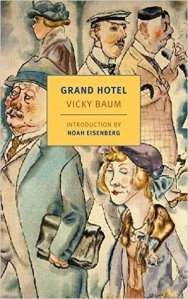
Grand HotelThe Grand Hotel is the place to stay for anyone who wishes to be surrounded by luxury and high society in 1920’s Berlin.  The guests that have all checked into the hotel in March of 1929 are an interesting mix of misfits whose stories all collide in a cleverly intertwined plot.

The first character to whom we are introduced is Dr. Otternschlag.  He sits for hours each day reading the paper and watching people go in and out of the revolving doors of the hotel.  He asks the porter several times if a letter has come for him and it is sad that no letters ever arrive for this lonely man.  He suffered a horrible injury during World War I which has left his face horribly scared.  He is utterly lonely, sad and has no zest for life.  He is the absolute opposite of Baron Gaigern who is also a guest at the hotel.

The Baron wears the finest clothes, has impeccable manners, is charming and extremely handsome.  He enjoys life to its fullest with gambling, fast cars, and lots of women.  But little does everyone know that the Baron is actually a petty thief and has no money other than that which he steals from his unsuspecting victims.  He latest mark is an aging ballerina named Grusinskaya whose famous string of pearls are said to be worth over 500,000 marks.  He has been secretly following the dancer around so that he can best ascertain how to get his hands on those pearls without being caught.  His plan for the heist is one of the most amusing and thrilling parts of the plot.  In the course of carrying out his carefully laid out plan, the unexpected happens to the normally cool and collected Baron–he falls in love with the woman who is supposed to be his victim.

The next person to check into the Grand Hotel is Otto Kringelein who is a lowly and badly paid clerk from a small town.  He is very sick and has only been given a few weeks to live so he gathers up all of his life savings, leaves his miserable wife and books a room at the hotel where he intends to have an exciting adventure before he passes away.  When his boss, Mr. Preysing, also checks into the hotel, he won’t let this angry and horrible bully spoil his fun. Kringelein finds a companion in the doctor for a while and even goes to the ballet with him.  But it is not until Kringelein meets up with the Baron that he really starts to feel alive.  The adventures that the Baron takes this provincial and naïve man on, which include boxing, gambling and flying, are absolutely hilarious.

The final adventure that Kringelein takes is of his own making as he comes to the aid of a beautiful young woman.  The story ends well for Kringelein even though it is still likely that he doesn’t have long to live.  He, like many others, checked into the Grand Hotel, as a solitary misfit.  But his exploits with the other guests turn him into a more worldly and confidant man who yearns to experience all that life has to offer.  The New York Review of Books has managed to reissue another fantastic classic that I devoured in just a few sittings.  I can’t recommend this book highly enough.

About the Author:
Vicki BaumVicki Baum (penname of Hedwig Baum) was born in a Jewish family in Vienna, Austria. She moved to the United States in 1932 and when her books were banned in the Third Reich in 1938, she started publishing in English. She became an American citizen in 1938 and died in Los Angeles, in 1960.

24 Comments

Filed under Classics, German Literature, Literature in Translation, New York Review of Books, Summer Reading

Review: Tolstoy, Rasputin, Others and Me by Teffi

My Review:
TeffiThis book is a collection of autobiographical essays from the renowned, female Russian author Teffi.  The essays were all written during the early part of the twentieth century and reflect Teffi’s own struggles with having to flee a turbulent and oppressive Russia.  The collection is divided into four parts, the first of which is entitled “How I Live and Work.”  These first few essays in the book capture her inner thoughts and self-doubts as she becomes Teffi “The Author.”

The second part of the book, “Staging Posts” deals with various aspects of Teffi’s personal life from her upbringing in a wealthy Russian family to her emigration to Paris during the Russian Civil War to her time in France during the German Occupation.   Teffi is well-known for her wit, but these essays show us an emotionally tender and serious woman.  She begins her essay entitled “Valya” on a sad and brutally honest note: “I was in my twenty-first year.  She, my daughter, was in her fourth.  We were not well matched.”  In this essay Teffi has a difficult time connecting with her daughter and I was not surprised to find out that her marriage was dreadfully unhappy and she eventually leaves her family in order to pursue her writing career.

My favorite essay in the third section of the book “Heady Days: Revolutions and Civil War” is the one that describes Teffi’s bizarre encounters with Rasputin.  This essay is a perfect example of Teffi’s ability to write a humorous essay but also to display her serious and emotional side.  When Teffi meets Rasputin, he is smitten with her and he tries to seduce her.  But Teffi sees right through his act; although many women have fallen for his smooth words and intimate gestures, Teffi finds his behavior strange and a little pathetic.  Rasputin comes across as a buffoon and we do laugh at his antics, but at the same time we also feel sorry for this ridiculous man who is finally killed by one of the many assassins who are after him.

The fourth and final part of the book is dedicated to some of the famous authors and artists that Teffi has come in contact with.  At the age of thirteen Teffi is enthralled with Tolstoy’s War and Peace.  She is so distraught by the death of Prince Andrei in this novel that she is determined to meet the author and ask him to change the story.   Teffi shows up at Tolstoy’s home but is so flabbergasted to meet him that all she can do is ask for his autograph and slink away in embarrassment.

The quality that comes through in every one of these essays is Teffi’s innate ability to read and truly understand people.  When she meets Lenin she senses a man who is crafty and cunning.  She meets many famous people throughout her life, from the Russian poet and novelist Merezhkovsky to the artist Repin to various other writers, journalists and politicians.  She is never fooled by the façade of their importance but instead she sees the true humanity beyond the exterior.

I have to admit that I am smitten with Teffi after reading this one volume from NYRB classics.  I ordered three more of Teffi’s books after I finished this one. I don’t think I’ve done Teffi’s writing justice in this brief review and so everyone must read a least one of her essays to experience her brilliant writing.

About the Author:
Teffi PicTeffi was a Russian humorist writer. Teffi is a pseudonym. Her real name was Nadezhda Alexandrovna Lokhvitskaya (Наде́жда Алекса́ндровна Лoхви́цкая); after her marriage Nadezhda Alexandrovna Buchinskaya (Бучи́нская). Together with Arkady Averchenko she was one of the most prominent authors of the Satiricon magazine.

13 Comments

Filed under Classics, Literature in Translation, New York Review of Books, Nonfiction, Russian Literature
